 Kateryna Ivanova

Feelings in English for kids is the rare vocabulary topic that gives back more than words: a 2–5-year-old who can say "I'm angry!" doesn't just know a word — she is already halfway to calming down. Neuroscience calls it affect labeling: a named feeling loses its grip. Ten words, a mirror and a daily "How do you feel?" — and English becomes a tool for emotional growth, not just a subject.
TL;DR:
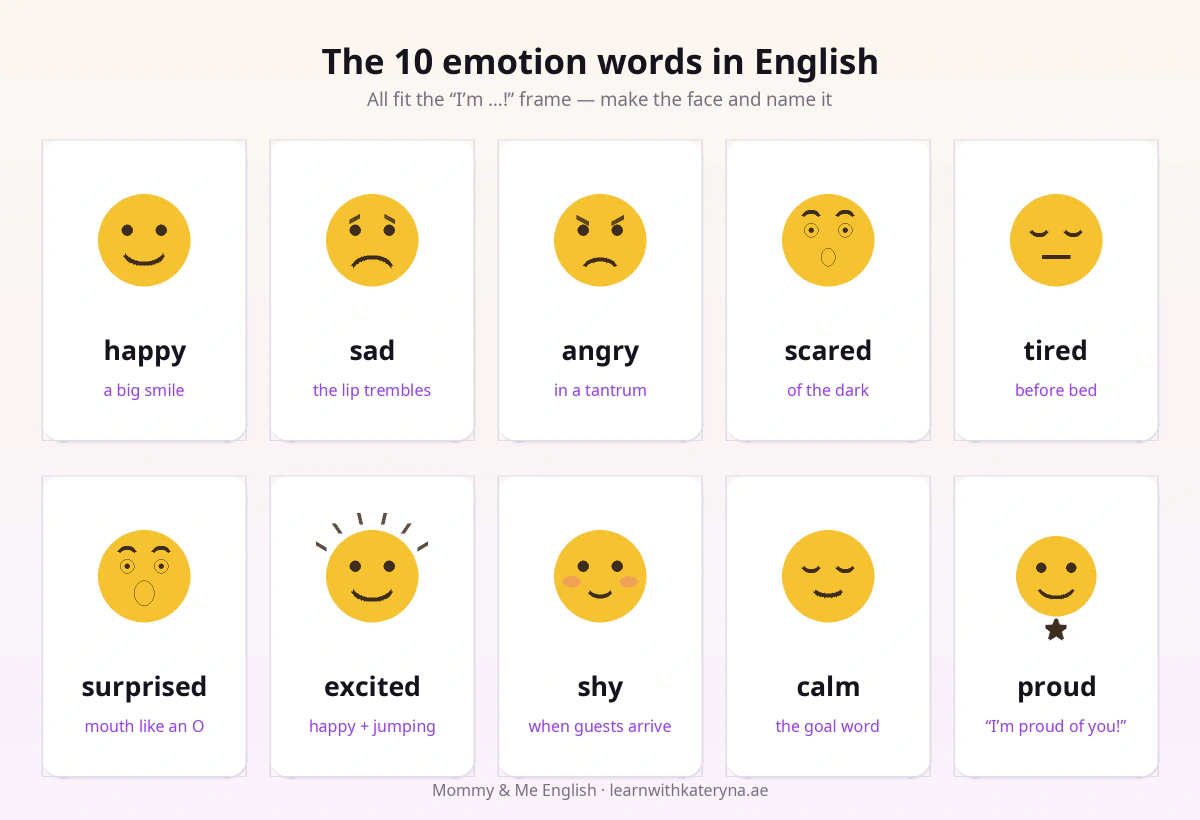
- 10 core words cover a child's whole emotional world: happy, sad, angry, scared, tired, surprised, excited, shy, calm, proud
- Name it to tame it: a UCLA study showed that labeling an emotion with a word lowers activity in the amygdala — the brain's alarm centre
- You cannot point at an emotion the way you point at an apple — so the main tool here is not flashcards but a mirror and your own face
- "I'm happy!" is a child's first sentence about herself: the I'm frame arrives whole, no grammar required
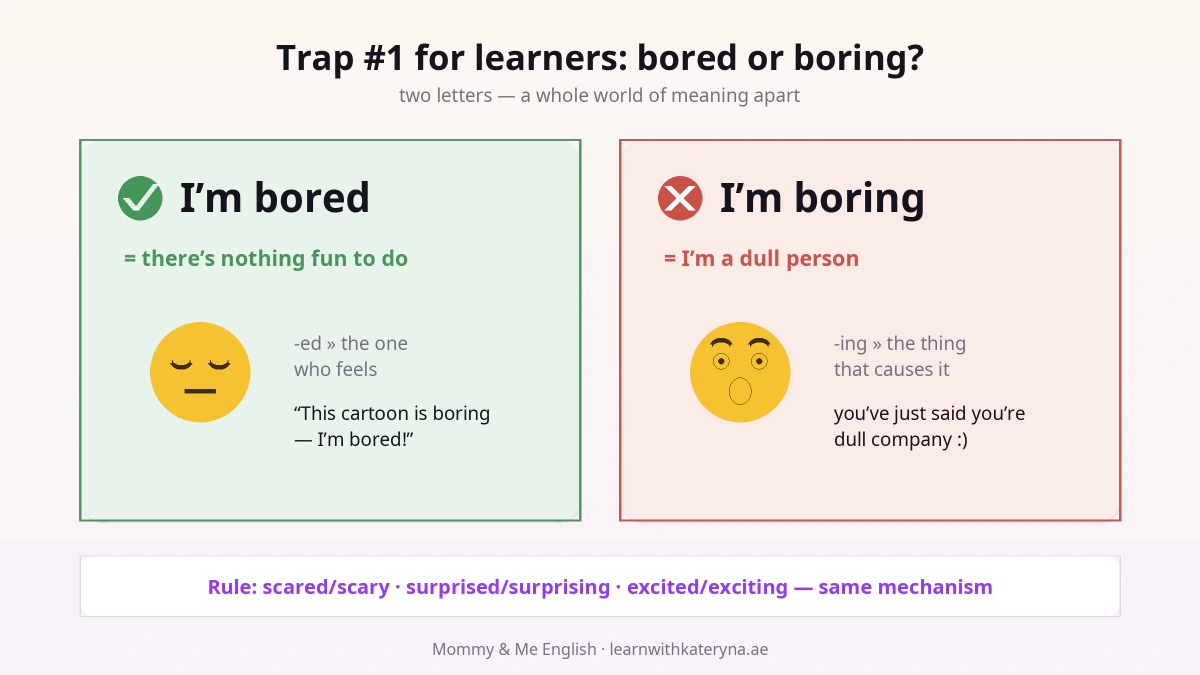
- The classic learner trap: I'm boring ("I am a dull person") instead of I'm bored — two letters apart, a world of meaning apart
Why feelings are a special English topic
Emotion vocabulary works twice. First as language: happy, sad and angry sit in the top 200 words of any children's conversation, book or cartoon. Second as a life skill: a child who can name a feeling manages it better. No other lexical set — not colors, not numbers — pays out on both fronts at once.
There is a third, practical reason: feeling words are the social key to any English-speaking nursery or playground. "Are you okay?", "Don't be sad!", "I'm so excited!" — half of children's social life runs on these lines. A toddler who understands and uses them has something to say in the moments that matter most: after a fall, in a burst of joy, when she wants to join a game.
Emotion vocabulary is the only English topic a child uses even while silent: understanding the word calm helps her settle before any words come out.
Name it to tame it: the neuroscience
Affect labeling is a documented effect: when a person puts a feeling into words, activity in the amygdala — the brain region that fires the fight-or-flight response — measurably drops. In the classic UCLA study (Lieberman et al., Psychological Science, 2007), participants who simply labeled the emotion on a photograph showed a calmer brain response than those who only looked.
For parents this translates simply: every learned emotion word is a small self-regulation tool. A toddler stomping through tears who manages "I'm ANGRY!" is no longer inside the tantrum — she is half a step beside it, because part of her brain is busy formulating, and the storm has begun to pass. Psychologists call the technique name it to tame it.
Early childhood is an advantage here, not an obstacle. A child who builds her emotion vocabulary in two languages at once gets a double set of volume knobs for her feelings — and the habit of naming a state rather than only living it. US pediatric guidance (CDC Developmental Milestones) lists naming feelings among the key social-emotional milestones at ages 3–4 — in any language.
The 10 core words with pronunciation
A child's emotional dictionary is ten state adjectives. All of them fit the I'm… frame, and every one has a face you can make:
- happy — the first and most frequent word of the topic
- sad — the first contrast pair: happy/sad
- angry — the single most useful word in a tantrum
- scared — essential for darkness, dogs and vacuum cleaners
- tired — the rescue word before bedtime
- surprised — the funnest face: mouth shaped like an "O"
- excited — the difference from happy: "happy plus jumping"
- shy — legalises the feeling when guests arrive
- calm — the goal word of every meltdown (the l is silent)
- proud — "I'm proud of you!" — the warmest parent line there is
For older children (4–5) add worried, bored (a special case below) and the body-state pair hungry/sleepy familiar from the food topic.
"I'm happy!": the first sentence about self
The I'm frame is the first construction a child uses to talk about herself. If the weather topic's "It's sunny" teaches describing the world, "I'm happy" teaches describing the self — and between those two frames sits half of conversational English.
The acquisition mechanics are identical: no explanations, only the statistics of your sentences. You narrate yourself ("I'm tired… time for coffee"), you voice the child at the peak of a real emotion ("You're happy! Look at that smile!"), you ask "How do you feel?" — and within weeks the frame glues itself on. First the child answers with one word ("Happy!"), later with the full formula — and that order is exactly right.
It's sunny — about the world. I'm happy — about me. Two frames a child absorbs whole — and first-grade grammar is already in her pocket, rule-free.
The feelings-mirror ritual in 5 steps
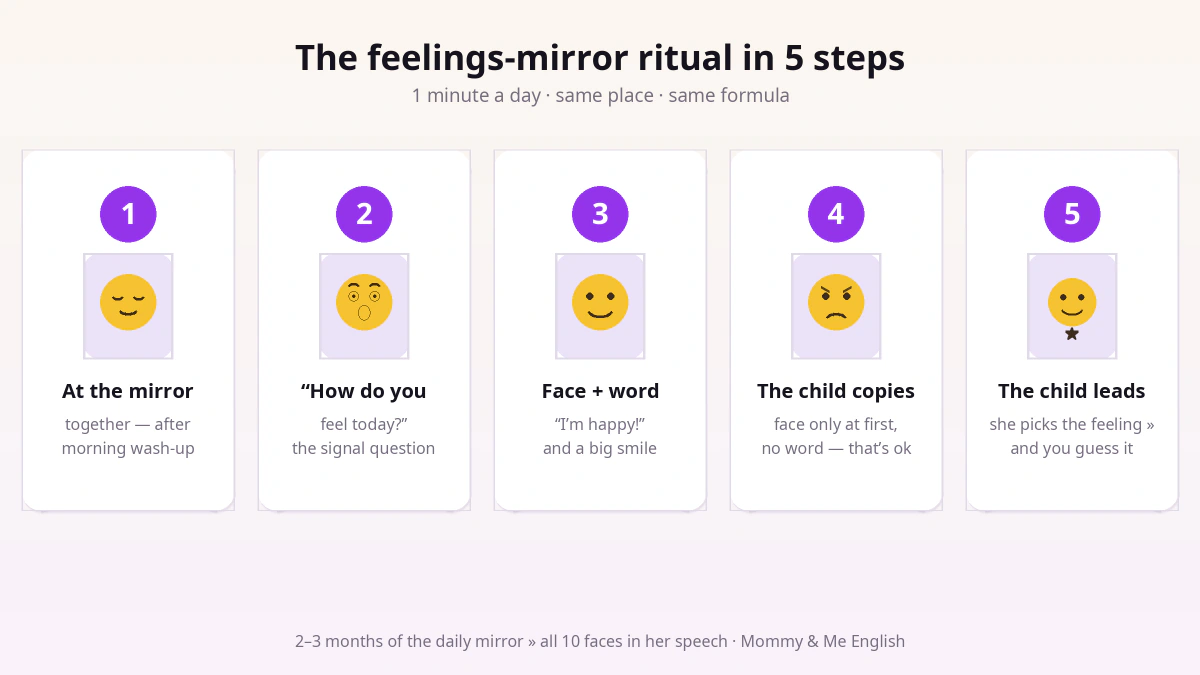
The topic's core ritual takes one minute and needs nothing but the hallway or bathroom mirror:
- Stand at the mirror together — best right after morning wash-up or before the evening bath: same time, same place, every day.
- Ask the signal question: "How do you feel today?" — always the same words, with play in your voice, never examination.
- Make the emotion with your face and name it: "I'm happy!" — and smile big enough for the mirror to confirm. Exaggerate: emotions are learned in close-up.
- Invite the child to copy the face — face only at first, no word required. A scrunched angry face in response to "angry" already counts as an answer.
- After a month, hand over the lead: now the child picks the emotion and you guess: "Are you… surprised?" Being the host is the strongest motivator this age knows.
Two or three months of the daily mirror — and all ten faces live in the child's speech. It is the same ritual mechanism as in our daily English rituals: constancy of place and formula beats length every time.
Faces instead of flashcards: teaching a word with no object
The emotions topic has a methodological quirk no standard course accounts for: you cannot point at an emotion. An apple sits on the table; a nose is right there on the face (which is why the body parts topic works so well). But "sadness" sits nowhere — it is either inside right now, or it is absent.
That is why smiley-face flashcards perform worse here than in any other topic: the child learns not "my sadness" but "a yellow circle with a downturned mouth." The true carriers of meaning are living faces — yours, the child's own in the mirror, book characters' at the moment of the event. The word sad, spoken the second the block tower falls and the lip actually trembles, is learned in one exposure. The same word from a card takes twenty.
Hence the topic's golden rule: catch moments, don't stage lessons. One comment in the second of a real feeling ("You're so excited!" — as the child bounces with joy) outweighs ten "emotions classes."
Building an English routine at home? The free Mommy & Me English starter guide lays out the daily rituals step by step.
Three levels of emotion words: table by age
| Age | Words | What the child can do |
|---|---|---|
| 2–3 years | happy, sad, angry, scared | Makes the face on hearing the word; answers "How do you feel?" with a single word ("Happy!") |
| 3–4 years | + tired, surprised, excited, shy | Uses the "I'm…!" frame about herself; spots and names characters' feelings in books ("He's sad!") |
| 4–5 years | + calm, proud, worried, bored | Builds a reason: "I'm sad because…"; asks others: "Are you okay? Are you happy?" |
The wave principle is the same as in every vocabulary topic: four contrast words are the base; the rest arrive with age and with your family's real situations. Pushing worried on a two-year-old is pointless — while happy/sad/angry/scared already covers 80% of her emotional life.
The bored/boring trap and other learner mistakes
The emotions topic hides the single most treacherous grammar trap for Ukrainian speakers — the -ed/-ing pair:
- I'm bored = there is nothing fun to do. I'm boring = I am a dull person. Two letters apart — and instead of complaining about a cartoon you have just confessed to being tedious company.
- The same pair everywhere: surprised/surprising, excited/exciting, scared/scary. The adult rule of thumb: -ed describes the one who feels; -ing describes the thing that causes it. "The dog is scary. I'm scared."
- Scared of, never scared from: "I'm scared of dogs" — the preposition does not match the Ukrainian pattern.
- Angry with a person, angry about a situation — not "angry on," which the Ukrainian «сердитись на» invites.
- Sad ≠ sorry: "I'm sad" reports your feeling; "I'm sorry" apologises or sympathises. The Ukrainian «мені жаль» tempts learners to merge two very different speech acts.
The good news: these traps don't threaten a 2–5-year-old — she takes the forms whole from your sentences, with no Ukrainian-to-English translation running in her head. The traps wait for parents. So check yourself: say "I'm bored" correctly ten times, and your child will never once say "I'm boring."
Emotion words in anxious times
For Ukrainian families — at home and in relocation — this topic carries an extra dimension. A child whose life includes sirens, moves or a new country needs words for what she feels more than any other vocabulary. And English helps in an unexpected way: naming a scary thing in the other language is sometimes easier — scared weighs a little less than «страшно», and becomes a safe side door into a conversation about feelings.
Psychologists working with families under stress recommend a habit that fits our method perfectly: a daily emotion check-in — a short "How do you feel?" in a calm moment, with no trigger and no consequences. Not an interrogation; a weather report. Feelings, like clouds, get named and drift on. And if your family is currently in an English-speaking country, the habit doubles as preparation for exactly the question nursery teachers will ask.
6 emotion games
1. Mirror faces. The ritual's base game: you name — the child shows the face. Then swap. From age 2.
2. Guess my face. You act an emotion silently — the child guesses: "Angry? Sad?" The first real conversation about other people's feelings. From 3.
3. Teddy check-in. "How does Teddy feel today?" — the child speaks for the bear. Through a toy, children name what they are shy to claim as their own. From 2.5.
4. The feelings traffic light. Three drawn faces on paper — happy, calm, angry. The child touches where she is right now. Works even wordlessly — and words gradually arrive. From 2.5.
5. Emotion hunting in books. Pause on characters' faces while reading: "Look! Is he happy or sad?" Turns any book into topic material — the mechanic from our guide to reading in English. From 3.
6. The feelings photo album. For 4+: shoot a collection of your child's own faces, then browse together: "This is my surprised face!" One's own face is the most interesting teaching material on earth.
Books and the topic song
The topic song is obvious and brilliant — "If You're Happy and You Know It": emotion plus action (clap your hands, stomp your feet) in a single formula. It is the same word-plus-movement link that powers the TPR method: the body remembers along with the ears. Sing it with real actions and invent your own verses: "If you're angry and you know it — stomp your feet!" (how to make any song actually teach — in our songs guide).
The topic bookshelf: "The Color Monster" by Anna Llenas — emotions as colours, the topic's world bestseller; "Glad Monster, Sad Monster" — emotion masks built into the book; and any Elephant & Piggie title by Mo Willems — two friends whose faces act out all ten emotions in one story.
5 parent mistakes
1. Teaching emotions from smiley cards. Yellow circles are the weakest material this topic has. Real faces — yours, the child's in the mirror, book characters' — are the true flashcards.
2. Asking "How do you feel?" only in bad moments. If the question appears only during tears, it becomes an alarm signal. Ask daily in calm — then it will hold as an anchor in a storm.
3. Correcting "Happy!" into "I'm happy." One word is a splendid answer at 2–3. The I'm frame glues itself on from the statistics of your speech — just echo the full form back: "Yes! You're happy!"
4. Dismissing negative emotions. "Don't be sad!" is the worst sentence in the topic: it teaches that sad is a forbidden word. The working formula is name and accept — "You're sad. I see. Come here." An emotion vocabulary only works where every emotion may be named.
5. Expecting words you never use yourself. If "I'm tired" or "I'm so happy!" never crosses your lips, the child has no model to take. You are this topic's primary textbook.
Next steps
Tonight before the bath, stand at the mirror together and make the first face: "I'm happy!" For two weeks, keep to four words (happy, sad, angry, scared) in the mirror ritual and in live moments. Then add "If You're Happy and You Know It" and a calm-moment "How do you feel?" In two to three months all ten emotions will live in your child's speech — along with the "I'm…" frame, her first sentence about herself. Keep the neighbouring guides handy: body parts (the face is where every emotion plays out), action verbs (cry, laugh, smile — emotions in motion) and parent phrases (ready-made comfort formulas).
And the complete system — video lessons, audio for every phrase, ritual checklists and a day-by-day plan — is in the Mommy & Me English starter guide: 10 minutes a day, mum in the lead role, and the hallway mirror as a free emotional-intelligence trainer.


