
 Kateryna Ivanova
Weather in English for kids takes 30 seconds a day — at the window. One question every morning, "What's the weather like today?", one answer, "It's sunny!" — and within 2–3 months a child aged 2–5 owns the entire weather vocabulary, her first "grown-up" It's… construction, and even her first forecast. No flashcards, no lessons — just a window, the sky and a ritual.
TL;DR:
- The whole topic is a 30-second window ritual every morning: question — look — answer
- 10 core words cover a child's entire "meteorological" life: sunny, rainy, cloudy, windy, snowy, hot, cold, foggy, stormy, rainbow
- "It's sunny!" is the child's first impersonal construction: grammar arrives as a whole chunk, with zero rules
- Weather can be felt with the body: wind on the face, a raindrop on the palm — the most sensory topic in early English
- The weather→clothes link ("It's cold — jacket!") is the first cause-and-effect reasoning in English
Why weather is the perfect toddler topic
Weather is the topic that refreshes itself daily. Every morning the sky "prepares" a new lesson: sun today, rain tomorrow, wind bending the trees the day after. No other topic has a built-in repetition calendar with natural variety — the words stay the same while the picture is alive and new every time.
The second reason: weather is visible and feelable. An apple on a flashcard has to be imagined; the rain is right there, drumming on the glass this very second. The child sees the phenomenon and hears the word in the same instant — the perfect synchrony that all early language acquisition runs on.
And the third, cultural one: weather talk is the "national sport" of the English-speaking world. British small talk opens with the weather; American nurseries do a weather check in every morning circle. A child used to answering "What's the weather like?" walks into an English-speaking nursery with a ready script for its most frequent conversation — and has something to say from day one.
Weather is the only English topic that paints fresh learning material outside your window every single morning. Free, no prep, 365 days a year.
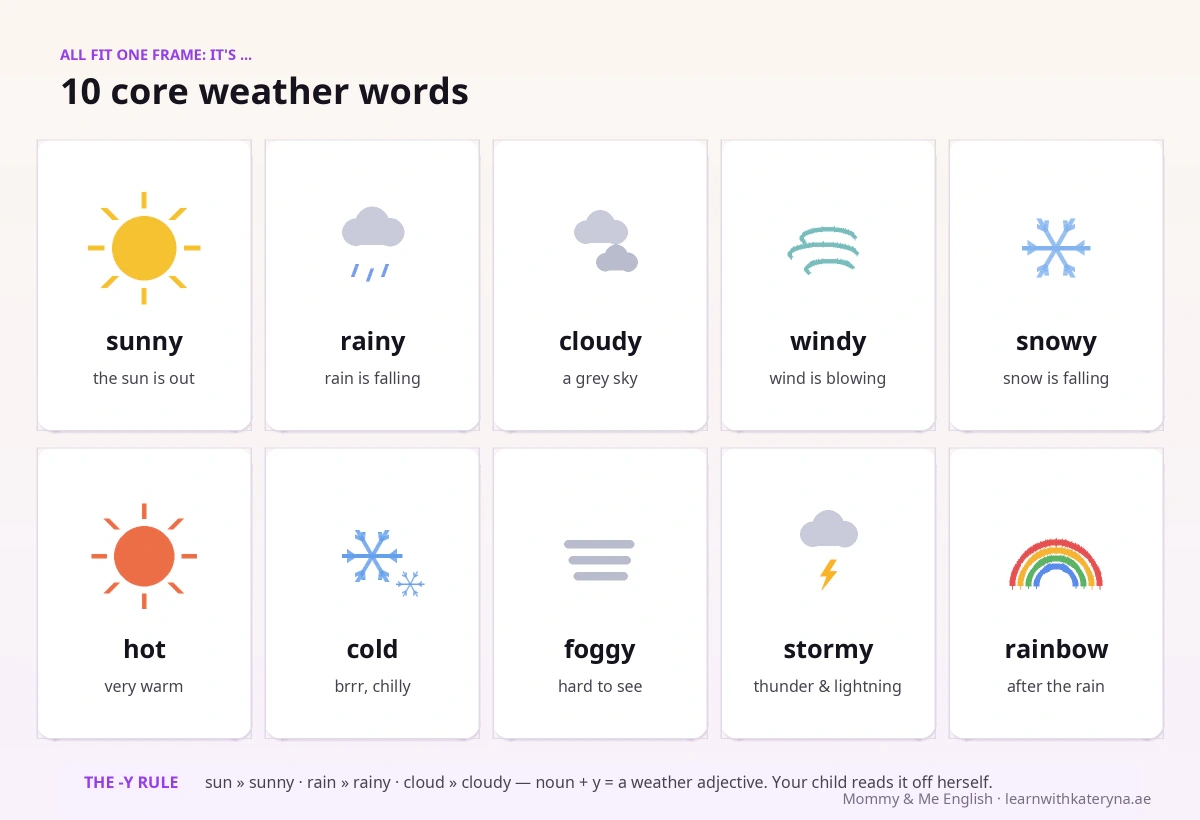
The 10 core words
A child's "weather reporter" vocabulary is ten words. All of them are state adjectives, and all work inside one frame — It's…:
- sunny
- rainy (plus the verb: It's raining — happening right now)
- cloudy
- windy
- snowy (It's snowing!)
- hot (familiar from the food topic — now in a new role)
- cold
- foggy
- stormy (with the bonus word thunder, which children adore acting out)
- rainbow (the list's only noun — and its most emotional word: "Look! A rainbow!")
Notice the beautiful word-building mechanic the child will "read off" by herself: sun → sunny, rain → rainy, cloud → cloudy, wind → windy, snow → snowy. Noun + -y = weather adjective. Don't explain the rule — just use the pairs side by side ("Look, the sun! It's sunny!"), and around age four the child starts building such words on her own. Sometimes non-existent ones — "It's doggy today!" — and that is a wonderful sign: the grammar engine has switched on.
"It's sunny!": the first grown-up construction without grammar
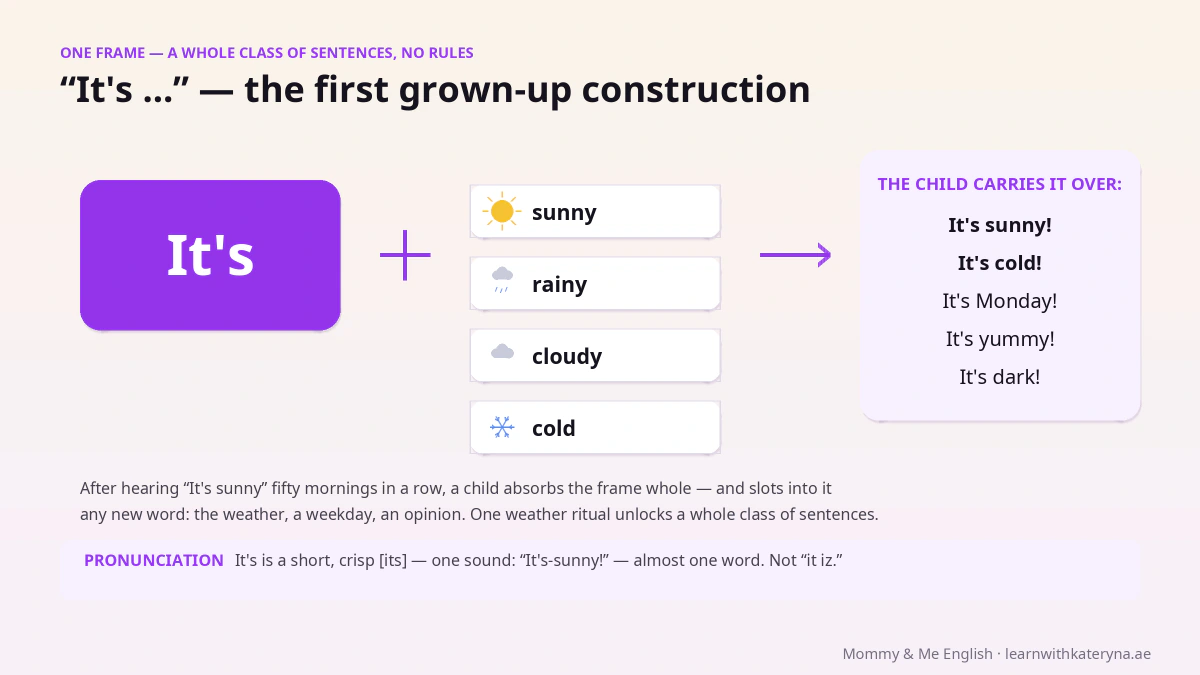
The impersonal It's is the construction English uses to describe the world: It's sunny. It's cold. It's late. It's Monday. For adult learners it is a textbook chapter ("the dummy subject it"); for a child it is simply the sound every weather phrase starts with. After hearing "It's sunny" fifty mornings in a row, the toddler absorbs the frame whole — and then slots any new word into it.
Why this matters strategically: the It's… frame is one of the most frequent in the entire language. A child who owns it from weather transfers it automatically to time ("It's Monday!" — hello, days of the week), to opinions ("It's yummy!"), to states ("It's dark!"). One weather habit unlocks a whole class of sentences — the same carrier-construction principle as in the parent phrases.
One pronunciation note: It's is a short, crisp [its] — one sound, not "it iz." Say it quickly and lightly: "It's-sunny!" — almost one word. That is how native speakers sound, and that is what a child copies most easily.
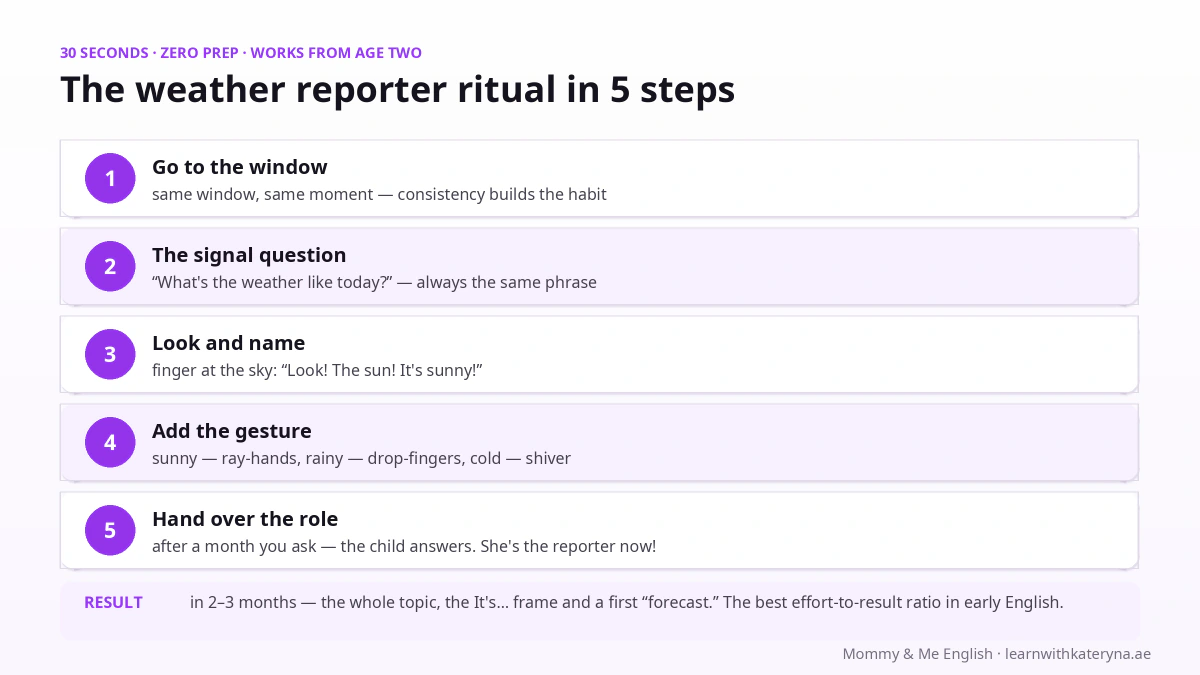
The "weather reporter" ritual in 5 steps
Here is the topic's complete method — a 30-second morning ritual that works from age two:
- Go to the window together. The same window, the same moment every morning — right after waking or before breakfast. Consistency of place and time makes the ritual automatic within two weeks.
- Ask the signal question. "What's the weather like today?" — always the same phrase, with genuinely curious intonation. For the first weeks, you answer it yourself.
- Look and name. Finger at the sky: "Look! The sun! It's sunny!" Point at the real phenomenon — the sun, the clouds, the wet pavement. The word glues itself to the picture outside.
- Add the gesture. Sunny — hands as "rays" around the face; rainy — fingers drumming like drops; windy — arms swaying like branches; cold — hug yourself and "shiver." The gesture turns the word into a body movement — the same memory mechanism as the TPR method.
- Hand over the role. After a month or two, you ask — and the child answers: "It's… cloudy!" She is now the family's weather reporter. Children love this role so much they start racing you to the window.
Thirty seconds, zero prep, zero materials. After 2–3 months of the daily ritual — full command of the topic. The best effort-to-result ratio in all of early English. And for children 5+ who have outgrown the window, there are excellent official kids' resources: the American weather service's education hub NOAA Weather.gov for kids and the British Met Office learning pages — window-grown weather curiosity has somewhere to grow.
Weather you can touch: learning with the body
Weather is the most sensory topic in the language: you can feel it on your skin. Use that on every walk:
Wind: stop, turn your faces into it: "Feel the wind! It's windy!" Wind ruffling the hair is the word windy written into body memory. Rain: a palm out from under the umbrella: "Rain! Drip-drop! It's raining!" Sun: cheeks up: "Feel the sun! Warm! It's sunny!" Cold: breathe out "steam" on a frosty morning: "Look — dragon breath! It's cold!" — a game children demand all season long.
This is the core difference between our approach and flashcards or workbooks: weather is learned not as a word list but as bodily experience. A child who has "caught" windy with her face and raining with her palm knows those words as deeply as her Ukrainian ones. A workbook picture will never do that.
Three tiers of weather words: the age table
Not all ten words at once — the topic unfolds in three waves:
| Tier | Age | Words | What the child can do |
|---|---|---|---|
| 1 — start | 2–3 yrs | sunny, rainy, hot, cold | points at the sky, copies gestures, understands the question |
| 2 — expansion | 3–4 yrs | cloudy, windy, snowy, rainbow | answers "It's…!" herself, notices weather changes |
| 3 — detail | 4–5 yrs | foggy, stormy, thunder, warm/cool | first "forecast," comparisons (hotter, colder), weather chats |
Tier 1 is deliberately built from the most contrastive pairs: sunny/rainy is visible, hot/cold is feelable. Contrast is a two-year-old's best teacher. Tier 3 adds the nuances: warm (between hot and cold) and cool. These "middle" words are the mark of mature command: a child who distinguishes hot, warm and cool is no longer naming — she is describing.
Seasons: the four colours of the year
Once the weather ten works, the seasons build naturally on top: spring, summer, autumn (American: fall), winter.
For a child, seasons are not a calendar (that is abstract, as we know from the days of the week) but sensory "bundles" of experience: winter is snow, sledges and dragon breath; summer is ice cream, the sea and bare feet. So teach seasons through their attributes, not their order: collect yellow leaves in autumn (hello, colours), build a snowman in winter, hunt the first flowers in spring. The sequence "spring, summer, autumn, winter" glues itself on at 4–5 — while the sensory bundles stay forever.
A lovely tool is "our tree": one specific tree outside that you "check" once a week: "Look at our tree! Green leaves — it's summer!" In autumn it turns yellow, in winter it stands bare ("No leaves! It's winter!"), in spring it greens again. One tree tells the child the whole yearly cycle — more vividly than any poster.
Building an English routine at home? The free Mommy & Me English starter guide lays out the daily rituals step by step.
The bridge to clothes: the first if–then
The most valuable use of the weather words is the link to the clothes topic: "It's cold! So what do we need? A jacket!" This is a child's first cause-and-effect reasoning in English — a tiny logical operation, "if cold, then jacket," out of which all future "because" speech grows.
The working morning script: first the reporter ritual at the window (steps 1–5 above), immediately followed by the clothes decision: "It's rainy today… so — boots! And a raincoat!" Two topics stitch into one natural chain of thought, and neither needs separate time. From 4.5, hand this decision over too: "You checked the weather. What do we wear?" A toddler who has "weather-appointed" rubber boots for everyone is using English for a real decision — a higher level of language ownership than any vocabulary count.
"It's cold — so jacket!" — five words that hold a child's first logic in English. A child who says them is no longer learning the language — she is thinking in it.
What if the weather never changes? The UAE experience
An honest question from our Dubai families: what is the point of a weather ritual when the window shows "It's sunny and hot" 300 days a year? The answer: the point stays, and the topic gently transforms.
First, work with gradations: hot — very hot — SO hot! The comparison "Today is hotter than yesterday!" is actually more sophisticated and more useful language work than naming different phenomena. Second, catch the rare events as festivals: the first "cool" winter day ("It's cool today! Finally!"), January fog over the city, and the famous rain that falls a few times a year and becomes the event of the week: "LOOK! IT'S RAINING!" — the emotion of rarity fixes a word more firmly than a hundred repetitions. Third, "import" weather: snow lives in books, cartoons and video calls with grandma ("What's the weather like in Ukraine? Snowy?!") — weather talk becomes a bridge between the child's two worlds, which is especially precious for families abroad.
Puddles, snowmen and kites: every weather is its own playground
The topic's second floor is the nouns that "belong" to each weather. They are learned not as a list but through the activity each weather brings:
Rain brings puddles — and childhood's greatest rainy entertainment: "Jump in the puddle! SPLASH!" Allow one proper puddle-jumping session in rubber boots with English commentary — and the words puddle, splash and wet get recorded at happiness level. Add the umbrella, which the child "operates" herself: "Open the umbrella! Close it!" — a familiar verb pair in a new role.
Snow brings the snowman — and with it a whole building session: "Let's build a snowman! A big ball… a small ball… eyes… a carrot nose!" One snowman drills sizes, face parts and numbers at once. Plus snowflakes to catch on the tongue ("Catch a snowflake!") — winter's most joyful "tasting."
Wind brings the kite — and the topic's most dynamic phrase: "The wind is strong! Hold it! Fly, kite, fly!" Wind also "plays" with the leaves — "Look! The wind is dancing with the leaves!" — the first poetic sentence a child hears in English.
Sun brings the shadow — and a game that needs nothing at all: "Look at your shadow! It's BIG! Can you catch my shadow?" Shadow-chasing is the classic of sunny walks, playable from age two.
The principle is the same as throughout the system: the word arrives together with an experience the child wants to repeat. A puddle learned by jumping and a snowman learned by building are never forgotten — unlike any flashcard.
6 weather games
1. Reporter of the day — the topic's main game (the ritual above). From age 4, extend it into a "forecast": "And tomorrow? Sunny or rainy?" A correct guess is the triumph of the morning.
2. Weather freeze-dance. You call — the child acts: sunny (ray-hands), rainy (drop-fingers), windy (swaying), stormy (stomping "thunder"). On "Freeze!" — hold still. The movement session from the verbs topic in a weather costume.
3. Rain in the bath. A watering can or the shower: "It's raining! Drip-drop!" Weather the child controls herself — and a rain rehearsal for "sunny" countries.
4. The weather TV frame. A cardboard "television frame": the child holds it before her face and "goes on air": "Hello! It's sunny today!" For 4+, the first public performance in English — and children adore it.
5. Dress the teddy for the weather. "It's snowy! What does Teddy need?" — the child picks the toy clothes. The weather+clothes link in doll format, playable from age 3.
6. Draw the week's weather. For 4.5+: seven squares, one small drawing a day (sun, cloud, drops). At the week's end, the "report": "Three sunny days! One rainy day!" Weather + numbers + a first infographic made by hand.
The topic song: How's the Weather?
The flagship song is "How's the Weather?" (Super Simple Songs): four weathers (sunny, rainy, cloudy, snowy), a simple question-melody and a built-in pause for the answer — the same anticipation mechanic that makes a teaching song teach. Play it right after the window ritual: the song "sets" the weather the child has just seen.
Work with it through the usual levels (details in the songs guide): first listen and gesture together, then sing with gaps ("How's the weather? It's…?" — the child fills in), finally the toddler "leads" the song herself. A bonus for older kids — "Rain, Rain, Go Away": the classic pleading rhyme a child will sing at real rain, stamping her foot — English with attitude.
5 parent mistakes
1. Teaching weather from flashcards indoors. The most absurd format for a topic that displays itself outside the window daily, free of charge. No cards needed at all: the sky is the best flashcard in the world.
2. Giving all ten words at once. A two-year-old needs four contrastive ones (sunny, rainy, hot, cold). The rest arrive in waves — by age and by the real weather of your region.
3. Skipping the gestures. A word without movement is half a word. Ray-hands for sunny and "shivering" for cold are not childish nonsense but the body-memory channel — the strongest one there is.
4. Waiting for the full correct answer. "Sunny!" without It's is a wonderful answer for a three-year-old. The It's frame glues itself on from the statistics of your phrases — don't correct, just echo it right: "Yes! It's sunny!"
5. Turning the ritual into a lesson. Thirty seconds at the window is a cheerful habit, like brushing teeth — not a class with demands. Missed a morning? Nothing happened: the sky will show new material tomorrow.
Next steps
Tomorrow morning — the first ritual: walk to the window, ask "What's the weather like today?" and answer it yourself, gesture included. Two weeks — just the four starter words. Within a month, hand the reporter role to your child, add the song and the clothes link. In 2–3 months the topic closes itself — and your child owns the ready script of the English-speaking world's most frequent conversation. Keep the neighbouring guides close: clothes (the natural next link of the morning chain), days of the week (the same morning moment) and songs.
And the complete system — video lessons, audio for every phrase, ritual checklists and a day-by-day plan — is in the Mommy & Me English starter guide: 10 minutes a day, mum in the leading role, and the sky outside as free teaching material.


