
 Kateryna Ivanova
Food is the only English topic that comes to your child by itself, three times a day. Breakfast, lunch and dinner are three ready-made "lessons" with zero extra minutes in the schedule, and with material you can touch, smell and eat. The table is also where a child's first English "opinions" are born: yummy and yucky — the first evaluation words in her life, the first way she tells you what she thinks. This guide covers 40 food words in the right order, the choice question that powers the whole topic, a delicate matter of uncountables (why a banana but never a bread), and an honest word about borshch — the word that must not be translated.
Three "lessons" a day: why the food topic teaches itself
Do the maths: three meals of 20 minutes each is a daily hour when your child sits across from you, interested and motivated. No other topic has that resource. If English sounds at the table regularly, the food topic gets acquired "for free" — as a side effect of lunch.
The topic's second trump card is multisensory input. An apple on a flashcard is just a picture. An apple on the table is a colour, a smell, a weight in the hand, a crunch and a taste. The more perception channels involved, the stronger the word: a banana eaten right after the word "banana" beats ten flashcard repetitions. And the third trump: built-in motivation — a child who wants the cookie listens to the word cookie very carefully indeed.
Start with fruit: the first ten
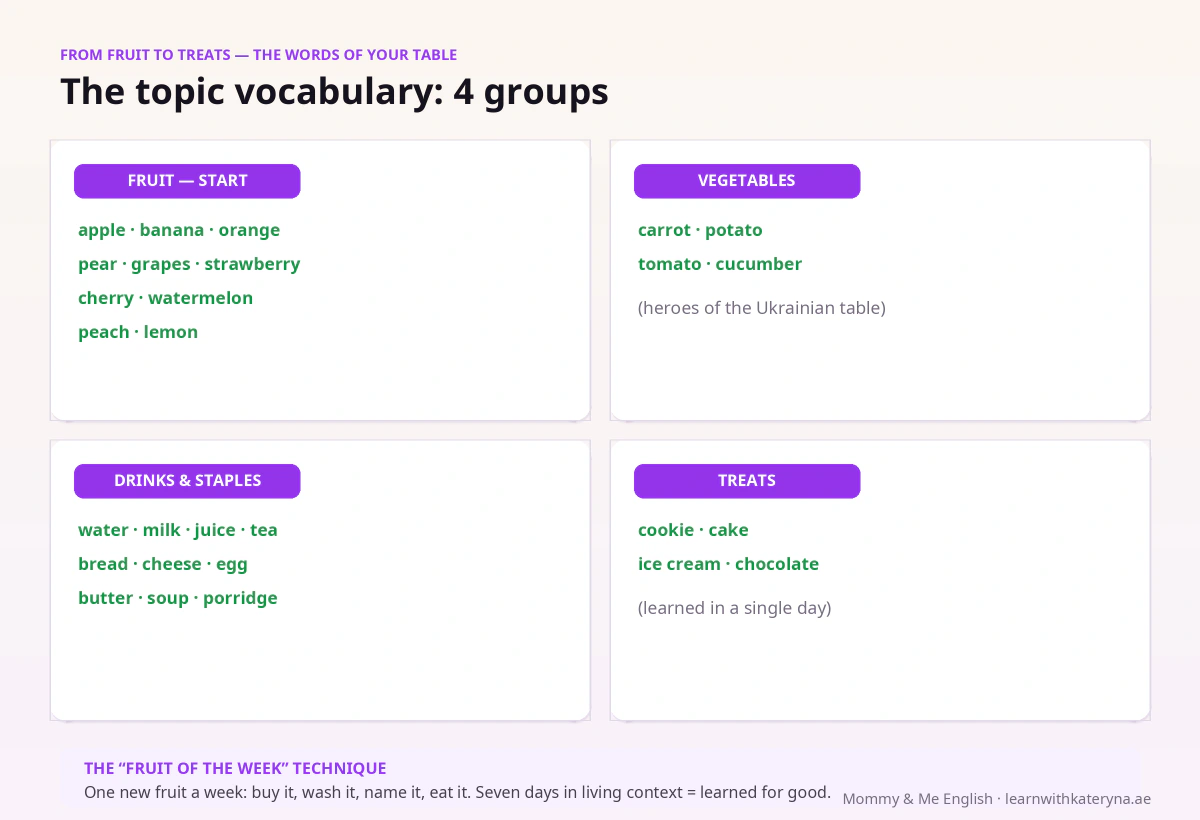
Fruit is the topic's starter set: bright, sweet, and loved by almost every child. Positive association guaranteed:
- apple
- banana (stress on the second syllable: ba-NA-na)
- orange (also the colour from the colours topic — a doubly useful word)
- pear
- grapes (always plural)
- strawberry
- cherry
- watermelon (water + melon — children love the logic)
- peach
- lemon (with a ready-made face for the word sour!)
The introduction technique is "fruit of the week": one new fruit becomes the weekly "star" — it gets bought, washed, named, eaten and spotted in picture books. Seven days with one word in living context — and it is learned for good.
Vegetables, drinks and staples
| Group | Words | Note |
|---|---|---|
| Vegetables | carrot, potato, tomato, cucumber | tomato and cucumber — heroes of every Ukrainian table |
| Drinks | water, milk, juice, tea | water — the first /w/ word: rounded lips |
| Staples | bread, cheese, egg, butter, soup, porridge | cheese — the photo-smile word! |
| Treats | cookie, cake, ice cream, chocolate | learned fastest — motivation at maximum |
An honest observation from practice: children learn cookie and ice cream in a single day with zero effort, while carrot can take a month. That is normal — motivation drives memory. Use it: introduce new "boring" words next to beloved ones ("Carrot first, then a cookie!") — the favourite word pulls its neighbour along.
Yummy and yucky: the first opinion words
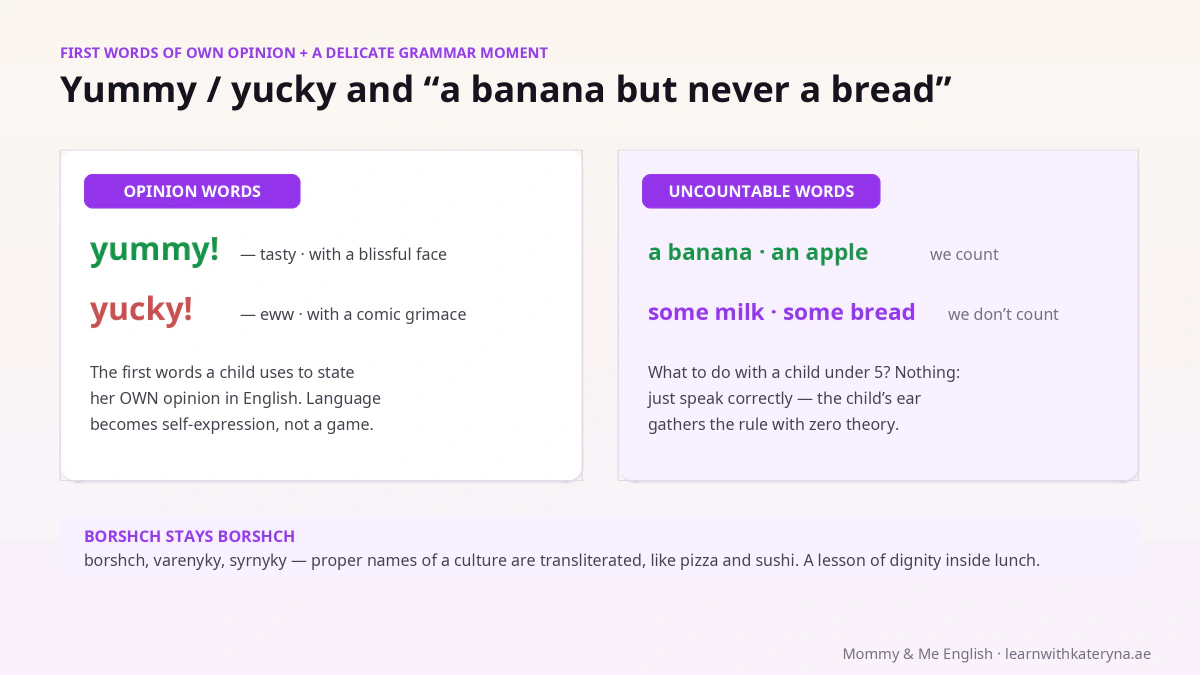
Here is the pair most parents underrate: yummy — tasty, and yucky — eww. These are not just baby words — they are the first words with which a child expresses her own judgement in English. Not repeating after you, not following a command — stating what she thinks: "Yucky!" — and the plate gets pushed away.
Psychologically that is a huge step: language stops being a game and becomes a tool of self-expression. So introduce yummy/yucky early and use them generously, with exaggerated faces: yummy with a blissful expression, yucky with a comic grimace. The child will copy the face before the word — and the word follows. And don't take offence when yucky lands on your signature soup: that is not culinary criticism, that is English working.
The choice question: the topic's engine
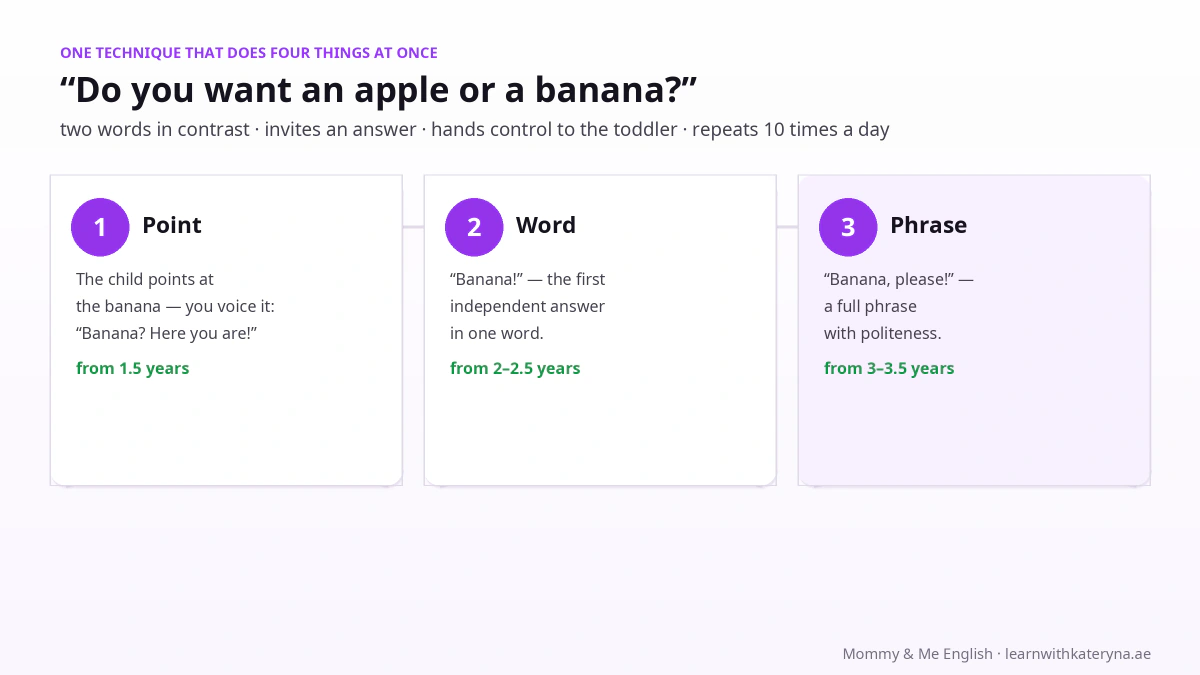
If you take one technique from this whole article, take this one. The question "Do you want an apple or a banana?" does four things at once: presents two words in contrast, invites an answer (even if it is still a finger pointed at the banana), hands the toddler control — and control is worth more than candy to a two-year-old — and repeats naturally ten times a day.
How it develops with age: first the child points and you voice it ("Banana? Here you are!"); then she answers with one word ("Banana!"); later with a phrase ("Banana, please!"). The same mechanics as in the everyday phrases: the choice question is the golden phrase of all toddler English — and it was born at the table.
I'm hungry! — the topic's most useful sentences
Two phrases worth setting as the topic's end goal: "I'm hungry!" and "I'm thirsty!" These are the most practical sentences in toddler English: with them a child reports a basic need — and every teacher in every English-speaking nursery hears them daily.
For families planning a move abroad — or already there — these two phrases are must-have number one: a child who can tell the teacher "I'm thirsty" feels safe in the new environment. They are learned through modelling: before lunch, say about yourself — "I'm hungry! Let's eat!" — and within weeks the child starts using it at her own hungry moment.
A banana but never a bread: meeting uncountables
Attentive parents notice the oddity: why a banana and an apple, but plain bread, water, milk — no "a"? These are uncountable nouns: English doesn't count bread, water or milk by the piece. Compare: one banana, two bananas — but never "one bread"; to count it you need some bread, a slice of bread.
What should you do about this with a child under five? Nothing. Don't explain the rule — just speak correctly yourself: "Do you want a banana?" but "Do you want some milk?" The child's ear will gather statistics from hundreds of your phrases and derive the rule on its own, with zero theory — exactly the way it derives all the grammar of the first language. Your single job is not to cement an error in your own speech. It is the same principle as with verbs: grammar enters through living phrases, not rules.
Building an English routine at home? The free Mommy & Me English starter guide lays out the daily rituals step by step.
Borshch stays borshch
A separate section for our families: how do you say «борщ», «вареники», «сирники» in English? The answer: borshch, varenyky, syrnyky. Ukrainian dishes are proper names of a culture — they are transliterated, not translated, exactly as pizza stayed pizza and sushi stayed sushi. Borshch is even officially recognised by UNESCO as an element of Ukrainian cultural heritage — and English texts have long written it borshch (or borscht).
For a bilingual child this matters more than it seems: "This is our borshch. In English it is also borshch, because it is special — it is ours" — a small lesson of cultural dignity served inside lunch. A child who tells her English-speaking nursery about borshch and varenyky isn't "missing the translation" — she is carrying her culture into her second language. Encourage it.
6 food games
1. The shop. Toy (or real!) products on the "counter": "Can I have an apple, please?" — "Here you are!" The topic's most popular role play — and a rehearsal for real shopping.
2. Chef and helper. Cook together with commentary: "Wash the tomato! Mix! Taste it — yummy?" Verbs from the action topic plus food in one game.
3. Taste test. Eyes closed, a piece on the tongue: "What is it?" — "Apple!" The most joyful vocabulary check there is — children beg for it daily.
4. Teddy picnic. The bears "eat": "Teddy wants a cookie. Bunny wants some milk." The child feeds and voices them — the gentlest bridge to her own speech.
5. Colour lunch. "Find something red on the table!" — the tomato! Food plus colours: red tomato, yellow banana, green cucumber.
6. The shopping list. For 4+: before the shop, draw a "list" together (three products as pictures); in the shop the child "reads" it: "Apples! Milk! Bread!" — and hunts the shelves. English steps out of the house into the real world.
Tastes: sweet, sour, salty — and why hot means it twice
After the product names, the natural next floor is the taste words. There are only four, and each carries a built-in "face" that makes memorisation instant:
- sweet (a smile and eyes closed with pleasure)
- sour (the lemon grimace — the funniest of all; one lemon slice makes the lesson unforgettable)
- salty
- hot — careful here: hot means both "high temperature" and "spicy"! "It's hot!" about soup is about heat; about pepper, about spice. For a toddler the first meaning is enough, with the phrase "Blow on it!"
The "taster" game gathers all four: a few pieces on a plate, eyes closed, the child tastes and "rates": "Sweet? Sour?" It extends the familiar taste test — but now the child describes rather than just names. Moving from "what is it?" to "how is it?" is the jump from the word level to the property level, and tastes are the most delicious way to make it.
Kitchen verbs: cook, cut, mix, pour
The kitchen is a verb workshop, and cooking together is one of the most powerful "sessions" in all of home English. The core six:
- cook ("Let's cook together!")
- cut (with a child-safe knife — a banana or a boiled egg)
- mix (favourite toddler job #1)
- pour (favourite job #2 — and the main puddle)
- taste ("Taste it! Yummy?")
- wash (vegetables — the perfect "grown-up" mission for a two-year-old)
The formula of cooking together: every action gets its phrase, every phrase gets its action. "Wash the tomato! Now cut… I'm cutting, you're watching. Mix-mix-mix! Pour the milk… careful… Taste it!" In fifteen minutes of pancakes the child hears six verbs several times each in full sensory context — flour on the hands, the smell, a result you can eat. No flashcard comes close.
And a motivation bonus: a dish the child "made herself" gets eaten without a single act of persuasion — even if it hides vegetables that were yucky yesterday. Many mums on our course discovered this side effect with astonishment: English in the kitchen quietly solved the picky-eater problem.
The café game: the first independent order
The topic's final game — and one of the most useful role plays there is: the home café. The child is the customer, you are the waiter (then swap). The script is short and never changes:
— Hello! What would you like?
— Juice, please!
— Here you are!
— Thank you!
Four lines — and inside them the entire structure of a real-world order: greeting, request with please, receiving, thanking. Minimal props: toy dishes or real cups, a "menu" of three drawn items. For 4+, escalate: "Anything else?", "How many cookies — one or two?", paying with toy money ("Two coins, please!" — hello, numbers).
Why this game is strategic: it is the rehearsal of your child's first real English transaction in the world. Families abroad know that moment of triumph — when the little one tells an actual waiter "Juice, please!" all by herself and glows with pride. It is the first experience of "my English works in the real world" — and after it, the child's motivation never needs topping up again. If you are mid-move or planning one, this game plus the survival phrases give your child the best possible start.
Table manners: please, thank you and the first politeness in English
The food topic is the natural home of first politeness, because the table is where requests and thanks sound most often. The manners four:
- please — "Milk, please!"
- thank you (children often shorten it to "ta!" — a perfectly normal British child variant)
- here you are — the giver's line
- you're welcome — the reply to thanks
The secret of instilling them is modelling with light emphasis, not demanding: you pass the plate — "Here you are!"; the child hands you a spoon — "Thank you!" with a warm smile. Please lands fastest through a soft game rule: a request with please gets fulfilled quickly and joyfully; a request without one also gets fulfilled (food is unconditional!) but with a gentle echo: "Milk? Milk, PLEASE!" — and you pour. No pressure, no "magic word" blackmail — just consistent sound.
Why this is more than manners: please and thank you are the social currency of the English-speaking world, used far more frequently and automatically than «будь ласка» in Ukrainian. A child trained on this pair at home reads instantly as "lovely manners" in an English-speaking nursery — and the warmth of adults, in turn, speeds up both adaptation and language. A small pair of words with a large social dividend.
4 parent mistakes
1. Turning lunch into a lesson. The table is not a school desk: if the child must "say it right" to get her food, the topic is poisoned within a week. English at the table is background and play; the food comes unconditionally.
2. Withholding food for a word. "Say cookie — then you get it!" turns the word into an instrument of pressure. Do the reverse: give the cookie and voice it — "A cookie! Yummy!" The word accompanies the joy instead of blocking it.
3. Teaching exotic food instead of your own table. Broccoli, avocado and mango from flashcards — while the actual table serves buckwheat, borshch and syrnyky daily. Teach the words of YOUR food: English should describe the child's real life, not the pictures.
4. Correcting "a milk." Uncountable errors are normal until school age (native-speaker toddlers make the same ones). Don't explain the rule — echo it back correctly: "Some milk? Here you are!" The statistics of your correct phrases will do the rest.
Next steps
Start at tonight's dinner: point at the plate and say "Yummy!" with the most blissful face you can produce. This week — the fruit of the week and the first choice question; next week — yucky with the grimace and "I'm hungry!" before lunch. Within two or three months the table will speak English by itself. Then the topic stitches naturally into the rest: "Do you want TWO cookies?" (numbers), "Wash the apple!" (verbs), "Daddy is hungry too!" (family).
The complete system — video lessons, audio and a day-by-day plan — is in the Mommy & Me English starter guide: 10 minutes a day, mum in the leading role, borshch on schedule.


