
 Kateryna Ivanova
English songs are the fastest path to English language acquisition for children aged 1–5. Rhythm, rhyme and melody activate phonetic-processing zones in a child's brain three to four times more efficiently than rote vocabulary memorisation. The child does not "learn" — she stores entire phrases as a single chunk, complete with native intonation and pronunciation. This article gives you the 25 songs that actually work, organised by age, plus the four-step protocol that turns each one into real spoken English in two to four weeks.
What this article covers
- When to introduce English songs into a child's life
- Why music outperforms flashcards and cartoons
- Age table: which song for which age
- Top-7 English songs for ages 1–2
- Top-9 English songs for ages 2–3
- Top-9 English songs for ages 3–5
- How to introduce a new song — 4-step method
- Daily schedule: 5 songs — 5 moments of the day
- Building the playlist: practical setup
- Songs vs flashcards vs cartoons: honest comparison
- For mothers who don't speak English
- Common parental mistakes
- How often to repeat — and when to introduce a new song
- Seasonal and holiday songs: when and why
- What to do on the road and at someone else's home
- Frequently asked questions
When to introduce English songs into a child's life
An English song is not entertainment — it is a neurolinguistic tool. Patricia Kuhl's work at the University of Washington shows that before age 3 a child's brain can form phonetic maps of any language without conscious effort. Music accelerates this process because rhythm acts as an additional memory anchor: the same lyric heard inside a melody is consolidated faster than the same lyric spoken at conversational tempo.
The optimal start age is 10–12 months. By this point the infant already discriminates the phonemes of the language she hears at home from those she does not, and her cortex is ready to lay down a second phonetic map alongside the first. Earlier start usually means cleaner pronunciation. Later start can still work — it simply produces an accent that is more flexible than fixed.
"Musical training in early childhood improves the brain's ability to discriminate phonemes of a foreign language — even if the child does not later continue with music." — Nina Kraus, Northwestern University, 2022
Why music outperforms flashcards and cartoons
The neuroscience is straightforward. When a child hears a sung phrase, three independent neural systems activate at once: auditory cortex for the phonemes, motor cortex for the rhythm, and limbic system for the emotional valence of the melody. A spoken phrase activates only the first. Three reinforced traces beat one isolated trace every time, which is why a child who has heard "Twinkle Twinkle Little Star" twenty times can usually hum it before she has consciously memorised any of its individual words.
This is also why flashcards underperform for children under three. A flashcard isolates a word from its context. Music does the opposite: it bonds a word to a melody, a gesture, a time of day and an emotion. The same word presented across these channels lays down a strong, redundant trace. Pull one channel out and the other three still carry the meaning.
Cartoons share music's weakness — they are passive — but lose its main strength: the child cannot meet the eye of the singer. Patricia Kuhl's 2003 experiment isolated this variable cleanly: infants exposed to a foreign language by a live speaker formed phonetic categories, while infants exposed to identical content via television or audio alone did not. A song with a live mother singing along therefore builds language; the same song playing while a child watches its animated video on YouTube does not.
Age table: which song for which age
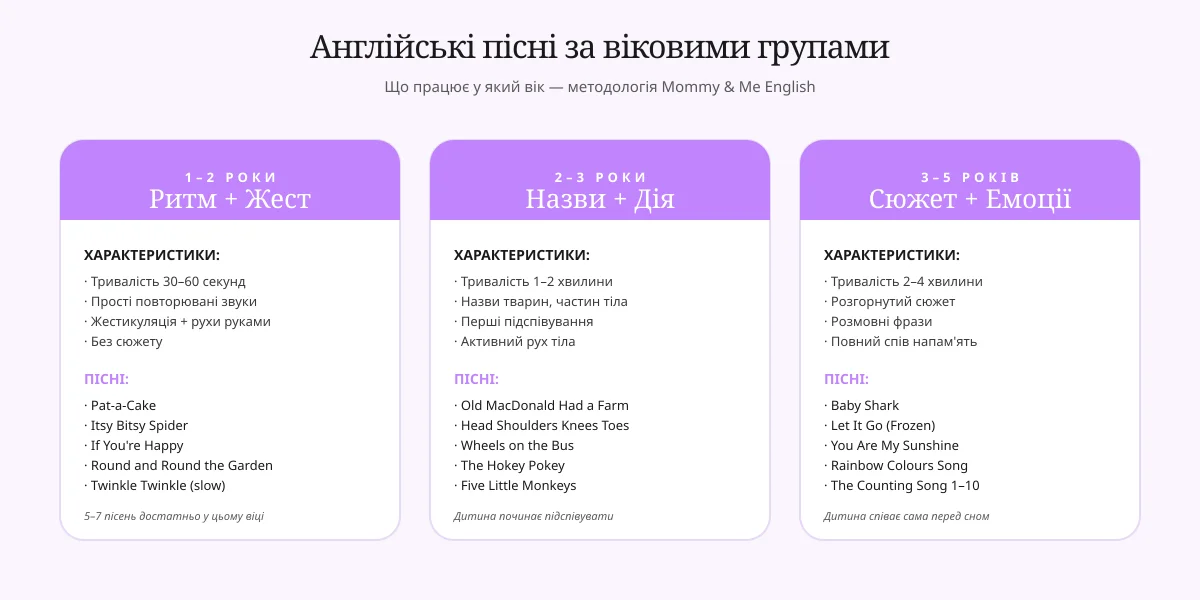
Age group determines which song will work. At 1, the child needs short rhythmic melodies with movement; at 4, songs with full storyline and active vocabulary. Picking the wrong age band is the most common reason parents report "songs aren't working" — typically a 2-year-old being asked to sit through a 4-minute storyline song designed for older children.
| Age | Length | Song type | New songs / week |
|---|---|---|---|
| 1–2 years | 30–60 sec | Simple repeating sounds + gestures | 2–3 new per month |
| 2–3 years | 1–2 min | Names of objects, body parts, animals | 1 new per week |
| 3–5 years | 2–4 min | Story-driven songs with full lyrics | 2 new per week |
Top-7 English songs for ages 1–2
At 1–2 the child does not sing — she moves to rhythm and repeats individual sounds. Songs must be short (under 60 seconds) with a recurring chorus, ideally with a built-in physical gesture you can do with her hands.
- Pat-a-Cake — classic clapping rhyme, 30 seconds; mum claps with the child's hands.
- Itsy Bitsy Spider — hand gestures and a simple spider story.
- If You're Happy and You Know It — clap your hands / stomp your feet.
- Round and Round the Garden — tickling rhyme; pure laughter and language together.
- Twinkle Twinkle Little Star (slow version) — for falling asleep.
- Rock-a-Bye Baby — a lullaby that mum sings herself, no recording needed.
- Where Is Thumbkin? — names of fingers (thumbkin, pointer, tall man).
Top-9 English songs for ages 2–3
At 2–3 the "sing-along window" begins: the child repeats single words from the song. Songs should contain names of familiar objects and actions she meets in the day.
- Old MacDonald Had a Farm — animal sounds (moo, oink, neigh).
- Head, Shoulders, Knees, and Toes — body parts and movement together.
- The Wheels on the Bus — round and round, swish swish swish.
- The Hokey Pokey — right / left / circle.
- Five Little Monkeys — counting 1–5 with a storyline.
- Apples and Bananas — fruits and vowel training in one song.
- I'm a Little Teapot — movement and pose.
- Open Shut Them — opposites: open / close.
- The ABC Song — sound-only first, alphabet later.
Top-9 English songs for ages 3–5
3–5 is the period of story-songs with full lyrics. The child sings from memory, understands every word, and conveys emotion. Now you can introduce songs whose lyrics build narrative arcs.
- Baby Shark — family relations and repetition that locks meaning fast.
- You Are My Sunshine — emotional bond mother-child; this song often becomes a personal lullaby for the family.
- Let It Go (Frozen) — strong emotion plus storyline; works because the child already knows the film.
- Rainbow Colours Song — 7 colours plus sequence.
- Ten in the Bed — counting backward 10 to 1.
- Days of the Week — Monday, Tuesday, Wednesday — anchor of the week.
- Down by the Bay — rhyming and imagination.
- BINGO — spelling and rhythm.
- If I Were a Butterfly — imagination plus animal names.
How to introduce a new song — 4-step method
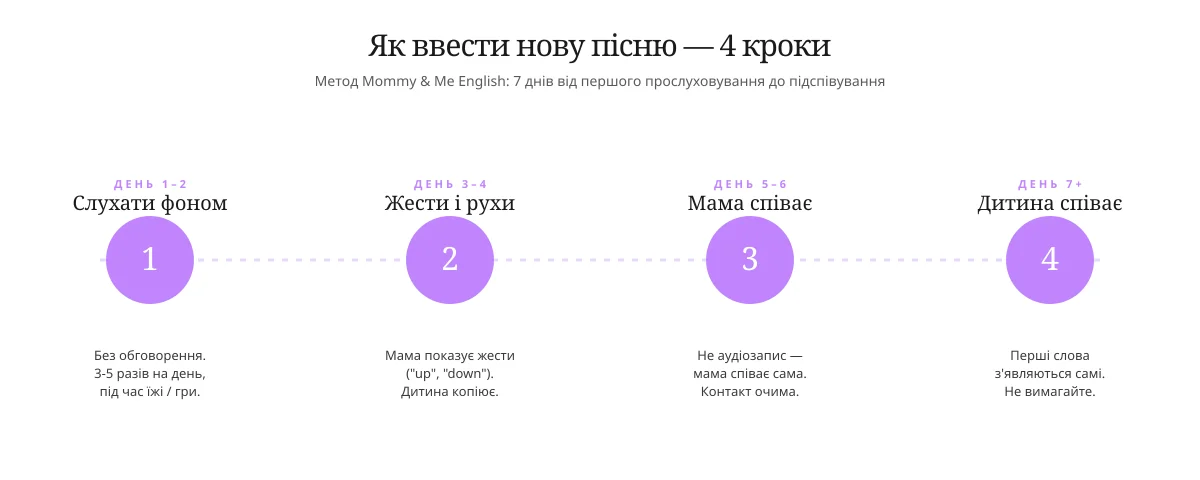
This is the most important section. The Mommy & Me English methodology for introducing a new song is a 7-day cycle in 4 phases. Most parents who report "the song isn't working" have skipped phases 2 and 3 — the part where the song stops being a recording and becomes a shared event.
Phase 1: Days 1–2 — listen as background
Play the song 3–5 times a day during meals, play, and car rides. Do not discuss, do not translate, do not demand attention. The child simply hears it. The brain is logging the melody contour and the rhythmic structure before any word becomes recognisable.
Phase 2: Days 3–4 — add gestures
Mum demonstrates gestures during the song: "up" — hand up; "down" — hand down; "round and round" — rotate hand. The child copies gestures before words. This is normal and not a sign of slow progress; movement is the bridge between hearing and speaking at this age.
Phase 3: Days 5–6 — mum sings live
The most important step. Replace the audio with mum singing live, with eye contact. The mother's voice activates brain zones that recordings do not. It does not matter whether the singing is in tune. The bond between mother and child is the thing the brain is locking onto, with the language going along for the ride.
Phase 4: Day 7+ — child begins singing
Do not demand singing. The child will start on her own — first sounds, then syllables, then words. This takes 2–4 weeks depending on age. The first complete verse usually arrives around week 6.
Building an English routine at home? The free Mommy & Me English starter guide lays out the daily rituals step by step.
Daily schedule: 5 songs — 5 moments of the day
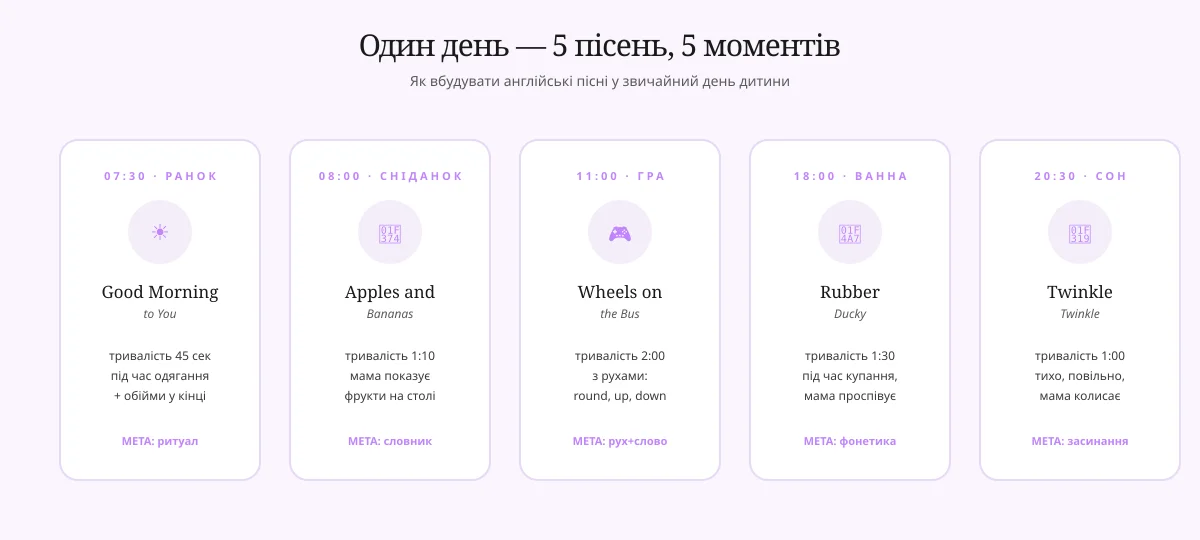
Instead of a "lesson," songs embed into the ordinary day. One day, one song per moment. Each anchor is a fixed time, a fixed song and a fixed action. This is how five songs land in a real parent's day without any of it feeling like extra work.
| Time | Moment | Song | Length |
|---|---|---|---|
| 07:30 | Morning ritual | Good Morning to You | 0:45 |
| 08:00 | Breakfast | Apples and Bananas | 1:10 |
| 11:00 | Living-room play | The Wheels on the Bus | 2:00 |
| 18:00 | Bath time | Rubber Ducky | 1:30 |
| 20:30 | Before sleep | Twinkle Twinkle Little Star | 1:00 |
The total exposure is just under seven minutes — but distributed across the day in five emotionally distinct contexts. That distribution is what consolidates language; a single 7-minute block at the same time daily does not produce the same result.
Building the playlist: practical setup
Most parents fail at the first ten seconds: they cannot find the song fast enough, so they default to a podcast or random YouTube and the moment is lost. Build the playlist before week one. The setup takes 30 minutes once and saves you from the daily friction that kills consistency.
- Make a flat playlist on your home device. Spotify, YouTube Music or Apple Music — all three have English-children-songs catalogues. Pick the one that opens fastest from your lock screen.
- Pin one song per moment. Five songs, ordered by time of day. No more. The discipline is the smallness of the list.
- Use the same recording every time. Different recordings of "Twinkle Twinkle" have different tempos. The child's brain is locking on the melodic contour; switching versions resets the contour and slows consolidation.
- Native-speaker audio only. Avoid covers by non-native singers or auto-generated content. The pronunciation has to match what your child will eventually produce.
- Lyrics in your phone notes. Have the lyrics one tap away — when the moment arrives, you do not want to be searching. The first few weeks are the hardest because the words are not yet in your head.
Songs vs flashcards vs cartoons: honest comparison
Parents often layer all three, hoping more inputs equals more output. The opposite is usually true: too many channels at once dilute attention. Below is how the three approaches stack up on the variables that actually decide retention under age 5.
| Variable | Songs (with mum) | Flashcards | Cartoons |
|---|---|---|---|
| Phonetic anchoring | High — melody + rhythm + voice | Low — single channel | Medium — voice but no rhythm |
| Live human contact | Yes | Yes (parent-led) | No |
| Emotional engagement | High | Low | Medium |
| Active output trigger | Strong (chorus pulls the child in) | Weak | Almost none under 3 |
| Time per session | 30 sec – 2 min | 3–5 min | 15–60 min |
| Best fit age | 1–5 | 3+ as supplement | 3+ as occasional |
Songs win on the variables that matter most for the under-3 brain. Flashcards become useful around age 3–4 as a supplement once the child can already speak — they are good for vocabulary expansion, not for first words. Cartoons are at best a low-cost source of background phonemes and at worst a screen habit that crowds out the parent-led moments where real language is built.
For mothers who don't speak English
The biggest fear of these mothers is "I have an accent, I'll harm my child." Cambridge University research (2023) shows: before age 5, a child forms her phonetic map from native-speaker audio, not from the adult's accent. The Mommy & Me English course includes native audio for each of the 25 songs — the mother simply sings along.
The advice reduces to three rules:
- Do not translate the song's lyrics. The child must form English context independently.
- Sing together, even imperfectly. There is no replacement for the mother's voice.
- One song — one week. Do not change the repertoire chaotically.
If you live in Dubai and want a sensory in-home version of this method for a 2.5–3.5-year-old, see the in-home English program for toddlers in Dubai. Each session is built around the same musical anchors covered in this article, delivered at the family's home.
Common parental mistakes
Five mistakes that come up again and again, and that quietly cancel out the method:
- Translating every word — produces passive English with delayed responses.
- Changing songs daily — the brain has no time to consolidate the pattern.
- Recordings only — without live singing from mum, the phonetic map forms weakly.
- Demanding performance — the child must sing on her own initiative.
- Songs as background all day — that is acoustic wallpaper, not language input. Five times three minutes beats three hours of background.
A sixth mistake worth flagging: introducing too many songs in the first month. Three songs for the first 30 days outperforms ten songs in the same period because consolidation, not volume, is what produces output. If you are not sure whether to add a sixth song this week, do not add it.
How often to repeat — and when to introduce a new song
Empirical rule from 50 course families:
- First 3 songs — repeat each minimum 30 days before introducing a new one.
- Songs 4–10 — new song every two weeks.
- Songs 11+ — new one weekly.
In one year a child confidently sings 25–30 songs. That is enough for a vocabulary of around 400–500 words — equivalent to a British-curriculum kindergarten English group at age 4. The single biggest predictor of getting there is not the choice of songs but the consistency of the cycle: same songs, same times, same daily count. Parents who allowed themselves a "skip day" every now and then took twice as long to reach the 25-song milestone as parents who held the cycle even on travel days, even on sick days, even on the bad days that every family has.
Seasonal and holiday songs: when and why
Seasonal songs are not a "bonus" — they are an efficient way to add vocabulary without expanding the daily five-anchor list. They work because the child hears them only a few weeks a year, so the brain tags them as rare and encodes them well. Do not confuse seasonal with daily — layer them on top of the daily set, not instead of it.
- Winter (December): Jingle Bells — rhythm, bells, winter vocabulary (snow, sled, ho ho ho).
- Halloween (late October): Five Little Pumpkins — counting plus imagination.
- Birthday: Happy Birthday to You — learns itself, because it plays every time a candle is blown out.
- Rainy day: Rain Rain Go Away — weather plus emotion.
- Summer: You Are My Sunshine — warmth, sun, family bonding.
The rule is simple: one seasonal song per season. Do not try to introduce three winter songs in December; one per season, and that rarity is exactly what makes them effective.
Seasonal songs also serve a second function: they become family anchors. A 3-year-old who sang Jingle Bells last winter will, the following winter, recognise it from the first three notes and start singing along before you have queued the video. That is real long-term acquisition — a song that lives in the child for a whole year without weekly repetition.
What to do on the road and at someone else's home
Travel is the most fragile part of an anchor-based system. Time zones shift, the routine collapses, the child is over-tired. The worst thing you can do is decide "we're on holiday from English." The best thing is to keep one song — the bedtime one — and let everything else slide. The full five anchors come back within two to three days of returning home, because the child's brain already knows the system. One held song keeps the whole cycle alive while you travel.
What to do this week
Pick one song from the age band that matches your child. Set one fixed moment — bedtime works for almost every family. Run the four-phase cycle without skipping phase 3. By week three you will hear the chorus coming back to you.
If you want native-speaker audio for every one of the 25 songs in this article, plus the lyrics, gestures and parent instructions for each, start with the free first lesson of Mommy & Me English. It opens with the morning ritual song and walks the mother through reading the lyrics out loud for the first time — the only skill you actually need to begin.
