
 Kateryna Ivanova
English colors for kids are 11 basic words (red, orange, yellow, green, blue, purple, pink, brown, black, white, grey) that a child aged 1–5 learns most easily not from flashcards but through real objects: the sky is blue, grass is green, the sun is yellow. Start with three primary colors (red, blue, yellow), add one a week, and lock them in with the "color of the day" method. For a Ukrainian-speaking child there's one unique trap: the English word blue means both "синій" and "блакитний" — two separate color names in Ukrainian. This article gives the full color table with pronunciation, the "color of the day" method, 8 games, and how to remove the "синій/блакитний" trap.
Colors are one of the first topics a child can really "see" in English: they don't need abstract translation, because a blue sky and green grass are the same in every language. But precisely because of that, many parents teach colors the wrong way — through flashcards instead of the world around them. Let's break down how to do it so the words stay for good.
How many colors to teach and where to start
The basic English colors a child aged 1–5 needs are eleven. These are the "universal color terms" — names that exist in almost every language and cover 99% of situations: red, orange, yellow, green, blue, purple, pink, brown, black, white, grey. Leave shades (turquoise, beige, maroon) for later — they aren't needed at the start.
Don't start with all of them at once, but with three primary colors: red, blue, yellow. These are the primaries all others are made from; they're the most common in a child's world (toys, clothes, food) and the easiest to pronounce. Once these three are confident, add green, then the rest one a week.
A child doesn't learn "a list of 11 words". They learn that the sky is blue and a banana is yellow. Anchoring to an object makes the color part of the world, not an abstraction on a card.
Colors sit beautifully after first words and the alphabet. If you're still at the start — begin with the first 100 English words and the English alphabet for kids, and add colors as a separate, easy topic.
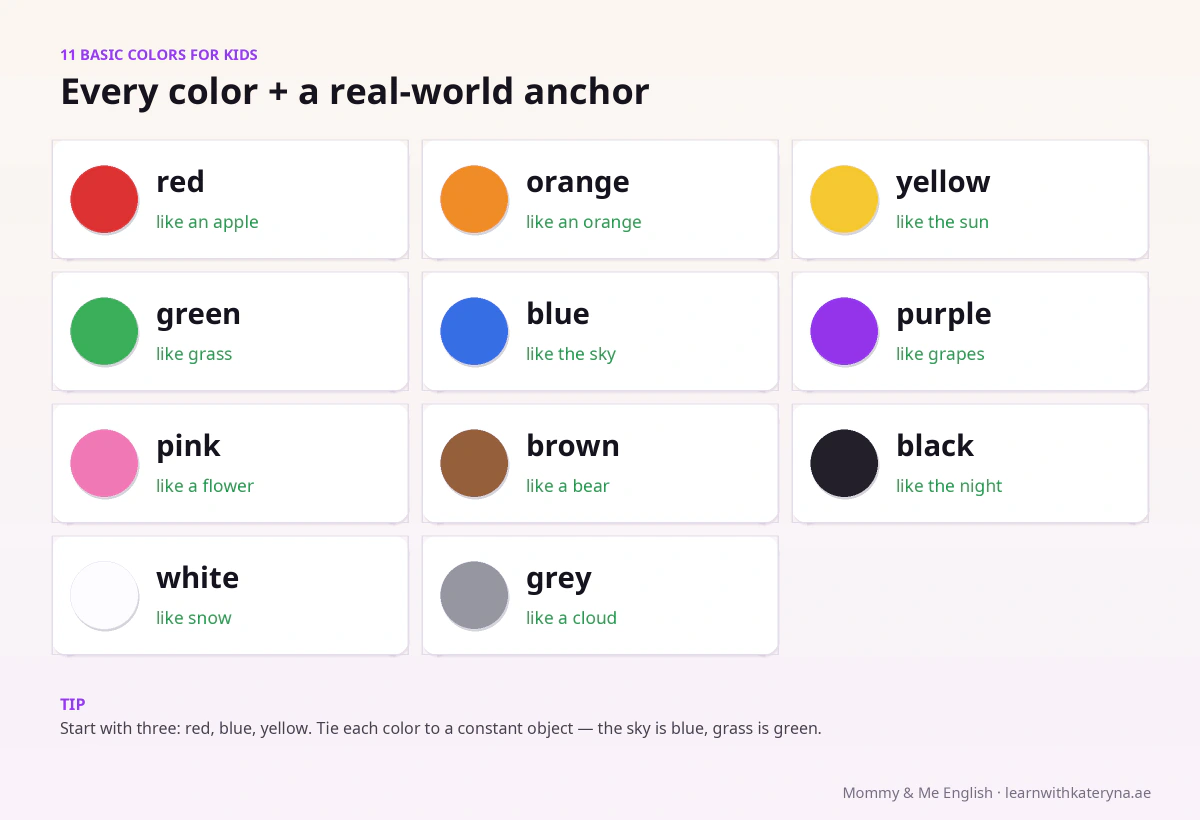
11 colors with a real-world anchor word
Below is the full list of basic colors with a real-world anchor word. The anchor is an object that "glues" the color to memory: not just "yellow", but "yellow like the sun".
| Ukrainian | English | Say it | Anchor |
|---|---|---|---|
| червоний | red | red | apple |
| помаранчевий | orange | or-inj | orange |
| жовтий | yellow | yel-low | sun |
| зелений | green | green | grass |
| синій/блакитний | blue | bloo | sky |
| фіолетовий | purple | pur-pl | grapes |
| рожевий | pink | pink | flower |
| коричневий | brown | brown | bear |
| чорний | black | black | night |
| білий | white | white | snow |
| сірий | grey | grey | cloud |
Two pronunciation notes where people slip most. First, yellow is "YEL-low" with the stress on the first syllable. Second, grey has two spellings: grey (British) and gray (American) — both correct, both sound the same. Anchor words are easy to pull from the list of first English words for a child.
The "синій vs блакитний" trap: why it's harder for Ukrainian-speaking children
This is the main unique difficulty that's in no English-language guide to colors. In Ukrainian, синій (dark blue) and блакитний (light blue) are two separate basic colors. In English there's only one word for both — blue. So where a Ukrainian child sees two colors, an English speaker sees one.
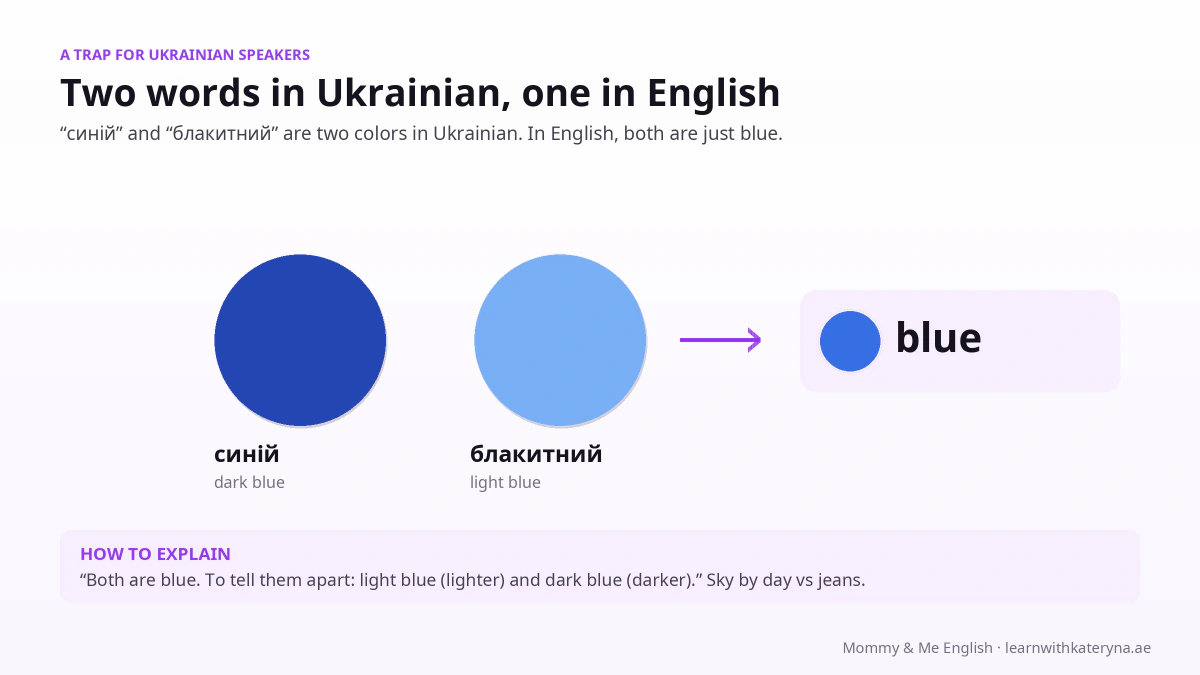
In practice this creates confusion both ways. The child asks: "And which one is блакитний in English?" — and the right answer is "Also blue". When they want to say синій and блакитний separately, English offers descriptive options:
- блакитний → light blue
- синій → dark blue or simply blue
For a Ukrainian-speaking child, "blue" isn't one color but two in one word. Explain it directly: "In English синій and блакитний are both blue. If you need to tell them apart — light blue and dark blue."
How to explain it without confusion: show the sky on a clear day ("light blue") and a dark evening sky or jeans ("dark blue") and say — "both are blue, one is just lighter". This not only removes the trap but naturally introduces the idea of shades (light/dark), which you'll need later. We covered the same "one form — different meaning" principle for letters in the article on English vs Ukrainian look-alike letters.
What age to teach colors
The ability to distinguish colors appears very early — a baby sees them within a few months. But naming a color with a word comes much later, and this is where it's important not to rush. Here are three natural stages.
- 18 months – 2 years — recognition. The child doesn't name the color yet but can point: "Where is the red one?" — and picks up the red toy. The goal is the word-color link, without demanding speech.
- 2–3 years — naming. The first color names appear. At first they often muddle them (everything bright can be "red"), and that's normal. Don't correct sharply — just repeat correctly.
- 3–5 years — confident use and shades. The child names all the basics and starts understanding light/dark. Here you can introduce the "синій/блакитний" trap and descriptive shades.
Important: before 2.5–3 years, muddling colors is a developmental norm, not a vision problem. The brain is still building the "shade → word" link. If after age 4 a child consistently confuses specific pairs (say, green and red), it's worth checking their vision with a doctor — but that's rare.
The "color of the day" method: building colors into daily life
The "color of the day" method is a technique where you pick one color and "hunt" for it in real life all day, instead of sitting with flashcards. It's the most effective way, because the child meets the word in dozens of natural contexts a day.
Here's what a red day looks like:
- Breakfast: "Look, a red apple! Red strawberry. Do you see red?"
- Getting dressed: "Let's find something red. Red socks!"
- The walk: "Red car! Red flower! A red sign — stop!"
- Play: gather all the red toys into one box — "All the red toys here".
- Before bed: "What was red today?" — the child recalls. That's the lock-in.
One color, one day. The next day — blue, then yellow. In two weeks the child has met each primary color in hundreds of contexts, without ever sitting down for a "lesson". It's the same logic of daily micro-moments as in daily English rituals at home.
8 games to learn colors without flashcards
Colors are locked in not by drilling but by play, where the child searches, sorts and names the color in movement. Here are eight ways with no desk and no special materials.
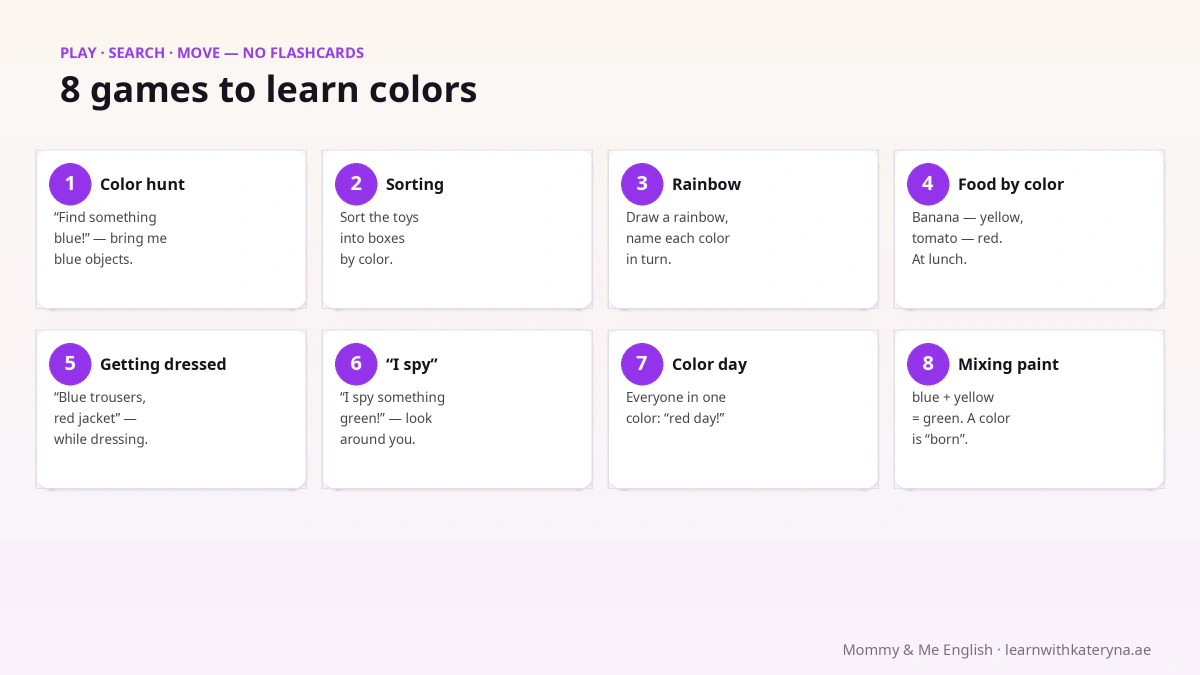
- Color hunt. "Find something blue!" The child runs around the room bringing blue objects. Each one out loud: "Blue cup! Blue book!"
- Sorting. Mix up blocks/toys and sort them by color into boxes, naming each.
- Rainbow. Draw a rainbow and name the colors in turn: red, orange, yellow, green, blue.
- Food by color. On the plate — "What colour is the banana? Yellow! The tomato? Red!"
- Clothes. While dressing: "Blue trousers, white socks, red jacket". Daily life becomes the lesson.
- "I spy." The I-spy game: "I spy something green!" — the child looks for green around them.
- Color day. Everyone wears one color together — "Today is a red day!"
- Paint and mixing. Mix blue + yellow = green. The child sees a color "born" — and remembers both.
Choose 2–3 games the child enjoys. The "paint mixing" game is especially valuable: it teaches the names and shows the link between colors (primary → secondary) at once.
Building an English routine at home? The free Mommy & Me English starter guide lays out the daily rituals step by step.
What order to introduce colors
The order of introducing colors matters: start with the most common and most contrasting, and leave similar shades for later so you don't cause confusion. Here's a proven sequence.
- Week 1 — red, blue, yellow. The three primaries. Maximally contrasting, most frequent.
- Week 2 — green, orange. Secondary, bright, easy to find in nature and food.
- Week 3 — black, white. A contrasting pair, simple to grasp.
- Week 4 — pink, purple, brown, grey. Harder shades. Here too introduce light/dark blue.
Don't give similar colors side by side at the start (for example, purple and pink at once) — the child will get muddled. Contrast first, nuance later. The same principle as the order of learning the alphabet letters.
Colors + objects: anchoring to the real world
The main secret to solid color learning is to anchor each not to an abstract square but to a constant object that's always that color. Then the color "lives" together with the image.
| Color | Constant anchor object |
|---|---|
| blue | sky, water |
| green | grass, tree |
| yellow | sun, banana |
| red | apple, tomato |
| white | snow, milk |
| black | night |
| brown | bear, chocolate |
When the child sees the sky — you say "blue"; when they see grass — "green". After a week of such links the child will start saying "blue!" themselves, looking out of the window. That's natural acquisition: the word is tied to the world, not to a card that's easily forgotten.
Color songs and cartoons: how to use them right
Color songs are one of the fastest ways to lock in the words, because the melody and repetition "sew" the name into memory effortlessly. But they work only as a supplement to real experience, not instead of it: the song gives the word, the object around gives the meaning.
What's worth using:
- "The Rainbow Song" — a classic: red, orange, yellow, green, blue. Simple, slow, ideal for 2–3-year-olds.
- "What Colour Is It?" — question-songs with a "question → pause → answer" structure that mimics live dialogue.
- Ms Rachel and Bluey — scenes with colors in natural context. How to watch them usefully — in the guide on English cartoons for kids.
One rule: after a song, always carry the word into reality. Sang about yellow — find three yellow objects at home. That turns the song from background noise into active learning. A full selection is in the article on English songs for kids by age.
Colors go out into the world: clothes, nature, feelings
Once the basic colors are recognised, the topic is ready to "leave the house" — and that is where it truly opens up, because color is literally everywhere:
Clothes — the daily trainer. "Blue trousers or red trousers?" — the choice question while dressing gives color a practical job: it is no longer "knowledge" but a decision criterion. A child who picked her yellow T-shirt herself wears not a T-shirt that day but HER choice — and the word yellow gains emotional weight.
Nature — the seasonal calendar of color. Every season "paints" the walk its own shade: autumn — yellow and orange leaves, winter — white snow, spring — green grass, summer — everything at once. The outdoor "color of the day" game: "Today we hunt for GREEN!" — and the whole walk becomes a one-color safari. It is that rare format that stays fresh for months, because the world serves up new finds daily.
The feelings of colors — for 4+. Older preschoolers are ready for the "how does this color feel" conversation: yellow — cheerful like the sun; blue — calm like the sky; red — fast and loud. This is not "color science" but first metaphors — the bridge from concrete vocabulary to figurative speech, and a lovely drawing game: "Draw a HAPPY picture! What colors will you use?"
And the topic's practical summit: color as a describing tool. "Which cup do you want?" — "The RED one!" A child who uses color to specify WHICH object she means is doing exactly what adjectives exist for in language. From that moment on, colors work for her daily — in play, at the table, in the shop.
Common parent mistakes
- Teaching all 11 colors at once. The child gets muddled. Three primaries first, the rest gradually.
- Flashcards only. A square on a card is an abstraction. Anchor the color to real objects.
- Correcting sharply. "That's not red, it's orange!" lowers the desire to speak. Just repeat correctly: "Yes, it's orange".
- Ignoring the "синій/блакитний" trap. For a Ukrainian-speaking child it's real confusion. Explain that both are blue.
- Giving similar colors side by side. Purple and pink at once at the start guarantees confusion. Contrast first.
- Turning it into an exam. "So what color is it? Say it!" — pressure kills interest. Colors are a game, not a test.
Next steps
English colors are one of the easiest and most rewarding topics: they're visible around you every day. Start with three (red, blue, yellow), anchor each to a constant object, use the "color of the day" method, and don't forget to explain the "синій/блакитний = blue" trap. In a month the child will confidently name all 11 basic colors.
Want a ready-made system instead of guesswork? The free Mommy & Me English starter guide gathers colors, first words, the alphabet and sounds into one step-by-step plan for the first months at home. Download the free starter guide and begin today.
Continue the first-vocabulary theme: the first 100 English words by age, the English alphabet for kids, and English songs for kids — songs about colors lock the words in especially fast.


