
 Kateryna Ivanova
Body parts is the topic where a Ukrainian-speaking child meets a surprise no textbook warns about: our word «рука» is two different words in English (arm and hand), «нога» is two as well (leg and foot), and «палець» is actually three (finger, thumb and toe). A child who doesn't know this says "my hand hurts" while pointing at an elbow — and a native speaker doesn't understand. This guide covers all the body parts, the five "split" words, the song every English-speaking nursery on the planet sings, and 8 games that need nothing but a mirror and some tickling.
The main trap: 5 Ukrainian words that split in two
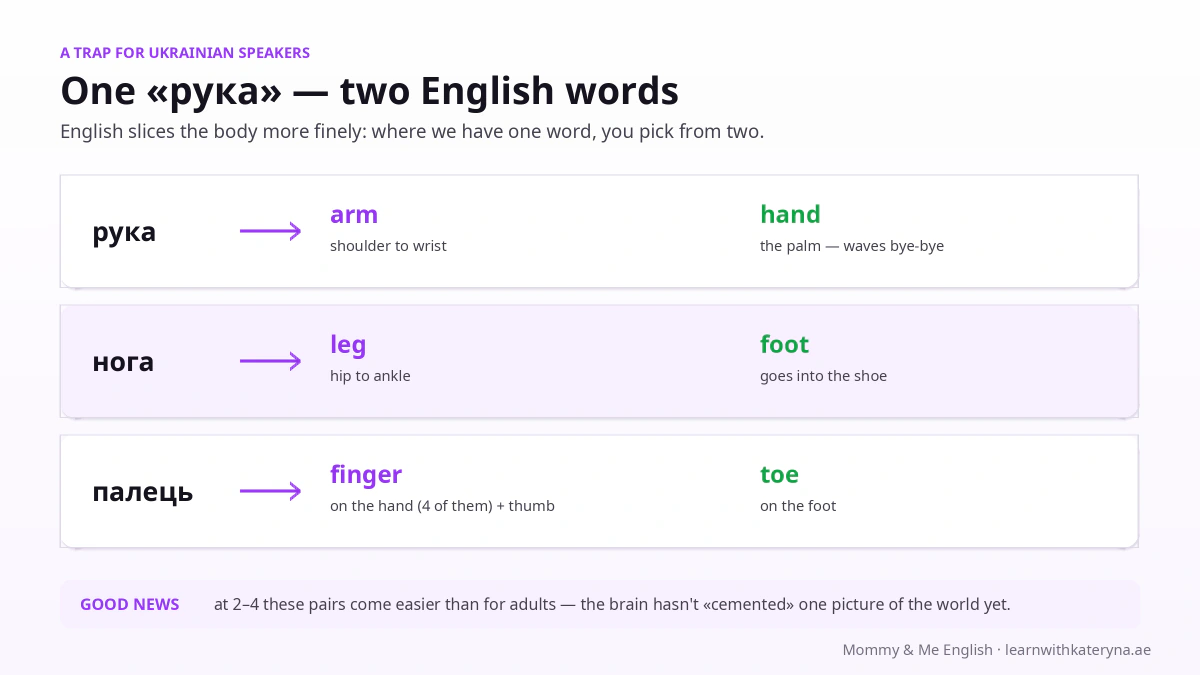
English slices the body more finely than Ukrainian does. Where we have one word, English demands a choice of two — and this is the single most common source of confusion for bilingual kids:
| Ukrainian | English | How to tell them apart |
|---|---|---|
| рука | arm + hand | arm — shoulder to wrist; hand — the palm with fingers. The hand is what waves "bye-bye" |
| нога | leg + foot | leg — hip to ankle; foot — what goes into the shoe |
| палець | finger + thumb + toe | finger — on the hand (there are four!), thumb — the big one, toe — on the foot |
| шия/горло | neck + throat | neck — outside; throat — inside (the one that hurts with a cold) |
| пальці ніг | toes | plural of toe — the ones in the famous song |
The good news: children aged 2–4 handle these pairs more easily than adults do. A toddler who hasn't yet "cemented" one linguistic picture of the world simply accepts it: the thing I hold a spoon with is a hand, the part above is an arm. No translation, no surprise. An adult brain resists ("how can one рука be two words?"); a child's brain doesn't. It is one more display of the early language window I wrote about in the article on bilingualism: before five, a child builds both language systems in parallel, and no category feels "extra."
The starter set: face and head
The face is the launch pad of the topic, because it can be "studied" during washing, in front of the mirror and in tickling games — several times a day:
- head
- face
- eyes ("Close your eyes!" — the key hide-and-seek phrase)
- nose (the star of "Where is your nose?")
- mouth ("Open your mouth!" — the phrase that saves every lunch)
- ears
- hair (no plural — never "hairs"!)
- cheeks (the best body part for kissing and tickling)
- teeth (one — tooth; "Brush your teeth!")
- tummy (the child-register word; the "grown-up" stomach comes later)
Note tummy: children's English has a whole layer of "soft" words — tummy instead of stomach, bottom instead of buttocks — and native speakers use exactly these with toddlers. Use the child variants confidently: it is not "wrong" English but the normal register for talking to small children, the same as Ukrainian «животик» instead of «живіт».
Torso, arms, legs
- shoulders
- arm / arms (down to the wrist)
- hand / hands ("Wash your hands!", "Clap your hands!")
- fingers
- thumb (the hero of "Where is Thumbkin?")
- back
- knees (the k is silent!)
- leg / legs (down to the ankle)
- foot / feet (irregular plural — teach it as a pair from day one)
- toes
Two grammar details worth planting early. First: foot → feet and tooth → teeth are irregular plurals. Don't explain the rule (there isn't one) — just always say the pair: "one foot, two feet." The child records the pair as a fact and will never need re-teaching at school. Second: knee starts with a silent k. Good for you to know so you don't cement an extra sound — more on how English letters and sounds relate in the guide to phonics.
What order to teach in
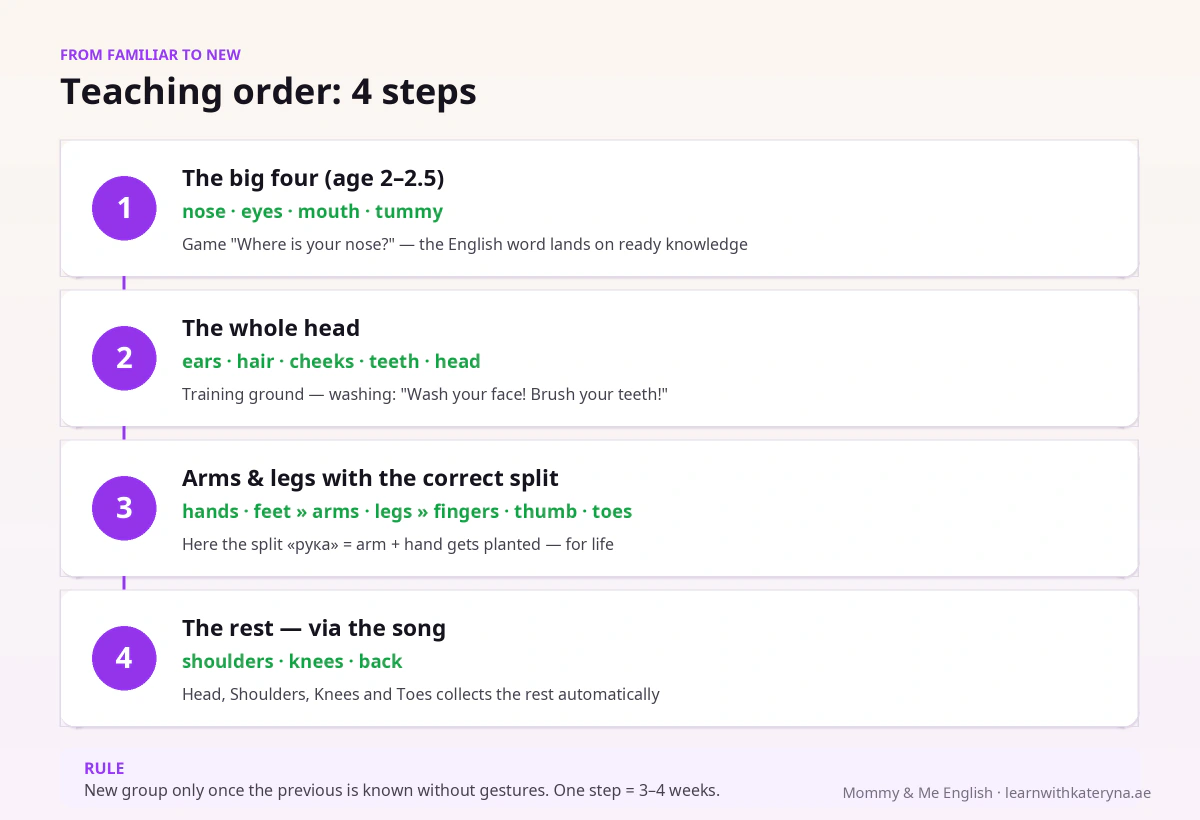
Step 1 (age 2–2.5): the big four. Nose, eyes, mouth, tummy. These are the parts the child already points to confidently in the first language — the English word lands on ready knowledge. One game does it all: "Where is your nose?" — and the little finger flies to the nose.
Step 2: the whole head. Ears, hair, cheeks, teeth, head. The perfect training ground is washing and brushing: "Wash your face! Brush your teeth! Brush your hair!"
Step 3: arms and legs with the correct split. Hands and feet first (they are "functional": we wash them, clap them, stomp them), then arms and legs, finally fingers, thumb, toes. This is the step where the рука=arm+hand split gets planted — and if it is planted at three, it stays for life.
Step 4: the rest via the song. Shoulders, knees, back — easiest collected through Head, Shoulders, Knees and Toes (below).
Head, Shoulders, Knees and Toes: squeezing out the maximum
This song is the "national anthem" of the body-parts topic: every English-speaking nursery in the world sings it, and for good reason. In 30 seconds a child touches eight body parts in a fixed order — head, shoulders, knees, toes, eyes, ears, mouth, nose. Movement + word + melody is triple encoding, the strongest kind there is (the same mechanic as the TPR method).
But most parents use the song at 20% capacity: play it — sing it — forget it. Here is how to squeeze out the rest:
Level 1 — slow, with touches. For the first weeks sing without the recording, at half speed, using the child's own hands: your palms guide hers to the head, the shoulders, the knees. The body memorises the route before the ears memorise the words.
Level 2 — speeding up. The classic nursery game: every round faster than the last, until everyone collapses laughing. Laughter is the best memory fixative there is.
Level 3 — gaps. Instead of singing head — silence and just the touch. The child "fills in" the word mentally: that is active recall now, not passive listening.
Level 4 — mixing it up. Sing "nose" while touching an ear. A three-year-old who giggles and corrects mum is a child who owns the topic completely. How to weave songs into daily rituals without "lessons" — covered in the guide to English songs.
8 body-part games
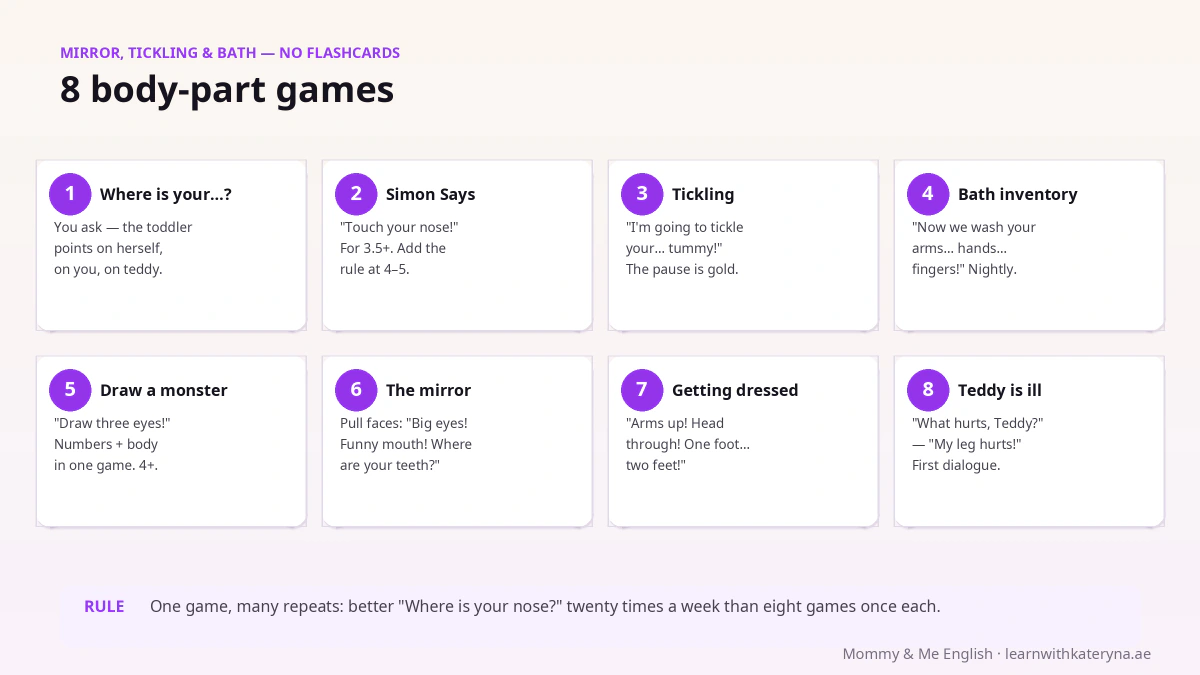
1. "Where is your…?" — the starter game for age 2: you ask, the toddler points on herself. Then reverse it: she points on you, on the teddy, in a picture book.
2. Simon Says (simplified). For 3.5+: "Touch your nose! Touch your toes!" Skip the "only if Simon says" rule at first — plain commands. Add the rule at 4–5.
3. Tickling with an announcement. "I'm going to tickle your… tummy!" The pause before the word is gold: the child freezes and listens with every ounce of attention she has.
4. Bath-time inventory. The sponge "announces" its route: "Now we wash your arms… your hands… your fingers!" The whole topic revised nightly without a single teaching minute.
5. Draw a monster. For 4+: "Draw three eyes! Draw six legs!" Numbers + body in one game (if numbers aren't in place yet, start with English numbers).
6. The mirror. Pulling faces in front of the mirror with commentary: "Big eyes! Funny mouth! Where are your teeth?"
7. Getting dressed with a route map. "Arms up! Head through! One foot… two feet!" — the body topic and the clothes topic stitched into one ritual.
8. Teddy is ill. The bridge into dialogues — next section.
Playing doctor: first dialogues
Somewhere around 3.5–4 comes the moment when a child is ready not just to point but to answer. The best stage for it is a toy hospital:
— What hurts, Teddy? — asks the little "doctor" (with your words at first).
— My leg hurts! — "answers" the teddy in your voice.
— Oh no! Let me help!
Three lines — and inside them: body parts in live use, the pattern "My … hurts" (the most useful phrase of the whole topic: one day your child will tell you "my ear hurts" and you will know exactly what is wrong), empathy, and role play. Swap roles, "treat" every animal in the house in turn, add plaster and medicine once the basics have settled. This is no longer vocabulary learning — it is your child's first real conversation in English, as a participant rather than a listener.
Building an English routine at home? The free Mommy & Me English starter guide lays out the daily rituals step by step.
Faces and feelings: happy face, sad face
As soon as the face is learned, it becomes the playground for the next topic — emotions. And this is not "extra material" but the most valuable continuation: a child who can talk about her body learns, as the next step, to talk about her feelings.
Start with the basic four: happy, sad, angry, tired. The tool is the same as for face parts — the mirror: pull faces together and name them: "Happy face! Sad face! Show me your angry face!" Children adore "switching" faces on command — a game and an acting exercise in one.
The second tool is books with expressive characters: "Look at the bear. Is he happy or sad?" The choice question, familiar from other topics, works here too. And from 3.5–4, add the key question: "How do you feel?" — and accept any answer, even in Ukrainian. The goal is not an English reply; the goal is for the feelings question to become a normal part of the day. Families who play "faces" regularly report an unexpected bonus: real emotions become easier for the child to live through, because they now have names — in two languages.
Big and small: the first adjectives, learned on the body
The body is the perfect training ground for the first adjective pair: big and small. The comparison is built into the situation itself: daddy has big hands, the toddler has small hands — palm pressed to palm, and the difference needs no translation.
Game formats: "Big eyes!" (open wide) versus "small eyes" (squint); "Take a BIG step! Now a small step"; "Open your mouth — BIG! Now small." Every pair is a movement, which means body-based memory, as in the TPR method. Later the pair expands onto the whole world: big dog — small cat, big spoon — small spoon at lunch.
Why this matters inside the body topic specifically: an adjective learned through comparison "on oneself" becomes a thinking tool, not just a word. A child who has physically felt the difference between a big step and a small step will never confuse the words — unlike a child who was shown two pictures.
The full hygiene script: morning and evening in English
Here is a ready-made script that stitches the whole body topic into two daily rituals. It is designed for unhurried delivery, with an action on every phrase:
Morning at the sink (2 minutes): "Let's wash your face! Water on your cheeks… on your nose… Wash your hands — rub-rub-rub! Brush your teeth. Open your mouth — big! Brush, brush, brush. Spit! Well done. Dry your face. Look in the mirror — what a happy face!"
Evening bath (3 minutes): "Bath time! In you go! Wash your tummy… your arms… your hands… your fingers — one, two, three, four, five! Now your legs… your feet… your toes! Wash your back. Close your eyes — washing your hair! All clean! Out you go. Dry your ears… dry your hair. Pyjamas on — arms up! Head through! Done!"
These two scripts contain fifteen body parts, six verbs, numbers and big/small — all sounding daily without a single "teaching" minute. For the first weeks, perform the script like an actor: exaggerated intonation, pauses before familiar words. Within a month it becomes your natural bathroom language; within two more, the child starts prompting the next phrase whenever you "forget" one. That is the goal: a ritual that runs itself.
What to expect at 2, 3 and 4
2–2.5 years: points to 4–6 parts on herself on an English prompt (nose, eyes, mouth, tummy, hands, feet). Doesn't name them herself — and doesn't have to.
3–3.5 years: points to 10–12 parts, names 5–8, sings chunks of Head, Shoulders along with you, distinguishes hand/arm inside familiar phrases ("Wash your hands" ≠ "Arms up").
4–5 years: confidently names 15+ parts, plays Simon Says by the rules, builds "My … hurts," corrects your deliberate mistakes. The arm/hand and leg/foot split is automatic — no translating through Ukrainian.
As always: the normal range is enormous, and silent understanding precedes speaking by months. Pointing correctly means the system is working.
Body meets clothes: the natural duet of topics
The body topic has a perfect partner — clothes: every garment "lives" on its own body part, and getting dressed automatically trains both topics. The minimal clothes vocabulary for the duet: hat (on the head), T-shirt, trousers (on the legs), socks (on the feet), shoes, jacket (on the arms — "Arms in!").
The linking formula is the question "Where does it go?" Hold up a sock with a puzzled face: "A sock! Where does it go? On your… head?" — and press it to the head. "NO! On your FEET!" roars the child. The deliberate clothes mistake is possibly the funniest game of the entire early years — and it trains body and clothes at once, inside the most natural scene of the day.
Two "list" topics thus merge into one living system: dressing by body parts. And that is a general principle worth keeping: early vocabulary topics work best not as separate drawers but as pairs stitched by a shared action — body+clothes, numbers+food, colours+walks.
5 parent mistakes
1. Teaching hand as «рука» without arm. Then at four the child calls an elbow a hand, and re-teaching hurts more than a correct start. Introduce the pair from day one: hand — up to the wrist, above it — arm.
2. Teaching from flashcards instead of the body. A real nose you can touch beats any picture. Cards are a supplement for 4+, not the foundation.
3. Correcting "my foots." The child logically adds -s — that is a sign grammar is working! Don't correct; just echo it back right: "Your feet? Show me your feet!"
4. Skipping the song because "it's too simple." Head, Shoulders is not nursery kitsch — it is the single most effective tool of the topic, proven on millions of children. Its simplicity is its power.
5. Turning the topic into an anatomy lesson. Elbow, wrist, ankle, eyebrows — all of that can wait for school. Twenty body parts that actually sound in daily life are a complete programme up to age five.
Next steps
Start today with "Where is your nose?" in front of the mirror — within a week the big four will be recognised. Then washing with commentary, Head-Shoulders at half speed, and tickling with announcements. In two or three months the topic closes itself, without a single "lesson." In parallel, keep the everyday phrases going (the body topic lives inside them: wash your hands, brush your teeth) and the numbers — together they produce the first real sentences: two hands, ten toes.
A ready-made system with video lessons, audio and a day-by-day plan is in the Mommy & Me English starter guide: 10 minutes a day, mum in the leading role, no tutors needed.


