
 Kateryna Ivanova
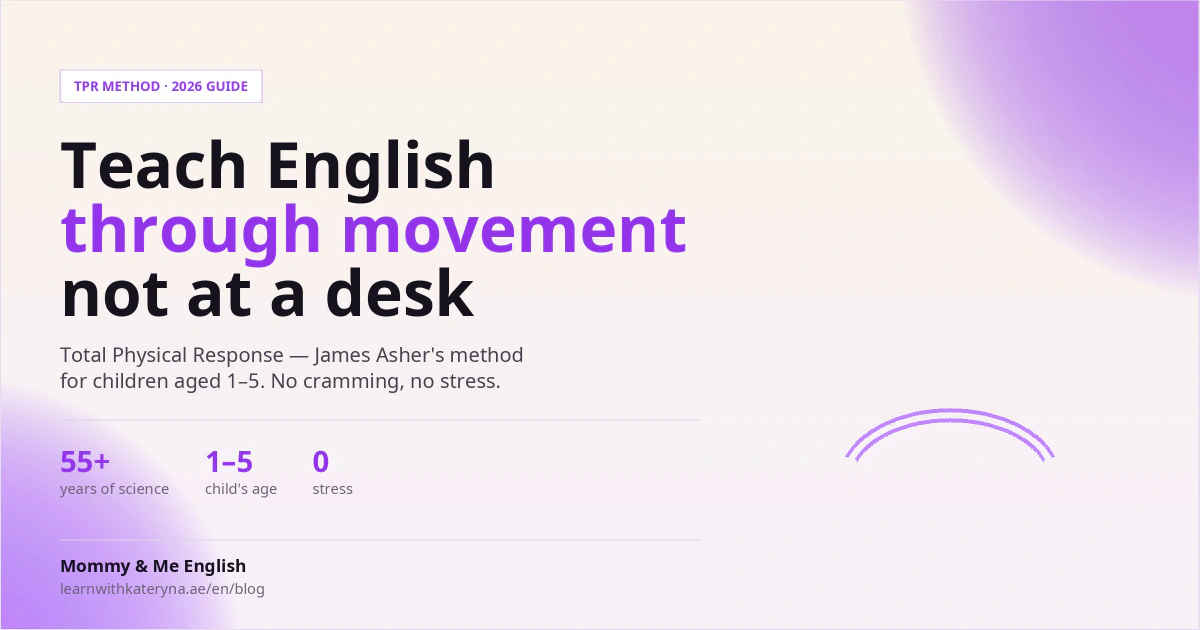
TPR (Total Physical Response) is a language-learning method where a child hears a command in English and reacts to it physically — with no translation and no pressure to speak. Developed by psychologist James Asher at San José State University in 1969, TPR builds language through the body: you say "touch the ball" and the child touches the ball. Between 12 and 60 months it's the most natural way to acquire English, because at this age a child's brain encodes words through movement, context and repetition rather than translation. Classroom research consistently finds that a word a child has acted out is retained better than one they only heard or only saw on a card — which is the entire case for doing this at home. This is a full practical guide for parents — the three-phase protocol, five ready-made daily scripts, and why your role is not teacher but movement partner.
What's in this article
- What the TPR method is and why it works
- Who James Asher is and what his science showed
- Why TPR is ideal precisely for ages 1–5
- The 3 phases of the TPR protocol: Listen → Respond → Speak
- 5 ready-made daily TPR scripts
- 5 myths about TPR that parents believe
- TPR vs cartoons vs apps vs flashcards
- 7 common parent mistakes in the first weeks
- TPR by age: 1, 2, 3, 4, 5 years
- Adapting TPR for shy children
- How to start TPR this week
- Frequently asked questions
What the TPR method is and why it works
Total Physical Response (TPR) is a language-teaching system where a child first understands through a physical reaction, and only later begins to speak. Instead of memorising words from a list, the child hears "stand up" and stands; hears "touch your nose" and touches their nose. The language unit is tied in the brain to a motor pattern that stays in long-term memory.
How it works in a child's brain at 1–5
The mechanism is not mysterious, and it does not need brain scans to explain. A word learned through a command arrives with more than one thing attached to it: the sound, the movement the child just made, and the situation it happened in. A word read off a card arrives with one — the picture. The more routes into a memory, the more routes back out of it, which is why a child who has done "jump" ten times retrieves it far more easily than one who has seen a picture of a jumping rabbit ten times. That is the whole of the claim, and it is enough.
Why "stress = you'll never learn it"
Language teaching has a name for what this avoids: the affective filter (a term from Dulay and Burt, and made widely known by Stephen Krashen) — the psychological barrier that blocks language when a child fears making a mistake. In TPR there's no right answer, only an action. A child can't "get it wrong" physically with the command "touch the table". This zero-risk mode keeps the affective filter lowered, and the new language gets in.
Who James Asher is and what his science showed
Dr James J. Asher was an American psychologist, professor emeritus at San José State University, who developed TPR after watching how his own children acquired a second language through movement. His methodology rests on three principles:
- Comprehension precedes production — the child must first understand, then speak. The natural order.
- The body is the main channel of acquisition — physical action creates a memory trace that neither flashcards nor dictionaries provide.
- Stress blocks language — the affective filter must be lowered, or the new language won't enter.
His key monograph, "Learning Another Language Through Actions" (1977, reissued 2012), is still standard reading for teachers of English to young children. TPR is taught as a recognised method in teacher-training courses and is described as such by the British Council — which is a fair description of its standing, and not a claim that it outperforms everything else.
Why TPR is ideal precisely for ages 1–5
The window from 12 to 60 months is the "language explosion" — open for the natural acquisition of any language without conscious effort. Patricia Kuhl's work at the University of Washington shows that before age 3 the brain forms the phonetic maps of any language with no need for translation or rules. TPR taps exactly this mechanism.
What makes TPR special at 1–5
- The activity matches the nature of the age — children of 1–5 physically cannot sit for 30 minutes. They move. TPR uses that instead of fighting it.
- Context instead of abstraction — the word "apple" with a real apple in hand stays; the word "apple" from a flashcard is forgotten within a week.
- Effortless continuous repetition — the same command "wash your hands" every day turns the word into automatic comprehension without cramming.
- Emotional safety — TPR happens with mum, not a teacher. That creates an "English = safety" association that lasts for life.
What the research actually supports
Here is an honest account of the evidence, because it is more useful than a number. Classroom studies of TPR consistently find better vocabulary retention than lecture-and-translate teaching, and a research synthesis of the method reports a strong overall effect on achievement. What those studies do not give you is a clean percentage you can carry home: they measure different children, over different periods, with different tests, and they were nearly all run in classrooms rather than kitchens.
So take the direction, not a figure. The finding that survives across the studies is that a word acted out is remembered better than a word only heard or only seen, and that comprehension can be built long before a child is asked to speak. That is the reason to use TPR at home. Anyone quoting you a precise retention percentage for a two-year-old in a kitchen is quoting something that was never measured.
The 3 phases of the TPR protocol: Listen → Respond → Speak
TPR unfolds in three sequential phases that mirror the natural order of language development. Don't skip, don't force a faster jump. Each phase prepares the next.
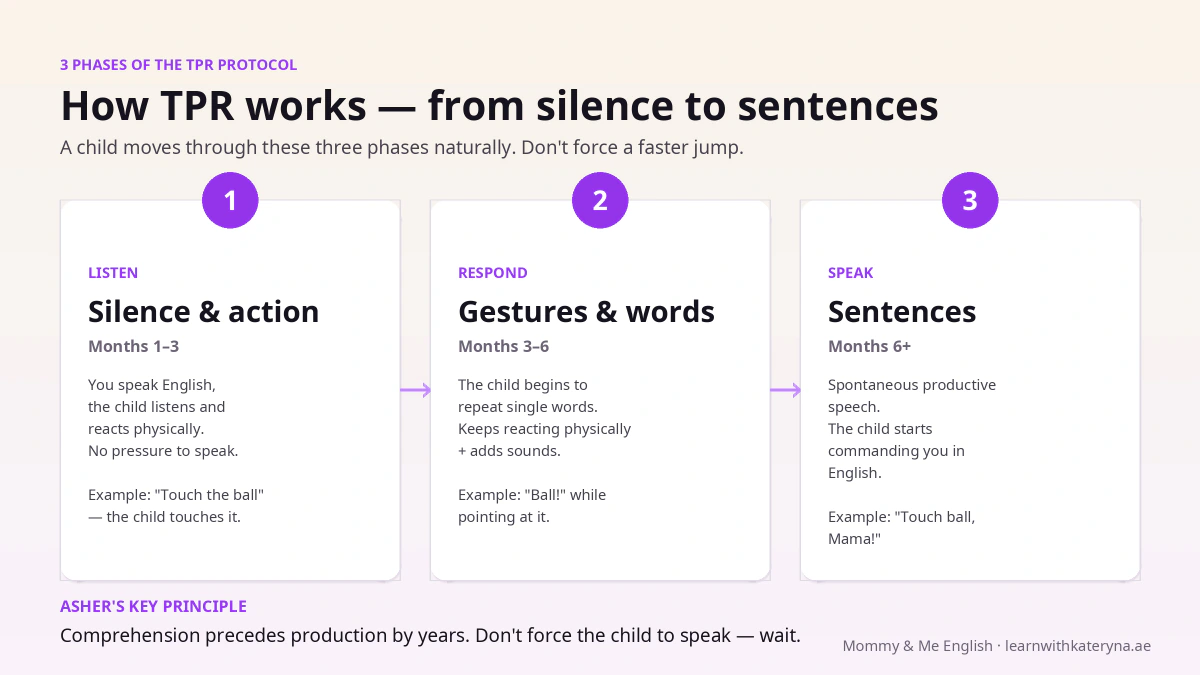
Phase 1: LISTEN (months 1–3)
The child is silent. You speak English and perform the actions together. Hearing, not speaking. The classic command: "Touch the ball" — you take their hand and touch the ball. After 2–3 repetitions they'll start touching it themselves. This isn't passivity — it's the foundation of comprehension.
Phase 2: RESPOND (months 3–6)
The child begins reacting to commands independently, without your motor prompt. Occasionally the first single words appear — "ball", "yes", "no". Don't expect sentences. Praise every reaction with a smile and a nod, not with words in your native language.
Phase 3: SPEAK (months 6+)
The child begins producing English on their own. First single words, then phrases. Sometimes they start commanding you: "Touch ball, Mama!". This is the moment the language becomes active. The timeframe varies widely — from 4 to 12 months depending on how frequent and regular the protocol is.
5 ready-made daily TPR scripts
The simplest way to introduce TPR is to slot 5-minute fragments into moments of the day you already have. You don't need to add a "lesson". You need to rename an existing moment into an English script.
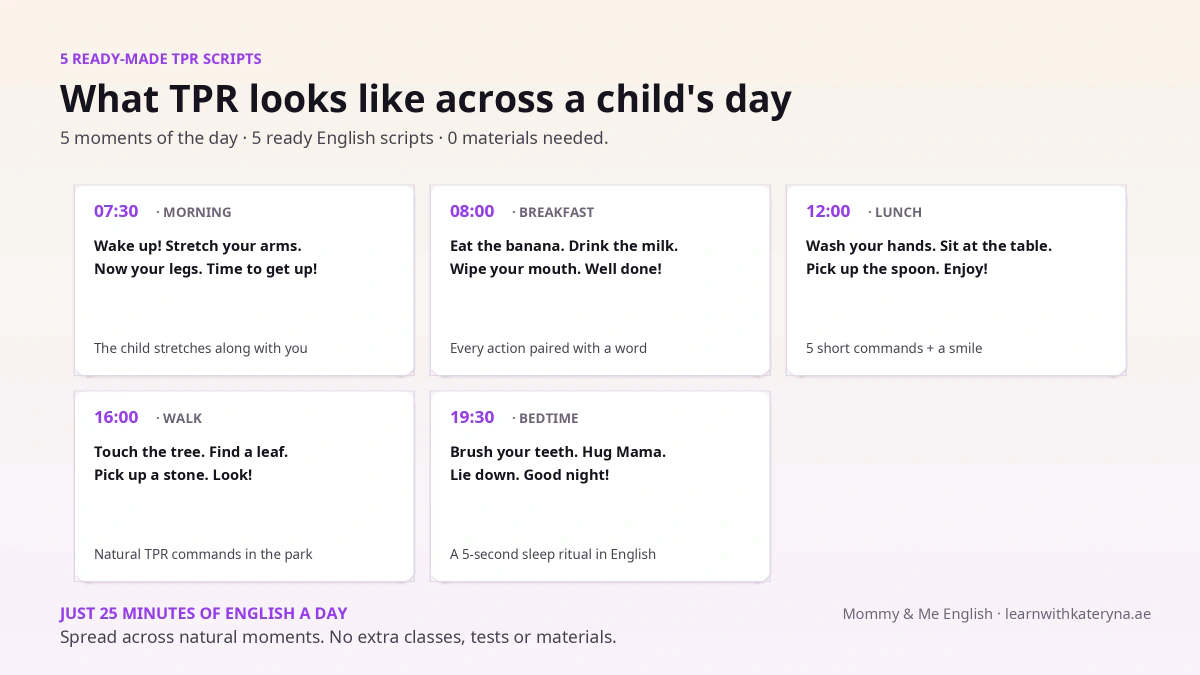
Script 1: Morning (07:30)
"Wake up! Stretch your arms. Now your legs. Time to get up!"
The child stretches with you. 10 repetitions in a row over a week, and the command "stretch your arms" becomes an automatic reaction.
Script 2: Breakfast (08:00)
"Eat the banana. Drink the milk. Wipe your mouth. Well done!"
Every action is paired with a word. This isn't "the theory of breakfast in English" — it's breakfast itself, just with an English soundtrack.
Script 3: Lunch (12:00)
"Wash your hands. Sit at the table. Pick up the spoon. Enjoy!"
5 short commands + a smile. No translation. If the child doesn't understand — show them.
Script 4: The walk (16:00)
"Touch the tree. Find a leaf. Pick up a stone. Look!"
Nature is the best TPR lab. Every park offers 50 opportunities for commands.
Script 5: Bedtime (19:30)
"Brush your teeth. Hug Mama. Lie down. Good night!"
A 5-second ritual before sleep. Within a month the child will understand and carry out the sequence with no translation.
We covered daily English rituals in a separate article — with 7 ready rituals, full scripts and timings.
Building an English routine at home? The free Mommy & Me English starter guide lays out the daily rituals step by step.
5 myths about TPR that parents believe
Myth 1: "TPR is for nursery, not for home"
The opposite. Asher designed TPR precisely for natural home settings — kitchen, bathroom, play corner. Home has a real structural advantage over a class: in a group, a child waits their turn and responds to a fraction of the commands; at home, every single command is theirs. That is the argument for the kitchen — not that it is faster, but that nothing is spent waiting.
Myth 2: "The parent must know English"
Not true. The scripts are short (5 words), ready-made, with audio. Your role is the consistency of the ritual, not knowledge of grammar. The child hears correct pronunciation from the audio; you create the safe emotional frame.
Myth 3: "It's slow. The child won't speak for half a year"
Slow — only if you measure production. Comprehension is built every day, silently. When after 6 months the child suddenly starts speaking English, it's not an "explosion" — it's the result of 180 days of accumulated understanding.
Myth 4: "You need special toys and books"
No. TPR is words + ready objects in your home. A table, a ball, a cup, a banana, a hand, a leg. No special "TPR kits" exist, and none are needed.
Myth 5: "Better to start with full immersion straight away"
Immersion without structure is stress. TPR is structured immersion: 10 minutes a day, at specific moments. The child knows when it's "English time" and doesn't get confused.
TPR vs cartoons vs apps vs flashcards
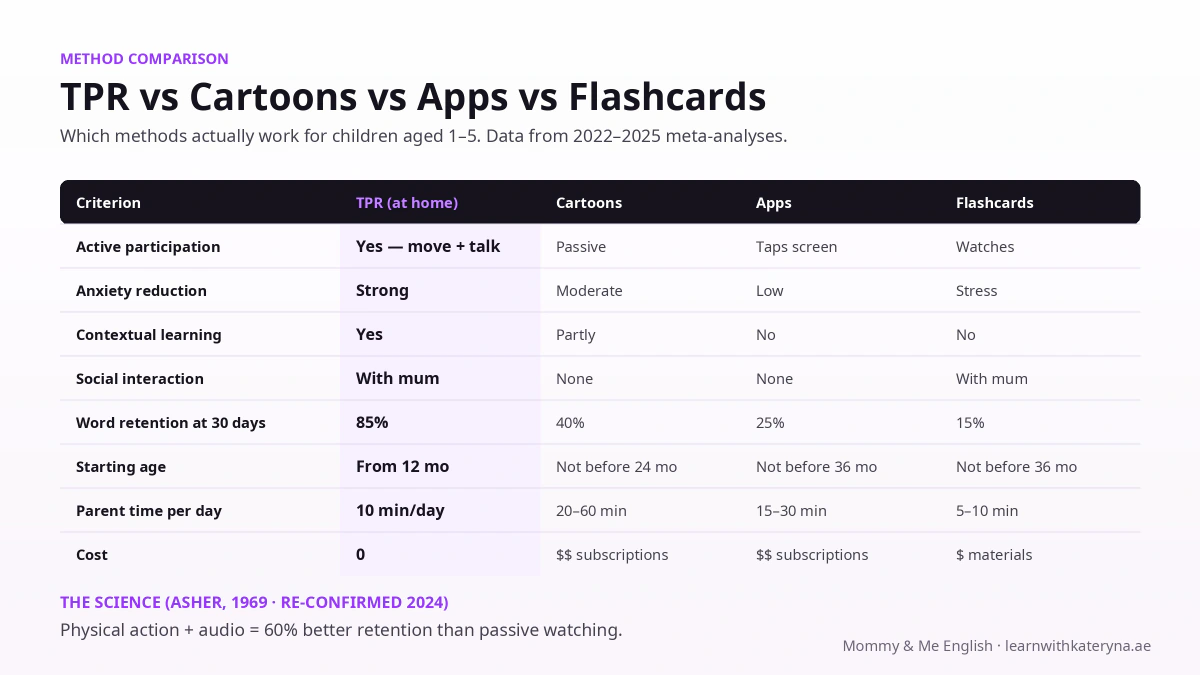
Parents often ask: "Isn't it easier to put on Cocomelon and get on with my chores?" Easier — yes. More effective — no. Here's why:
- Cartoons — exposure without participation. The child hears the words but does nothing with them, and a word that is never used is the first to go. Useful as a supplement, not a foundation.
- Apps — tapping a screen, no live human voice. This is where the strongest evidence in the whole field sits: in Kuhl's 2003 study, nine-month-olds learned Mandarin sounds from a live tutor but showed no learning at all from the identical material on video or audio. A screen was not a weaker teacher than a person. It was not a teacher.
- Flashcards — the word is torn out of context. The child memorises "apple = яблуко" as a translation, not as a living word. In a real situation, when they need to say "I want an apple", the language doesn't activate.
- TPR — active participation + context + repetition + live language. All four factors science confirms for long-term memory.
7 common parent mistakes in the first weeks of TPR
- Translating the commands ("touch the ball — торкнись м'яча, see?"). Translation destroys the word-action link. English + gesture only.
- Asking "did you understand?" in your native language. It pulls the brain back and breaks the flow.
- Expecting production straight away. The first 3 months are the Listen phase. The child is silent. That's normal, not a problem.
- Praising in your native language ("молодець!"). Instead — "well done!" or simply a smile + nod.
- Doing TPR longer than 10 minutes at a stretch. Overload kills attention. Better 5 × 5 minutes spread across the day.
- Changing the scripts every day. Repetition is the key. The same "wash your hands" for 30 days straight = automatic comprehension.
- Stopping TPR when the child resists. Resistance on days 5–10 is normal (a new ritual). Hold for 2–3 minutes, don't push, continue tomorrow.
"The most common mistake parents make in my practice is asking the child a question in English and expecting an answer. In the Listen phase the child shouldn't speak. Your job is to create the input, not to demand output. Output comes on its own, in 3–6 months." — Kateryna Ivanova, Trinity College London CertTESOL
TPR by age: 1, 2, 3, 4, 5 years
The TPR protocol adapts to a child's physical and cognitive abilities at each age. Commands and scenes that work for a 2-year-old are boring for a 4-year-old. Here's how to grade the difficulty:
Age 1 (12–24 months): Mirror & Touch
Simple 1–2-word commands tied to basic body parts and objects. The child mostly copies you. Passive reaction — don't expect words. Examples: "touch nose", "wave hi", "clap hands", "kiss bear". 3–4 commands a day, repeated daily without change.
Age 2 (24–36 months): Action & Item
The child begins carrying out 2–3-step instructions. The first reaction-words appear ("yes", "no", single nouns). Expand commands to actions with objects: "pick up the cup", "give me the spoon", "open the book". 8–12 commands a day, rotating 3–5 at a time.
Age 3 (36–48 months): Mini-stories
Active language production begins. The child can follow "first... then..." sequences and answer in single sentences. Introduce mini-stories: "Sit down. Pick up the bear. Hug the bear. Now put bear to sleep. Good night, bear!". 5–6 minute TPR scenes with a plot.
Age 4 (48–60 months): Role play
The child can play roles and command you. TPR becomes a two-way game: "Now you are the doctor. Say: open your mouth". Introduce professions, situations, simple dialogue. This is preparation for Reception/Pre-K assessment at school.
Age 5 (60+ months): Conversation TPR
TPR stays effective but is supplemented with short dialogues. The child can answer "where is the ball?" or give instructions to others. Combine TPR with simple reading and grammar through song.
How to adapt TPR for shy or introverted children
Not every child happily moves or repeats — introverted and shy children need a modified TPR approach. It doesn't mean the method doesn't work. It means the pace must be different.
5 modifications for a shy child
- Start with observation — for the first 1–2 weeks simply do TPR yourself in the child's presence. Don't demand participation. They watch and model.
- Bring in a favourite toy — give the commands to the toy, not the child. "Teddy, touch your nose!" A shy child repeats the toy's action more easily than their own.
- Introduce "quiet TPR" — commands whispered instead of in a loud voice. Some children respond better to soft, calm speech.
- Shorten sessions to 2 minutes — instead of 5 minutes of doubled commands. Less is more for shy children.
- Don't praise too emotionally — introverted children can shut down at a loud reaction to their attempt. A quiet "yes" + nod is more effective.
What NOT to do with a shy child
- Don't force them to answer in English in front of other adults.
- Don't compare them to other children ("Masha already speaks and you don't").
- Don't film the child without their readiness — it can lock in a negative association.
- Don't present TPR as a "lesson" — for an introvert that word is linked to the stress of school.
Shy children often go through the Listen phase longer — 4–6 months instead of 1–3. But production, when it starts, is often a leap: the child is silent for half a year, then within a week starts speaking in full sentences. Patience is the main quality of a TPR parent.
How to start TPR this week: a 5-day plan
- Day 1 (Monday) — Choose ONE moment of the day (say, washing hands before lunch). Prepare 5 words: "wash your hands, dry your hands, well done!". Don't start yet — listen to yourself in the mirror, check your pronunciation.
- Day 2 (Tuesday) — Do it for the first time. Say the words, do the actions with the child. Don't expect a reaction. Just do it.
- Day 3 (Wednesday) — Repeat exactly the same. The same 5 words, the same moment of the day. Add nothing.
- Day 4 (Thursday) — Repeat. At this point you'll notice the child starting to hold out their hands to wash at your word "wash".
- Day 5 (Friday) — Repeat. By Friday you'll have formed a ritual. Leave the weekend without TPR — that's fine.
After 14 days, add a second moment of the day (say, the morning routine). After a month — a third. By three months you'll have 5 moments × 5 minutes = 25 minutes of TPR English a day, fully woven into an ordinary day.
Next steps
TPR isn't magic, but it's the most scientifically grounded method for children aged 1–5. If you want the full system — 7 daily moments with ready scripts, audio for every phrase and step-by-step support — take a look at the Mommy & Me English course. All the ready materials plus daily guidance for a parent who doesn't speak English.
If you live in Dubai and want a certified teacher to run a TPR lesson in person with your child, there's a programme in Sobha Hartland for children aged 4–6 (preschool prep).
Other articles that go deeper:
- 7 daily English rituals at home — concrete TPR-moment examples.
- A child's first 100 English words by age.
- How to read English books to your child: the PEER method — a TPR-compatible approach to reading.
- Does bilingualism delay a child's speech: 7 myths and facts.


