
 Kateryna Ivanova
Last updated: May 17, 2026 · Author: Kateryna · Reading time: 13 min
TL;DR
- Don't "read" — converse with the book. A 1–3-year-old does not follow plot — she follows your finger and your voice.
- The PEER method (Prompt-Evaluate-Expand-Repeat) is a clinically validated approach that raises a child's vocabulary by 8 months of equivalent development in 30 days.
- Read the first book 20 times — not 20 books once. Repetition = retention.
- Do not translate every word. The child will get it from the picture, your gesture, your tone.
- Five minutes a day is enough. Seven rhythmic minutes beat thirty chaotic ones.
"I picked up the first English book, opened to 'The cat sat on the mat'. My toddler looked at me like I was crazy and walked away." A typical first attempt by a non-native parent. The problem isn't the child. The problem is that we transfer an adult reading model onto a child who can neither read nor understand English yet. This guide explains how to actually read English picture books to a 1–3-year-old — even if you aren't a native speaker yourself.
Contents
- Quick answer: how to read English books to a toddler
- What is dialogic reading?
- The PEER method — 4 steps that grow vocabulary by 8 months
- CROWD — 5 question types for children 18m+
- Which books to pick for first readings
- The "silent" technique for 12–18-month-olds
- 5 common mistakes parents make reading in English
- How often and how long to read
- 7 proven first English books
- FAQ
Quick answer: how to read English books to a toddler
Reading English picture books to a 1–3-year-old is not narration — it is an interactive game with pictures and short repeating phrases. Don't start with full sentences. Point to the dog and say "Look, a dog! Dog says woof-woof.". Wait two seconds. If the child repeats or points — react. If not — move to the next picture. A month of reading this way — rather than simply reading aloud — was enough, in Whitehurst's original trial, to produce a measurable jump in what children could say.
Rule #1: your job is not to "finish the book". Your job is to give the child five minutes of active contact with English — through pictures, your voice, and your finger. Finishing is for adults. Interactivity is for children.
What is dialogic reading?
Dialogic reading is a technique in which an adult and a child take turns being the "narrator" of the book. The adult asks questions, waits for an answer, expands on it, and repeats. It isn't a lecture — it's a conversation in which the book is just an excuse to talk.
The method was developed by psychologist Grover Whitehurst at Stony Brook University, and his 1988 study "Accelerating Language Development Through Picture Book Reading" is still the reference point. What it actually found is worth stating precisely, because it is impressive enough without embellishment:
- Parents were trained for a single month. Children in the trained group then scored significantly higher on expressive language than the control group;
- They spoke in longer utterances and relied less on single words;
- The advantage was still measurable nine months later.
Four weeks of a different way of reading, still visible most of a year afterwards. What the follow-up literature has not produced is a tidy number of IQ points or a percentage of reading comprehension you can carry home — treat anyone quoting you one with caution.
The effect is even stronger for bilingual children, because each reading session delivers a concentrated dose of the second language — something the daily routine rarely supplies. We cover the bilingual context separately in "Does bilingualism delay speech?".
The PEER method — 4 steps that grow vocabulary
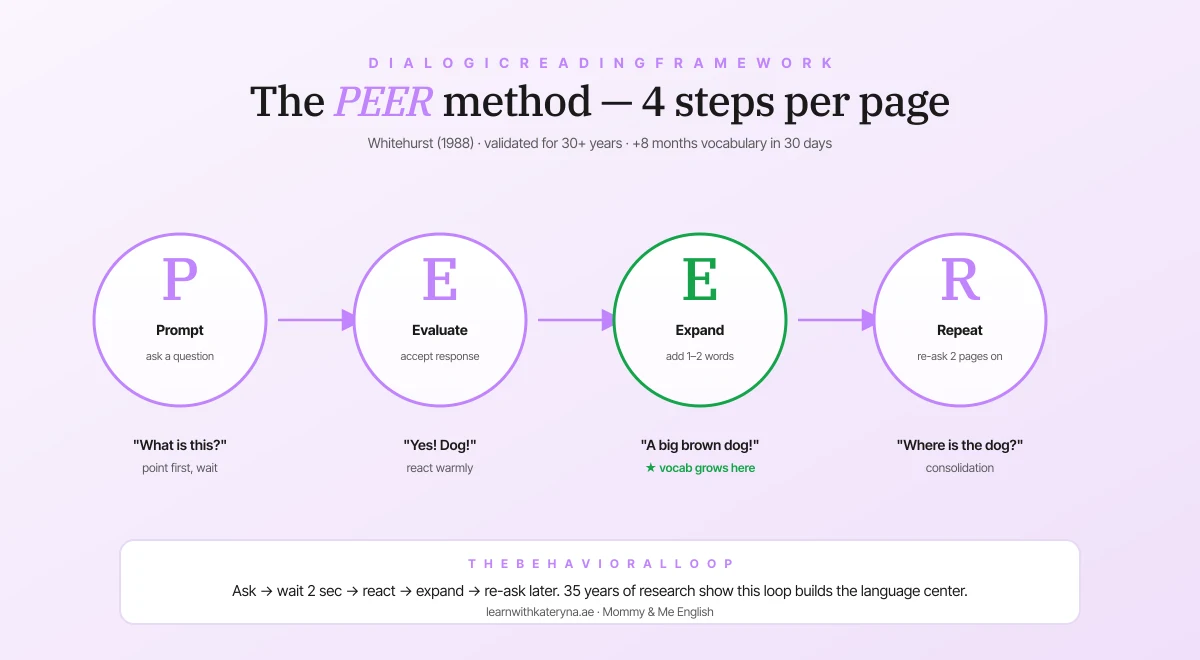
PEER is an acronym for four actions that turn passive read-aloud into active dialogue. The sequence repeats on EVERY important page.
P — Prompt
Point at something and ask: "What is this?" or "Where is the dog?". Start with a question, not the answer. This switches the child's brain from "listening" to "thinking" mode.
E — Evaluate
The child points or says "dog". React positively: "Yes! Dog!". Even if she says "woof-woof" instead of "dog" — that's still an answer. Accept everything. Silence is also an answer ("still thinking") — don't push.
E — Expand
Add 1–2 words to the child's response. She said "dog" — you reply: "Yes, a big dog! A big brown dog.". This is the moment vocabulary grows. Your expansion is new information delivered in a ready-to-absorb state.
R — Repeat
Two or three pages later, point at a dog again: "Where is the big brown dog?". This is consolidation. Without repetition the word will not stick.
PEER is not a text formula. It is a behavioral loop: ask → wait → expand → repeat. Thirty-five years of neuropsychology research show that this exact loop builds the child's language center.
CROWD — 5 question types for children 18m+
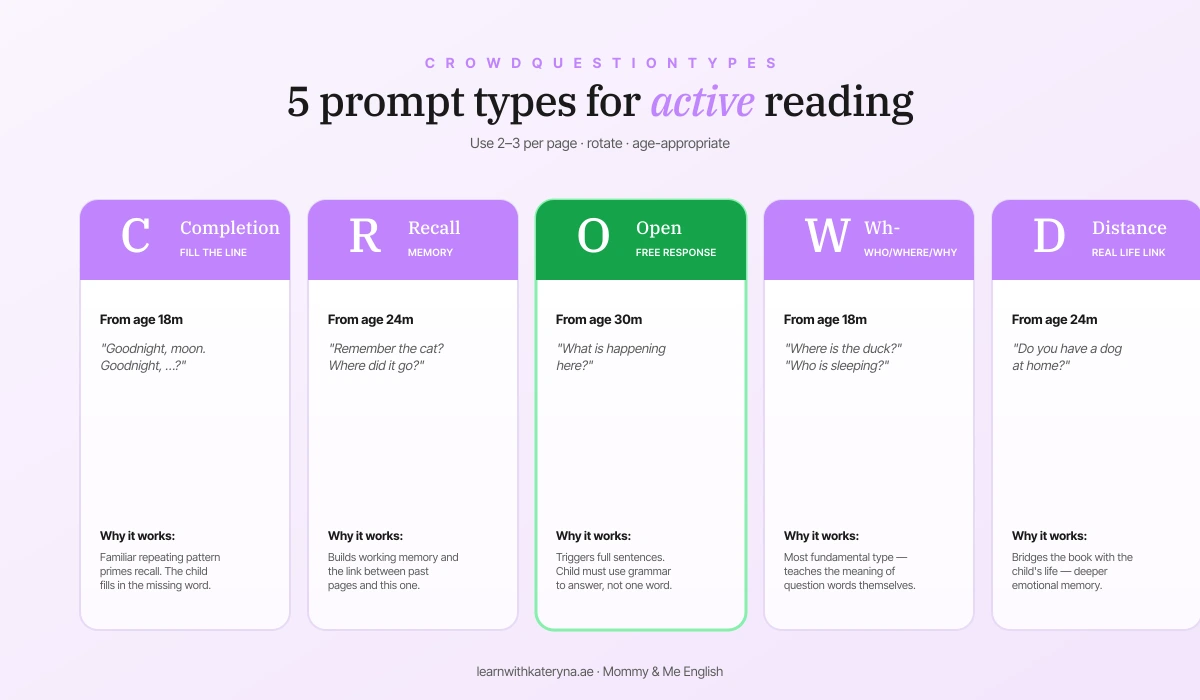
Once your child recognises simple nouns (dog, ball, cat), move to CROWD — five question types that push active language.
| Type | Example | Start age |
|---|---|---|
| C — Completion Finish the line | "Goodnight, moon. Goodnight, …?" Child fills in: stars. | 18 mo. |
| R — Recall Memory | "Remember the cat? Where did the cat go?" | 24 mo. |
| O — Open-ended Free response | "What is happening here?" | 30 mo. |
| W — Wh-questions What/Where/Who | "Where is the duck?", "Who is sleeping?" | 18 mo. |
| D — Distance Link to real life | "Do you have a dog at home?" | 24 mo. |
Don't use all five at once. Pick 2–3 types per page and rotate.
Which books to pick for first readings
Not every English book is equal. For a 1–3-year-old, look for five qualities:
- Big illustrations, little text — 1–4 words per page for 12–18 months; 5–10 words for 18–30.
- Repeating structures — "Brown bear, brown bear, what do you see?" (Eric Carle). Repetition = predictability = safety.
- One focus per page — one animal, one object, one action. Don't confuse the toddler with five details.
- Sensory grounding — things the child already sees in real life (food, animals, household).
- Board book (thick cardboard pages) — 1–2-year-olds shred thin pages. Cardboard survives.
Avoid:
- Books with long text paragraphs under each picture — those are for 5+.
- "Educational" books with exercises — at 1–3 years, learning has to be implicit.
- Books featuring characters the child doesn't know (Spider-Man, Princess Sofia). Familiar visuals win.
The "silent" technique for 12–18-month-olds
For the very young, even PEER is too early. Use the point-and-name technique:
- Sit next to the child. The book sits between you.
- Open the first page. Look at it together for 2 seconds.
- Point at the main object: "Dog!" — loud and clear.
- Wait 2 seconds. If the child looks at your finger, that's already a win.
- Turn the page. "Cat!".
- Don't try to read the FULL text. Just the main word on the page.
- After 5 minutes, close the book: "The end! Bye-bye, book!".
This is not a "lite" version — it's the right version for this age. After 6 weeks, the child will start pointing herself and waiting for your word. That is the beginning of language.
5 common mistakes parents make reading in English
1. Translating every word
"Cat — this is кіт. Cat says мяу." is the fastest way to kill interest. The child's brain receives the signal: English = code I have to decode through Ukrainian. She stops searching for meaning in pictures and tone. Don't translate. If the child does not understand a word, use a gesture or point at the picture.
2. Trying to "finish the book"
A book is read not when you have voiced the entire text, but when your child has spent five minutes in contact with the language. If she wants to skip to the middle — skip. If she wants to reread the same page three times — reread.
3. Expecting "good" behaviour
An 18-month-old will not sit still for 10 minutes. She will stand up, run, come back. That's normal. Readiness is not silence — it is curiosity.
4. Switching books every day
"We have 20 books — I want my child to hear them all." That is an adult mindset. The toddler brain works differently: repetition = retention. One book read 7 days in a row beats 7 different books in a week. Horst, Parsons & Bryan (2011) showed: children who heard one book repeatedly learned new words 3× better.
5. Demanding "correct" pronunciation
"Say 'dog'! Not 'woof-woof', say 'dog'!" creates stress. Any form of engagement is success. Clear pronunciation comes on its own after several weeks of repetition.
Building an English routine at home? The free Mommy & Me English starter guide lays out the daily rituals step by step.
How often and how long to read
Optimal: 5–7 minutes a day, ideally at the same time (before sleep is best — the brain consolidates new information during sleep).
Less than that: 3 minutes a day still beats 30 minutes once a week. Consistency beats volume.
More than that: if the child asks for more, keep going. Don't exceed 15 minutes — attention drops after.
Best time: before bed — the ritual cues the brain that sleep is coming. Second best: after lunch, before nap.
This fits into the wider language-day architecture covered in "7 daily English rituals".
7 proven first English books for ages 1–3
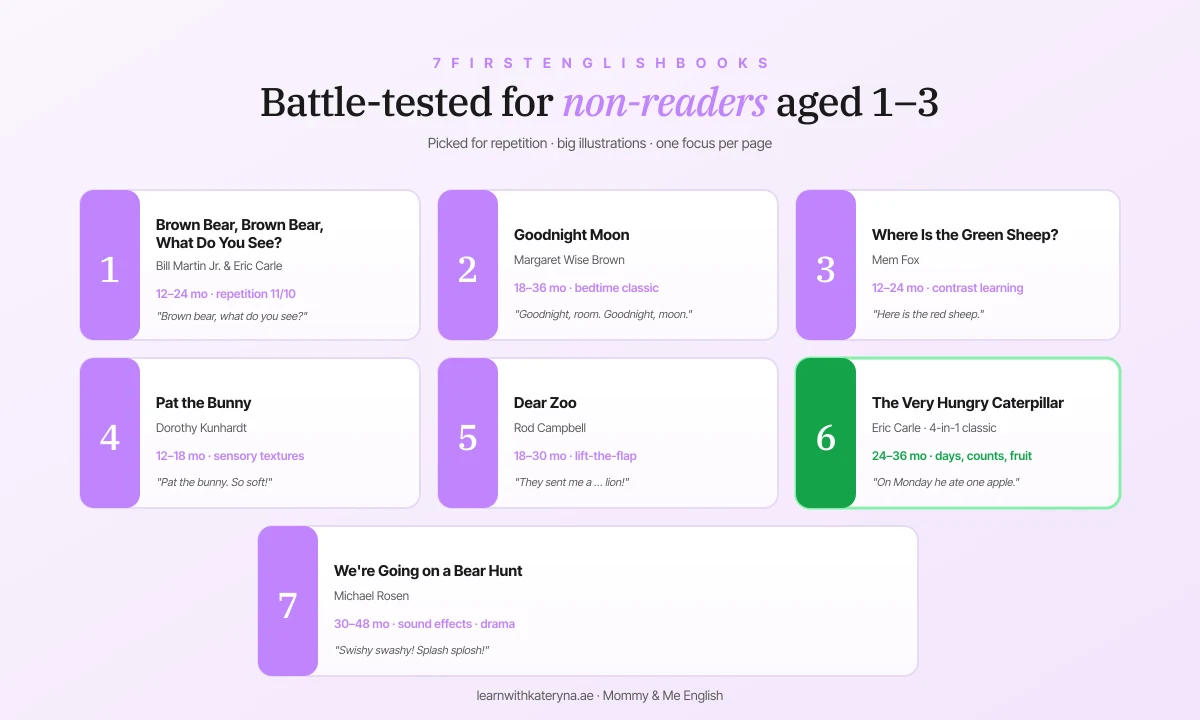
- "Brown Bear, Brown Bear, What Do You See?" — Bill Martin Jr. & Eric Carle. 11/10 on repetition. A 12–24m classic.
- "Goodnight Moon" — Margaret Wise Brown. The bedtime classic. 18–36m.
- "Where Is the Green Sheep?" — Mem Fox. Simple nouns + contrast. 12–24m.
- "Pat the Bunny" — Dorothy Kunhardt. Sensory book with textures. 12–18m.
- "Dear Zoo" — Rod Campbell. Lift-the-flap. 18–30m.
- "The Very Hungry Caterpillar" — Eric Carle. Days of the week, counting, fruit. 24–36m.
- "We're Going on a Bear Hunt" — Michael Rosen. Sound effects. 30–48m.
All 7 are available in major online bookstores or as free PDFs/audio on YouTube. If buying isn't an option, print picture cards and use them as a "home book".
Expert insight: why one book beats a shelf
In 9 years of teaching I have seen hundreds of home libraries. The paradox: families with 50 English books often have weaker results than families with 5 favorites. The reason is simple — 50 books = shallow contact with each one. 5 books = deep absorption of every phrase, every word, every illustration. The Mommy & Me English principle is minimum books, maximum contact. That is what separates the method from "buy more and hope".
Real scripts: "Brown Bear, Brown Bear" from session one to ten
To show how the same book evolves over a week, here are the full scripts of the first four sessions with the most-loved first English book.
Session 1 (Night 1) — point-and-name only
[Page 1, bear] "Brown bear!" [pause 2 sec] [Page 2, red bird] "Red bird!" [Page 3, yellow duck] "Yellow duck!" [Child watches mom's finger.] [Continue through 8 pages, one word each]. "The end!" [Close the book].
Duration: 3 minutes. The child says nothing. That is fine. Session one is introduction.
Session 3 (Night 3) — add a Prompt
[Page 1] "Look! What is this?" [Wait 3 sec. Child is silent.] "It's a brown bear!" [Page 2] "And this? What is this?" [Child points at the bird. No word yet.] "Yes! A red bird!" [Continue].
Duration: 4 minutes. The child started pointing — that is active participation, even without words.
Session 5 (Night 5) — full PEER
[Page 1] "What is this?" [Child says "bear"!] "Yes! A bear! A brown bear!" [Expand] [Page 2] "And this?" [Child says "bird".] "A red bird! A red flying bird!" [Page 5] "Remember the bear? Where was the bear?" [Child flips back. Repeat is working.]
Duration: 6 minutes. By night 5, the child voices key nouns. Your "expand" adds the adjective.
Session 10 (Night 10) — the child reads to you
[Page 1, you haven't even started.] [Child: "Bear!"] [Flips to page 2.] [Child: "Bird!"] [Page 3.] [Child: "Duck! Yellow duck!"] [Page 4.] [You: "What is this?" Child: "Horse!"] [You: "Yes! A blue horse! Blue, blue, blue horse!"]
Duration: 5 minutes. It is now her book. She leads, you support. Seven new English words in ten days, from one book the child chose herself.
How to read in English when your own English is shaky
"My English is B1, but I'm not sure about grammar and pronunciation." This block is for you.
Step 1: prep the book before the session (2 minutes)
Walk through the book once, without the child. Don't "study" — just:
- Read the text out loud. Record yourself on the phone.
- Listen back — hear how you sound.
- If there is a word whose pronunciation you doubt — search "pronunciation of [word]".
- Forvo.com has native recordings for any word. Listen 2–3 times.
- Record yourself again. Compare.
Step 2: focus on 5 key words per page
Don't pressure yourself to "read the whole book beautifully". Pick the 5 key nouns and verbs — make sure YOU say those correctly. Voice the rest as best you can. The child cares about the key words, not the connectors.
Step 3: BBC iPlayer Kids and CBeebies as a secondary source
20 minutes a week of CBeebies (Hey Duggee, Bluey, Sarah & Duck) gives the child native-speaker pronunciation. Your 30+ minutes of reading a week + 20 minutes of video = a complete ecosystem. Audible Kids audiobooks are an extra layer.
Step 4: do not suffer over being "imperfect"
University of Reading (2019): a 2-year-old who hears a non-native parent live and native speakers through video content has, one year later, the same pronunciation as a child of two native parents. Your accent will not "lock in" as an error. Don't panic.
A 30-day plan for the first reading ritual
- Week 1: one book. Read 5 minutes at bedtime for 7 days in a row. No PEER — just point-and-name.
- Week 2: same book. Add PEER: one Prompt per page ("What is this?").
- Week 3: same book. Add Expand: your reply is 2 words longer than the child's answer.
- Week 4: same book + a second book every other day. By end of month, your child has 15+ words from both books in active vocabulary.
Stick to the plan, and by day 30 the child will bring the book to you herself, point at the dog and wait for your words. That's the moment language becomes part of her world.
If the book "isn't working": 6 diagnostic questions
Sometimes you do everything "right" but the child isn't engaged. Before giving up or "changing the approach", check these six points. It is nearly always one of them.
- Time of day. A hungry, tired, or over-stimulated child won't absorb language. Best windows: 30 minutes after nap, or 15 minutes before nighttime sleep.
- Position. On mom's lap, not at a table. Body contact triggers oxytocin — the memory-consolidation hormone.
- Distractions removed. TV off. Phone in another room. Siblings occupied elsewhere. These 5 minutes are yours.
- Book difficulty. Maybe you picked a 30-month-level book and the child is 15 months. Drop complexity — 3 words per page instead of 10.
- Tone. A flat voice kills interest. Let yourself play: different voices for characters, pauses, whispers, dramatic loudness.
- Expectations. If you are waiting for "proper behaviour", the child senses it. Relax. Three minutes of shared time is also a session.
What to do next
- Read about the first 100 English words by age — so you know which words from the books "stick".
- See the 7 daily English rituals — reading is one of seven.
- Listen to 25 English songs by age — songs + books = double effect.
- If your child is 1–5 and you can commit 10 minutes a day, join the Mommy & Me English course. Ready scripts, plans, video lessons.
Last updated: May 17, 2026 · Author: Kateryna — certified English teacher (Trinity College London, NILE Norwich), 9+ years working with children aged 1–12. Background in speech pathology and primary education. 50+ families in Ukraine, EU, and the UAE.


