
 Kateryna Ivanova
"My own English is weak — how can I possibly speak it with my child?" This is the question I hear most often from mums, after nine years of teaching. My answer is always the same: you do not need fluent English. You need 50–100 ready-made everyday phrases that repeat daily in the same situations — at breakfast, while getting dressed, in the bath, on a walk. A child aged 1–5 learns language not from words but from phrases tied to actions. This guide contains every phrase you will realistically need, plus the "5 carrier constructions" method that turns those phrases into hundreds of new ones.
Why phrases beat single words
Most parents start with flashcards: apple, dog, ball. The child learns twenty nouns — and cannot produce a single sentence. The problem is not the child but the approach: a toddler's brain absorbs language in whole chunks, not in separate bricks. When a two-year-old hears "Time for lunch!" every day before the meal, she memorises the entire phrase as one "word" — together with its intonation, situation and action. This is exactly how children learn their first language too: "want-milk" and "no-go" appear long before any awareness that these are separate words.
Research on early bilingualism is consistent: what determines acquisition is not the parents' vocabulary size but the number of live repetitions in context. The phrase "Put on your shoes," said 200 times a year by the front door, outperforms any lesson. It always sounds at the same moment, accompanies the same action, and has an immediate, visible result. That is the whole secret: don't teach the language — live in it for 10 minutes a day. I described this approach in detail in my article on daily English rituals at home.
And one more argument for mums embarrassed about their level: everyday phrases are a closed system. Morning, meals, clothes, bath, play, sleep. Six situations, each with 10–15 phrases that don't change for months. This is not "learning English" — it is learning one spread of a phrasebook. Entirely doable in a month, even if your school English was a C.
5 carrier constructions: the base that generates hundreds of phrases
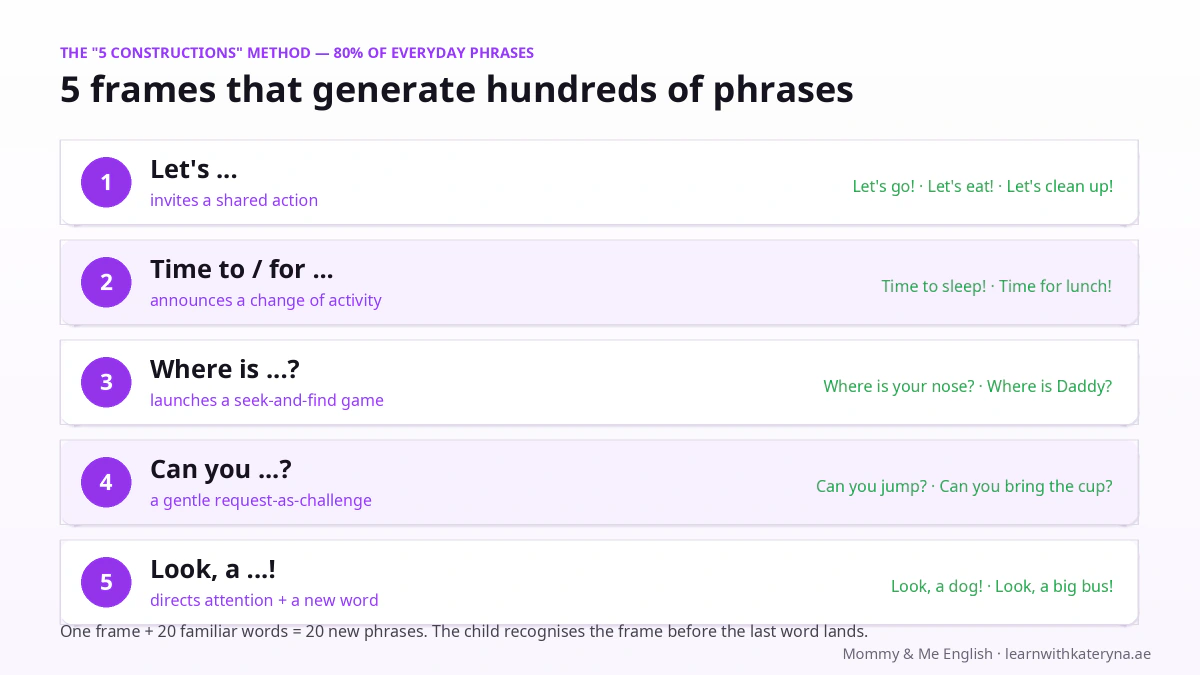
Before the lists, here is the master trick. 80% of all everyday phrases with a child are built on five constructions. Learn these five "frames" and you can assemble new phrases yourself, slotting in words your child already knows (for example, from the first 50 English words):
| Construction | What it does | Examples |
|---|---|---|
| Let's… | invites a shared action | Let's go! · Let's eat! · Let's play! · Let's clean up! |
| Time to… / Time for… | announces a change of activity | Time to sleep! · Time for lunch! · Time to go home! |
| Where is…? | launches a seek-and-find game | Where is your nose? · Where is the ball? · Where is Daddy? |
| Can you…? | a gentle request-as-challenge | Can you jump? · Can you bring the cup? · Can you show me? |
| Look, a…! | directs attention, delivers a new word | Look, a dog! · Look, a big bus! · Look, it's raining! |
Why this matters: when a child hears "Let's," she already knows a shared action is coming — before she has decoded the last word. The construction creates a predictable frame into which a new word clicks easily. One frame + 20 familiar words = 20 phrases with zero extra effort on your side. It is the same mechanic that powers the TPR method: language + movement + repetition.
Morning: waking up and getting dressed
Morning is the best place to start because the sequence is identical every day: wake up → wash → dress → breakfast. Every step is a ready-made scene for a phrase. The core set:
- Good morning, sunshine!
- Did you sleep well?
- Time to wake up!
- Let's wash your face.
- Brush your teeth.
- Put on your T-shirt.
- Where is your sock? (turns getting dressed into a game)
- Arms up! (when pulling clothes over the head)
- All done!
- You look great!
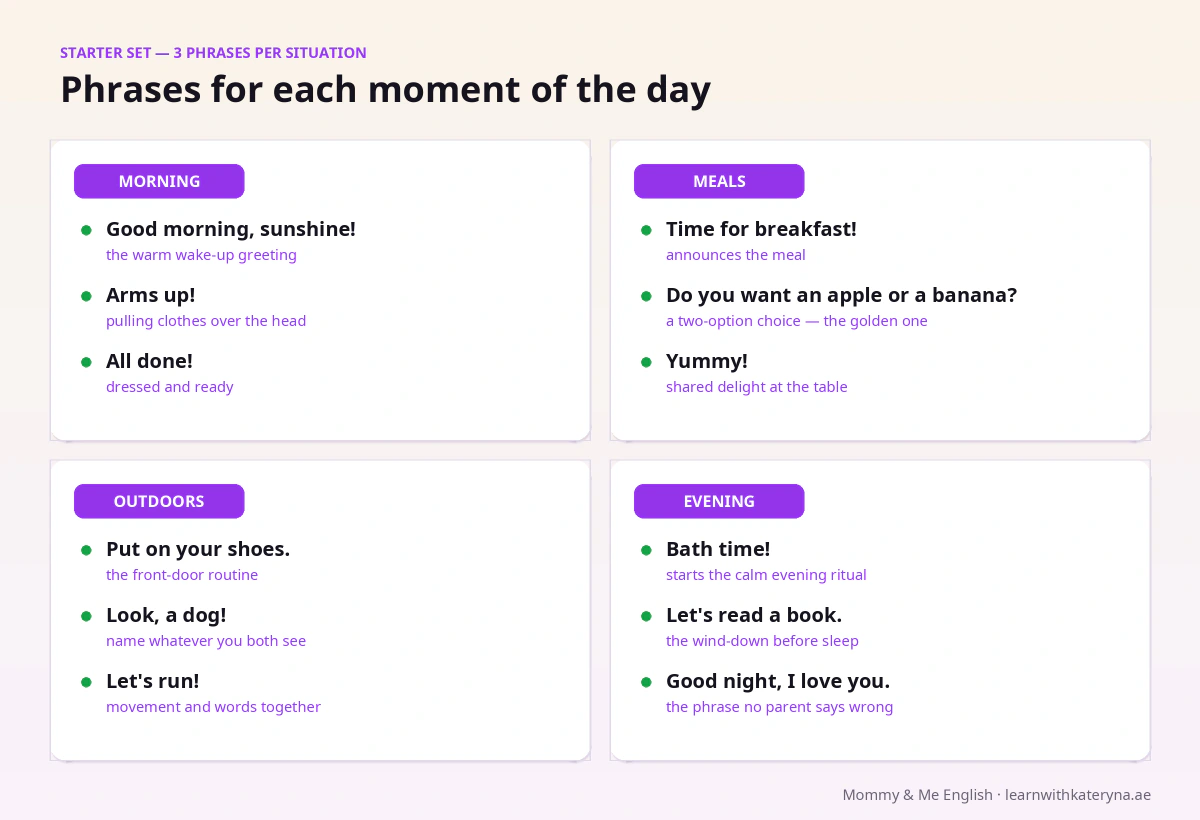
A tip from practice: don't try to say all ten phrases on the very first morning. Pick three — say, "Good morning," "Arms up" and "All done" — and use only those until they become automatic for both of you. Then add the next ones. A child needs to hear a phrase 40–60 times in context before responding to it without translation.
Meals: breakfast, lunch, dinner
Meals give you three English sessions a day without a single extra minute in the schedule. This is also where the child's first reaction appears fastest — the motivation to get something tasty beats any methodology:
- Time for breakfast!
- Sit down, please.
- Are you hungry?
- Do you want an apple or a banana? (a two-option choice — the golden phrase: the child answers even if only by pointing)
- Yummy!
- It's hot. Blow on it.
- More?
- Drink your water.
- Wipe your hands.
- Thank you for eating so well!
The champion here is "Do you want X or Y?". It does three things at once: presents two words in contrast, invites a response (even a silent one), and hands control to the toddler — the best fuel for engagement there is. Start with food, then transfer it to toys, books and clothes.
Walks and getting around
The street is a living picture book: everything the child sees can be named. The key construction outdoors is "Look, a…!":
- Let's go for a walk!
- Put on your shoes.
- Hold my hand.
- Look, a dog!
- A big bus!
- Can you hear the birds?
- Let's run!
- Be careful!
- It's cold today.
- Time to go home.
On walks, the "one day — one theme" rule works beautifully: today you name only vehicles (car, bus, bike), tomorrow only animals (dog, cat, bird). The child hears the same words many times in a row instead of thirty different words once each — and it is repetition, not variety, that builds vocabulary at this age.
Bath time and the evening ritual
Evening is the time for calm, cuddly phrases. They sink in deepest because they sound at the moment of maximum closeness and relaxation:
- Bath time!
- The water is warm.
- Wash your tummy.
- Splash-splash!
- Dry your hair.
- Put on your pyjamas.
- Let's read a book.
- Good night, sweetheart.
- Sweet dreams.
- I love you.
"I love you" at bedtime is the phrase I recommend to every parent who feels shy about speaking English with their child. It is impossible to say it "wrong," it requires no reply, and from day one it builds the core association: English = warmth and mum close by. Every other phrase comes easier after this one.
Building an English routine at home? The free Mommy & Me English starter guide lays out the daily rituals step by step.
Play: phrases that lead the game
Play is the one situation where phrases don't just accompany the action — they drive it. This is where the first action verbs and the child's first replies appear:
- What's this? (the single most important question in all of toddler English)
- It's a car!
- Give me the ball, please.
- Here you are.
- Jump! Run! Stop!
- Again?
- Your turn.
- Let's clean up.
- Where does it go?
- That was fun!
The pair "Give me… / Here you are" is your child's first English dialogue. At first you play both parts yourself (hold out your hand — "Give me the ball, please"; the child hands it over — "Here you are! Thank you!"). A few weeks later the toddler starts saying "Here you are" unprompted while passing a toy. That is a moment mums remember forever. Add songs to the mix and the process speeds up dramatically — I explained exactly how in my article on English songs for kids.
Praise and gentle boundaries
A separate block, because these phrases sound more often than all the others combined — and they set the emotional tone of English in your family:
| Praise | Gentle boundaries |
|---|---|
| Well done! | No-no. |
| Good job! | Be gentle. |
| You did it! | Not now, later. |
| I'm so proud of you! | It's dangerous. |
| High five! | Stop, please. |
| Almost! Try again. | Wait a minute. |
One important nuance: praise effort, not "correctness." "You did it!" after the child brings the cup on "Bring me the cup" — yes. Correcting a three-year-old's pronunciation — no. A child who gets corrected goes quiet; a child who gets applause tries again. At this age the only success metric is that the toddler wants to keep playing in English.
If your English is weak: speaking without fear
Now for the fear that stops most parents: "my pronunciation is wrong — I'll teach my child mistakes." Let's take it apart honestly:
First, your pronunciation is not the only source. If your child hears native-speaker songs and cartoons daily (and these should absolutely be in the diet), your accent becomes just one voice among several. Children are remarkably good at "averaging" pronunciation across sources — studies of bilingual families show that a child's final accent is shaped by the highest-quality regular source, not the most frequent one.
Second, for Ukrainian-speaking parents there are only six sounds worth watching, because they don't exist in Ukrainian: the dental /θ/ and /ð/ (three, this — tongue between the teeth, not "s/z"), /w/ (water — rounded lips, not "v"), /æ/ (cat — a wide open "a"), /ŋ/ (morning — a nasal "n" with no hard "g" at the end) and the short /ɪ/ (sit — shorter than "ee"). You don't need to "train" them formally — just knowing they exist, and checking a word in Google Translate's speaker button before using it, is enough.
Third — and most important — a mum's imperfect English works better than a tablet's perfect English. Before age three, a toddler's brain learns almost nothing from a screen: it needs live eyes, live emotion and a live response to its own actions. A mum with schoolbook pronunciation and warm hugs gives her child many times more than flawless YouTube audio. That is not a motivational slogan — it is the consistent finding of neuroscience research on early bilingualism.
The 4-week plan: one situation per week
The biggest mistake is trying to introduce all 100 phrases at once. Three days in, you are exhausted from translating in your head, and everything stalls. The pace that works:
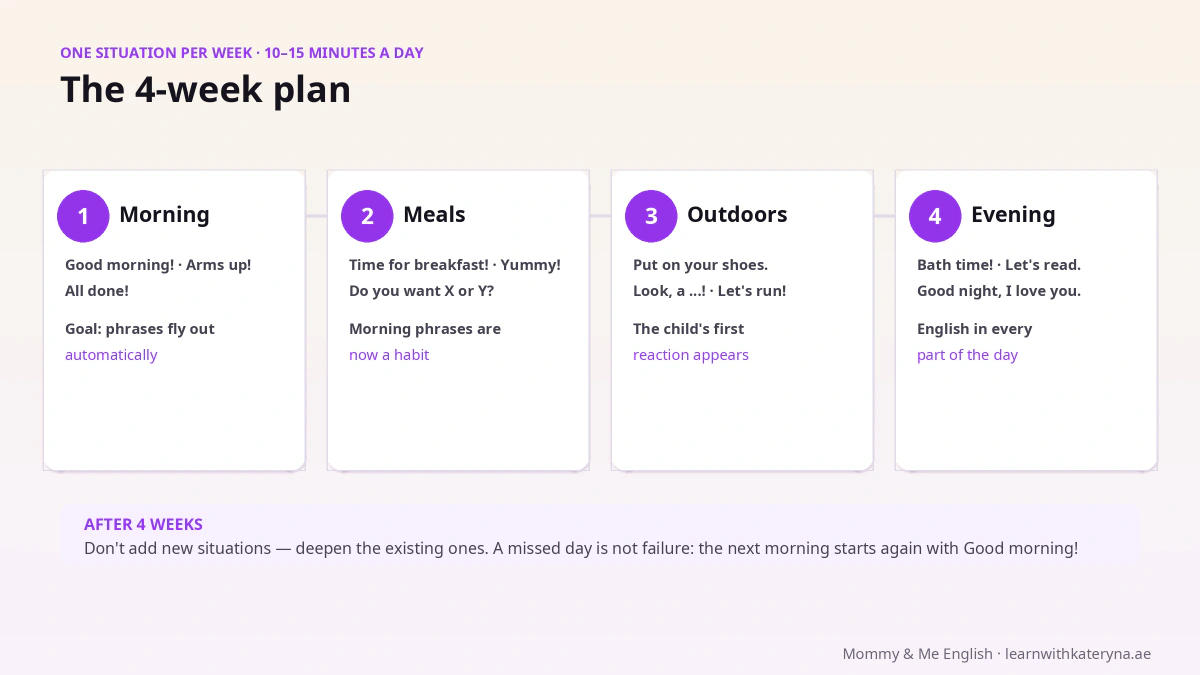
Week 1 — morning. Just three phrases: "Good morning!", "Arms up!", "All done!". Your goal is for them to fly out automatically, with no internal translation. The child doesn't have to react yet — she simply hears.
Week 2 — meals. Add "Time for breakfast/lunch/dinner!", "Yummy!" and the choice question "Do you want X or Y?". The morning phrases keep going — they are a habit now.
Week 3 — walks. "Put on your shoes," "Look, a…!" and "Let's run!". This is usually the week the first reaction appears: the child turns her head at "Look!" before you have even pointed.
Week 4 — evening. "Bath time!", "Let's read a book," "Good night, I love you." The circle closes: English now sounds in every part of the day in small doses — the same 10–15 minutes total, distributed naturally.
After week four, don't add new situations — deepen the existing ones: add "Where is your sock?" to the morning, "It's hot, blow on it" to meals. Grow deeper, not wider. And remember: a missed day is not failure. Failure is three missed weeks. A missed day simply starts again next morning with the same "Good morning, sunshine!".
7 mistakes that undo all the effort
1. Translating every phrase. "Time for lunch — that means it's lunchtime, understood?" teaches the child to wait for the translation and never switch English on directly. Replace translation with action: say "Time for lunch!" and put the plate down. Context translates by itself.
2. Demanding repetition. "Say apple! Come on, say it!" is the shortest route to killing motivation. The child will speak when she has accumulated enough input. For some that's a month, for others half a year of silent listening — both are normal.
3. Mixing languages inside one sentence. "Дай мені cup, будь ласка" trains the brain to treat English words as decorations inside Ukrainian. The rule: one phrase — one language. A short, complete English phrase beats a long mixed one.
4. Running table-top "lessons." Sitting a two-year-old down "to study" is a fight against nature. The entire power of everyday phrases is that they are not a lesson — they are life.
5. Quitting over "zero reaction." Silence is not absence of progress. A child builds passive understanding for weeks before showing it. The test is simple: say "Where is your nose?" with no gestures — if a finger drifts toward the nose, everything is working.
6. Being embarrassed in public. If English only sounds "when nobody can hear," the child reads the signal: this is something odd, something to be ashamed of. Speak on the playground exactly as you do at home.
7. Waiting for the perfect moment. "We'll start after the holidays / once she speaks Ukrainian properly / on Monday." The early language window doesn't wait. The best moment was a year ago; the second best is tonight, with "Good night, I love you."
Next steps
Bookmark this page — it is designed as a phrasebook you come back to. Start tonight with three morning phrases, walk through the four-week plan, and once the phrases are habit, add the first 50 words, songs and TPR games so that passive understanding grows into active speech.
And if you would rather not assemble the system piece by piece but get it ready-made — with video lessons, audio for every phrase, checklists and support — take a look at my Mommy & Me English starter guide. It is the same method used by hundreds of Ukrainian families from Kyiv to Dubai: 10 minutes a day, no tutors, with mum in the leading role.


