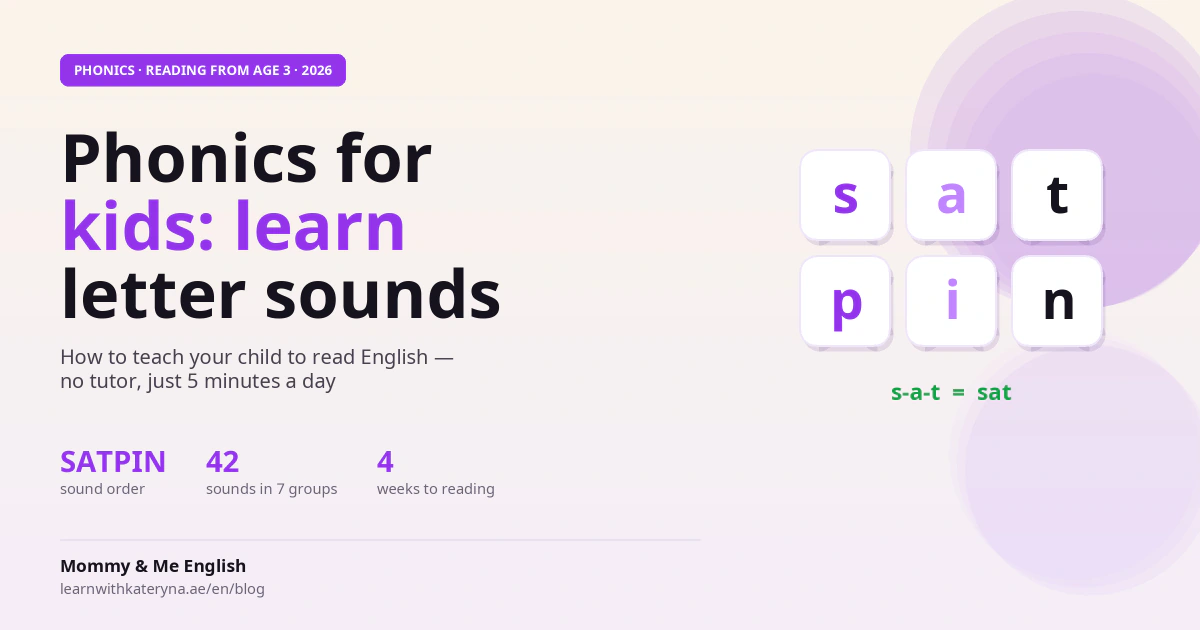
Phonics is a method of teaching reading in which a child learns the sounds of English letters (not their names) and blends them into words. For children it's the shortest path from "I know letters" to "I read on my own": first the child learns six sounds — s, a, t, p, i, n — immediately builds simple words from them (sat, pin, tap), and only then expands to the full set of 42 sounds. You can start at home, with no tutor, in just 3–5 minutes a day.
Ukrainian-speaking parents often confuse phonics with learning the alphabet — and that's exactly why a child can sing "ay-bee-see" for years yet can't read the word cat. This article explains the difference, gives the right order of sounds, a ready table of sounds that don't exist in Ukrainian, and a step-by-step 4-week plan.
What phonics is — and why it isn't the alphabet
Phonics is a system for teaching reading that links a speech sound to the letter that represents it. Put simply: the child learns that the letter m sounds like /m/, the letter s like /s/, and when she sees those letters together she "blends" them into a word.
The alphabet is different. The alphabet is the names of letters: "ay, bee, see, dee". The name of the letter b is "bee", but in the word bat it sounds like /b/. If a child knows only the name, she'll try to read bat as "bee-ay-tee" — and nothing comes together. That's why the ABC song on its own doesn't teach reading.
A child who knows 42 sounds reads hundreds of words. A child who knows 26 letter names reads none. The difference between phonics and the alphabet is the difference between a skill and a decoration.
The science is solid: Reading Rockets and the National Reading Panel report (NICHD, USA) showed that systematic phonics is the most effective method for teaching early reading in English. That's not an opinion — it's a 20+ year research consensus.
What age to start phonics
Phonics has two stages, and age determines which one you're on. Don't try to "build words" with a two-year-old — her brain isn't ready for blending yet. But sound play can begin at one.
- 1–2.5 years — phonological play. No word-building at all. Just hearing and recognising sounds: "What starts with /s/? Sssss-snake!" Sound imitation, songs, an exaggerated first sound. This is the foundation.
- 2.5–3.5 years — individual sounds. The child learns that each letter "has its own sound". One sound over a few days. Still no blending, but already recognising the letter.
- 3.5–5 years — blending. The child blends sounds into words: /s/-/a/-/t/ → sat. This is the moment it "clicks" and real reading begins.
If your child is one and you're just starting English, build the basic vocabulary and ear first. Our step-by-step plan for English from age 1 without a tutor and first 100 English words by age are what to start with before phonics.
SATPIN: what order to teach the English sounds
Sounds in phonics are taught not in alphabet order. The most common and best-tested system — Jolly Phonics — splits 42 sounds into 7 groups. The first group is s, a, t, p, i, n (hence "SATPIN"). Why these six? Because they immediately build dozens of simple three-letter words.
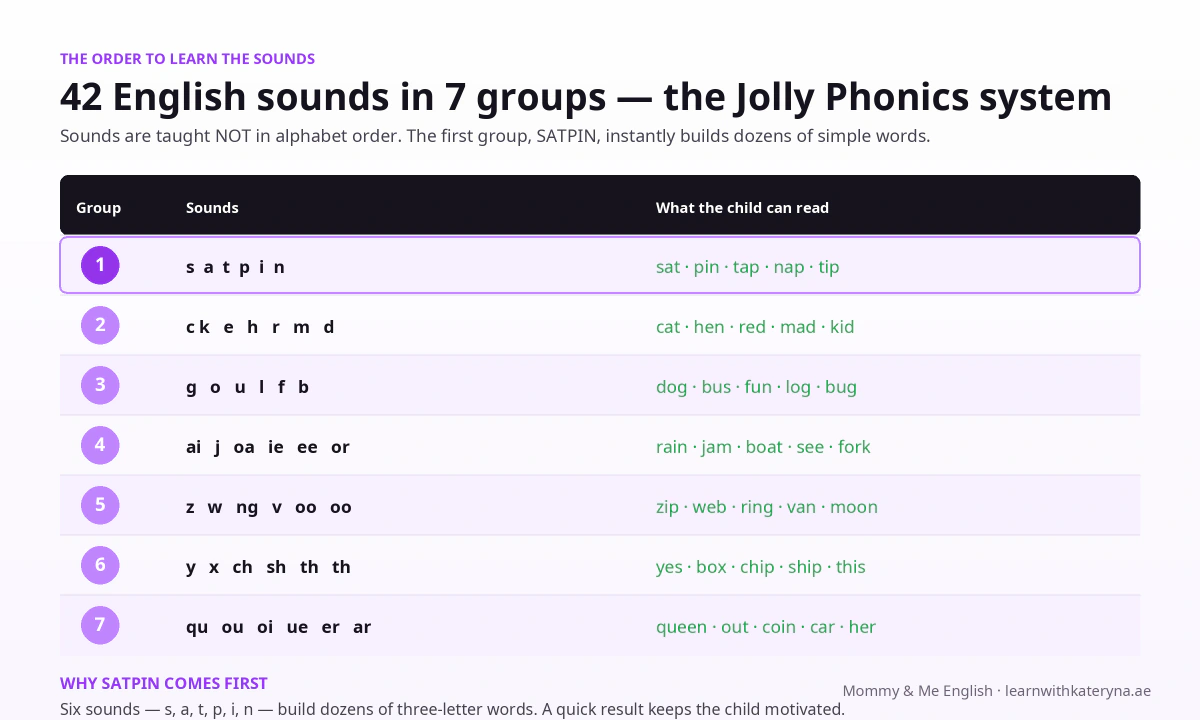
After the very first group the child reads real words: sat, sit, sip, tap, tip, pin, pan, nap, pat, tin, nip, pit. That's the magic of the SATPIN order — a quick result keeps the child motivated.
| Group | Sounds | What it lets you read |
|---|---|---|
| 1 | s, a, t, p, i, n | sat, pin, tap, nap, tip |
| 2 | c k, e, h, r, m, d | cat, hen, red, mad, kid |
| 3 | g, o, u, l, f, b | dog, bus, fun, log, bug |
| 4 | ai, j, oa, ie, ee, or | rain, jam, boat, see, fork |
| 5 | z, w, ng, v, oo, oo | zip, web, ring, van, moon |
| 6 | y, x, ch, sh, th, th | yes, box, chip, ship, this |
| 7 | qu, ou, oi, ue, er, ar | queen, out, coin, car, her |
Don't rush groups 4–7: that's where digraphs appear (two symbols, one sound, like sh, ch, th) and vowel combinations. For a 3–4-year-old, a comfortable pace is one group every 2–3 weeks.
Why the sound, not the letter name
This is rule number one of phonics, and it's the one parents break most often. Say the sound, not the letter name. S is /s/, not "ess". M is /m/, not "em". T is a short /t/, not "tee".
An important nuance for consonants: say the sound cleanly, with no "uh" at the end. Not "suh", "tuh", "muh" — a dry /s/, /t/, /m/. If you add a vowel ("tuh"), the child can't blend t-a-p into tap — it becomes "tuh-a-puh". This is the most common reason blending "doesn't stick".
Blending sounds isn't "tuh-a-puh". It's /t/-/a/-/p/, said faster and faster until the three sounds merge into one word — tap. A clean consonant sound is half the battle.
For vowels, use only short sounds at the start: a as in apple (not "ay"), i as in sit (not "eye"), o as in dog. Long vowels ("ay", "eye") come later, in group 4.
Let's show blending with the word pin. Step 1: the child says each sound separately and slowly — /p/… /i/… /n/. Step 2: repeat, but faster — /p/-/i/-/n/. Step 3: faster still, until the three sounds "glue" into one word — pin. If you get stuck, help by "stretching" the first sound: "pppp-in". Stretchy consonants (s, m, n, f) blend more easily than "explosive" ones (p, t, b), so start the first blends with those.
5 steps: how to teach one sound at home
One sound — one short cycle. No more than 3–5 minutes at a time, but several times a day. Here's a proven sequence for any sound.
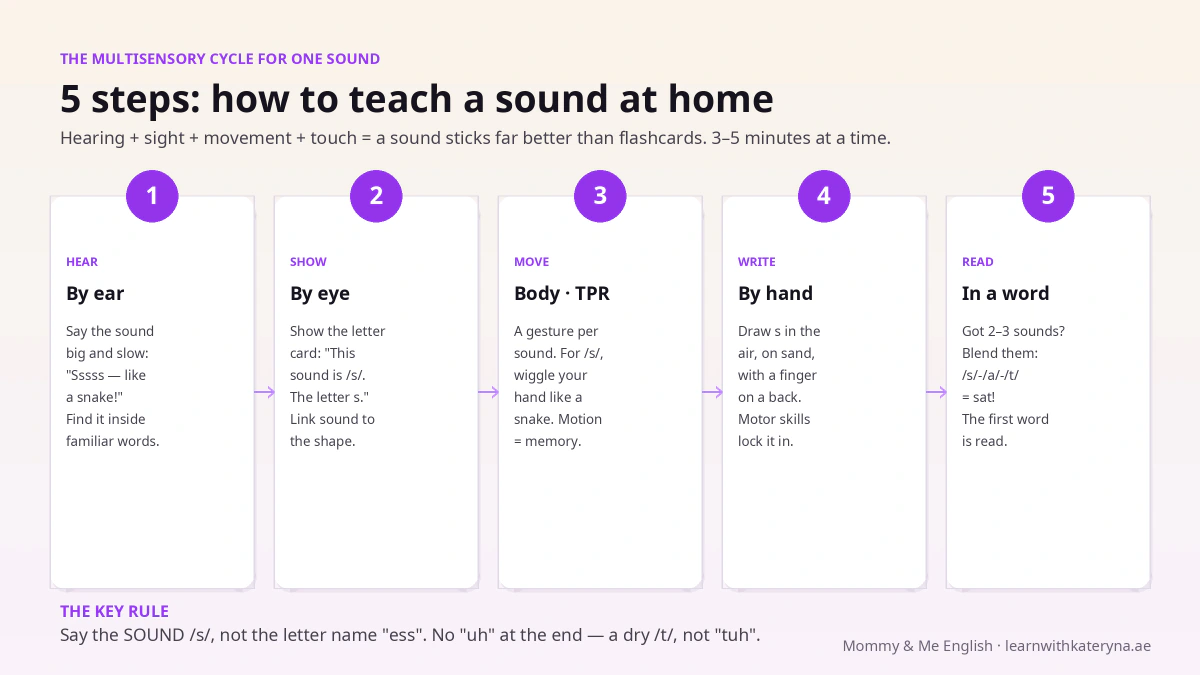
- Hear the sound. Say it with exaggeration: "Sssss — like a snake". Ask the child to repeat. Find the sound in familiar words: "Sssun, sssock, sssnake".
- Show the letter. Show the card with the letter s. "This sound is /s/. The letter is s." Link the sound to the shape.
- Add movement. A gesture for each sound (as in the TPR method). For /s/ — "wiggle like a snake" with your hand. Movement ties the sound to body and memory.
- Write in the air. "Draw s in the air", on semolina, with a finger on someone's back. Motor skills lock in the letter's shape.
- Read it in a word. As soon as there are 2–3 sounds — blend: /s/-/a/-/t/ → sat. Victory! The child has read their first word.
This cycle leans directly on the TPR method — learning through movement and action. If you're not using it yet, read how to teach English through movement with TPR: gestures make phonics many times more effective.
Sounds that don't exist in Ukrainian
This is the most important part for Ukrainian parents — and the one English-language guides ignore completely. Six English sounds don't exist in Ukrainian, so parents instinctively replace them with the nearest Ukrainian sound — and teach the child wrong from day one. Fixing it later is hard.
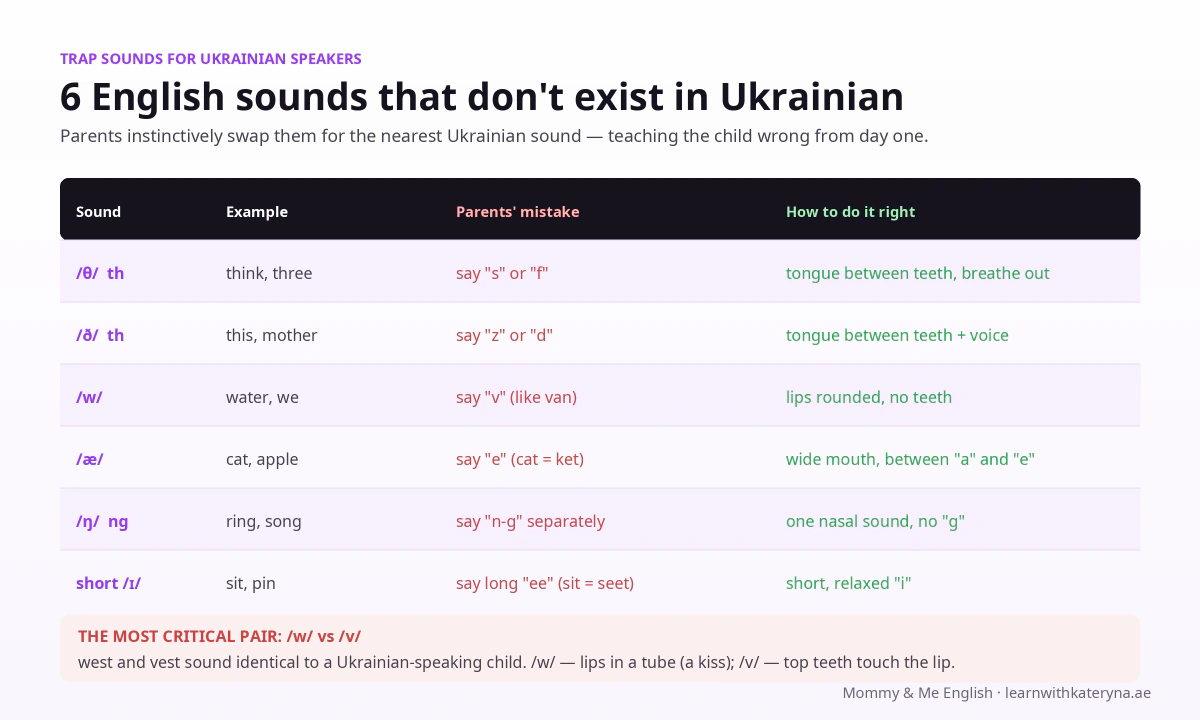
| Sound | Example | Parents' mistake | How to do it right |
|---|---|---|---|
| /θ/ (th) | think, three | say "s" or "f" | tongue between teeth, breathe out |
| /ð/ (th) | this, mother | say "z" or "d" | tongue between teeth + voice |
| /w/ | water, we | say "v" (like van) | lips rounded, no teeth |
| /æ/ | cat, apple | say "e" (cat→ket) | wide mouth, between "a" and "e" |
| /ŋ/ (ng) | ring, song | say "n-g" separately | one nasal sound, no "g" |
| short /ɪ/ | sit, pin | say a long "ee" (sit→seet) | short, relaxed "i" |
The most critical pair is /w/ and /v/. Ukrainian only has "v", so west and vest sound identical to the child. Show the difference with your hands: for /w/ the lips round into a tube (a kiss), for /v/ the top teeth touch the lower lip. If you don't trust your own pronunciation, use native-speaker videos and songs. Songs, by the way, "sew" correct sounds into memory perfectly: here are 25 of the best English songs by age.
Why it's easier for Ukrainian families than English-speaking ones
It's a paradox, but a Ukrainian child has a head start in phonics. Ukrainian is a phonetic language: we write "кіт" and read "кіт", every letter equals one sound. You already read "as it sounds". English-speaking parents don't have this mechanism — English spelling is inconsistent (compare through, though, tough).
This means two things. First, the very principle of phonics — "letters represent sounds" — is intuitive to your child, because that's how her native language works. Second, you as a parent already have the skill of sound-analysing a word, even if you never learned it consciously.
Bilingualism doesn't confuse a child — it gives her two "keys" to sounds. Ukrainian shows the "letter = sound" principle; English just adds new sounds to an already familiar logic.
Many parents fear the two languages will "mix" or delay speech. That's a myth. We covered it in detail: does bilingualism delay speech — 7 myths and the facts. In short: no, it doesn't — and phonics in two languages only strengthens phonemic awareness.
Multisensory phonics: movement, song, touch
A child's brain remembers a sound better when several channels work at once: hearing, sight, movement and touch. This is the multisensory approach — the basis of Jolly Phonics and the reason it works better than "flashcards in front of the child".
- Hearing + voice: songs about sounds, exaggerated pronunciation, sound imitation.
- Movement (TPR): a gesture for each sound — /f/ "a fish swims", /m/ "yummy, rub your tummy".
- Touch: sandpaper letters, drawing on semolina, moulding from dough.
- Sight: a sound card + a hint picture (s = snake).
Build phonics into daily rituals, not "lessons at a desk". One sound of the day at breakfast, the same sound in the bath, on a walk. How to organise this effortlessly is in our guide on daily English rituals at home.
Here's what the "sound of the day" /m/ looks like in a real day: at breakfast — "Mmmm, milk! /m/". In the bath — a bowl, soap, a teddy (mouse, moon on the toys). On a walk — a "hunt": find three things with /m/. Before bed — a song with a repeating /m/. The child met the sound in five different contexts in one day, without ever sitting down for a "lesson". That's how a sound moves into long-term memory — through repetition in natural life, not cramming.
A child learns a sound not at a desk but at lunch, in the bath and on a walk. The more contexts, the stronger the memory. One "lesson" loses to five chance encounters with the sound across a day.
How to tell your child is ready to blend
Blending (merging sounds into a word) is a cognitive leap, and it doesn't happen on command. Before you expect a child to read sat, make sure she's been through the phonological foundation. Here are four signs of readiness.
- Hears the first sound in a word. Asked "What starts with /s/?", the child gives an example. This is basic phonemic awareness.
- Distinguishes individual sounds. Can repeat /s/, /a/, /t/ separately without automatically blending them into a syllable.
- Recognises a few letters by sound. Sees s and says /s/ (not "ess") — at least for 3–4 letters of the SATPIN group.
- Has steady attention for 3–5 minutes. Can focus on a short sound game without losing interest.
If at least two signs are missing — step back to phonological play: rhyming, songs, "sound hunting". Rushing into blending when the brain isn't ready only brings frustration. The child will "click" on her own — usually between 3.5 and 4.5 years. Early-reading research (Reading Rockets, phonemic awareness) shows: phonemic awareness is the strongest predictor of reading success, stronger than IQ or vocabulary.
Phonics or memorising words (sight words)
There are two approaches to teaching reading, and parents often confuse them or choose the weaker one. Phonics teaches a child to decode any word by its sounds. The whole-word method (sight words, "look and say") teaches recognising a word as a whole, like a picture. Here's the difference.
| Criterion | Phonics (sounds) | Sight words (whole words) |
|---|---|---|
| Principle | decodes a word by its sounds | memorises a word as an image |
| New, unfamiliar words | reads them independently | can't read without a prompt |
| Memory load | low (42 sounds) | high (thousands of words) |
| Quick start | moderate | very fast on the first words |
| Evidence base | strong (National Reading Panel) | limited for the basis of reading |
The science is clear: phonics is the foundation, and sight words are a small addition. Some English words really don't read by the rules (the, was, said, one) — those the child memorises whole. But there are dozens of them, not thousands. Build reading on phonics, adding only the handful of "exception words" that can't be decoded.
A 4-week plan without a tutor
Here's a realistic start for a 3.5–5-year-old. 5 minutes twice a day. No tutor — just you, some cards and a little consistency.
What you need (almost all free): a set of cards with the SATPIN letters (you can draw them by hand), one or two simple books with three-letter words, native-speaker videos with sound songs, and your voice. No apps or paid courses are needed at the start — they distract more than they help in the first weeks. The main "tool" is you nearby and a few minutes of attention each day.
- Week 1 — sounds s, a, t. Two days per sound. By the end of the week — the first blend: sat, at. Celebrate the first win.
- Week 2 — sounds p, i, n. Now you have the whole SATPIN group. Build: pin, pan, tap, nap, tip, sit, pit. The child reads 10+ words.
- Week 3 — review + group 2 (c, k, e, h). New words: cat, hen, kid, peck. Start "sound hunting" at home.
- Week 4 — r, m, d + first sentences. "A cat sat.", "Sam is sad." The child reads a short sentence — a huge milestone.
After reading single words, the logical next step is reading books together. The PEER method turns shared reading into a dialogue and speeds up the move from sounds to meaning: how to read English books to your child with the PEER method.
Common parent mistakes
- Teaching letter names instead of sounds. "Bee-ay-tee" will never become bat. Sounds only.
- Adding "uh" to consonants. "Suh-tuh-puh" destroys blending. The sound must be dry: /s/, /t/, /p/.
- Teaching in alphabet order (A-B-C). Start with SATPIN — otherwise the child can't build a single word for a long time.
- Rushing into digraphs. sh, ch, th — after simple words blend confidently, not before.
- Sessions longer than 5 minutes. A 3–4-year-old's attention is short. Better 3 times for 5 minutes than once for 20.
- Ignoring "foreign" sounds. If you say think as "sink" from the start, you'll be fixing it for years.
Next steps
Phonics is the bridge between "knows words" and "reads on her own". Start with the six SATPIN sounds, say the sound instead of the letter name, keep sessions short and use your advantage — the phonetic Ukrainian language. In 4 weeks the child will read her first words. That's not an exaggeration — it's the maths of repetition.
Want a ready-made system instead of guesswork? Our free Mommy & Me English starter guide gives a step-by-step plan for the first months of English at home — sounds, words, rituals and songs in one document. Download the free starter guide and begin today.
And if you're just at the beginning, return to the foundation: the first 100 words and English from age 1 without a tutor prepare the ground on which phonics "takes off".