
 Kateryna Ivanova
Last updated: May 15, 2026
Bilingualism does not delay your child's speech. That sentence is backed by decades of peer-reviewed research — from Petitto & Kovelman's classic work to the 2023 ASHA Journal of Speech, Language and Hearing Research review. And yet the "two languages cause delay" myth remains the #1 reason mothers postpone teaching English at home. In this article I break the myth down step by step: what 2023–2025 science actually says, why code-mixing is a sign of competence (not confusion), what to say when grandma pushes back, and when a speech therapist consult is genuinely warranted.
- Bilingualism does NOT cause speech delay — confirmed by ASHA (2023), Cornell (2024), Frontiers in Psychology (2023).
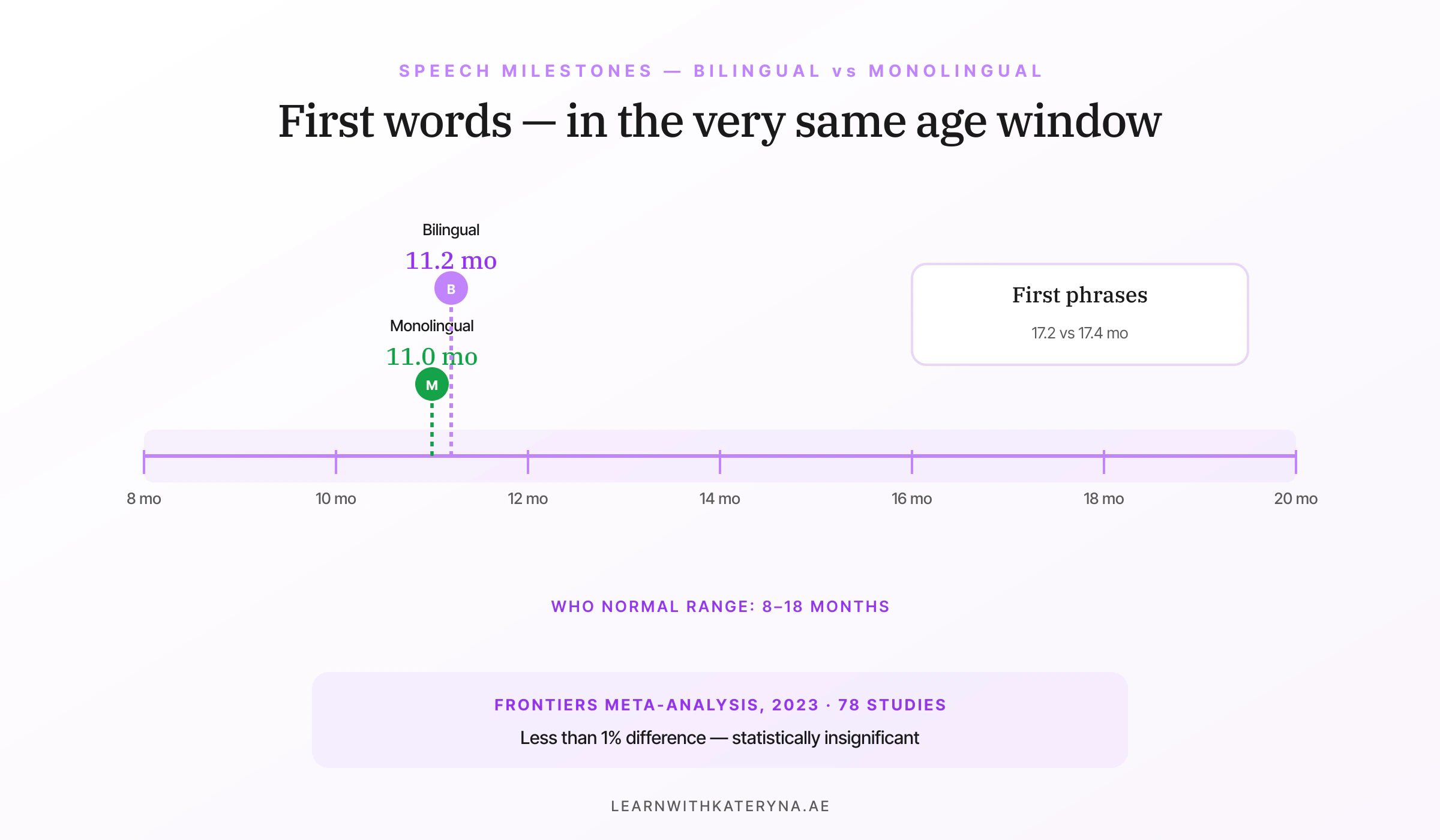
- Bilingual toddlers say first words in the same 8–15 month window as monolinguals.
- Total vocabulary across both languages is typically equal or larger than monolingual peers.
- Code-mixing ("Give me воду") is a sign of healthy development, not confusion; it fades by 4–5.
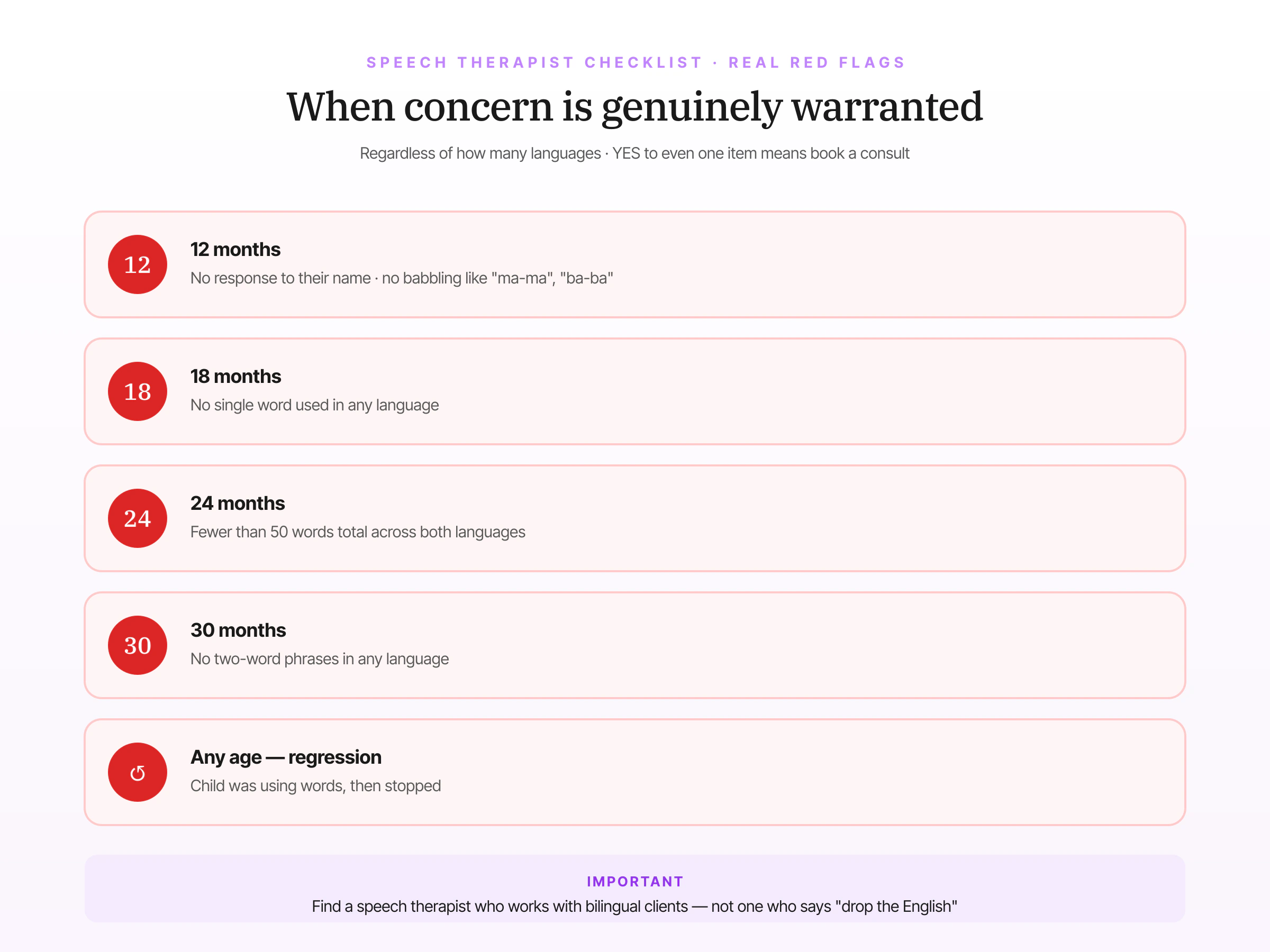
- See a speech therapist if at 18 months your child doesn't respond to their name, or at 24 months doesn't use a single word in any language.
Quick answer
Does bilingualism delay speech? No. Recent research (ASHA 2023, Cornell 2024, PMC 2022) consistently shows bilingual children hit every major language milestone — babbling, first words, first phrases — within the same age windows as monolingual children. The "delay" appearance happens when adults count vocabulary in only one language. Count both languages together and bilinguals are typically on track or ahead.
What bilingualism actually is — and what it isn't
Childhood bilingualism is regular exposure to two languages during the first years of life. It is NOT "speaking two languages like a native", it's NOT "translating", and it's NOT "two languages on flashcards at once". A bilingual child can dominate in one language, actively speak only one, and merely understand the other. That's normal.
Researchers distinguish two early bilingualism types:
- Simultaneous — child hears both languages from birth. Classic case: dad speaks English, mom speaks Spanish.
- Sequential — child masters one language by age 3, then begins systematic exposure to the second (daycare, immigration, mom-led English course).
The Mommy & Me English course is designed around the sequential model: native language is the base, English added via short daily rituals and songs.
What 2023–2025 science actually says
Three landmark studies in the past three years have effectively buried the "bilingualism causes delay" myth.
ASHA study (2023)
The Journal of Speech, Language, and Hearing Research published "Exploring Assumptions of the Bilingual Delay in Children With and Without Developmental Language Disorder". Conclusion: bilingual and monolingual children with DLD show identical delay patterns. Bilingualism is not a risk factor.
What the milestone evidence actually shows
Bilingual children reach the core milestones — first words, first two-word combinations, first sentences — in the same window as monolingual children. That is why no professional body advises dropping a language in order to "speed up" speech: there is nothing to speed up. Treat the precise tenths-of-a-month figures that circulate online with caution; they come from different samples, counted in different ways.
Cornell University study (2024)
The Cornell team showed that bilinguals develop executive function earlier than monolinguals — better attention switching, impulse control, working memory. This cognitive advantage persists into old age.
"The question is no longer whether bilingualism delays speech. The question is how we build environments that let bilingual children realize their cognitive advantage." — Dr. Erika Hoff, Florida Atlantic University, NPR interview, 2024
Why the myth refuses to die — 4 reasons
If the scientific consensus has been clear for two decades, why does the myth persist? Four reasons:
- Monolingual-centric milestone tables. Most "when should my child talk" tables come from 1950s–80s US studies on monolingual kids. Bilinguals don't fit cleanly — and the misfit reads as "delay".
- First-word timing shifts by a few weeks. Some bilinguals say their first word 2–4 weeks later than the median. That's within normal range, but worried parents see a red flag.
- Distributed vocabulary. A bilingual 18-month-old might know 20 English and 15 Spanish words — 35 total, which is excellent. Count only one language and they look "behind".
- Authority of older generation. Grandparents and old-school speech therapists often say "don't confuse the child". This has no scientific basis but gets transmitted family-to-family.
7 bilingualism myths debunked
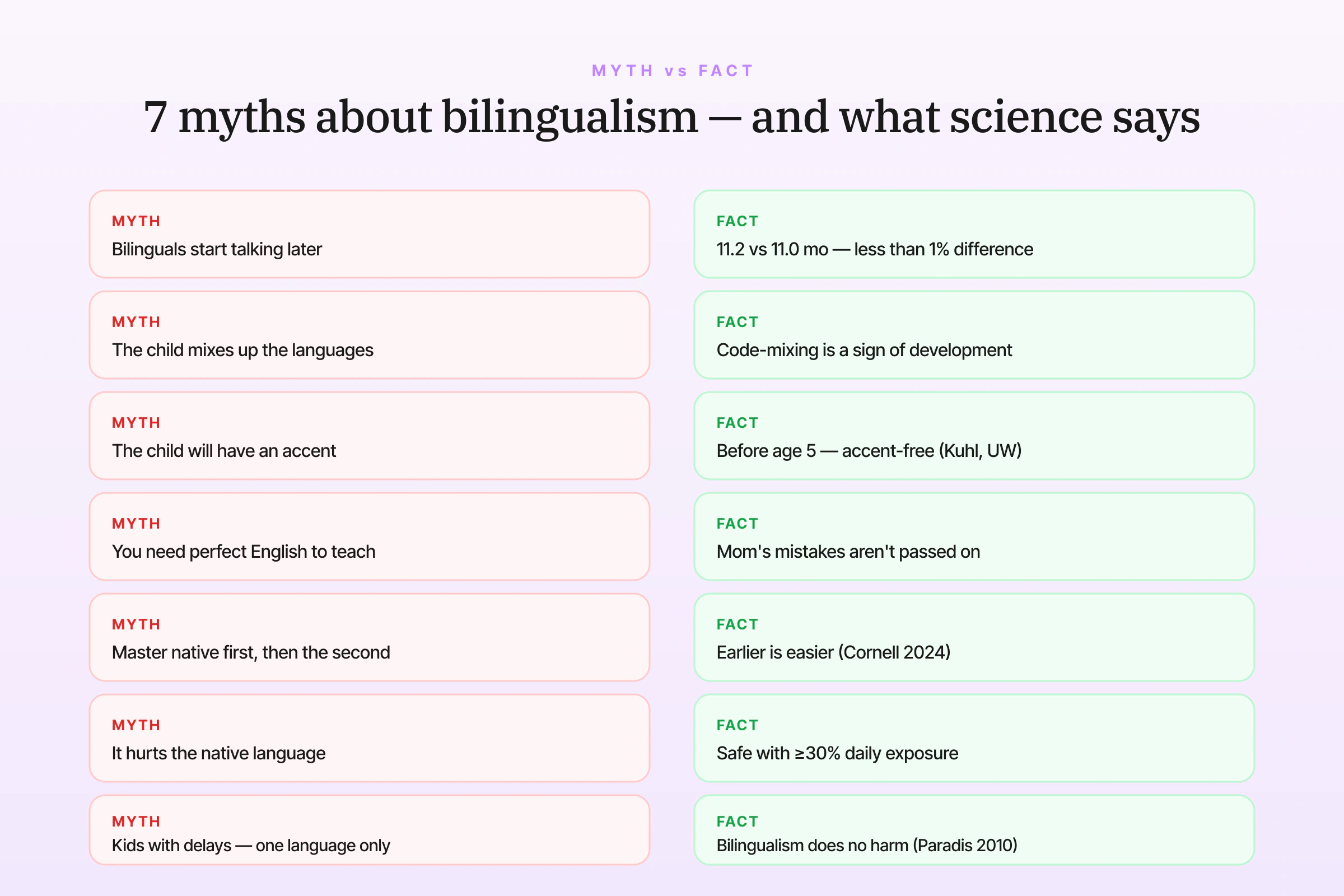
| Myth | What science says |
|---|---|
| Bilinguals speak later | First words in 8–15 month window for both groups (Frontiers, 2023) |
| Child will mix up the languages | Code-mixing is a developmental sign, not a disorder (ASHA, 2023) |
| Your child will have an accent | Bilinguals exposed before age 5 speak accent-free (Kuhl, UW) |
| You need "perfect" English to teach | Consistent simple phrases work; mom's accent isn't transferred |
| First master native, then add second | Earlier = easier; the phoneme window closes by 9–12 months (Kuhl, 2011) |
| It hurts the native language | A language heard all day is not at risk; Pearson's ~20% figure is about minority-language uptake |
| Kids with delays — only one language | Children with DLD or autism benefit from bilingual therapy (Paradis, 2010) |
Myth #1: "Bilinguals start talking later"
The most common and most damaging — and the one the research is clearest about. Bilingual children say their first words, and put their first two words together, in the same age window as monolingual children. ASHA states plainly that learning two languages does not cause a speech or language disorder, and a 2023 review in its Journal of Speech, Language, and Hearing Research tested the "bilingual delay" assumption directly and found no support for it — not even for children who already have a developmental language disorder.
Myth #2: "Children mix up the languages"
What sounds like confusion is called code-mixing — normal and even sophisticated use of linguistic resources. We unpack this below.
Myth #3: "The second language hurts the first"
This one is worth getting right, because the figure usually quoted is wrong. Barbara Zurer Pearson's group at the University of Massachusetts Amherst worked with roughly 20% of waking hours as a cut-off — and that describes the exposure at which a minority language tends to take root, not a threshold your home language has to clear in order to survive. No researcher has suggested that a language spoken all day is at risk.
Do the arithmetic for your own home and the worry disappears. Ten to fifteen minutes of English a day, against roughly twelve waking hours, is about two per cent of your child's day. The other ninety-eight per cent is the home language. There is nothing there to threaten.
Myth #4: "You need perfect English to teach"
Genesee's McGill research (2014) found children don't inherit mom's imperfect pronunciation if they're also exposed to native sources (songs, cartoons, audiobooks). Your simple "Good morning, sunshine!" paired with Super Simple Songs gives the right phonetic template.
Myth #5: "Master native first, then add second"
This logic is reversed. The later you start, the more effort it takes and the less neuroplasticity is available. Patricia Kuhl (University of Washington) demonstrated that by 9 months the brain's ability to distinguish every phoneme of every language begins narrowing rapidly.
Myth #6: "Bilingualism is for elites"
US Census Bureau figures put it at roughly one in five American children speaking a language other than English at home. Worldwide, bilingualism is the norm, not the exception. The question isn't "is this accessible to me" but "how do I structure consistent exposure".
Myth #7: "Kids with delays/autism — single language only"
The most harmful myth for children with DLD (Developmental Language Disorder) or autism. Canadian research by Paradis (2010, 2022) shows that removing one language does not help these children — and deprives them of the resource of communicating with their family.
Code-mixing — why "Give me воду" is competence, not confusion
Code-mixing (using both languages within a single utterance) is when a 2–4-year-old says "Give me воду" or "I хочу спати". This SCARES most parents but actually confirms the language system is healthy.
What's happening in the child's brain:
- The child knows these are two distinct languages.
- They retrieve the word that surfaces first in active memory — called lexical retrieval.
- When tired, emotional, or rushed, the brain switches to the most accessible word in either language.
- By 4–5 years a "switch" develops and code-mixing disappears in formal contexts.
Adult bilinguals code-mix too ("Spanglish", "Hinglish"). It isn't an error — it's a linguistic superpower.
"If your child mixes languages — celebrate. They aren't confusing them, they're using them." — Erika Hoff, "Language Development", 2020
When concern IS warranted — signs of real delay
Bilingualism does not mask or cause real language delay. If a real disorder is present, it shows up in both languages simultaneously. That's the key ASHA diagnostic criterion.
Red flags regardless of how many languages a child hears:
- 12 months — no response to their name, no babbling like "ma-ma", "ba-ba".
- 18 months — no single word used in any language.
- 24 months — fewer than 50 total words across both languages combined.
- 30 months — no two-word phrases in any language.
- Any age — regression: child was using words and stopped.
- Any age — persistent difficulty understanding simple instructions.
If you see even one of these, it's a reason to consult a speech therapist and pediatrician — but not a reason to drop English. Quite the opposite: a child with a real delay benefits more from bilingual therapy.
Scripts for grandparents and old-school pediatricians
This is the hardest part. Grandparents, aunts, and some older pediatricians may say "don't confuse the child", "let them speak our language first", "they don't even know their first language yet". Here are ready scripts:
| What they say | What to say back |
|---|---|
| "The child will mix up the languages" | "It's called code-mixing — it's a sign the brain works correctly. Fades by age 5." |
| "They'll speak later" | "A 2023 review in an ASHA journal found no support for a bilingual delay." |
| "Native language first" | "Earlier exposure means accent-free pronunciation later." |
| "It hurts the brain" | "Cornell 2024: bilinguals develop attention and memory earlier." |
| "What if she has a delay?" | "Delay shows in both languages together. That's what I monitor." |
Three typical family situations
Family 1: Both parents native + at-home country
The simplest setup. Native is the base, English is 10–15 min/day via rituals, songs, and stories. Zero threat to the native language — child hears it ≥90% of the day.
Family 2: Mixed-language household
The child is already growing up bilingual. Adding English as a third language is possible but I recommend waiting until age 2 and introducing English through one adult only (the "one parent — one language" method).
Family 3: Immigrant family (US, UK, Germany, Poland)
The most complex case. The child hears one language at home, another at daycare. English via mom-led rituals would be a third. Here I'd suggest first strengthening the home language (reading, songs, cartoons in the home language) to avoid losing it. Then English 5–10 min/day, no more, until age 4.
Speech-therapist checklist: when to actually go
A simple 4-step screen. If any answer is "YES", it's not a reason to panic — but it is a reason to book a consult.
- Are red flags present (12/18/24/30 month milestones above) — regardless of language?
- At 12+ months, does the child not react to loud sounds? (Hearing is the first thing to check.)
- Is eye contact absent when you address the child?
- Has there been regression — did your child use words and then stop?
Look for a speech therapist who works with bilingual clients. A therapist who says "drop the English" is not the specialist you need. ASHA-certified bilingual specialists are available across the US, UK, EU, and online.
What neuroscience actually says: the critical window
By 9 months, a baby's brain can distinguish every phoneme in every human language. This is Patricia Kuhl's (University of Washington) landmark finding — she's one of the most cited neurolinguists alive. After 9 months the brain starts "discarding" phonemes it doesn't regularly hear. By age 6, most children have lost the easy ability to distinguish sounds absent from their native language.
The technical term is phonetic narrowing. This is why adult Spanish speakers struggle with English /θ/ ("think") — their brain literally no longer "sees" the distinction. An 8-month-old sees it perfectly.
Practical implications:
- Before age 1: Even passive exposure to English songs builds the phonetic foundation. You're not "teaching" — you're loading the system.
- 1–3 years: The window for natural grammar acquisition. The child catches patterns without rules.
- 3–5 years: Accent is still forming. With native input (songs, cartoons), the child will speak without a foreign accent.
- After age 6: Language is still learnable, but now as a "foreign" language with rules and conscious effort.
Kuhl's Seattle lab showed that 9-month-old infants who heard 12 hours of Mandarin over 4 weeks through a live person retained Mandarin phoneme discrimination for 5 years. The same 12 hours through video — zero effect. Interactivity is the decisive factor.
Building an English routine at home? The free Mommy & Me English starter guide lays out the daily rituals step by step.
5 mistakes English-teaching parents make
After 9 years of working with families, I see the same patterns block children from realizing their language potential. Top 5:
- Waiting for "the right age". "I'll start when she's 3 and speaks fluently in our language first." By age 3 the window is already closing. Starting with English songs at 6 months saves years of effort later.
- Switching to the home language at the first sign of resistance. A 2-year-old saying "no" is normal. Don't quit — shorten the ritual. A 30-second "Good morning hug" beats a 5-minute battle.
- Translating every word. "Good morning means доброго ранку." This destroys natural acquisition. Show the gesture, smile, and the child gets it from context.
- Background-playing English cartoons. Passive background listening doesn't teach language — dozens of studies confirm this. The child must see your face, interact, and get responses.
- Hunting for the "perfect course" instead of starting. The worst option is 0 minutes a day spent searching for the best methodology. Any ritual you actually do beats any methodology you don't start.
"The best language-learning method is the one you'll actually use every day." — Stephen Krashen, USC linguist, originator of Comprehensible Input theory
From my practice: 3 families, 3 trajectories
After 9 years working with families in Ukraine, the EU, and the UAE, I see the same fears repeat regardless of country. Three anonymized stories that show how this looks in real life.
Anna, 32, Dnipro — son Artem, 2 years
At 22 months Artem was speaking only five Ukrainian words. A local speech therapist said: "It's because you play English cartoons. Drop the English and he'll talk." Anna came to me for a second opinion. We counted the combined vocabulary: 18 Ukrainian + 14 English = 32 words. Within WHO range (10–50 words at 24 months). We didn't drop English — we replaced background cartoons with an interactive morning ritual. Four months later Artem had 90+ words across both languages and was building his first phrases.
Olena, 28, Warsaw — daughter Sofia, 3 years
Sofia was born in Ukraine; the family moved to Warsaw at 18 months. Polish at preschool, Ukrainian at home, and mom wanted to add English. A classic trilingual case. The strategy: first strengthen Ukrainian (reading, songs, Ukrainian video) — there was a real risk of losing it. English was added only at 2.5 years, through one adult (dad) plus songs. Today, 4-year-old Sofia speaks Ukrainian and Polish fluently and understands and uses 70+ English phrases. Zero delay.
Maria, 35, Dubai — son Leo, 4 years
Leo didn't speak at all until 28 months — and then only English, because the family moved to the UAE when he was 6 months old. He understood Ukrainian but didn't speak it. Mom panicked: "He's losing his native language." A proper assessment showed: combined vocabulary across both languages was 120+ words — excellent for 28 months. The plan: 15 minutes of Ukrainian via daily rituals with mom + weekly grandparent calls. Within a year Ukrainian caught up.
The common thread across all three: proper assessment of combined vocabulary, not panic over one language.
What to do today
If you read this far you already did the most important thing — checked the facts instead of the fears. Concrete next steps:
- Review language milestones for your child's age — counting both languages together.
- If everything looks fine, start with a 5-minute morning English ritual. See my 7 daily English rituals at home.
- Add 1–2 English songs a day — age-based list here: 25 best English songs for kids.
- Still unsure? Start with my free first lesson — I'll show you how to do English without a tutor.
- Deciding how to split the two languages at home? The OPOL method (one parent, one language) is one clear structure.
- Raising your child outside Ukraine? See English for Ukrainian kids abroad for the silent period and realistic timelines.
And remember: the only thing that actually delays your child's language is a parent who's too afraid to teach. Two languages are a lifelong gift.


