
 Kateryna Ivanova
Teaching English to a 1-year-old without a tutor is achievable when you replace lessons with daily ritual phrases. A child between 12 and 36 months acquires any language through context, gesture, repetition and emotional safety — not through translation, flashcards or scheduled study. Ten to fifteen minutes of daily English exposure, embedded into morning, mealtime, play, bath and bedtime, is enough to build comprehension and produce first active words within four to eight weeks. This article gives the mother who does not speak English a plan she can start tomorrow.
What this article covers
- The 1–3 year language window: what science actually says
- What "from scratch" means at age 1
- First principle: no translation
- The 7-day plan for a beginner mother
- Daily rituals: 5 anchor moments per day
- How long until first words: real timeline
- For mothers who do not speak English
- 7 mistakes that nullify the method
- A private tutor vs. the mother: honest comparison
- What to do when nothing seems to work
- The first 12 months: realistic milestones
- Frequently asked questions
The 1–3 year language window: what science actually says
The 1–3 year language window is the developmental period during which a child's auditory cortex builds phonetic maps for any language it hears regularly. Patricia Kuhl's lab at the University of Washington has demonstrated, in over two decades of work, that infants under 12 months can discriminate the phonemes of every human language. By 12 months that ability narrows: the brain begins to specialise in the phonemes of the languages spoken around it, and to lose sensitivity to the rest.
This is the central reason early start matters. A 1-year-old exposed to English in short, regular doses keeps the English phonetic map active and growing. A child first exposed at age 6 must rebuild that map from scratch, consciously — which is why a 6-year-old "studying" English looks slow and awkward, while a 2-year-old absorbing the same phrases looks effortless.
Two further findings reshape what a parent should do at this age:
- Live human voice is irreplaceable. Kuhl's 2003 experiment showed that infants exposed to a foreign language through a live speaker formed phonetic categories; infants exposed to the same content via television or audio alone did not. The mother is therefore not optional. Recordings supplement her voice; they do not replace it.
- Emotional state gates learning. A neutral or stressed child does not encode new sound patterns. A laughing, curious or calm child does. Bath, song and play work because they are emotionally safe by default.
"Babies are little scientists. They take statistics on the world. Before they can talk, they have already figured out which sounds belong to their language and which don't." — Patricia Kuhl, University of Washington
What "from scratch" means at age 1
"From scratch" does not describe the child. It describes the mother. The 1-year-old's brain is fully prepared for English; she is missing only the input. The mother who has not used English since school often starts from "I don't speak English, I can't teach this." That is the actual starting line, and the plan in this article is built for it.
The implication is freeing: you are not your child's English teacher. You are her language environment. A teacher needs grammar; an environment needs only a handful of phrases used at the same moment every day.
First principle: no translation
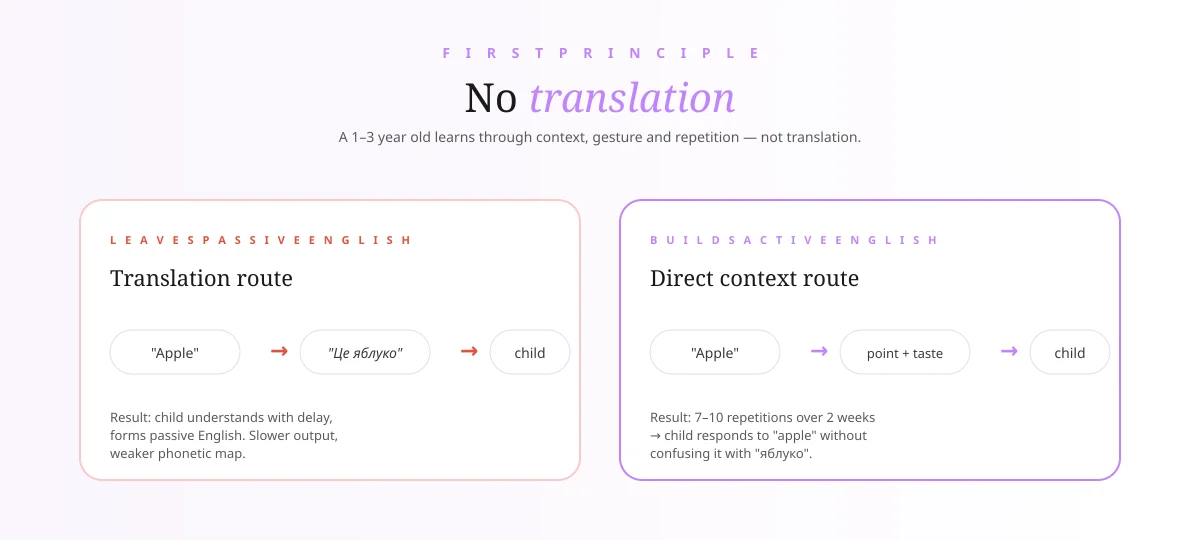
The biggest single mistake parents make is translating English words into Ukrainian or Russian during the act of teaching. "This is apple — це яблуко." The child's brain receives the English word and immediately overlays it with a stronger, already-known native concept. The English label becomes a footnote to the native word, not a parallel one. This is how passive English is built: the child understands with a delay because she has to translate internally before responding.
The replacement protocol is simple. When you hand the child an apple, you say "Apple." You do not say "це яблуко." You point, you let her touch, you let her taste, you repeat. After seven to ten exposures, spread across one to two weeks, she will turn her head when you say "apple" — and she will not confuse the word with "яблуко", because the two words are stored in two separate networks rather than chained through translation.
Patricia Kuhl's group has documented this in dual-language households worldwide. Children whose parents translate develop slower active output. Children whose parents use direct context develop faster active output, with cleaner pronunciation. The mechanism is the same in any language pair.
The 7-day plan for a beginner mother
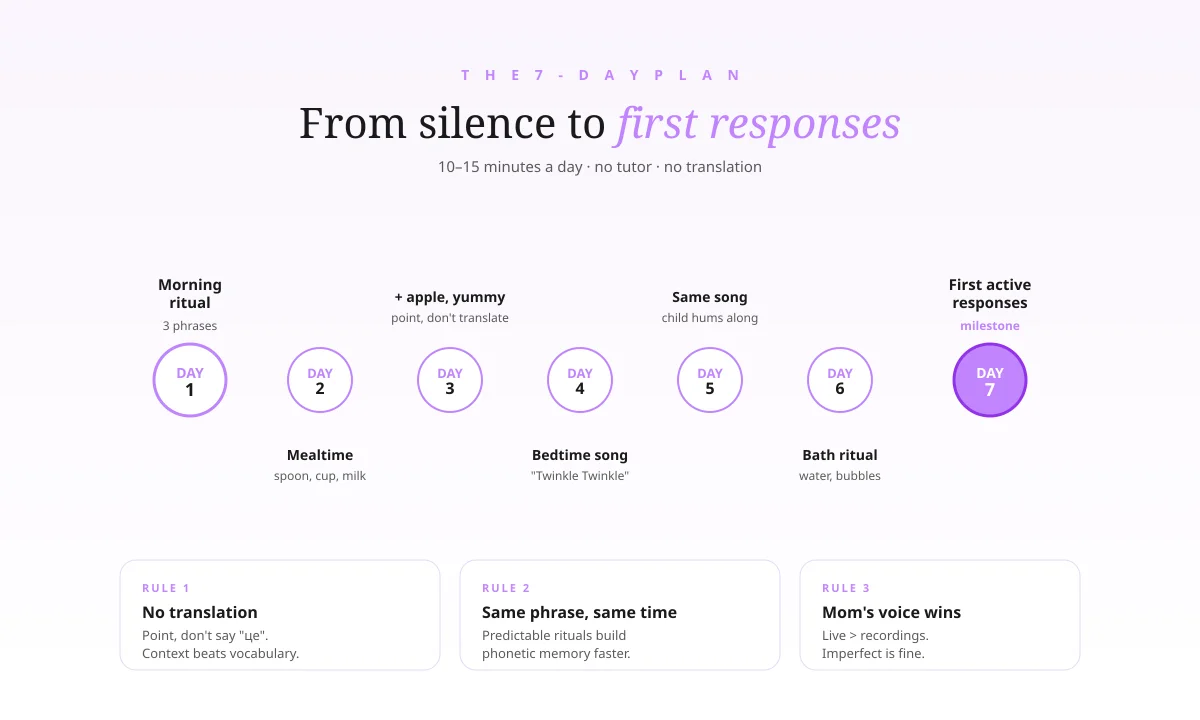
This is the entry-level plan. The only requirement is that the mother can read an English phrase out loud. Audio for every phrase is in the Mommy & Me English course; the first lesson is free.
Day 1 — morning ritual (3 minutes)
- Good morning, sunshine! — said when you kiss your child's cheek
- Time to wake up! — said when you open the curtains
- I love you! — said when you pick her up
Same three phrases, in the same order, every morning. Do not demand a response. Do not translate. The child is encoding the rhythm of the morning before she encodes the meaning of the words. By day three she will start to anticipate the second phrase after the first.
Day 2 — breakfast labels (3 minutes)
At breakfast, name five items the child is already looking at: spoon, cup, apple, milk, yummy. Point to each. Do not translate. By day four she will begin to recognise words from context — you say "spoon" and her eyes flick to the spoon before her hand moves.
Day 3 — second meal, same words
The same five labels at lunch. Add nothing new. The brain consolidates only what it meets twice in the same context. New parents are tempted to add 20 words on day 2; this destroys retention. Five words for the first week is the right number.
Day 4 — first bedtime song
Play one English song every night before sleep. Twinkle Twinkle Little Star works for a reason: melody is repetitive, lyrics are simple, the rhythm matches a calm body. Same song, four nights in a row, no exceptions.
Day 5 — sing along yourself
The audio plays. You hum or sing alongside. Imperfect singing is fine; mother's voice activates a deeper brain network than a recording does. By the end of day 5 the child will start to vocalise during the chorus — not real words yet, but rhythmic sound.
Day 6 — bath ritual
Add four bath phrases: water, bubbles, wash hands, splash splash. Use them in the same order every bath. Bath is a high-success environment because the child is calm, focused, and physically immersed in objects you are naming.
Day 7 — listen for the first response
By day 7, most children produce a behavioural response: a head turn, a pointed finger, a vocalised approximation. This is comprehension, not yet speech. Do not pressure her to say a word. The next stage — first active word — appears in week 2 to 4 if the rhythm holds.
Daily rituals: 5 anchor moments per day
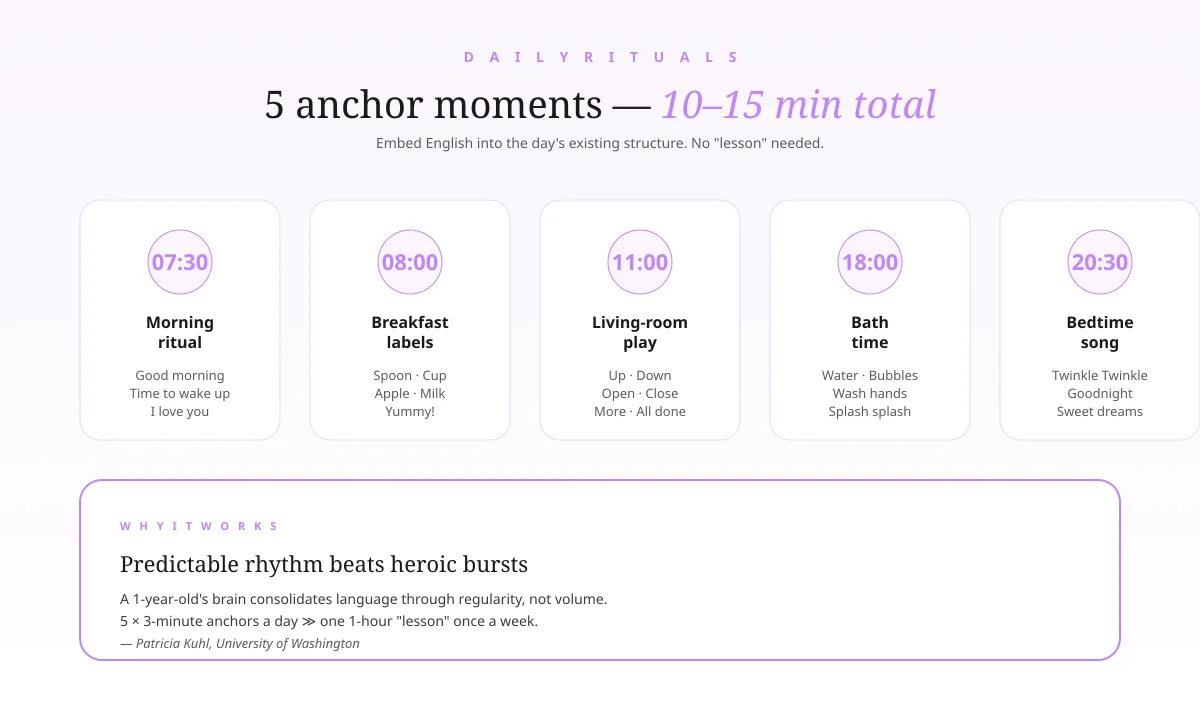
Once week 1 is complete, you replace the artificial "plan" with five anchor moments embedded in the day's existing structure. Each anchor is a fixed time, a fixed phrase set and a fixed action. This is how 10–15 minutes of English fits into a real parent's day without anyone calling it a lesson.
| Time | Anchor | Phrases | Length |
|---|---|---|---|
| 07:30 | Morning ritual | Good morning · Time to wake up · I love you | 3 min |
| 08:00 | Breakfast labels | Spoon · Cup · Apple · Milk · Yummy | 3 min |
| 11:00 | Living-room play | Up · Down · Open · Close · More · All done | 3 min |
| 18:00 | Bath time | Water · Bubbles · Wash hands · Splash splash | 3 min |
| 20:30 | Bedtime song | Twinkle Twinkle · Goodnight · Sweet dreams | 2 min |
The total is fourteen minutes. Spread across five anchors, no individual moment exceeds three minutes. A 1-year-old's attention span never exceeds three minutes anyway, which is why a one-hour "lesson" approach fails for this age group: the child stops absorbing after the first three minutes and the remaining 57 are wasted.
Predictable rhythm beats heroic bursts. A toddler's brain consolidates language through regularity, not through one-shot volume.
Building an English routine at home? The free Mommy & Me English starter guide lays out the daily rituals step by step.
How long until first words: real timeline
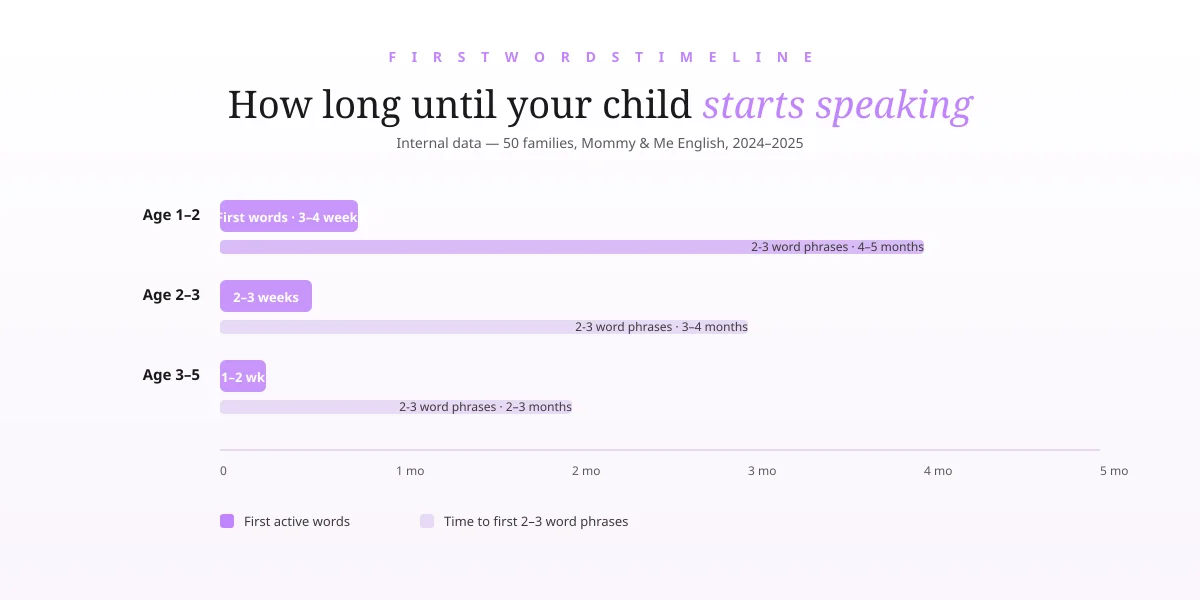
The following timeline is drawn from 50 families who completed the Mommy & Me English program in 2024 and 2025. Each child's mother followed the daily-anchor protocol described above and used native-speaker audio for every phrase.
| Child age | First active English words | First 2–3 word phrases | Comprehension threshold |
|---|---|---|---|
| 1–2 years | 3–4 weeks | 4–5 months | Day 7–10 (head turn, point) |
| 2–3 years | 2–3 weeks | 3–4 months | Day 5–7 |
| 3–5 years | 1–2 weeks | 2–3 months | Day 3–5 |
Two patterns repeat across the dataset. First, the older the child at start, the faster the first active word — because cognitive control and motor planning are more developed. Second, the younger the start, the cleaner the eventual pronunciation — because the phonetic map is laid down without interference.
The combination most parents want — fast first word and clean accent — does not exist. You can choose one. Starting at 1 prioritises the accent; starting at 4 prioritises the speed.
For mothers who do not speak English
The most common fear we hear is "I'll teach my child a wrong accent." This fear is misplaced. Cambridge University's 2023 review of bilingual home environments found that, before age 5, a child's pronunciation is shaped overwhelmingly by the highest-quality phonetic input she hears repeatedly — usually the native-speaker audio in songs, shows or course materials — not by the parent's accent. The mother's role is rhythm and emotional engagement, not pronunciation correctness.
What this means in practice: every phrase your child hears should reach her in two forms. First, native-speaker audio (song recording, course audio). Second, your live voice. The audio carries the accent; you carry the consistency. This pair is what produces children who speak with a near-native accent in spite of having a parent who does not.
The three rules collapse into:
- Use audio for every new phrase. If a phrase has no audio, do not introduce it.
- Speak alongside the audio, not perfectly. Imperfect repetition is what teaches the child this is a real language and not a recording to be ignored.
- Stay in the routine. A mother who repeats imperfectly every day outperforms a tutor who visits once a week and says everything correctly.
7 mistakes that nullify the method
- Translating every word. Builds passive English with delay-shaped responses.
- Changing the phrase set every day. The brain consolidates only what it meets repeatedly in the same context. Five phrases for one week beats fifty phrases in one day.
- Audio without the mother. Cartoons, podcasts and language apps as the only English input fail under age 3 — Patricia Kuhl's TV-vs-live experiment is the canonical evidence.
- Demanding speech. A toddler who senses she is being tested produces silence. A toddler who senses she is being played with produces sound.
- Background noise as substitute. Five minutes of focused song beats three hours of English playing in another room. Background English is acoustic wallpaper, not language input.
- Skipping the rhythm. One missed week resets several weeks of progress at this age. Daily — even if shorter — beats weekly.
- Comparing to other children. Variance at this age is enormous. A child whose first word arrives at week 6 is not behind a child whose first word arrived at week 3. Both are inside the normal range.
A private tutor vs. the mother: honest comparison
Parents often ask whether a private tutor for a 1- or 2-year-old is faster than the mother-led approach. The honest answer: the variables that decide the outcome are different in each case, and the mother-led path wins on most of them at this age.
| Variable | Private tutor (1 hour / week) | Mother-led (10–15 min / day) |
|---|---|---|
| Total exposure / month | ~4 hours | ~6–7 hours |
| Repetition frequency | Weekly — too sparse for consolidation | Daily — matches consolidation cycle |
| Emotional safety | Variable; depends on rapport | Maximum (parent attachment) |
| Embedded in routine | No — separate appointment | Yes — anchored to existing daily moments |
| Cost / month | 200–600 AED in Dubai for under-3s | One-time course price; mother continues solo |
| Best fit | Age 4+, focused output coaching | Age 1–3, foundation building |
A tutor adds value above age 4, when the child is ready for structured input and conversational practice. Below age 3, the tutor's session is too sparse and too short to compete with the daily rhythm of the parent. The two approaches stack rather than substitute: do the mother-led foundation under 3, then add a tutor or group class from 4.
If you live in Dubai and want a sensory, in-home option for a 2.5–3.5-year-old, see the in-home English program for toddlers in Dubai — it follows the same comprehension-first principles and is delivered at the family's home.
What to do when nothing seems to work
If you have run the plan for seven days and the child shows no signs of reaction, it is almost always one of three things. Check them in order.
- The phrases are landing in different physical contexts. A 1-year-old anchors language to scene as much as to sound. If "good morning" happens in bed today, in the corridor tomorrow and in the kitchen the day after, the ritual never crystallises. Return the phrase to one consistent spatial context — bed, kitchen, bathtub.
- You are testing the child instead of speaking with her. "Say apple, say apple" is the shortest path to silence. Replace the request with action: say the phrase yourself, place the object in her hand, then turn away. If she will speak, she will speak without an audience watching.
- The audio is missing or not a native speaker. Machine voices, the parent's heavily-accented voice in isolation, or "simplified" pronunciation does not build a phonetic map — even with daily exposure. Check the source: every phrase in this article is included with native-speaker audio in the Mommy & Me English course.
If all three checks pass and you have held the rhythm for fourteen days, add one more week of the same set. Some children need three weeks where most need two. This is normal variance, not a signal that the method is failing.
The first 12 months: realistic milestones
Below is a milestone map drawn from program data across one full year of consistent mother-led practice. Treat it as orientation, not a deadline.
- Weeks 1–2: child stops, listens, points. No spoken English yet.
- Weeks 3–4: first English word emerges — usually one of the high-frequency household nouns (apple, milk, ball) or a feeling word (yummy, more).
- Months 2–3: two-word combinations begin (more milk, my apple, mama up).
- Months 4–5: first three-word phrases (I want milk, where is dada).
- Months 6–8: the child code-switches by speaker — speaks Ukrainian to grandma and English to mum without effort, an unmistakable bilingual marker.
- Months 9–12: short narrative — three to four-line stories about her day, songs sung from memory, basic question forms.
By month 12 a child who started under 2 typically has a 300–500-word active English vocabulary and a passive vocabulary several times larger. That is sufficient for comfortable conversation with English-speaking peers in a nursery, mixed-language playground or short trip abroad.
Where to start tomorrow morning
Pick three phrases. Pick a fixed moment. Repeat for seven days. That is the entire entry. The whole structure of a bilingual home is built on top of this single mechanic, and most parents who feel "I can't do this" feel that way because they were imagining a curriculum, a tutor or a level of English they do not have. None of those are required for a 1- or 2-year-old.
If you want the audio for every phrase in this article — the version your child's accent will actually be built on — start with the free first lesson of Mommy & Me English. It contains the morning ritual, the breakfast labels and the bedtime song with native pronunciation, alongside instructions for the mother who is reading them out loud for the first time.

