
 Kateryna Ivanova
Last updated: May 15, 2026 · Author: Kateryna · Reading time: 12 min
TL;DR
- First English words appear between 8 and 15 months — the same range for monolingual and bilingual children.
- Start with functional words ("more", "up", "no") — not the alphabet or colors. Your child has to want to say the word.
- The first 100 words split into 5 blocks: people, actions, food, rituals, objects. Norms: 10 words by 18 months, 50 by 24, 100 by 30.
- Don't teach "words". Teach moments. "Up!" — when you pick the child up. "Yummy!" — when she eats.
- 5 repetitions a day × 7 days = a word is learned. Not magic — basic neurobiology.
"Say 'dog'! Say 'cat'! Say 'red'!" — the most common mistake parents make trying to introduce English. A word a child repeats on command but doesn't use spontaneously is not a learned word — it is a parroting reflex. In 9 years of working with children aged 1–5, I have watched hundreds of parents start with the English alphabet and quit a month later. This guide is about how first English words actually appear in a toddler, and which 100 words to embed in the first 24 months of exposure.
Contents
- Quick answer: which words come first and how many to expect
- How first words emerge — the neurobiology
- Why not to start with the alphabet or colors
- Functional words — the first ones to embed
- The first 100 English words — full list by age
- How to teach: the 5×7 rule
- 5 common parent mistakes
- How to count vocabulary in a bilingual child
- Red flags — when to consult a speech therapist
- FAQ
Quick answer: which words come first and how many to expect
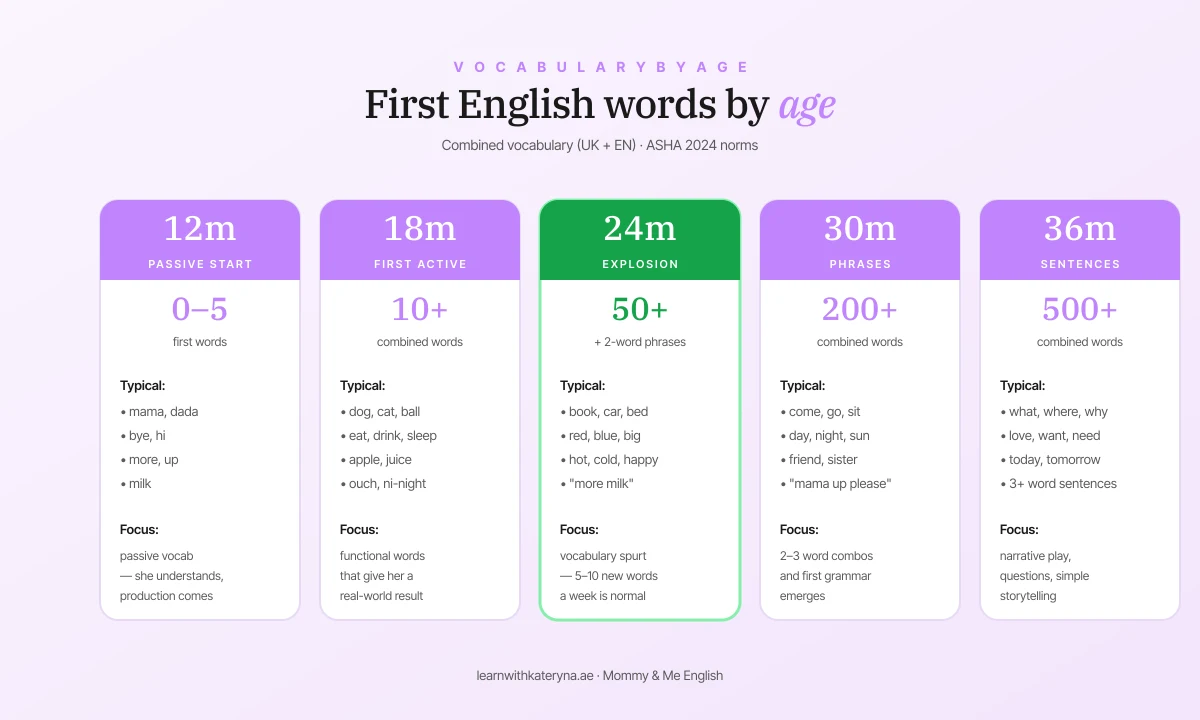
A toddler's first English words are short, functional, emotionally charged sounds that unlock a specific action or response in the child's world. "More", "up", and "bye" appear before "apple" or "red". By 18 months a child should have 10+ words combined (across both languages, for bilingual kids). By 24 months — 50+. By 30 — 200+. These are American Speech-Language-Hearing Association (ASHA, 2024) norms.
Rule #1: the child's first word is the one that is most useful to her right now. Say "red" all day with no payoff — it won't stick. Say "more" right before serving a second bowl of soup — she'll have it within five days.
How first words emerge — the neurobiology
A toddler's speech develops in five stages. Knowing them changes the whole approach.
Stage 1: Cooing (2–4 months)
The baby produces vowels and some consonants. This is not language — it is the vocal tract warming up. In English, react: "What a happy sound!", "You're talking to me!" Don't teach — build feedback.
Stage 2: Babbling (6–10 months)
"Ba-ba-ba", "ma-ma-ma", "da-da-da". The baby is playing with syllables. Talk to her face to face — the brain maps mouth movements to sound.
Stage 3: First word (8–15 months)
The first "real" word — one the child uses on purpose to get a reaction. Most often "mama", "dada", "more", "bye", "hi". If at 15 months there is no word at all, check hearing and oral-motor function.
Stage 4: Vocabulary explosion (18–24 months)
After 50 words, vocabulary grows explosively — 5–10 new words a week. This is the best window to seed English words in parallel with the native language.
Stage 5: First phrases (22–30 months)
The child starts combining: "more milk", "mama up", "bye dog". Not grammar — functional communication. By 36 months, full 3+ word sentences appear.
Why not to start with the alphabet or colors
"The English alphabet" — a habit inherited from school memories — is the most common starting point for non-native parents. But for a 1–3-year-old, the alphabet has zero functional value. Letters are abstractions; toddlers operate on concrete objects and actions.
Same with colors. "Red", "blue", "green" — these are adjectives that require a full grammatical model (noun + adjective). For a child not yet producing single words, an adjective is just noise. Across the acquisition literature the order is consistent: nouns and verbs arrive before adjectives, and colour words are among the last to be used reliably — often not until four or five.
What the science says: functional words tied to the child's will — "more", "up", "no", "mine" — are learned in 5–7 days on average. Colors and numbers take 3–6 months.
Functional words — the first ones to embed
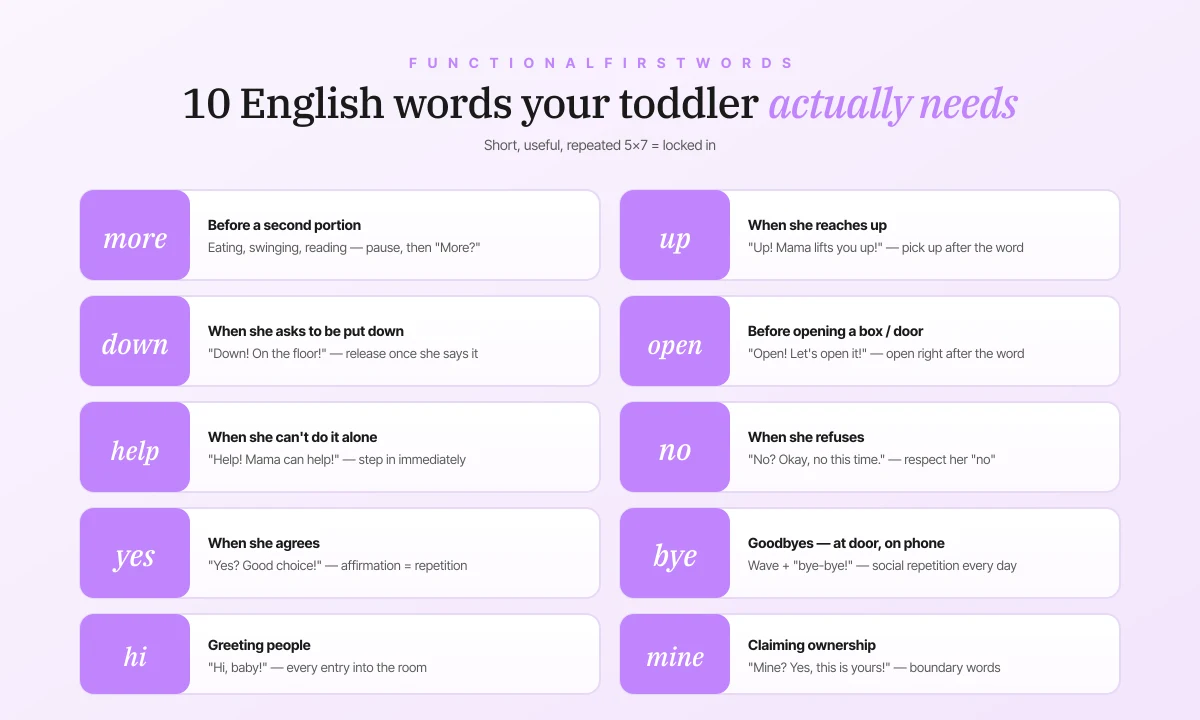
A functional word is a word that gives the child a real-world result. "Up" = I get picked up. "More" = I get more. "Help" = mom intervenes. This is not "language teaching" — it is a tool of influence.
Top 10 functional English words for the first year
| Word | When to use it | Child's reaction |
|---|---|---|
| more | Before second portion of food/play | Wants more, says "more" |
| up | When she reaches up to you | Gets picked up |
| down | When she asks to be put down | Goes to the floor |
| open | Before opening box/door | Gets access |
| help | When she can't do it alone | Mom steps in |
| no | When refusing | She is heard |
| yes | When agreeing | Agreement reached |
| bye | Saying goodbye | Contact closes |
| hi / hello | Greeting | Social contact |
| mine | Claiming ownership | Boundary set |
All 10 — short, one-syllable, with a hard ending. All give the child real-world feedback. That is exactly why the Mommy & Me English ritual method begins with them.
The first 100 English words — full list by age
Listed by age band. This does not mean a 12-month-old should know every word in the 12m block — it is the pool from which to pick 10–20 key words for your family.
Block A: 0–12 months (build the passive vocabulary)
People: mama, dada, baby, grandma, grandpa
Ritual actions: hi, bye, more, up, down, yes, no
Food: milk, water, num-num (or yummy)
Body: nose, eyes, mouth, hand, foot
20 words — the foundation of passive vocabulary. The child understands these by 12 months and starts producing them after.
Block B: 12–18 months (first active words)
Animals: dog, cat, bird, fish, cow, duck
Food: apple, banana, bread, juice, egg
Actions: eat, drink, sleep, walk, play
Rituals: wake-up, bath, ni-night, ouch, please, thank-you
22 words — typical 18-month norm.
Block C: 18–24 months (vocabulary explosion)
Objects: book, ball, car, bed, chair, cup, spoon, toy, shoes, hat
Colors: red, blue, yellow, green
Description: big, little, hot, cold
Places: home, park, store, outside, inside, in, on, under
Feelings: happy, sad, tired
27 words — moving into active vocabulary.
Block D: 24–30 months (phrases and grammar)
Actions: come, go, sit, stand, jump, run, look, listen, give, take, throw, catch
Concepts: day, night, sun, moon, water, rain, snow
Social: mommy, daddy, friend, sister, brother
21 words — typical 30-month norm.
Block E: 30–36 months (full sentences)
Time: now, later, today, tomorrow, morning, night
Questions: what, where, who, why, how
Emotions: love, like, want, need, scared
16 words + ~100 context words from daily life.
Total — 106 words. The core. Everything else is layered on top.
Don't teach "100 words". Embed 5 words a month. After 20 months, your child has 100. It works because it is slow and stable — not fast and shallow.
How to teach: the 5×7 rule
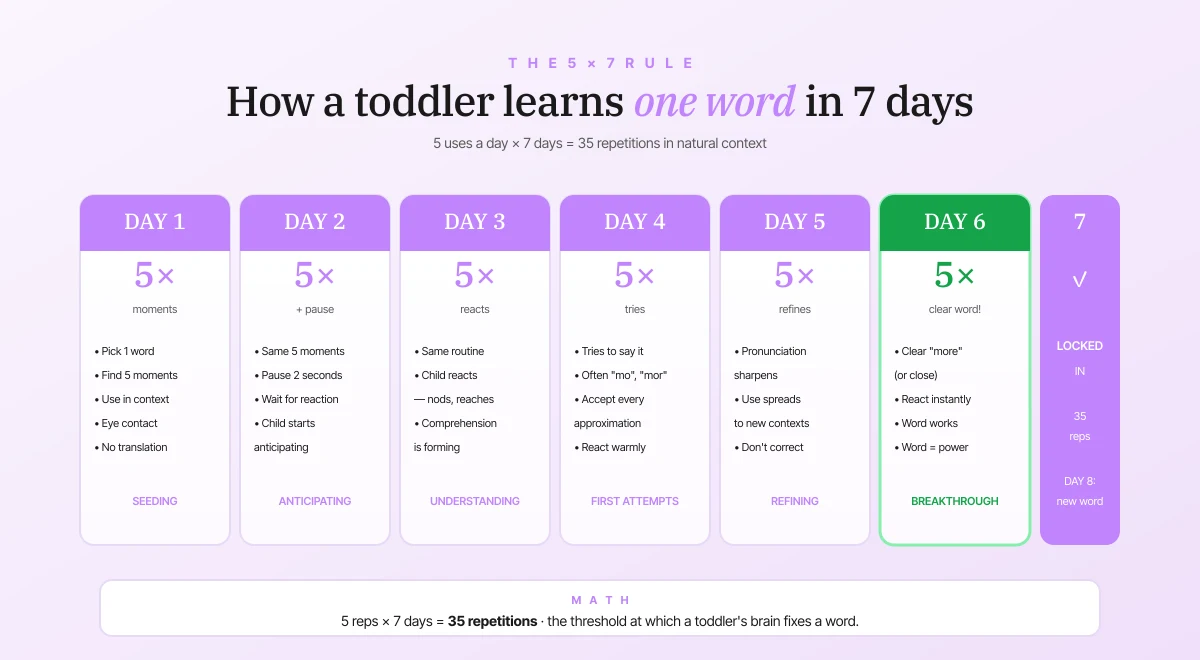
Each word should be used 5 times a day for 7 days in natural context. That is 35 repetitions — the threshold at which the toddler brain "fixes" the word.
Step-by-step over 7 days
- Day 1: pick one word (e.g. "more"). Find 5 daily moments where it fits: second helping of soup, one more swing, one more page of the book, one more song, one more hug. Each "more" — smiling, clear, eye contact.
- Day 2: repeat the same 5 moments. Pause 2 seconds after saying "more" before giving — the child starts to anticipate the word.
- Day 3: after "more", the child reacts — nods, reaches. This is the beginning of comprehension.
- Day 4–5: the child tries to say the word. Often "mo", "mor", "mi". Accept everything — the attempt is what matters.
- Day 6: clear "more" (or close enough) emerges. React instantly — the word works.
- Day 7: consolidation. "More" is now in the active vocabulary.
- Day 8: move to the next word — for example, "up".
Four new active words a month. 48 a year. Enough for a 24-month-old to have 50+ active English words — the full active-vocabulary norm.
5 common parent mistakes
1. Testing instead of using
"Say 'dog'!" is a test. The child feels examined and shuts down. Instead: point to the dog and say "Look, a dog! Dog says woof-woof!". The word lives in context — it is not demanded.
2. English in the background, no interaction
Cocomelon in the background does not teach language. Patricia Kuhl's 2003 study at the University of Washington showed that nine-month-olds learned new speech sounds from a live tutor but showed no learning at all from the identical material on video or audio. Live interaction is the key.
3. Translating instead of letting context speak
"Apple — this is яблуко" breaks the natural acquisition mechanism. The child should understand "apple" through the object itself — saw it, held it, bit it, heard the word. No translation.
4. Expecting "correct" pronunciation
"Bi", "mi", "mo" are normal stages of "bye", "milk", "more". Don't correct — accept and react. Articulation stabilizes on its own by 30 months.
5. Focusing on quantity
"How many words does my child know?" matters less than "how is she using them". 10 words a child uses beat 50 she "knows but won't say".
How to count vocabulary in a bilingual child
If your child is growing with Ukrainian + English, count combined vocabulary. "Mama" and "мама" — one word (one concept). "Dog" and "собака" — two words. This is standard practice for exactly one reason: a test given in a single language measures only the part of a bilingual child's vocabulary that happens to sit in that language, and therefore always understates what the child actually knows.
We covered this in depth in "Does bilingualism delay speech?" — where we show why "distributed vocabulary" is not a deficit.
Red flags — when to consult a speech therapist
Bilingualism is not an excuse for absent words. If your child:
- 12 months — no babbling, no response to her name;
- 18 months — fewer than 10 words combined across both languages;
- 24 months — fewer than 50 words, no 2-word phrases ("mama give", "more milk");
- 30 months — speech is unintelligible to the family;
- 36 months — no 3+ word sentences,
— book a speech therapist. A delay is a delay regardless of how many languages are spoken at home.
Which words to embed in each daily ritual
Words don't live in a vacuum. They appear with situations. So instead of "teaching 10 words from a list", tie each word to a specific ritual — repetition then happens naturally.
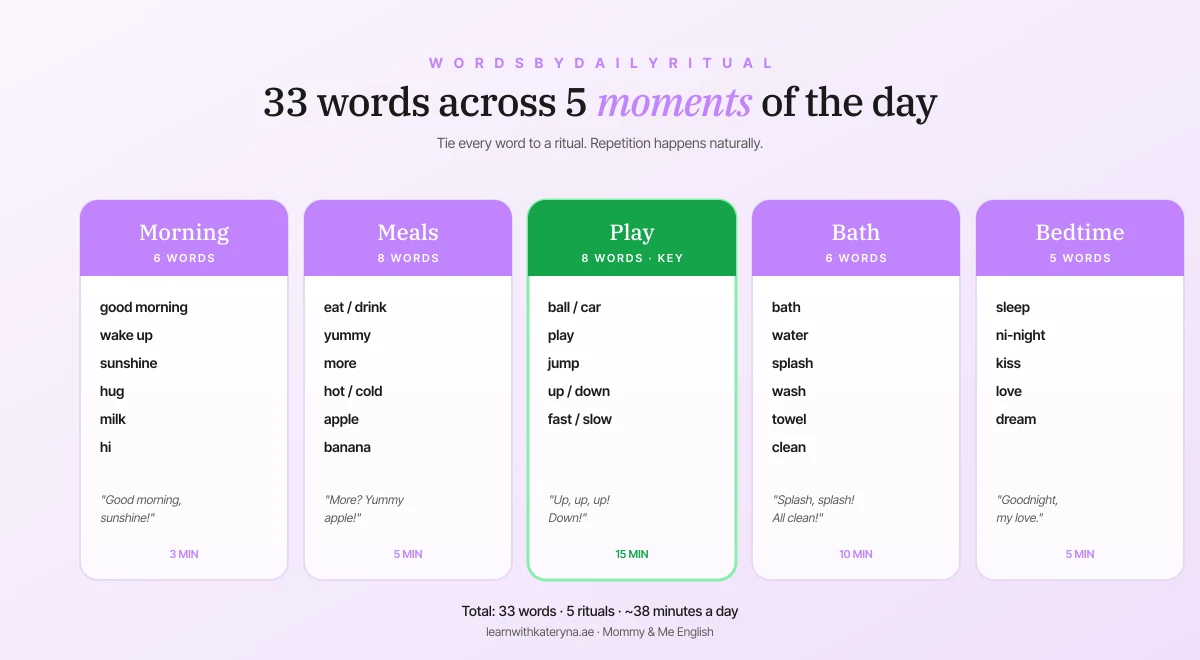
Morning ritual — 6 words
Words: good morning, wake up, sunshine, hug, milk, hi.
Script: walk into the child's room, open the curtains: "Good morning, sunshine! Wake up, my love!". Hug: "Big hug!". Carry to breakfast: "Milk! Time for milk!". By day 7, the child anticipates these phrases and starts repeating the first part.
Breakfast and lunch — 8 words
Words: eat, drink, yummy, more, hot, cold, apple, banana.
Script: before the second spoonful — "More?" — and wait 2 seconds. Before giving an apple — "Apple! Yummy apple!". If food is hot — "Hot! Be careful!". Context makes the word transparent without translation.
Play — 8 words
Words: ball, car, play, jump, up, down, fast, slow.
Script: roll a ball — "Ball! Catch the ball!". Swing the child — "Up, up, up! Down!". Push a car — "Fast! Slow!". Words tied to movement — muscle memory locks them in twice as fast as "seated" lessons.
Bath — 6 words
Words: bath, water, splash, wash, towel, clean.
Script: "Bath time! Water is warm!". Splashing — "Splash, splash!". Drying: "All clean! Big towel!". Bath is the most rewarding moment for English: the child is in a positive emotional state, the brain is wide open.
Bedtime — 5 words
Words: sleep, ni-night, kiss, love, dream.
Script: "Time to sleep. Goodnight, my love. Big kiss. Sweet dreams.". The same sequence every evening. Within 30 days, the child says "ni-night" or "kiss" on her own.
Together — 33 words, distributed across natural daily rituals. Two months in, you have embedded them all — without a single "lesson".
How to track your child's vocabulary properly
This is the question that confuses parents the most. Speech therapists use standardized scales — MacArthur-Bates CDI, ICDI, or Words and Sentences. At home, a simple journal works.
What counts as a "word"
A word is any sound or approximation a child uses consciously in the right context. The pronunciation does not have to be precise. "Bi" for "bye", "mo" for "more", "woof" for "dog" — all count. Not a word: a random sound, repetition without context, or a word produced on command ("say 'dog'!").
How to keep a vocabulary log
- A notebook or doc: two columns — Ukrainian words, English words.
- Date: when you first heard the word in a real context.
- Context: the situation in which the child used it.
- Monthly check: is the child still using the word? If not, return it to the daily ritual.
After 6 months you have a clear picture of progress. Useful both for your peace of mind and for any conversation with a pediatrician or therapist.
What NOT to count
- Words produced on command ("Say 'dog'!" → "dog"). This is a parroting reflex, not active vocabulary.
- Sound effects with no referent ("woof-woof" without pointing to a dog).
- Words the child said once two months ago and never again.
A 30-day starter plan for the first vocabulary block
Prefer a ready-made plan on paper? Download our free Mommy & Me English starter guide — the daily rituals and first-words plan in one printable PDF.
- Week 1: embed "more", "up", "bye". 5×7 rule for each.
- Week 2: add "mama" (English pronunciation if she already says it in Ukrainian), "milk", "no".
- Week 3: add "yes", "hi", "open". By now your child understands 9 words.
- Week 4: add "book", "ball", "dog". End of month — 12 active English words.
After 30 days you see first active production. After 90 — first 2-word combinations ("more milk", "mama up"). Not magic. Five repetitions a day × stability.
Expert insight: why a word list is not a course
In 9 years of teaching I have read dozens of "100 first words" lists online. All beautiful. None, on their own, teach a language. Because words are not text units — they are behavioral tools. A toddler learns words from repeated situations, not from a printout. This is the principle behind the Mommy & Me English method: we don't teach the alphabet. We embed English into the moments of the day where words work.
What to do next
If you have read this and are thinking "I want to start but I don't know when in the day" — start in the morning. The morning ritual is the most powerful, because the child's brain after sleep is at its most receptive.
- Read 7 daily English rituals — the full architecture of a language day.
- See 25 best English songs by age — songs = rhythm + words = fastest memorization.
- Make sure you are not repeating myths: Does bilingualism delay speech?
- If your child is 1–5 — join the full Mommy & Me English course. 10 minutes a day, ready scripts, results in one month.
Last updated: May 15, 2026 · Author: Kateryna — certified English teacher (Trinity College London, NILE Norwich), 9+ years working with children aged 1–12. Background in speech pathology and primary education. 50+ families in Ukraine, EU, and the UAE.


