 Kateryna Ivanova

Counting to ten in English is the skill toddlers love showing off to grandma. But between reciting "one-two-three" like a rhyme and understanding that five means five actual objects lies a gap no vocabulary list ever mentions. This guide covers all the numbers from 1 to 20, the trap that confuses even adults (thirteen vs thirty), the three developmental stages of learning to count, and 9 games that need nothing but fingers, stairs and biscuits.
Three stages: the rhyme, the quantity, the numeral
When a three-year-old rattles off "one, two, three, four, five," that is not yet counting. Child psychologists distinguish three separate skills, and they emerge at different times:
Stage 1 — rote counting. The child memorises the sequence of words as a song — exactly the way she memorises "Baa Baa Black Sheep." This appears first, around age 2–2.5, and it is a wonderful start: the melody of the sequence settles into memory for good. But the word five is not yet connected to any quantity.
Stage 2 — cardinality. Around age 3.5 the big leap happens: the child understands that the last number named answers the question "how many?" You show three biscuits, count together "one, two, three" — and the toddler realises: there are three biscuits. Researchers of early maths call this the "cardinality principle" — and this, not the rhyme, is real counting.
Stage 3 — numeral recognition. The link "symbol 5 = word five = five objects" matures even later, closer to 4–5, together with interest in letters. No need to rush: written numerals are the most abstract layer, and without the first two stages they collapse into mechanical memorisation.
The practical takeaway: sing counting rhymes with a two-year-old, count real objects with a three-year-old, hunt for numerals on houses and lift buttons with a four-year-old. Everything in its own order — and it works in English exactly as it does in the child's first language.
Numbers 1–10
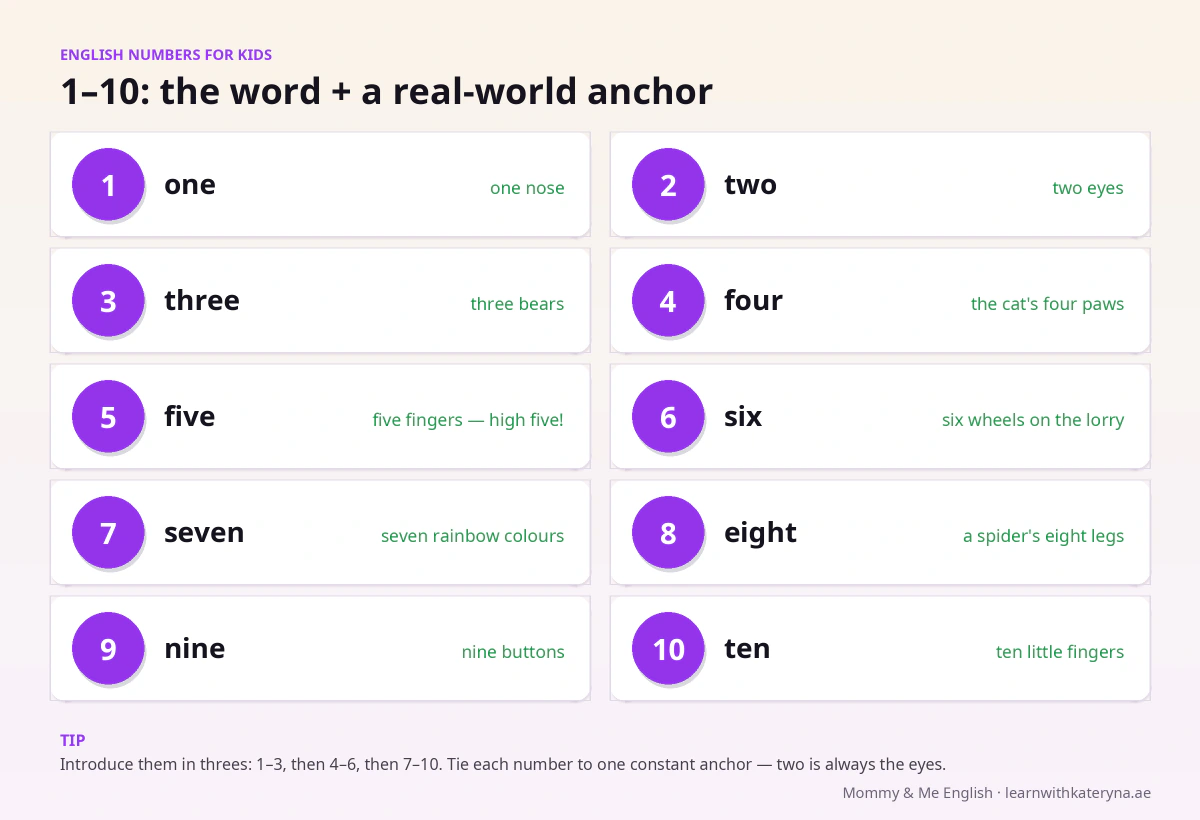
The first ten covers 90% of all toddler counting. Anchor each number to a constant, physical association:
| Number | Word | Anchor it to |
|---|---|---|
| 1 | one | one nose |
| 2 | two | two eyes |
| 3 | three | three bears |
| 4 | four | the cat's four paws |
| 5 | five | five fingers — high five! |
| 6 | six | six wheels on the lorry |
| 7 | seven | seven colours of the rainbow |
| 8 | eight | a spider's eight legs |
| 9 | nine | nine buttons |
| 10 | ten | ten little fingers |
A tip that saves months: introduce numbers not all at once but in threes — first 1–3, a week or two later 4–6, then 7–10. Three items is what a two-year-old can hold in play without overload. And tie every number to the body or the home immediately: two is always the eyes, five is always the palm. One constant association beats ten changing ones (the same principle I described in the guide to the first 50 English words).
Numbers 11–20: where it gets tricky
The second ten of English numbers is built unevenly, and knowing this in advance saves you from being puzzled by your child's mistakes:
| Number | Word | Note |
|---|---|---|
| 11 | eleven | an exception — learn it as its own word |
| 12 | twelve | an exception — learn it as its own word |
| 13 | thirteen | the first "-teen"; stress falls on the end |
| 14 | fourteen | four + teen — the logic kicks in |
| 15 | fifteen | watch out: fif-, not five- |
| 16 | sixteen | six + teen |
| 17 | seventeen | seven + teen |
| 18 | eighteen | eight + teen (a single t) |
| 19 | nineteen | nine + teen |
| 20 | twenty | the tens begin; stress on the start |
Three things to note. First: eleven and twelve are pure exceptions — they are simply memorised. Second: in thirteen and fifteen the root changes (not three-teen, not five-teen) — these are the most common child errors, and they are completely normal; native-speaker toddlers make exactly the same ones. Third: 11–20 is worth introducing only after the first ten feels like home — usually around age 4–4.5.
The thirteen/thirty trap
Here is the trap that trips up even adults with years of English behind them: the pairs 13/30, 14/40, 15/50 and onwards sound almost identical. Thirteen — thirty. Fourteen — forty. The difference sits in two small details:
Stress: in the -teen numbers it falls on the end (thir-TEEN); in the -ty tens it falls on the start (THIR-ty). The final sound: -teen is long and ringing [teen], -ty is short and clipped [ty].
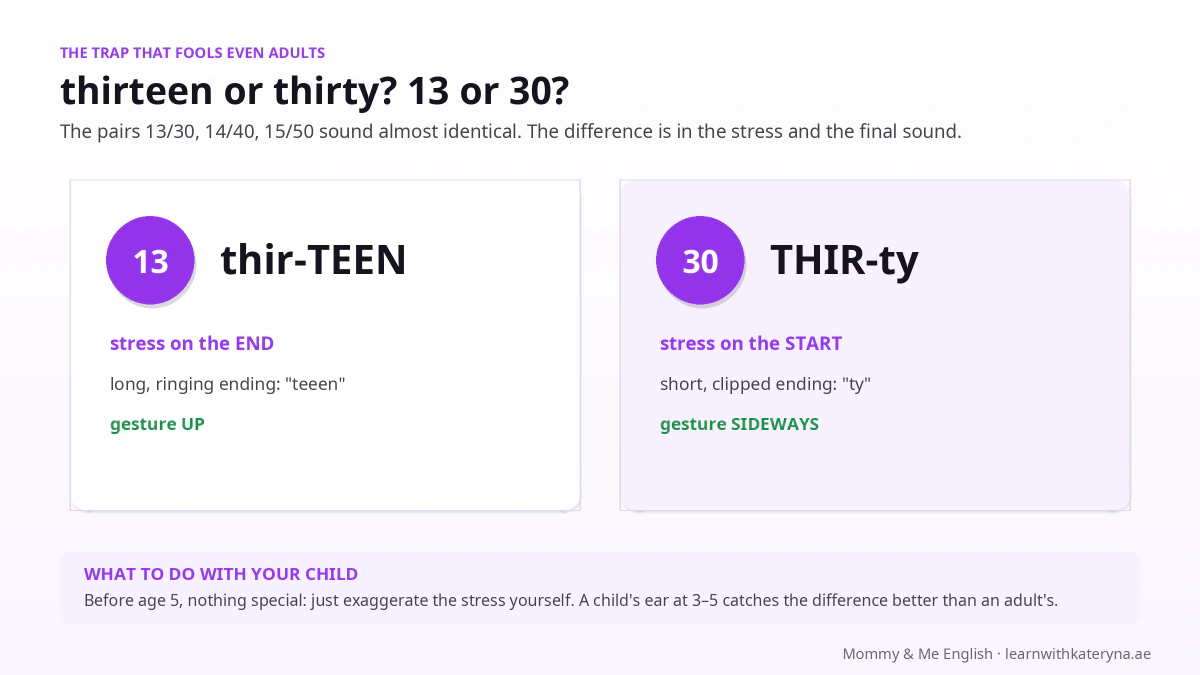
What should you do with a toddler? Nothing special before age 5 — just exaggerate the stress yourself: "thir-TEEEEN!" with a gesture upwards, "THIR-ty" with a gesture sideways. A child's ear, trained on songs, catches this difference naturally — better than an adult's ear does. This, by the way, is the strongest argument for starting numbers in the preschool years: phonemic hearing peaks between 3 and 5, and what gets recorded correctly now stays correct forever.
Pronunciation: 4 sound traps for Ukrainian speakers
1. Three — not "free" and not "tree." The dental /θ/: the tip of the tongue rests gently between the teeth while you blow. Practise in front of a mirror together — it is a fun game in itself ("show your tongue to number three!").
2. One — starts with /w/, not a Ukrainian "у". Round the lips as if for "oo," then release straight into "a." Compare with van — there the upper teeth touch the lower lip; in one they don't.
3. Six versus sex. The short /ɪ/ in six sits between "ee" and "i". Stretch it into "seeex" and you get an awkward word. Keep it short and light.
4. Eight without extra sounds. Not "eyeht" — a clean diphthong [ey] plus a crisp [t].
If you want a systematic approach to English sounds, I have a separate guide to phonics for toddlers — all 42 sounds in the right order.
9 number games with no flashcards and no tablet
1. Stairs. The simplest and the most effective: climb the stairs, count every step aloud. Twenty steps twice a day = forty repetitions of the sequence without a single "lesson" minute.
2. Fingers. "How many fingers? One, two, three!" Fold your child's fingers one by one. Bonus: the tactile feeling of "one more" is a physical experience of addition.
3. Biscuits on a plate. "You have three cookies. One, two, three!" One gets eaten — "Now two!" This is no longer a rhyme; it is real cardinality: the quantity changes before the child's eyes.
4. Hide-and-seek countdown. You count to ten in English while the toddler hides. The motivation to listen to the end is built into the game.
5. Number hunt. For 4+: hunt for numerals on a walk — house numbers, buses, lift buttons. "Look, a five!" The city becomes a textbook.
6. Jumps. "Jump three times! One, two, three!" Movement + number = the formula of the TPR method, the fastest route to retention at this age.
7. Setting the table. "We need four plates. One, two, three, four." Counting with a practical result — the most meaningful kind of all.
8. "How many are hiding?" Show three toys, cover them with a scarf, remove one. "How many now?" For ages 4.5–5 this is first arithmetic disguised as play.
9. Countdown. "Ten, nine, eight… blast off!" A rocket launch (= tossing the toddler up) is the one game children beg to count for again.
Building an English routine at home? The free Mommy & Me English starter guide lays out the daily rituals step by step.
Songs and counting rhymes that work
Number sequences are where songs are irreplaceable: rhythm holds a sequence better than any repetition. Three time-tested classics:
"One, Two, Three, Four, Five (Once I Caught a Fish Alive)" — the classic count to ten with a built-in story and actions (caught a fish — let it go — it bit "this little finger on my right").
"Five Little Ducks" — the best song for counting down 5→0 and for first subtraction: the ducklings disappear one by one, and the child physically sees "one less."
"Ten in the Bed" — a 10→1 countdown with the beloved "roll over!": play it with the child's own toys on the bed, rolling them off one at a time.
How to weave songs into the day without separate "lessons" — I covered that in detail in the guide to English songs for kids. In short: one song per week, at the same moments of the day, with actions.
What to realistically expect at 2, 3, 4 and 5
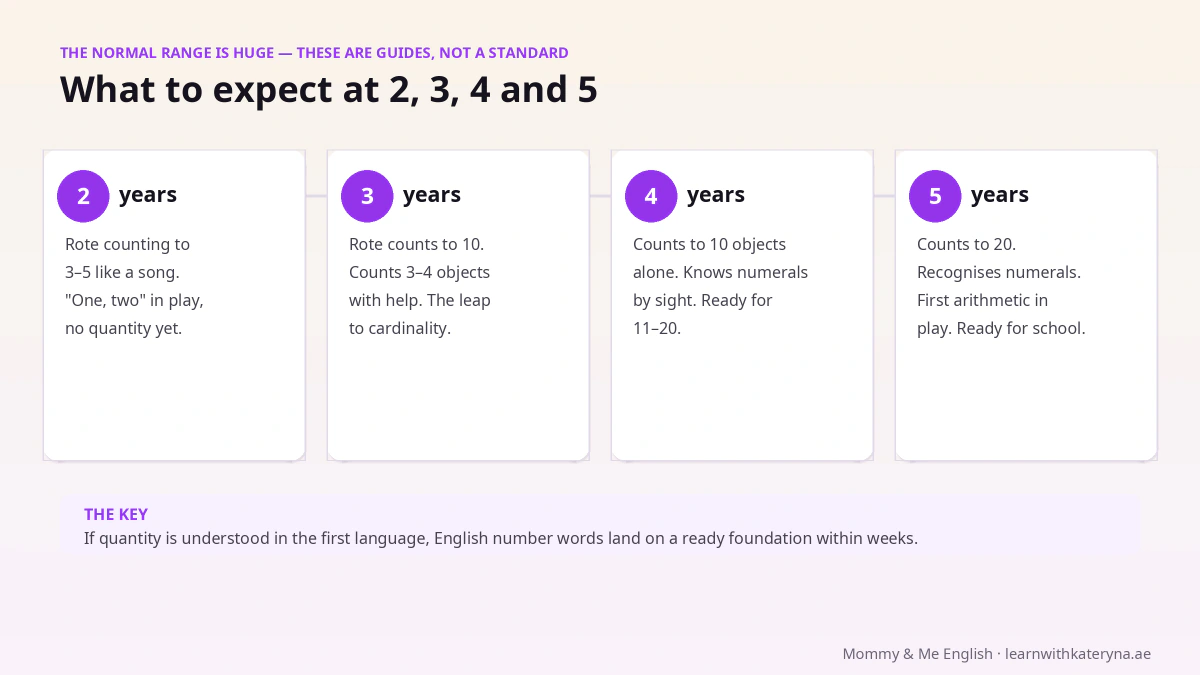
2–2.5 years: repeats "one, two" inside a song, shows "one" on a finger. Rote counting to three or five — as a melody, without quantity. That is normal, and that is success.
3–3.5 years: rote counts to ten, reliably counts 3–4 real objects with your help. Starts answering "How many?" for small quantities. Somewhere here the cardinality leap happens.
4–4.5 years: counts up to ten objects independently, knows several numerals by sight, is ready for 11–20. Understands "more" and "less" when comparing piles.
5 years: counts to twenty, recognises numerals to 10–20, plays "how many are hiding" with objects removed. This is a level that makes starting school comfortable — Ukrainian or international alike.
Important: the normal range is enormous. A child who doesn't count to ten in English at 3.5 is not "behind" — she may simply be investing her resources elsewhere right now. If quantity is already understood in the first language, English number words land on a ready foundation within weeks. And if you are worried the two languages might tangle each other up, read my breakdown of bilingualism myths — spoiler: they won't.
6 parent mistakes with numbers
1. Chasing "up to one hundred." Counting to 100 at age four impresses the guests but has zero developmental value if no quantity stands behind the words. Ten objects counted with understanding beat a hundred words in a row.
2. Counting only "in the air" — without objects. A rhyme with nothing to touch stays stuck at the song stage. Always let the finger touch the object: touch — count — touch — count.
3. Correcting skipped numbers. "One, two, five, nine!" is not an error — it is a normal stage. Don't interrupt. Just count together more slowly next time.
4. Introducing written numerals before quantity. The symbol "7" is a floating abstraction for a three-year-old. First seven biscuits, then the word seven, and only then the sign.
5. Mixing languages inside one count. "Один, два, three, чотири" — that way the sequence gets recorded in neither language. One count — one language, all the way through.
6. Turning counting into an exam. "Go on, count to ten for auntie!" is the fastest way to grow an aversion. Counting lives in play — in stairs, biscuits and rockets, not in performances for an audience.
Numbers inside everyday phrases
Individual numbers get memorised, but they only come alive inside phrases. As soon as the first three are settled, start weaving numbers into ordinary moments of the day — the same principle as in the everyday phrases for parents:
- At the table: "Two more bites!" — and "One for you, one for me" while sharing biscuits: a distribution the child personally controls, which is why she listens very closely.
- While getting dressed: "Two socks! One… two!" — socks, mittens and shoes are natural everyday "pairs."
- In the bath: "Let's count your toes! One, two, three…" — ten toes are a nightly counting machine that never gets boring.
- While waiting: "Let's count to ten and then we go!" — counting as a timer makes waiting understandable and bearable: in a queue, at a traffic light, while food warms up.
- Playing ball: "Throw it three times!" — any repeatable action becomes counting: throws, jumps, spins.
The rule is the same as everywhere in early English: the number should sound at the moment of the action, not instead of it. Not "let's study numbers" but "One, two — two socks!" during real dressing. Ten such micro-moments a day deliver more than half an hour at a desk — and cost you not a single extra minute.
Zero, more, less: three words around the numbers
Three "non-number" words keep the numbers from staying half-alive — and children pick up all three gladly, because each is instantly practical:
More. The first of the three, and often one of the very first English words overall: "More?" you ask, holding the spoon, and the toddler nods. More is the number "bigger than now," and it works long before the child can count to three. Later it grows into comparison: "Who has more cookies — you or teddy?"
Less / fewer. Arrives much later than more (around age 4), and that is normal: everywhere in development, the child brain masters "more" before "less." Don't force it — introduce it through pile comparisons: "Look, this plate has less porridge!"
Zero. Every four-year-old's favourite "number," because it is funny: "How many elephants are in our kitchen? ZERO!" The game "count what isn't there" is unexpectedly powerful: the laughter of absurdity ("how many crocodiles in the bath?") cements both the word zero and the very idea of an empty set — one of the hardest mathematical concepts there is, delivered through a joke.
The daily working trio: "More apples or less? How many now? One, two — and zero bananas left!" Three words turn mechanical counting into the first genuine mathematical conversation.
Ordinals: first, second, third
After the counting numbers, the ordinal ones appear in a child's life early: who runs to the door first, who is second in line for the slide. For preschool age, only three are genuinely needed:
- first ("I'm first!" — the phrase your child will learn entirely on her own, because every playground demands it)
- second
- third (the dental th again — tongue between the teeth)
Note: the first three English ordinals are complete exceptions (first, second, third — no trace of one, two, three in them), which is exactly why they are learned as standalone words, not as a "rule." From four onwards everything is regular — fourth, fifth… — but that is a school-age story.
Where ordinals live in daily life: stairs ("First step… second step!"), queues ("Mummy first, then you!"), the sequence of the day ("First we wash hands, THEN we eat" — the first/then frame is the most useful tool for explaining order of actions, and a gentle patience trainer at the same time), and the favourite — races: "Ready, steady, go! Who is first?"
The first… then… frame deserves its own paragraph, because it solves an everyday problem every parent knows: transitions between activities. "First bath, then book," said calmly and with gestures, works better than long explanations in any language — the formula is short, predictable and always kept. Many families on our course report that first/then became their number-one "peace phrase" of the evening.
Next steps
Start with one-two-three on the stairs today — no preparation, no materials. Over a month or two add 4–6 and 7–10, keeping each number on its own constant association. A song of the week, biscuit-counting at lunch and a countdown before every "rocket launch" — and the first ten will consolidate itself. Next come colours (numbers + colours = first phrases like two red apples) and everyday phrases for parents, so English sounds beyond counting too.
And if you would rather have a ready-made system than assemble one piece by piece — take a look at the Mommy & Me English starter guide: video lessons, audio, checklists and a plan for every day. Ten minutes a day with mum in the leading role — and numbers, colours and phrases enter your child's speech as naturally as the first language.


