 Kateryna Ivanova

Clothes in English are learned not from flashcards but while getting dressed: a child aged 1–5 dresses and undresses 4–6 times a day, and every single time is a ready-made mini-lesson with real things in hand. Fifteen core words, the put on / take off pair and three ritual phrases are enough — and within 6–8 weeks the topic runs inside daily life with zero table-top lessons.
TL;DR:
- Getting dressed is the day's most frequent "lesson": 4–6 natural sessions daily — more than any other topic offers
- 15 core words cover the entire toddler wardrobe; clothes is always plural
- The put on / take off pair is the topic's engine: two phrasal verbs learned through the body
- The choice question at the wardrobe ("Red or blue T-shirt?") reduces morning meltdowns — the side effect parents value most
- Independent dressing and English grow together: by 4–5 a child dresses herself — and narrates it in English
Why getting dressed is the day's most frequent lesson
Count honestly: morning dressing, getting ready for the walk, undressing afterwards, changing after lunch or bath, pyjamas at night. On average a child aged 1–5 goes through dressing or undressing four to six times a day — 28–42 "sessions" a week. No other early-English topic comes with that frequency of natural repetition: meals give three contacts a day, bath time one — clothes outrun them all.
The second advantage is full sensory input. The child doesn't look at a picture of a jumper — she pushes her head through it, feels the fabric, wrestles the sleeve. A word that sounds at the moment of physical action with the object is remembered many times more firmly than a word from a card — the same body-learning principle the TPR method is built on.
And the third, most underrated one: dressing is an activity you cannot skip. You can miss the book or the song, but the child gets dressed no matter what. A topic embedded in an unavoidable ritual doesn't depend on inspiration, energy or schedule — it runs by itself, daily, for years.
Clothes is the only English topic with a guaranteed 4–6 "lessons" a day, none of which can be cancelled. The only question is whether they happen in English.
The core wardrobe: 15 words
A toddler's wardrobe in English is 15 words. Not the 40 of adult lists (blazer, cufflinks, turtleneck), but exactly what a child wears daily:
- T-shirt
- trousers (British; Americans say pants)
- shorts
- dress
- skirt
- jumper (American: sweater)
- jacket
- coat
- hat (any headwear in toddler language)
- socks
- shoes
- boots
- pyjamas
- gloves (mittens — the fingerless toddler kind)
- scarf
Introduce by frequency in your actual life, not by list order. In summer start with T-shirt, shorts, hat and shoes; in winter with jacket, hat, boots and gloves. The rule is the same as with the first words: three or four at a time, each tied to a real thing the child handles every day.
A small detail that isn't small: clothes is always plural
The word clothes itself exists only in the plural: clothes ARE, never clothes is. There is no "one clothe" — just as there is no single "scissor." For parents this means one simple habit: "Where are your clothes?", "Your clothes are here!"
The second plural trap is the paired items: trousers, shorts, pyjamas and gloves are always plural too (two legs, two hands). So it's "Where are your trousers?" — even about a single pair. No need to explain this to the child — it is enough that the correct form keeps sounding in your phrases: the child's ear assembles grammar from statistics, as everywhere else. Socks and shoes, meanwhile, have a normal singular — and when one sock has vanished (as one always does), you get one of the topic's most-used real phrases: "One sock! Where is the OTHER sock?"
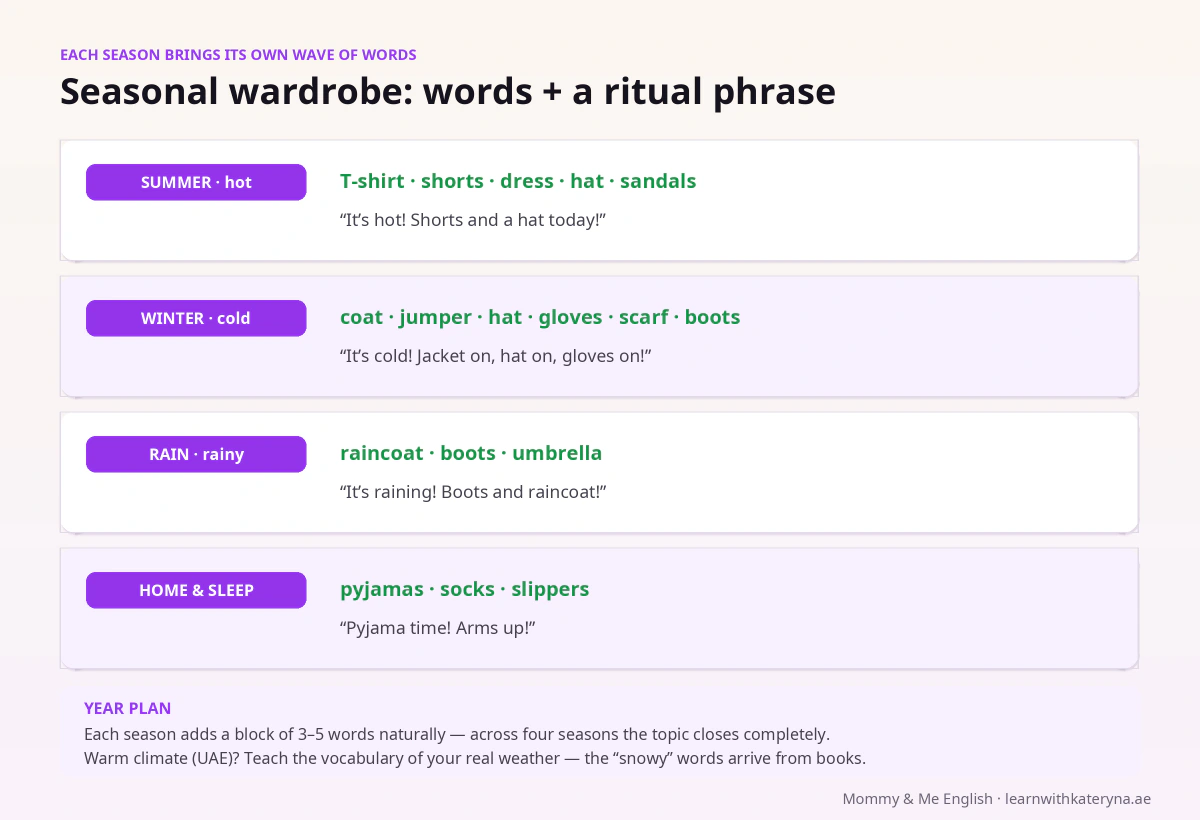
The season table: summer, winter and rain
Clothes are a seasonal topic, and that is a bonus: the wardrobe changes four times a year, each time delivering a "new wave" of words in natural context:
| Season / weather | Key words | Ritual phrase |
|---|---|---|
| Summer (hot) | T-shirt, shorts, dress, hat, sandals | "It's hot! Shorts and a hat today!" |
| Winter (cold) | coat, jumper, hat, gloves, scarf, boots | "It's cold! Jacket on, hat on, gloves on!" |
| Rain (rainy) | raincoat, boots, umbrella | "It's raining! Boots and raincoat!" |
| Home / sleep | pyjamas, socks, slippers | "Pyjama time! Arms up!" |
The table doubles as a year plan: each season adds its block of 3–5 words, and within four seasons the topic closes completely with zero forcing. For families in the UAE and other warm places the winter block sounds rarely — and that is fine: teach the vocabulary of your real climate, and the "snowy" words will arrive from books and cartoons.
Put on / take off: the pair that drives the topic
Put on — to dress in, take off — to remove. These two phrasal verbs are the engine of the entire topic: every one of the 4–6 daily sessions is made of them. "Put on your socks! Now put on your shoes! …Take off your jacket, we're home!"
For adult learners, phrasal verbs are the textbook horror chapter. For a toddler, put on is simply one action-word she hears at the exact moment her foot slides into the trouser leg — hundreds of times a month. As I wrote in the verbs guide, a child raised on put on / take off receives English's "hardest" grammar as a gift, before school even starts.
A pronunciation note for parents: in put on the weight falls on ON, in take off on OFF. Say the particle clearly and separately — it carries the meaning of direction (onto / off the body), and the child navigates primarily by it.
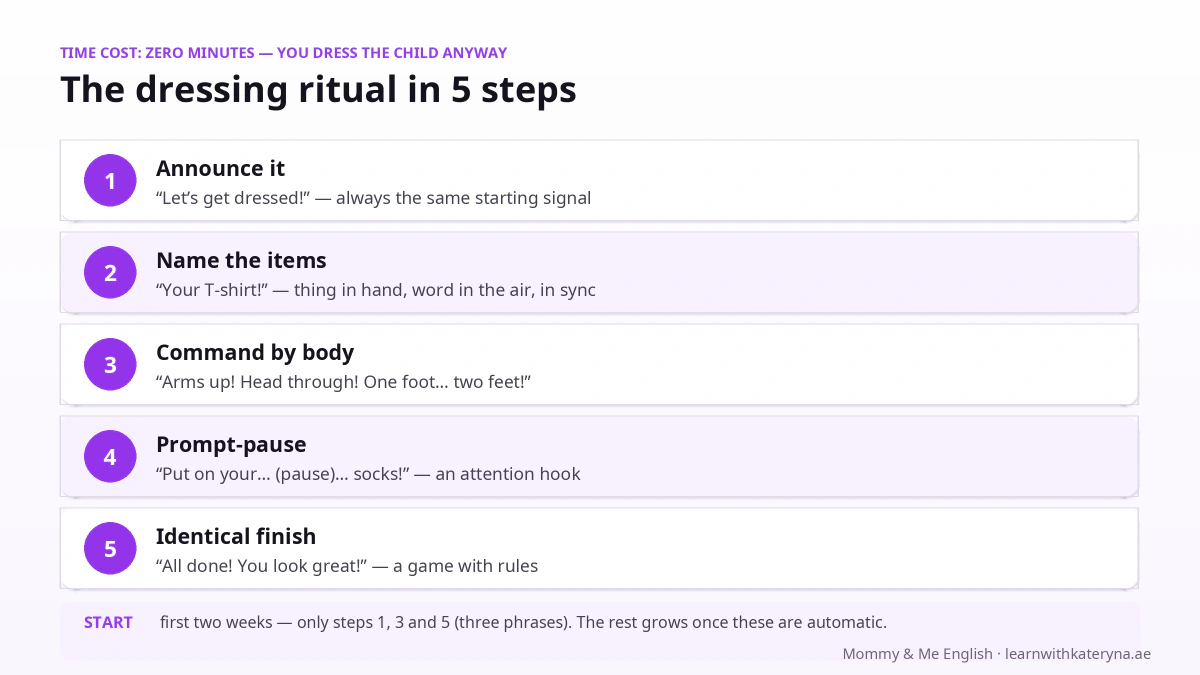
The dressing ritual in 5 steps
The full method for turning ordinary dressing into a daily mini-lesson — five steps proven by hundreds of families on our course:
- Announce the session. "Let's get dressed!" — the starting signal, always identical. Within a month the child heads to the wardrobe on hearing it.
- Name each item as you pick it up. "Your T-shirt! Your trousers!" Thing in hand — word in the air: the synchrony of action and sound is the entire secret.
- Command by body parts. "Arms up! Head through! One foot… two feet!" Here the clothes topic stitches itself to body parts — two topics in one ritual.
- Pause before familiar words. "Now put on your… (pause)… socks!" The pause is an attention hook: the child "prompts" the word internally — and soon starts prompting out loud.
- Finish identically. "All done! You look great!" A ritual with a clear ending reads as a game with rules — and the child plays it gladly every day.
The method's time cost is zero minutes: you dress the child anyway. Only the language it happens in changes. For the first two weeks stick to three phrases ("Let's get dressed", "Arms up", "All done"), then grow — exactly as with the everyday phrases.
Weather decides: the first reasoning conversation
The topic's summit is the weather→clothes link, because it is no longer vocabulary — it is the child's first cause-and-effect reasoning in English. Every morning at the window: "Look outside! Is it hot or cold? …Cold! So what do we need? A jacket!"
This thirty-second conversation trains three things at once: weather words (hot, cold, rainy, sunny, windy), if–then logic, and the structure of a real dialogue with a question and a justified answer. For a child of 3.5–4 it is the first experience of deciding in English rather than naming — a qualitatively different level of language ownership.
The 4.5+ extension: let the child decide. "You are the weather boss today! Look outside — what do we wear?" A child who has "weather-appointed" rubber boots for the whole family feels in charge — and you have received a three-to-four-phrase English monologue, produced with zero pressure.
"Cold — so jacket" is the first if–then a child utters in English. All the school-age "because" speech grows out of this tiny piece of reasoning.
Building an English routine at home? The free Mommy & Me English starter guide lays out the daily rituals step by step.
Clothes + colours + choice: the anti-meltdown method
Now for the side effect parents thank us for most. The morning wardrobe meltdown is a classic of ages 2–4: the child refuses to dress because her day contains almost no decisions that are hers. The choice question hands control back — and dissolves the conflict:
"Red T-shirt or blue T-shirt?" — holding up both. The child chooses (by finger or by word — either counts), and the dressing goes easier from there, because this is now HER T-shirt, her decision. The mechanics are the same as the choice question at the table from the food topic — while the colours get drilled in their most natural role: as a decision criterion.
Important: the choice must be real (both options fine with you) and limited (two, maximum three — five T-shirts paralyse a two-year-old the way a ten-page menu paralyses an adult). And accept the choice without commentary: a child whose choice was "corrected" won't choose next time — and you lose both the easy morning and the English practice with it.
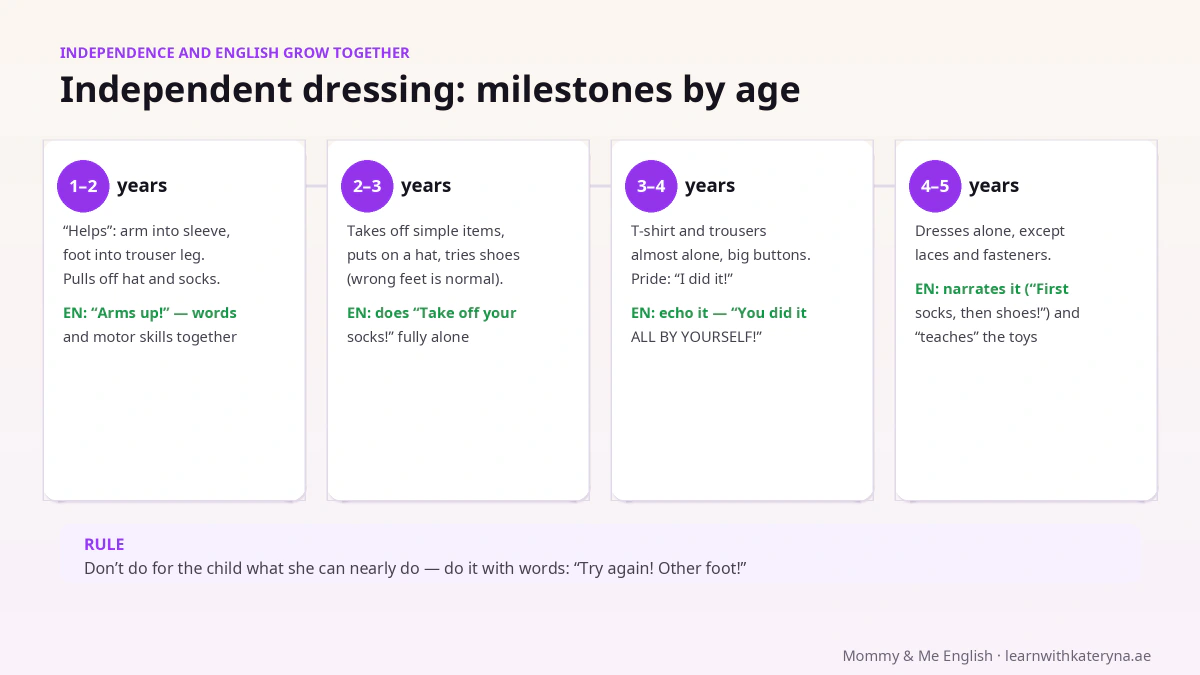
Independent dressing: what a child can do at which age
The clothes topic has one more dimension — motor development, and English walks hand in hand with independence here. The reference points (per the CDC developmental milestones programme and the Australian parenting portal raisingchildren.net.au):
1–2 years: "helps" with dressing — extends an arm into the sleeve, a foot into the trouser leg, pulls off hat and socks (undressing always runs ahead of dressing!). Your commands "Arms up!", "Foot in!" are language and motor-planning practice in one.
2–3 years: removes simple items independently, puts on a hat, attempts shoes (often on the wrong feet — completely normal). The English milestone: the child executes "Take off your socks!" entirely alone — a command has become an independent action.
3–4 years: puts on a T-shirt and trousers with minimal help, undoes large buttons. Pride arrives: "I did it!" — a phrase worth catching and amplifying: "You did it! You put on your T-shirt ALL BY YOURSELF!"
4–5 years: dresses almost fully alone, except tricky fasteners and laces. The English milestone: the child narrates the process ("First socks, then shoes!") and "teaches" younger siblings or toys to dress — the topic's highest level.
The practical takeaway: don't do for the child what she can nearly do — do it with words instead. "Try again! Other foot!" instead of silently swapping her shoes — and every minute of "slow" independent dressing doubles in value: motor skills plus language.
Clothes leave the house: the suitcase and the shop
The topic's final level is two "field" scenarios that turn wardrobe vocabulary into a life tool:
The suitcase game. Before any trip (or simply in play) the child gets a real small bag and a mission: "We're going to grandma! Pack your clothes: two T-shirts… pyjamas… socks!" The toddler brings the items one by one; you count and fold together. One game runs clothes, numbers and sequence memory at once — while the child receives the "grown-up" responsibility children adore. For families who travel or live between two countries, the game also eases packing anxiety: a suitcase the child packed herself is a piece of control over the move.
The clothes shop. An extension of the shop game from the food topic — now with clothes on the "counter." "Can I have the blue T-shirt, please?" — "Here you are!" — "Thank you!" For 4+, add the fitting verdict: "Too big! Too small! …Just right!" — the Goldilocks trio children learn from a single story evening. And in a real shop, a child who can say "I like the red one!" turns a boring clothes errand into her own small mission.
Both scenarios do the same thing: they take the words out of the wardrobe and into a world where they make decisions. That is the end goal of any topic — not a list, but a tool.
6 clothes games
1. "Where does it go?" — the deliberate mistake, the topic's funniest game: press a sock to your ear — "A sock! On your… ear?" — "NO! On your FEET!" Guaranteed giggles, words cemented.
2. Dress the teddy. The classic: the child is the stylist, you are the voice: "Put on the hat! Now the scarf!" The full ritual in doll form, playable from age 2.
3. The dressing race. For 3.5+: "Ready, steady… put on your socks! GO!" A song instead of a stopwatch. Side effect: getting ready for the walk takes half the time.
4. The magic bag. Clothes in an opaque bag; the child identifies by touch: "What is it? …Socks!" Tactile recognition is the deepest level of knowing a word.
5. Laundry sorting. Sort the clean clothes together: "Daddy's T-shirt! YOUR T-shirt! Mummy's socks!" Clothes plus family plus possessives — three topics in one laundry basket.
6. The fashion show. For 4+: the child assembles an "outfit" and presents it: "Look! My red T-shirt! My blue shorts!" Applaud generously — publicly naming one's own clothes is already a small performance in English.
Songs: Put On Your Shoes
The flagship song is "Put On Your Shoes" (Super Simple Songs): four verses, one item each (shoes, jacket, scarf, hat) and the same hurrying chorus — "put on your shoes, let's go outside! Hurry up, hurry up…". It is a ready-made soundtrack for getting ready: play it at the actual dressing moment, and the song becomes the ritual's audio cue.
The second is the classic "This Is the Way" ("This is the way we put on our socks… so early in the morning"): an endlessly extendable routine song that accepts any morning action. Both work by the rules from the songs guide: one song per week, tied to the real moment, with actions.
5 parent mistakes
1. Teaching clothes from flashcards. The world's most absurd flashcard is "socks" — while real socks pass through the child's hands twice a day. This topic needs no cards at all: the real wardrobe beats any printed material.
2. Teaching the adult vocabulary. Blouse, suit, tie and waistcoat from grown-up lists are dead weight for a three-year-old. Fifteen words of the real toddler wardrobe are the complete programme until school.
3. Rushing and doing it for the child. Dressing her quickly yourself wins three minutes and loses a motor-skills-and-language lesson. Genuinely in a hurry? Say so honestly — "Today mummy helps — quick-quick!" — and hand independence back when there is time.
4. Ignoring undressing. Take off is half the topic — and the easier half: children master undressing first. The evening "Take off your socks! Take off your T-shirt!" is the same lesson as the morning one, with a higher success rate.
5. Perfectionism about the/your. "Put on shoes" without your is not a catastrophe. Don't correct the child and don't torment yourself: articles and possessives assemble themselves from the statistics of your phrases. What matters is that the phrases keep sounding — daily, inside real sleeves and trouser legs.
Next steps
Tomorrow morning — the first ritual: "Let's get dressed! Arms up! …All done!" Three phrases, zero extra minutes. In two weeks add the item names and prompt-pauses; in a month, the choice question at the wardrobe and the weather talk at the window. The topic closes itself in 6–8 weeks, and the seasonal blocks top up across the year. Keep the neighbouring topics close — body parts (they live in the same ritual), colours (the choice criterion) and verbs (put on / take off are family).
And for the whole system at once — video lessons, audio for every phrase, ritual checklists and a day-by-day plan — take a look at the Mommy & Me English starter guide: 10 minutes a day, mum in the leading role, and English built into life rather than added to it.


