
 Kateryna Ivanova
Mummy is usually the first English word a child says not in a game but for real — addressing someone. The family topic is the warmest and simplest of them all: every "teaching material" already lives in your home, and the motivation is built into the words themselves. And here, for once, the cross-language surprise is a pleasant one: where Ukrainian distinguishes the grandmother on mum's side from the one on dad's side, English gets by with a single grandma. This guide covers all the family words, the difference between mummy and mother, the Finger Family song, the photo-album game that beats every flashcard in the world, and the first possessive phrases — "my mummy, your daddy."
Why family is the most rewarding topic
The family topic has three advantages found nowhere else. First — emotional charge: mummy and daddy aren't just words but the most important people in a child's world; words with that much charge stick after one or two repetitions. Second — the "material" is always present: an apple on a flashcard has to be imagined, but mum is right here, every day. Third — built-in practice: a child addresses you dozens of times a day, and every one of those moments can sound in English without a single extra minute of study.
That makes family the perfect second topic after the first everyday words: small (ten words cover the whole inner circle), warm, and instantly usable.
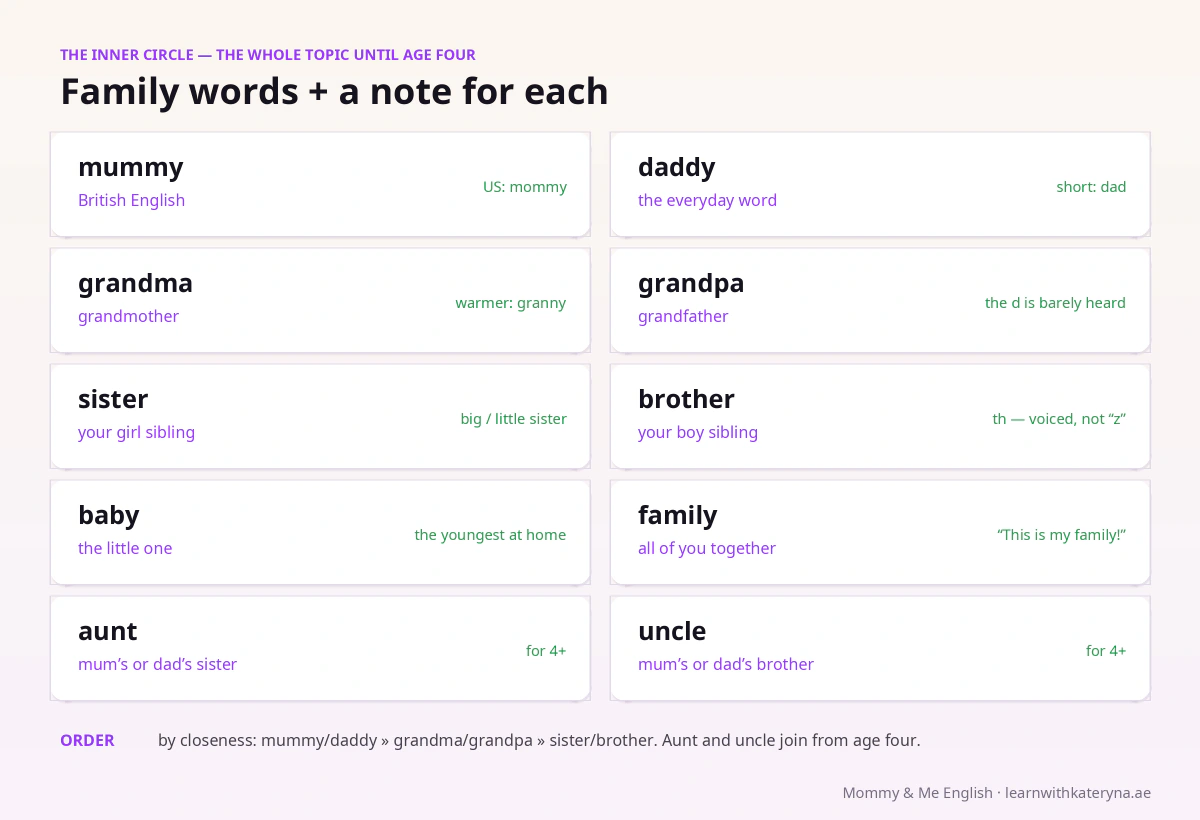
The core words
| Word | Ukrainian | Note |
|---|---|---|
| mummy | мама | British; the American variant is mommy |
| daddy | тато | short form — dad |
| grandma | бабуся | the warmer variant — granny |
| grandpa | дідусь | the d before p is barely heard |
| sister | сестра | big sister / little sister |
| brother | брат | the th is a voiced dental — not a clean "z" |
| baby | малюк | also what the youngest in the family gets called |
| family | сім'я | "This is my family!" — the topic's crowning phrase |
| aunt | тітка | for 4+, once the inner circle is settled |
| uncle | дядько | for 4+ |
Introduce by closeness, not by list: mummy and daddy first (they're nearly free — see below), then grandma/grandpa (especially if the grandparents are nearby or on weekly video calls), then sister/brother if there are any. Leave aunt and uncle for year four — they are more abstract simply because they appear in the child's life less often.
Mummy or mother? Child and adult registers
Textbooks say mother and father — and parents dutifully teach those words. Don't: no English-speaking three-year-old calls her mum "mother." The living child register is mummy (or mama for the smallest), daddy (or dada). Mother and father are formal words for documents and adult conversations; the child will move to them naturally at school — exactly as a Ukrainian child eventually adds «матір» to «мама».
It is the same child-register principle as tummy instead of stomach in body parts: native speakers talk to toddlers in a special, soft language — and your English at home should sound the same. A bonus of this register: mama and dada are phonetically the simplest words in human language (which is why they come first in every culture), so English mummy/daddy costs a Ukrainian toddler almost nothing — the articulation is already in place.
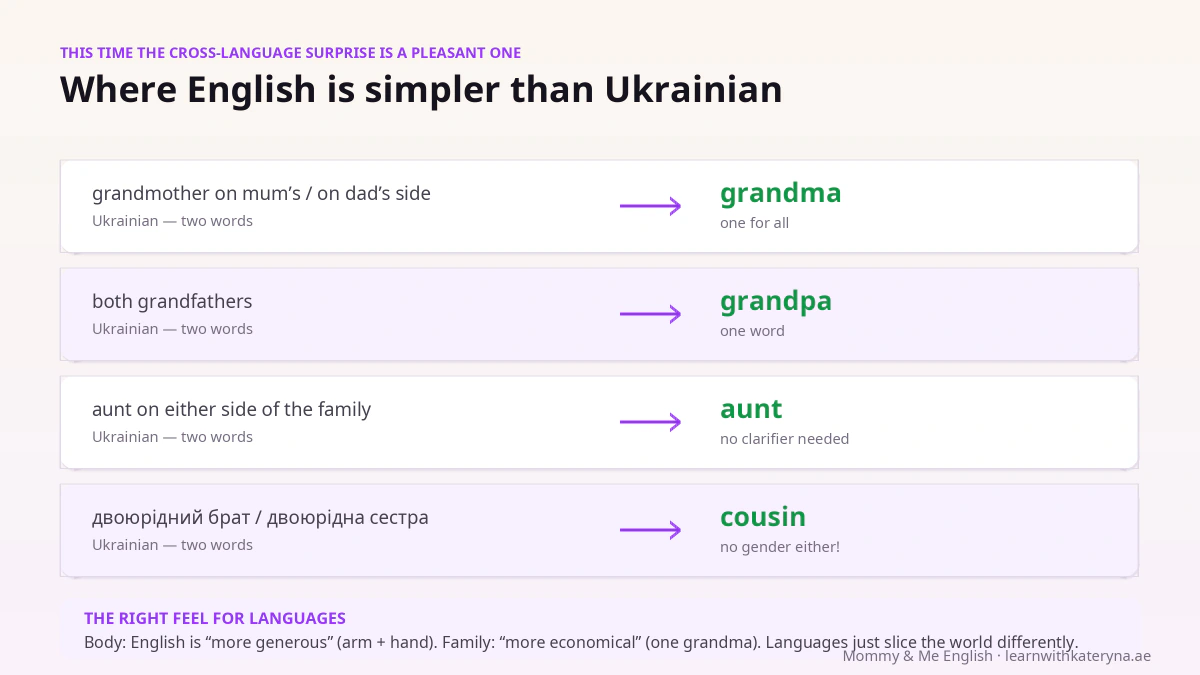
Where English is simpler than Ukrainian
Remember the trap in body parts, where one «рука» splits into arm and hand? In the family topic it's the other way round — and that is excellent news:
| Ukrainian — two words | English — one |
|---|---|
| grandmother on mum's side / on dad's side | grandma — one for all |
| the two grandfathers | grandpa |
| aunt (mum's sister) / aunt (dad's sister) | aunt |
| двоюрідний брат / двоюрідна сестра | cousin — no gender either! |
Cousin is a special gift: one word covers both the male and female cousin. For a child it is simply "Sasha — my cousin!" with zero grammatical deliberation. Keep this asymmetry as a story for yourself: topics where English is "more generous" (the body) and topics where it is "more economical" (the family) together give the right intuition — languages aren't better or worse, they just slice the world differently.
The photo album: the topic's best "textbook"
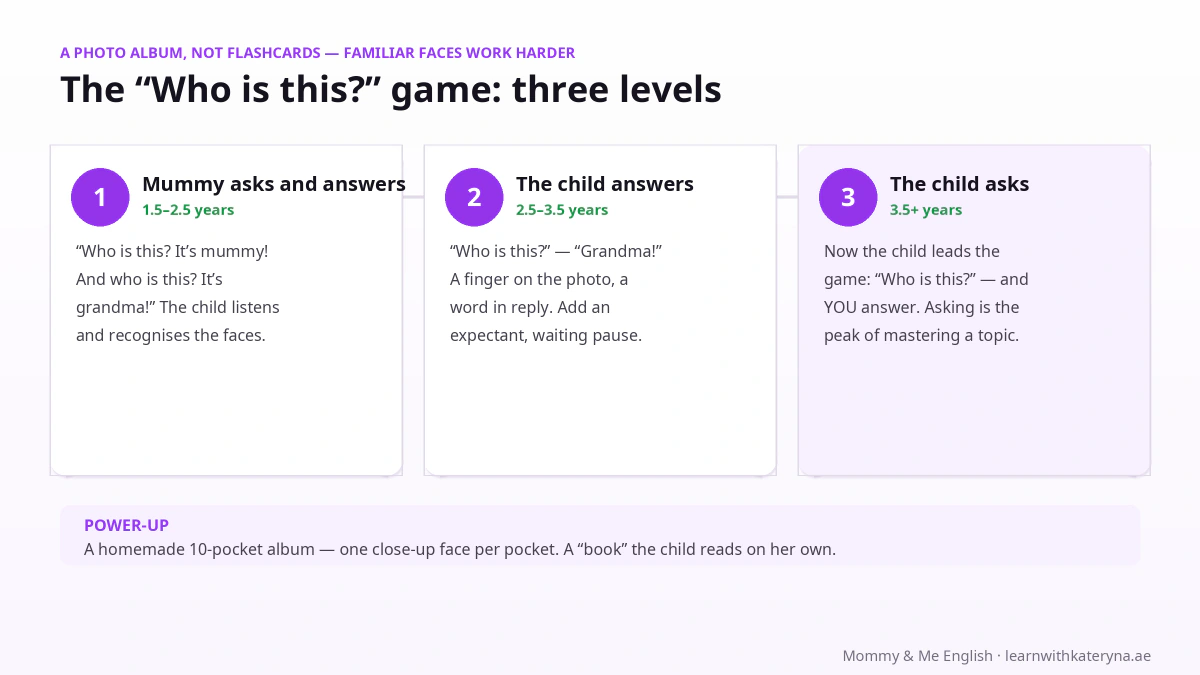
Forget flashcards with drawn "mums" and "dads" — you own material a hundred times stronger: family photos. A child studies familiar faces with a delight no picture can match, and the topic's main game is built exactly on that:
"Who is this?" Open the album (or the phone gallery): "Who is this? It's mummy! And who is this? It's grandma!" At first you ask and answer yourself; a few weeks later the child answers; later still — she asks you. Three levels of one game, months of mileage.
The power version is a homemade family album: a small 10-pocket photo album, one close-up face per pocket. It is a "book" the child can "read" on her own — and the best tool ever for video calls with grandma: "Show grandma the album! Who is this?"
Finger Family: a song on five fingers
The topic's flagship song is "Finger Family": each finger is a family member, from the thumb (Daddy finger) to the pinkie (Baby finger). The melody is primitive to a fault — and that is exactly why it works: all of the child's attention goes to the words and the fingers, not the tune.
How to sing it for maximum effect: hide your hand behind your back and "summon" each finger: "Daddy finger, daddy finger, where are you? — Here I am, here I am!" — and the finger pops out. The moment of appearance is the same anticipation hook as a pause before a familiar word: the child freezes and waits. Later, hand the role over — let her fingers "answer" your questions. That, by the way, is a ready-made rehearsal of the question–answer structure all conversation is built on.
A bonus: the song automatically drills thumb from the body parts topic — the topics stitch together beautifully.
My mummy, your daddy: first possessives
The family topic is the natural doorway into the first "grammar of relationships": my and your. Children feel "mine" early and fiercely — so my mummy is acquired instantly and gladly: "My mummy!" says a three-year-old, hugging you — and that is already a sentence with a possessive pronoun, though nobody said the word "grammar."
Expand gradually: "Is this YOUR daddy? — Yes! MY daddy!" In toy play: "This is teddy's mummy. Where is YOUR mummy?" The my/your pair works better in the family topic than anywhere else, because here "mine" isn't about things — it's about the dearest people, and the emotion doubles the retention.
Building an English routine at home? The free Mommy & Me English starter guide lays out the daily rituals step by step.
6 family-word games
1. "Who is this?" with the album — the topic's main game (above). Works from 18 months to school age.
2. Calling grandma. Before the video call: "Let's call grandma!" After: "Say bye-bye to grandma!" The word sounds at the moment of a live encounter — no stronger context exists.
3. The toy family. Any figures become a family: "This is the daddy bear. This is the baby bear." The child builds families herself — and speaks the whole topic without noticing.
4. "Who is where?" around the house. "Where is daddy? — In the kitchen!" Hunting family members room by room: family words plus the first prepositions of place in one game.
5. Drawing the family. For 3.5+: the child draws, you caption aloud: "This is mummy… this is grandpa…" Hang the finished drawing on the wall — a topic poster made by the child's own hands.
6. Finger Family in reverse. For 4+: mix the fingers up on purpose ("Mummy finger?" — showing the pinkie). The child corrects you, giggling — the same "silly mummy" check that works in every topic.
One family, two languages: families abroad
For families living abroad (like many of our students in the UAE), the family topic has an extra dimension. The child grows up in a world where the nursery teacher says mummy and grandma on the video call says «мама». Here is what matters: this is not a conflict — it is wealth. A child understands very early that «бабуся» and grandma are the same love in two languages, and switches effortlessly depending on who she is talking to.
The single rule: don't mix languages inside one sentence («це твоя grandma») and don't "translate" grandma when talking to her — let the Ukrainian family words live in Ukrainian conversations and the English ones in English. A child who calls her grandmother «бабуся» and tells her teacher about grandma is a bilingual whose development is going exactly to plan. More on why two languages don't confuse a child — in the breakdown of bilingualism myths.
The wider circle: friend, teacher, boy, girl
Once the inner circle is settled, the child's social world demands the next four words — all of them more important than aunt and uncle, because they sound daily:
- friend — "My friend!" says a three-year-old about a child she played with for five minutes in the sandpit, and that usage is correct: in the toddler world, a friend is whoever you are playing with right now.
- teacher — for a nursery child (especially abroad), one of the most important words there is.
- boy and girl — the playground pair: "Look, a boy on the swing! A girl with a ball!"
These words do important work: they take English out of the home and into the social world. A child who knows mummy and daddy talks about her family; a child who has added friend, teacher, boy and girl can talk about her day: "My friend — a girl — we played!" That is the first step towards retelling events — the skill all school-age speech grows from.
And a bonus word with a big heart: everybody. "Everybody at the table! Everybody dance!" Children pick it up fast from nursery commands — and bring it home like a gift.
Who does what: family meets the verbs
The most powerful use of the family words is joining them with the verbs into "reports" about the living household: "Daddy is cooking. Grandma is sleeping. Baby is crying!" Every family member is doing something right now — and each such phrase is not an exercise for the child but news about her world.
Three game formats. First — the home reporter: walk the flat together and "report": "Look! Daddy is reading. Shhh!" Second — guess who: act out an action (someone snoring), ask: "Who is sleeping?" — "Daddy!" Laughter guaranteed, especially if daddy is nearby and protesting. Third — the phone report: during grandma's video call the child "briefs" her on who is doing what: "Mummy is cooking. Daddy is… hiding!" A real listener turns the phrase into genuine communication instead of practice.
After a few months of these games a beautiful thing happens: the child starts informing you about family events on her own — "Mummy! Baby is crying!" — in English, on her own initiative, because that is the language your household "reports news" in. You built not a vocabulary but a function of language.
The family tree: a weekend craft
For a child of 4+, the family topic deserves a proper finale — a homemade family tree. A one-weekend project that gathers every word of the topic into a single picture, which then hangs on the wall and keeps working for months.
How to build it: a large sheet, a tree with branches drawn on. At the bottom of the trunk — the child herself ("This is ME!"). On the lower branches — mummy and daddy. Above — grandma and grandpa on both sides (here the one-grandma-for-all rule pays off: the English tree is simpler than the Ukrainian one!). Nearby — brother, sister, cousin, if any. Photos beat drawings, but drawings are fine — what matters is that the child glues each one herself and says the word at the moment of gluing: "Grandma — here! Grandpa — here!"
The finished tree becomes an interactive poster for every game in the topic: "Who is this? Show me grandpa! Who is next to mummy?" And a point of pride: the child presents HER tree to guests and to grandma on the video call, naming everyone in English. Presenting one's own work is the most natural speaking motivation you can create at home.
For families abroad the tree carries an extra meaning: on it, the people in the next room hang side by side with the people thousands of kilometres away — and the child sees it plainly: the family is whole, just spread wider. Sometimes that sheet of paper does more for a child's heart than all the conversations.
The age cheat-sheet: who to introduce when
The topic's closing navigation — how many family words are genuinely needed at each stage:
1.5–2.5 years: mummy, daddy, baby (about herself!) — and that's all. Three words that sound naturally hundreds of times a day. Grandma/grandpa — if the grandparents are physically present in the child's life (nearby or on regular video calls).
2.5–3.5 years: the full inner circle — grandma, grandpa, sister/brother (where present) and the summarising family. "Who is this?" with the album and Finger Family begin. The possessive my mummy appears on its own.
3.5–4.5 years: the social expansion — friend, teacher, boy, girl. The "home reporter" game (family + verbs). The child starts talking about her day using people words.
4.5+ years: the outer circle as needed — aunt, uncle, cousin (once these people actually figure in her life), the family tree as a project, and the first full-sentence family stories: "This is my family. I have a mummy, a daddy and a baby brother!"
The general rule is the same as everywhere in early English: a word enters when a living person stands behind it and there is a real need to talk about them. A list of relatives "for later" doesn't work; a family there is something to say about works every time.
4 parent mistakes
1. Teaching mother/father instead of mummy/daddy. A toddler who says mother sounds to native speakers like a tiny professor. The living child register is mummy, daddy, granny. The "official" words arrive at school on their own.
2. Teaching every relative at once. Aunt, uncle, cousin, nephew — stop. The inner circle (6–7 words) is the entire topic until age four. The outer circle joins when those people actually appear in the child's life.
3. Using drawn cards instead of photos. An abstract "grandma" from a picture is a stranger. Your grandma in a photo is a beloved face the child recognises with joy — and the emotion of recognition is the memorisation mechanism itself.
4. Translating how the child addresses you. Don't correct «мамо!» into "mummy!" — the form of address is the child's own choice, and it may differ across language contexts. Your job is for both options to be available, not for one to push out the other.
Next steps
Tonight, open the phone gallery and play the first "Who is this? It's mummy!" — the topic launches in one minute. This week add Finger Family with the hand hidden behind your back; next week, the "calling grandma" ritual in English. Within a month or two the inner circle will be solid, and the family words will start gluing themselves to the other topics: "Daddy, look! Three ducks!" — family, verbs and numbers in one three-year-old's sentence.
The complete system — video lessons, audio, a family-album template and a day-by-day plan — is in the Mommy & Me English starter guide: 10 minutes a day with mum in the leading role. In this topic — literally.


