 Kateryna Ivanova

A dog says «гав-гав» in Ukrainian — and "woof-woof" in English. A rooster cries «кукуріку» at home, but in English picture books it's "cock-a-doodle-doo." Animal sounds are not a cute footnote: they are the most underrated tool of early English, because it is through them that a child aged 1–3 produces her first English "utterances" — before any real words. This guide covers 20 animals with their names and sounds in both languages, the reason onomatopoeia speeds up speech, Old MacDonald used as a training machine, and 7 games that need nothing more than a toy farm or a picture book.
Why animal sounds are the best start for ages 1–3
There is a reason the first "words" of most toddlers on the planet are «гав», «му» and «мяу»: onomatopoeia is phonetically simpler than real words (repeated syllables: woof-woof, moo-moo), emotionally charged, and always tied to a vivid image. Speech therapists call these "proto-words" — the bridge between babbling and speech.
For English this is a gift: an animal sound is the first English "word" a child can say at twelve to eighteen months. A toddler who physically cannot yet produce dog will happily say woof — and collect her first experience of "I spoke English and mum lit up." That experience of success is worth more than any methodology.
The second bonus: animal sounds come as a ready-made pair of "easy word + harder word." At first the child says woof while understanding dog; a few months later woof naturally gives way to dog — exactly as «гав-гав» gives way to «собака» in Ukrainian. You get a two-storey system where every child has something to say at her own level. It is the same gradualness principle as in the first 50 words: from simple to complex without jumps.
The farm: 10 animals with names and sounds
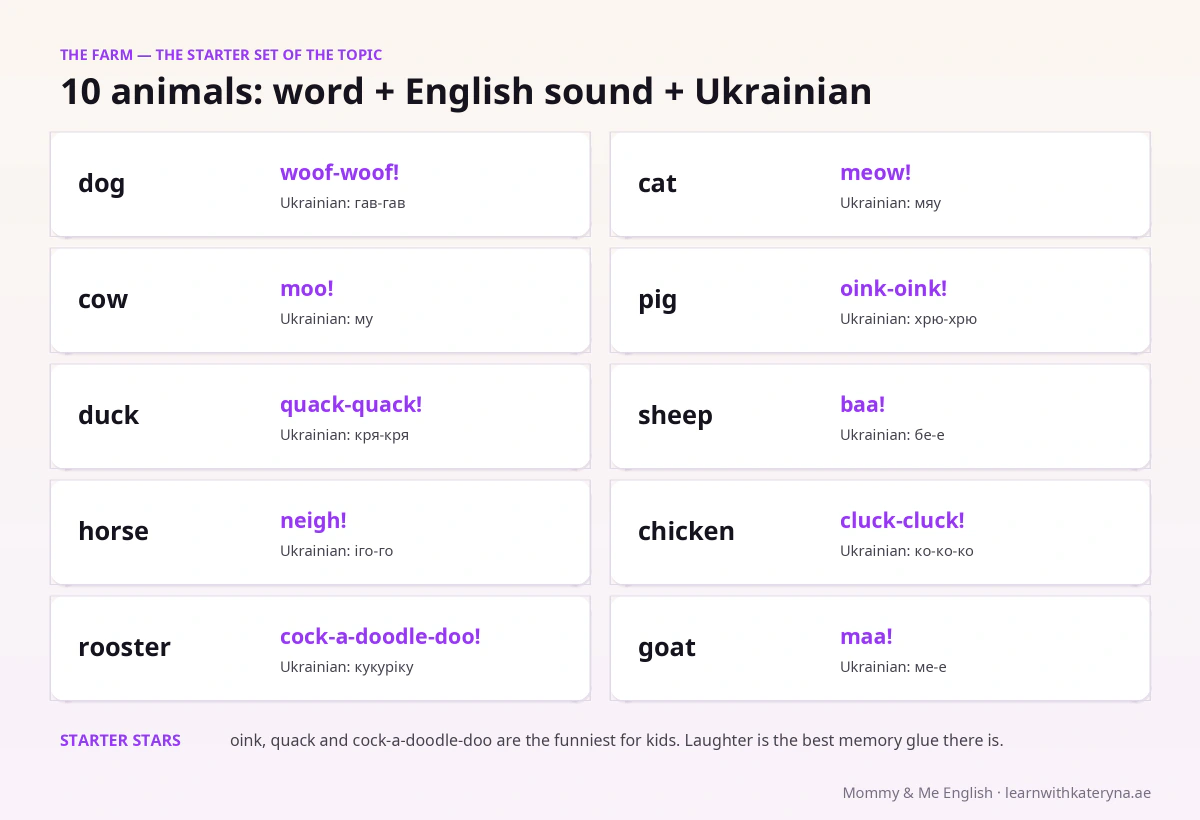
The farm is the starter set of the topic — its sounds are the most contrastive and the most famous from songs:
| Animal | English sound | Ukrainian sound |
|---|---|---|
| dog | woof-woof! | гав-гав |
| cat | meow! | мяу |
| cow | moo! | му |
| pig | oink-oink! | хрю-хрю |
| duck | quack-quack! | кря-кря |
| sheep | baa! | бе-е |
| horse | neigh! | іго-го |
| chicken | cluck-cluck! | ко-ко-ко |
| rooster | cock-a-doodle-doo! | кукуріку |
| goat | maa! | ме-е |
The brightest stars for a first session are oink (the pig), quack (the duck) and cock-a-doodle-doo (the rooster): they differ so wildly from their Ukrainian counterparts that they make both children and adults laugh. Laughter is the best memory glue there is — a word your child giggled at does not get forgotten.
Wild animals and pets
- lion — roar!
- bear — growl!
- elephant — trumpets through its trunk
- monkey — ooh-ooh-ah-ah!
- snake — hiss!
- frog — ribbit-ribbit! (Ukrainian frogs say «ква-ква»)
- bird — tweet-tweet!
- bee — buzz!
- mouse — squeak!
- owl — hoo-hoo!
A note on order: don't teach "the farm" and then "the jungle" as lists. Follow the toys and books your child already loves. If the favourite toy is a dinosaur, the first sound will be roar — and that is perfect: a child's interest always beats methodical order.
Why «гав» ≠ "woof": a little linguistics for parents
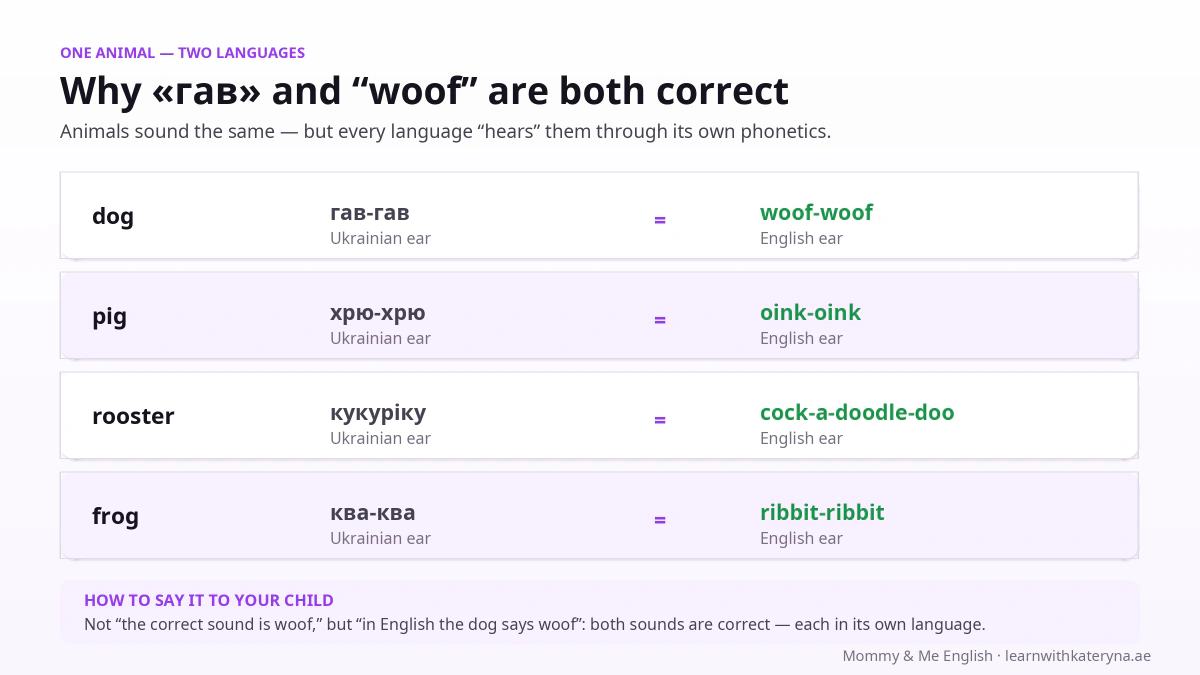
Children (and plenty of adults) are genuinely puzzled: it's the same dog — why are the sounds different? The answer is beautiful: animals sound the same, but every language "hears" them through its own phonetics. Ukrainian has no English w — so the Ukrainian ear heard «гав». English has no rolled «р» the way «кукуріку» starts — so the English ear heard "cock-a-doodle-doo."
For a child this is the first — and very deep — discovery about languages: the same world can be heard and named differently. A three-year-old who knows the pig says both «хрю» and "oink" already understands the essence of bilingualism: languages are two parallel pictures of the world, not a "right" and a "wrong" one. That is why you should never say "the correct sound is woof" — say "in English the dog says woof": both sounds are correct, each in its own language. More on how a child's brain runs two systems at once — in the article on bilingualism myths.
Old MacDonald: a trainer, not just a song
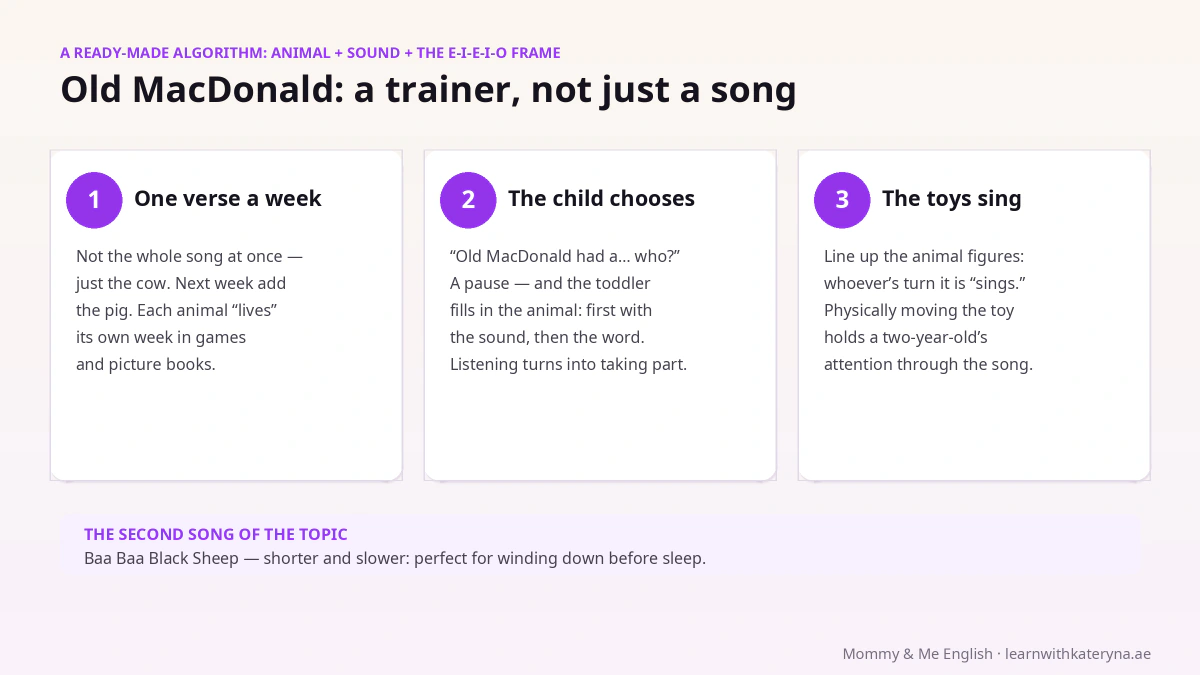
"Old MacDonald Had a Farm" is the anthem of this topic and one of the smartest children's songs ever written. Its structure is a ready-made teaching algorithm: every verse names an animal (cow), gives its sound (moo-moo) and repeats it eight times inside the unchanging "E-I-E-I-O" frame. A predictable structure plus one new word per verse — the formula through which the topic consolidates itself.
How to squeeze out the maximum:
One verse per week. Don't sing the whole song at once — just the cow. Next week add the pig. Each animal gets to "live through" its own week of games and books.
The child picks the animal. "Old MacDonald had a… who?" — and a pause. The toddler fills in the animal (first with the sound, later with the word) — her first "contribution" to the song, the moment listening turns into participating.
The toys sing. Line up the animal figures: whoever's turn it is, "sings." Physically moving the toy holds a two-year-old's attention through the whole song.
The second song of the topic is "Baa Baa Black Sheep": shorter, slower, perfect for winding down before sleep. How to build the weekly "song diet" overall — in the guide to English songs for kids.
7 animal-sound games
1. "What does the cow say?" — the topic's foundation game. Question — sound — applause. A month later, reverse it: you say moo — the child points to or names the cow.
2. Sound theatre with a book. Any animal book becomes an English book: point — "A pig! Oink-oink!" Favourite books survive dozens of repetitions, and repetition is what builds vocabulary (more in the article on reading English books to toddlers).
3. Guess who I am. You "become" an animal: crawl and hiss — "I'm a snake! Hiss-s-s!" Then it's the child's turn. Movement + sound + word — triple encoding.
4. The farm wakes up. A morning game: the toy animals are "asleep," and the child wakes each one with its sound: "Wake up, duck! Quack-quack!"
5. Sounds on a walk. Spot a dog — "Look, a dog! What does it say?" One real animal outweighs ten flashcards: the emotion of a live encounter welds the word in place.
6. Silly mummy. Point at the cat: "It says woof!" A two-year-old who indignantly corrects you — "meow!" — owns the topic actively. The most fun knowledge check in existence.
7. Zoo in the bath. Rubber animals in the water: each one dives with its own sound. Splash + roar — and bath time becomes an English zoo.
Building an English routine at home? The free Mommy & Me English starter guide lays out the daily rituals step by step.
Baby animals: puppy, kitten and the magic of -y
Once the basic animals are recognised, add their babies — children love this layer tenderly, because the babies are "like me": small, funny and next to their mums. The core four:
- puppy — the dog's baby
- kitten — the cat's
- duckling — the duck's (hello, "Five Little Ducks"!)
- chick — the chicken's
Play "mummy and baby": one big toy, one small — "Big dog says WOOF! Little puppy says woof-woof!" — the same animal, two sizes of voice. The child instinctively makes a "baby" voice for the little one — and inside that game silently trains volume, tone and the big/small pair all at once.
Here lives a small gift of English: the suffix -y/-ie makes any word affectionate — dog → doggy, cat → kitty, duck → ducky. It is the exact counterpart of Ukrainian «песик, котик, качечка». A child who has heard doggy and kitty will start "diminutivising" other words on her own — and that is wonderful: language play means the language has become her own.
Where animals live: farm, zoo, forest
The topic's next floor is sorting animals by home. Three "addresses" cover everything: farm, zoo, forest. And the question-game that drives it: "Where does the cow live?" — "On the farm!"
Practical formats. First — toy sorting: three "houses" (boxes or sheets of paper), and the child moves the animals in, commenting as she goes. It is the same sorting mechanic as in the colours topic — but now by meaning, which is a serious cognitive step: grouping by an invisible feature. Second — a trip to a real zoo (or farm), which after home preparation turns from an outing into a triumph: "Look! A REAL lion! What does he say? ROAR!" An animal the child "knew" from pictures and suddenly meets alive is an emotional explosion that fixes the word forever.
Third — the riddle game for 4+: "I live on the farm. I say moo. Who am I?" Riddles are the first step from naming to describing — and children quickly start making up their own (hilariously broken at first, then more and more precise).
First animal sentences: I have a cat
The animal topic hands a child her three first "own" sentences — all three built on the most frequent constructions in the English language:
"I have a cat." The possession frame I have is one of the first a child starts using unprompted, because she always has something to report: a toy, a cookie, a scratch. If you have a real pet, the phrase grows out of real life; if not — "I have a teddy!" works just as well.
"I see a dog!" The walking phrase: an expansion of the familiar "Look, a dog!" into a full first-person sentence. At first you say it while pointing; within weeks the child starts "reporting" on her own — "I see a bus! I see a cat!" — and that is spontaneous speech, the most valuable outcome there is.
"The cat says meow." The topic's crowning frame, which assembles animal and sound into a grammatically complete sentence. It trains best through books: the same frame on every page with a new animal — predictable, rhythmic, reliable.
Three frames — I have, I see, X says — form the bridge from animal sounds to real conversation. A child who says "I see a big dog! It says woof!" is already chaining two sentences — the level where free child speech begins.
What to expect at 1.5, 2 and 3
18 months: repeats 2–4 of the simplest sounds (moo, baa, woof) in games and songs. That already counts as English speech — yes, «му» counts!
2–2.5 years: knows the sounds of 8–10 animals, answers "What does the pig say?" with the sound, starts naming the simplest animals: cat, dog, duck, cow.
3–3.5 years: names 10–15 animals with words and uses sounds "for fun" rather than instead of names. Sings whole verses of Old MacDonald and fills animals into the pauses. Understands — and finds hilarious — that the Ukrainian pig "oinks" differently from the English one.
As always in the early years: the normal range is enormous, and understanding runs months ahead of speaking. If the toddler points to the cow on "Where is the cow?", the system is working even while she stays silent.
Sounds all around: the method works beyond animals
Once the animal sounds are running, extend the same method to the rest of your child's sound world — English onomatopoeia is far richer than it seems, and all of it is toddler-accessible:
- Transport: car — beep-beep! (Ukrainian «бі-бі»), train — choo-choo! («чух-чух»), plane — zoom!, fire engine — nee-naw! (that is how British children "do" the siren)
- Water and bath: splash!, drip-drop
- Falls and bumps: boom!, bang!, crash! — the three sounds no block tower can live without
- Food: crunch! (apple, cookie), gulp!
- Silence: shhh! — the only "sound" that means its own absence, and the most useful one for parents
The mechanics are identical to the animals: sound + moment + emotion. The tower falls — "CRASH!", soup spills — "Splash!", the apple crunches — "Crunch!" A child who has mastered woof and moo picks these up in days, because the principle is familiar. And the payoff is double again: the sounds themselves, plus a ready bridge to words (beep-beep → car, choo-choo → train). Within half a year a "sound-trained" child carries two or three dozen transport, household and nature words in her passive vocabulary — none of them ever "studied."
5 parent mistakes
1. Correcting «гав» into "woof." Both sounds are correct — each in its own language. Say "and in English the dog says woof," never "not гав — woof." Otherwise the child learns that her first language is somehow "wrong."
2. Skipping the sound stage — "straight to real words." The sound is the bridge: a child can say woof at one, but dog closer to two. Remove the bridge and a half-year gap of silence opens between babbling and English words.
3. Teaching by list rather than by interest. A child who adores cats will learn cat-meow in a day and pull the whole topic along behind it. Follow the interest, not the table.
4. Screens only, no live play. Cartoons with animal sounds are a great supplement (which ones — in the guide to English cartoons for toddlers), but before three the brain learns from live interaction. The screen shows; mum teaches.
5. Stopping at the sounds. Sounds are the start, not the finish. Once your child plays confidently with the sounds, add sentence frames: "The cow says moo" → "A big cow!" → "I see a cow!" That is how the animal topic grows into the first real sentences.
Next steps
Start today with the three animals that already live in your home — as toys or in books. One question does it: "What does the … say?" Two weeks later add a verse of Old MacDonald; a month later, the "silly mummy" game. The topic closes itself within 2–3 months, with no table-top lessons. In parallel keep the everyday phrases and numbers going — and one day you will hear the first real sentence: "Look! Three ducks! Quack-quack!"
The complete system — video lessons, audio of every sound and word, checklists and a day-by-day plan — is in the Mommy & Me English starter guide: 10 minutes a day, no tutors, with mum in the leading role.


