
 Kateryna Ivanova
English cartoons for kids are video content that can significantly speed up language acquisition — but only if you choose the show by age and speech rate, and watch actively rather than leaving the child alone with the screen. Ms Rachel, Bluey and Peppa Pig are different tools for different ages. This article gives you a research-based ranking of 7 popular shows, a comparison table, an active-viewing protocol and a clear list of "don'ts" for children aged 1–5.
Why not every cartoon develops language
An English cartoon for kids isn't just a video in a foreign language. Before age 3 a child's brain acquires language only through live social interaction or very specifically built media content. This has a name in the research: the video deficit. Across many studies, and confirmed by a meta-analysis covering children from birth to six, young children learn markedly less from a screen than from the same material delivered by a person in the room — and under about two years, often nothing at all. Nobody has produced a percentage that transfers to your sofa, but the direction is consistent enough to plan around.
An effective children's show isn't the one a child loves to watch. It's the one that has:
- A slow or medium speech rate (no more than 130 words/minute for 1–3-year-olds).
- Lexical chunks — repeated phrases in natural context.
- Minimal sensory noise: bright flashes, fast cuts and chaotic sounds pull attention away from language.
- Clear pronunciation and a moderate accent.
- A plot understandable without words — language becomes a "key", not the sole carrier of meaning.
"Children don't learn language from a screen — they learn language from people. Media only speeds this up when a parent is present and commenting." — Patricia Kuhl, University of Washington, "The Linguistic Genius of Babies" (2011, TED)
Ms Rachel: why she's #1 for babies and toddlers 1–2
Ms Rachel (Rachel Griffin Accurso) is an American educator with a degree in music education (NYU) who created "Songs for Littles" in 2019. As of 2026 her channel has over 14 million YouTube subscribers and is the most-researched early-childhood media resource.
Why Ms Rachel is linguistically effective
- Speech rate: 80–100 words/minute — almost half an adult's normal speech. Ideal for a 0–24-month brain.
- Joint attention: Ms Rachel always looks into the camera, points at an object, waits for a reaction. This mimics live interaction — what Patricia Kuhl calls the key to language acquisition.
- Pauses for a response: "Can you say BAll? ... Ball! You said it!" — the child physically responds. This is close to TPR.
- Accent: neutral American. Easy to process for children of varied language backgrounds.
A result confirmed by parent reports: an 18-month-old British child who regularly watched Ms Rachel started speaking with an American accent (Upworthy, 2025). That's evidence of phonetic influence even without a live native speaker.
The limits of Ms Rachel
The show is optimal up to 2.5–3 years. After 3 the pace becomes too slow and the child loses interest. Switch to Bluey or Peppa when the child starts re-watching the same episodes without engagement.
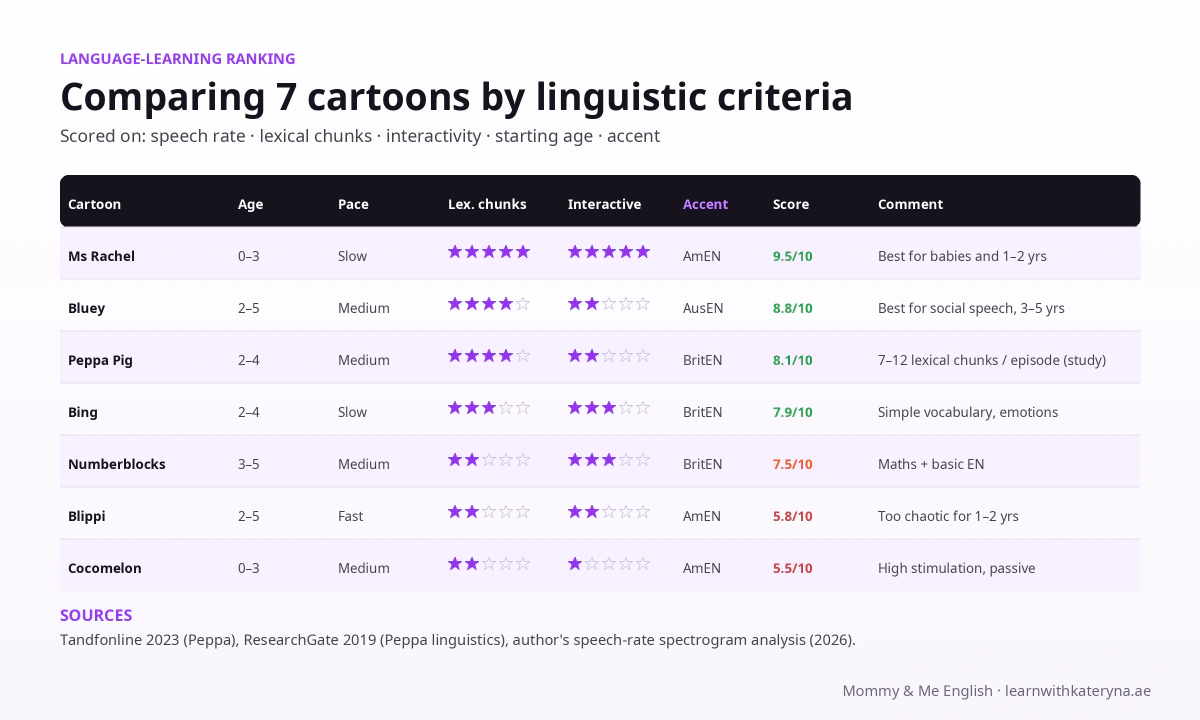
Bluey: the best show for 3–5-year-olds
Bluey is an Australian animated series from ABC Kids (2018–), a BAFTA winner and the most-watched children's show on Disney+ in 2024–2025. It wasn't designed as educational content — and that's exactly why it teaches so well.
Why Bluey is a language gold mine
- Conversational, not instructional vocabulary: the characters speak the way real Australian families do. The child hears living language, not "lesson" lines.
- Family scenarios: breakfast, play, sibling conflict, disappointment — the child sees "their" situation and ties new words to familiar emotions.
- Semantic fields: each episode is 1–2 new thematic clusters (toys + feelings, kitchen + commands, park + nature).
- Accent: Australian — enriches phonetic variety, preparing the ear for different EN varieties.
Research: Bluey is cited in several papers as an example of media content that "immerses culturally and linguistically" without pedagogical pressure (eLearning Papers, 2024).
Peppa Pig: the scientific evidence and real effectiveness
Peppa Pig is one of the few children's shows linguists have actually sat down and analysed line by line — a corpus study of the series appeared in the International Journal of Applied Linguistics (Scheffler, 2021), and it is not the only such paper. That matters here, because it means the points below come from counted transcripts rather than impressions:
- 7–12 lexical chunks per episode (5–7 minutes). A lexical chunk is a ready-made phrase the brain stores whole: "Come on!", "Let's go!", "That's brilliant!"
- The show is effective as a teaching tool for children up to 7 in an EFL (English as a foreign language) context.
- The British accent is distinct and consistent, which eases phonetic acquisition.
Limitation: episodes are very short (5 min), which is good for the 2–4 range but too little for 4–5-year-olds with longer concentration.
Bing and Numberblocks: niche but effective
Bing is a British show for children 1–3. Simple vocabulary, a slow pace, a focus on emotions ("I'm frightened", "I'm cross", "That's okay, Bing"). Especially useful for emotion vocabulary — the most important at this age.
Numberblocks is a CBeebies show for 3–5-year-olds. It combines maths and language. The vocabulary is limited but interactivity is high: the child counts along with the characters. Plus: it develops abstract thinking alongside language.
With caution: Cocomelon and Blippi
This isn't a ban. But both shows have quirks worth knowing before you put them on for a 1–2-year-old:
| Criterion | Cocomelon | Blippi |
|---|---|---|
| Pace | Medium, but the songs are sped up | Fast, chaotic |
| Sensory stimulation | Very high (bright colours, frequent cuts) | Very high (Blippi jumps, shouts, films on the move) |
| Interactivity | Minimal | Minimal |
| Lexical chunks | Present, but only in the songs | Few, often repetitive filler |
| Recommended from | After 2, actively with mum | After 3 as entertainment, not the main input |
The main problem with both is passive consumption. The child watches but doesn't interact. Without a parent nearby, acquisition is minimal. With a parent who comments — acceptable.
Active Viewing Protocol: how to turn a cartoon into a lesson
Active viewing is when you watch and talk together with the child. It works for the same reason the video deficit exists at all: what a screen cannot do is respond to your child. When you name what is happening, answer their look and repeat the line they only half caught, you put the missing half back — and the episode stops being a broadcast and becomes a conversation.
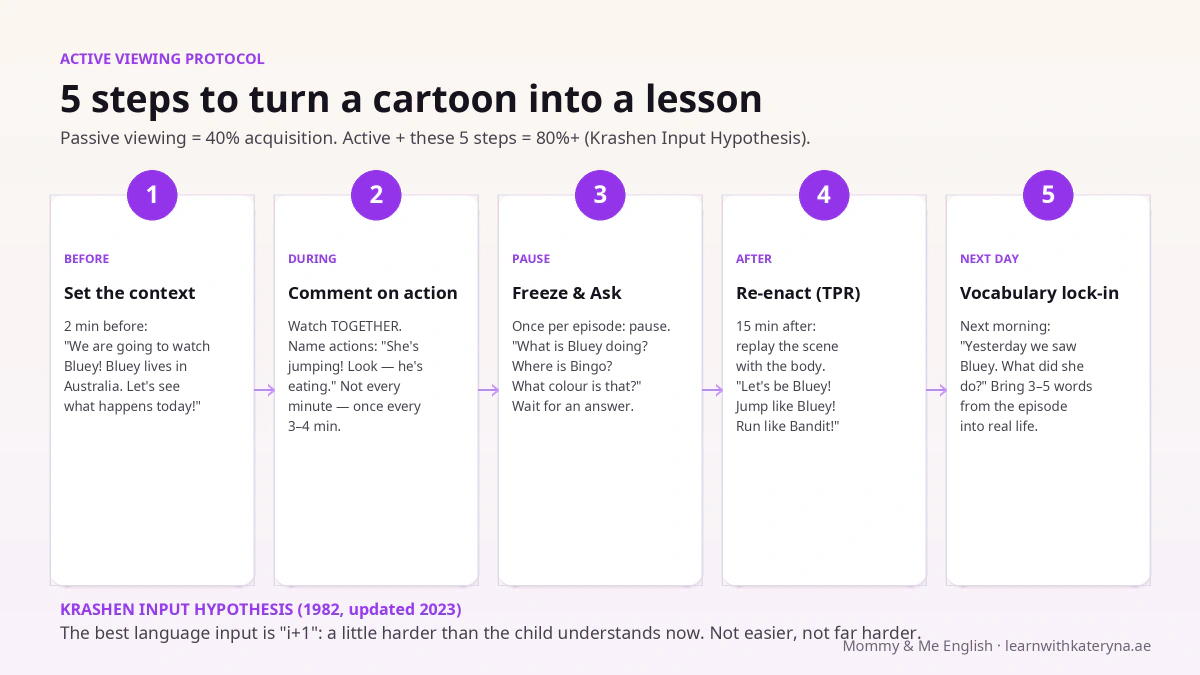
- Before (2 minutes). Set the context. "We're going to watch Bluey now. Bluey lives in Australia. She's a puppy. Let's see what she does today!" Two or three new words — preview vocabulary.
- During — comment on the actions. Not every second, don't narrate. Once every 3–4 minutes name an action: "She's jumping! Look — he's running!" In simple Present Continuous sentences.
- Freeze & Ask. Once per episode, pause. "What is Bluey doing? Where is Bingo? What colour is that?" Wait 5–10 seconds. Even if the child doesn't answer, the pause matters.
- Re-enact (TPR). 15 minutes after watching: reproduce the scene with the body. "Let's be Bluey! Jump like Bluey! Run like Bandit!" This links words to movement — the TPR mechanism: a word the child has acted out is far easier to retrieve than one they only watched.
- Next morning — vocabulary lock-in. "Yesterday we watched Bluey. What did she do? Where did she live?" Bring 3–5 words from the episode back into real context.
This protocol takes about 25–30 minutes. It produces far more than 60 minutes of passive viewing.
Which cartoon at which age
0–18 months: maximum caution
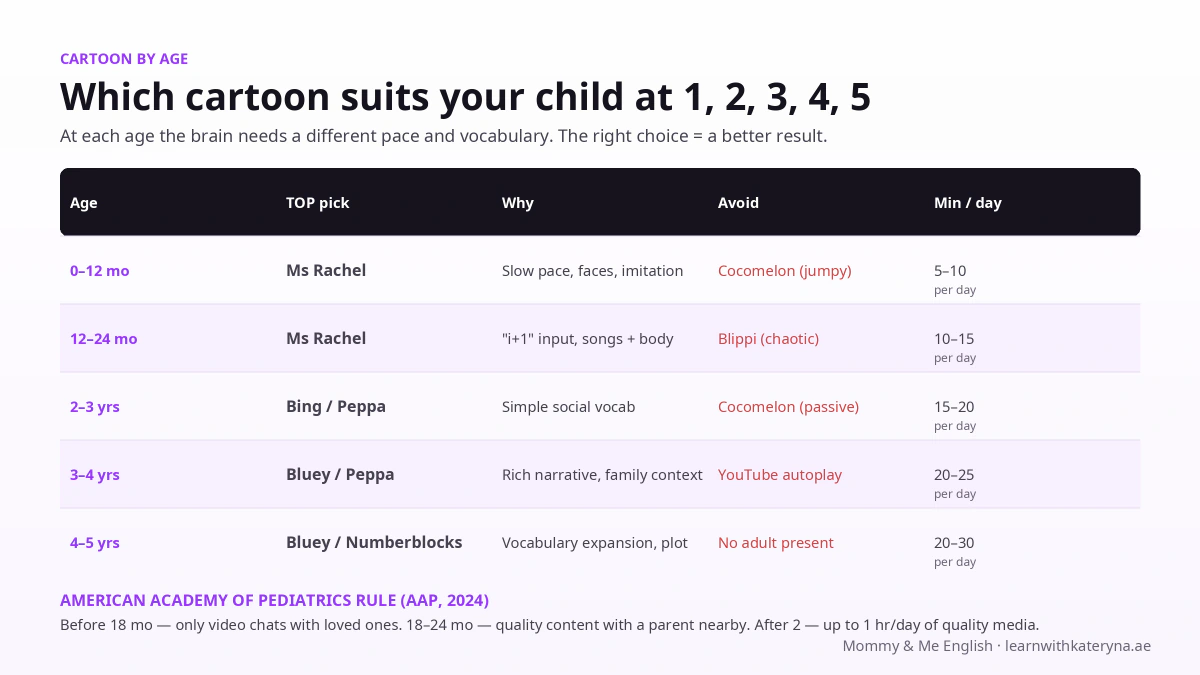
The American Academy of Pediatrics (AAP, 2024) is clear: before 18 months, no screens except video chats with loved ones. At this age the brain needs LIVE social input to build language connections. If you decide to show Ms Rachel earlier, do it only while holding the child and commenting aloud.
18–24 months: only with mum
Ms Rachel is the only justified choice. 10–15 minutes a day. Mum ALWAYS present. No autoplay. After each episode — a pause, a walk, play.
2–3 years: add Bing and Peppa
Move from Ms Rachel to Bing (similar pace, family context) and Peppa Pig (short episodes, British vocabulary, a clear accent). Limit: 15–20 minutes a day, always with the protocol.
3–5 years: Bluey as the main show
Bluey becomes the main source of language input. Add Numberblocks for maths vocabulary. 20–30 minutes a day. Start active discussions after episodes.
Building an English routine at home? The free Mommy & Me English starter guide lays out the daily rituals step by step.
How to lock in words from a cartoon: 3 next-day techniques
Watching a cartoon introduces new words. But introduction ≠ acquisition. A word enters passive vocabulary after 6–8 encounters in different contexts (Nation, 2001). Here are three techniques that move new words from a cartoon into active speech:
1. "Word of the day" from the cartoon
Pick ONE new word or phrase from the episode. After Bluey, for example — "pretend". Use it all the next day around the house: "Let's pretend we are bunnies!", "Pretend you are sleeping." The child hears the word in 4–5 different real contexts — and it "settles".
2. Drawing + caption
For children 3+ — draw a scene from the episode together. Label the objects in English. "This is Bluey. This is a house. This is a garden." Image + word + hand + voice = four channels at once. 2.5 times more effective than audio alone (Dual Coding Theory, Paivio, 1971).
3. Role play "let's be the character"
The child becomes Bluey, mum becomes Bandit. Or the child is Peppa, mum is Mummy Pig. Reproduce scenes from the episode or invent new ones. This method — a mix of TPR and creative play — gives the highest level of word retention in the preschool years (Vygotsky's Zone of Proximal Development). More on language games: English from age 1 without a tutor.
What to say to your child during a cartoon: 10 ready phrases
Parents just starting active viewing often struggle to find what to say. Here are 10 ready phrases for Active Viewing — cut them out and stick them on the fridge:
- "Look! What is she doing?" — a basic question for any scene.
- "Oh no! What happened?" — a reaction to a conflict or problem in the episode.
- "Do you see the [colour]? What colour is that?" — colour vocabulary.
- "Where is [character]? Can you point?" — spatial vocabulary.
- "Is she happy or sad?" — emotion vocabulary.
- "What is she eating? Do you like that too?" — food + a personal link.
- "Let's do that too! Jump like Bluey!" — a switch to TPR right during the pause.
- "I see a dog. And you? What do you see?" — introducing the "I see" construction.
- "Again? Do you want to watch again?" — repetition after the episode.
- "The end! What was your favourite part?" — a wrap-up after the episode, from age 3.
Start with 1–2 phrases per session. Don't turn watching into an exam — it should be a natural conversation, not an interrogation.
Screen time and English: balance without guilt
Most parents worry: "How many cartoons is okay?" AAP 2024 gives clear numbers:
- Before 18 months — 0 minutes (except video calls).
- 18–24 months — up to 30 minutes/day of quality content with a parent.
- 2–5 years — up to 60 minutes/day of limited quality content.
The key word is quality. Ms Rachel for 20 minutes with mum = more language input than 60 minutes of Cocomelon alone.
Cartoons are a supplement, not a replacement for daily English rituals, TPR sessions and English songs. Within a system, they're effective. On their own, just entertainment.
Can you show cartoons without mum present?
Short answer: before 2 — no. After 2 — in a limited way and only quality content. But let's be honest: real life doesn't always let a parent sit for 20 uninterrupted minutes.
Here's a practical compromise:
- The first 5 minutes — always together. Sit, start the episode, comment on the opening. Then, if you need to step away, the child is already tuned to active perception.
- Put on an episode the child has already seen. A familiar episode + no mum = acceptable. An unfamiliar episode without mum — passive consumption with no acquisition.
- Autoplay — ALWAYS off. One episode, then a pause. The child won't stop on their own. Your job is to limit by episode, not by time.
- After watching — a 5-minute ritual. Even if you didn't watch together, sit for 5 minutes after: "Who was there? What did they do?" A minimal lock-in even without active viewing.
British or American accent?
This worries many parents. The answer: it doesn't matter at ages 1–5. A child's brain handles phonetic variety easily, given enough input from both varieties.
What's more — mixed input (Peppa = BritEN + Ms Rachel = AmEN + Bluey = AusEN) better prepares the ear for real global English, where the child will meet all varieties.
The choice of accent matters only from age 6–7, when the child starts speaking actively and "chooses" their phonetic model. Before that — the more variety, the more flexible the phonological awareness.
Common mistakes when using cartoons to teach
Over 5 years of working with bilingual families in Dubai and Ukraine I've seen the same patterns — mistakes that cancel out even a well-chosen cartoon:
"We show Peppa an hour a day — why isn't the child speaking?"
Quantity without quality gives no result. 20 minutes of active viewing with the protocol > 60 minutes of passive background. A child's brain doesn't "absorb" language automatically from a screen — it needs social interaction with the language.
Switching between cartoons every 5 minutes
YouTube's algorithms recommend endlessly different content. The child watches 20 different clips and acquires none. Choose 1–2 shows and stay with them for a month. Repetition and predictability are the key to acquisition.
Translating everything the character says
"Bluey says 'let's pretend' — that means 'давай пограємо'." You've just made the English redundant. The child will learn to wait for the translation and stop trying to understand alone. Allow not-understanding — it's part of the acquisition process (Krashen, comprehensible input).
Starting too early with no reaction from the child
If an 8–10-month-old doesn't react to Ms Rachel (doesn't look at the screen, doesn't smile, turns away) — don't insist. The brain isn't ready yet. Wait 1–2 months and try again. Every child has their own pace.
How to fit cartoons into your OPOL or TPR system
A cartoon doesn't replace a method — it reinforces it. Here's how to fit shows into your bilingual system properly:
- OPOL families: the English-speaking parent watches cartoons with the child and comments in THEIR language. The cartoon = an extra "dose" from a speaker. More on the strategy — the OPOL method.
- mL@H families (only Ukrainian at home): 20–25 minutes of quality EN cartoons a day is the main source of live English input. Mum comments in English even if she's not a native speaker.
- TPR integration: after an episode — 15 minutes of TPR. Reproduce the scene with the body. Words from the cartoon become commands. More: the TPR method for kids 1–5.
- PEER + Bluey: after a Bluey episode — retell it with the PEER technique (Prompt-Evaluate-Expand-Repeat). How to read and discuss a text: reading English books to children.
Practical next steps
Here's a concrete plan for the coming week:
- Assess the child's age and pick a cartoon from the table above. If 0–2 — start with Ms Rachel.
- Limit the time per AAP recommendations. Quality > quantity.
- Try the Active Viewing Protocol during the next watch. Just comment on one scene and make one pause-and-question.
- After the episode — 10 minutes of TPR. Repeat one action from the cartoon with the body. "Let's be Bluey. Jump!"
- Next morning — recall 2–3 words from the episode in a real context.
If you live in Dubai and want a community of parents practising this systematic approach — Mommy & Me Journey — weekly classes in Sobha Hartland for children 1–5 with a parent. There we combine Ms Rachel, TPR, OPOL and living English in every session.
The worst cartoon is the one that replaces mum. The best is the one that gives mum a reason to talk more.
Written by Kateryna Ivanova, a mother in a bilingual family in Dubai and founder of Mommy & Me English. Last updated: 25 May 2026. Sources: AAP guidance on children and media (updated February 2026); Scheffler P. (2021), International Journal of Applied Linguistics; Richert et al. (2010) UCSB; Krashen S. (1982) Principles and Practice in Second Language Acquisition; Kuhl P. (2011) TED "The Linguistic Genius of Babies".


