A cabin crew assessment day is a full-day, in-person selection event where an airline watches how you behave — in a group, under time pressure, in English, and one-to-one — and cuts candidates after most stages. It is not one interview. It is five back-to-back filters, and the group task fails more people than any other. This guide walks every stage, shows what the assessor's clipboard actually marks, and gives you plain-B1 English you can use on the day — even if English is your second language.
TL;DR:
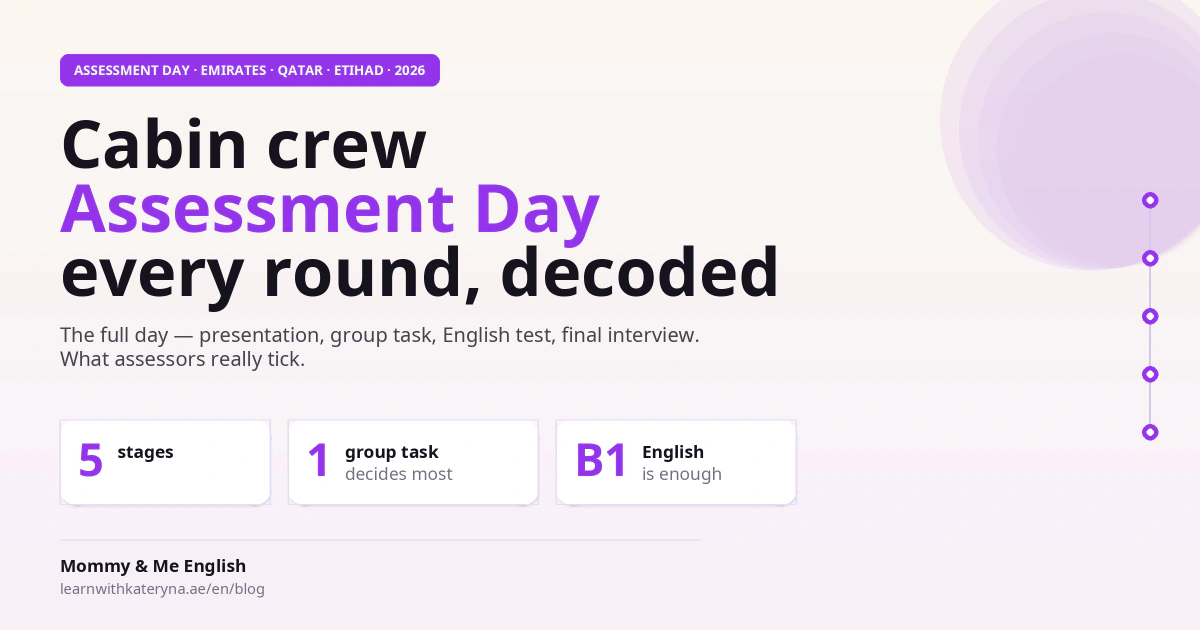
- A cabin crew assessment day has 5 stages: welcome presentation → group activity → English test → psychometric/online test → final competency interview. There are cuts after most stages.
- The group activity fails the most people. Assessors grade how you interact — active listening, empathy, teamwork — not who gives the "right" answer.
- The two ways to fail the group task are dominating (interrupting, deciding alone) and disappearing (going silent). Aim for the middle: contribute and invite others in.
- You are assessed from the moment you arrive — the queue, the coffee break, how you treat other candidates. Not just the exercises.
- B1 English is enough. Short, warm sentences beat complex grammar. A small phrasebank lets you contribute without dominating.
What a cabin crew assessment day is
A cabin crew assessment day (also called an "open day" or "assessment centre") is a structured selection event that replaces the ordinary job interview for flight attendant roles. Instead of one conversation, the airline runs a sequence of tasks over several hours and eliminates candidates in waves. The goal is simple: airlines cannot see your service behaviour from a CV, so they build a day that forces it into the open.
Emirates, Qatar Airways and Etihad all use the same skeleton. A recruiter presents the role, then candidates move through a group activity, an English test, an online or psychometric test, and — for those still standing — a final one-to-one interview. Most people who walk in do not walk out with a job. That is normal, and it is not personal.
An assessment day does not ask "are you qualified?" It asks "would I feel safe with you in a cabin at 3 a.m. when something goes wrong?" Everything you do is read through that one question.
The 5 stages of the day
The day runs stage by stage, and each stage is a gate. Here is the standard shape, with the elimination pressure at each step.
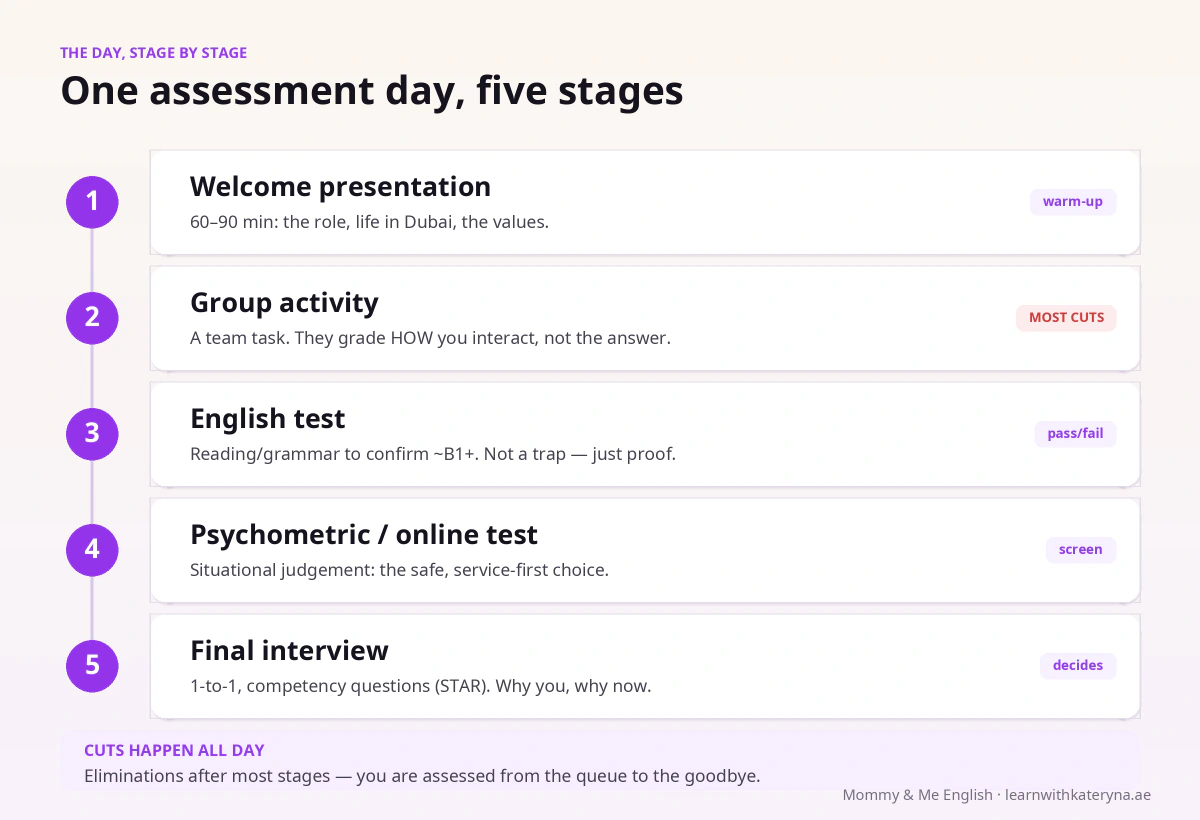
| Stage | What happens | What they measure | Cut risk |
|---|---|---|---|
| 1. Welcome presentation | 60–90 min on the role, life in Dubai, values | Your attention, warmth, first impression | Low (but watched) |
| 2. Group activity | A team task with a time limit | Listening, empathy, teamwork | Highest |
| 3. English test | Reading, grammar, sometimes writing | Working English (~B1+) | Pass / fail |
| 4. Psychometric / online test | Situational judgement questions | Safe, service-first decisions | Screen |
| 5. Final interview | 1-to-1, competency (STAR) questions | Evidence you have done it before | Decides |
Not every airline runs the stages in this exact order, and some split the day across two rounds. But the logic never changes: broad group filters first, expensive one-to-one time last.
You are assessed from the door
The single most useful thing to understand: assessment starts before the first task and never stops. Recruiters note how you queue, whether you introduce yourself to strangers, how you speak to the person handing out water, and what your face does when you think no one is watching. A candidate who performs well in the exercise and then rolls their eyes during the break has just failed the part nobody announced.
This works in your favour, because warmth is free and repeatable. Arrive early. Learn two or three names in the waiting room. Smile at the other candidates — they are not your enemy for the day, they are your evidence of teamwork. The reach test, height and grooming checks also happen here; if you are unsure about the physical requirements, read our cabin crew reach test and grooming standards pages before the day.
The group task: contribute, don't dominate
The group activity is the stage that fails the most candidates, and it fails them in two opposite ways. The first is dominating: interrupting, deciding for everyone, treating the task like a debate to win. The second is disappearing: going quiet, avoiding eye contact, agreeing with everything and adding nothing. Both read as "not safe in a crew."
The trap is believing the task has a right answer. It rarely does. The exercise is a mirror the assessor holds up to your behaviour. They are grading active listening, empathy, negotiation and time management — not whether your group reached the "correct" solution.
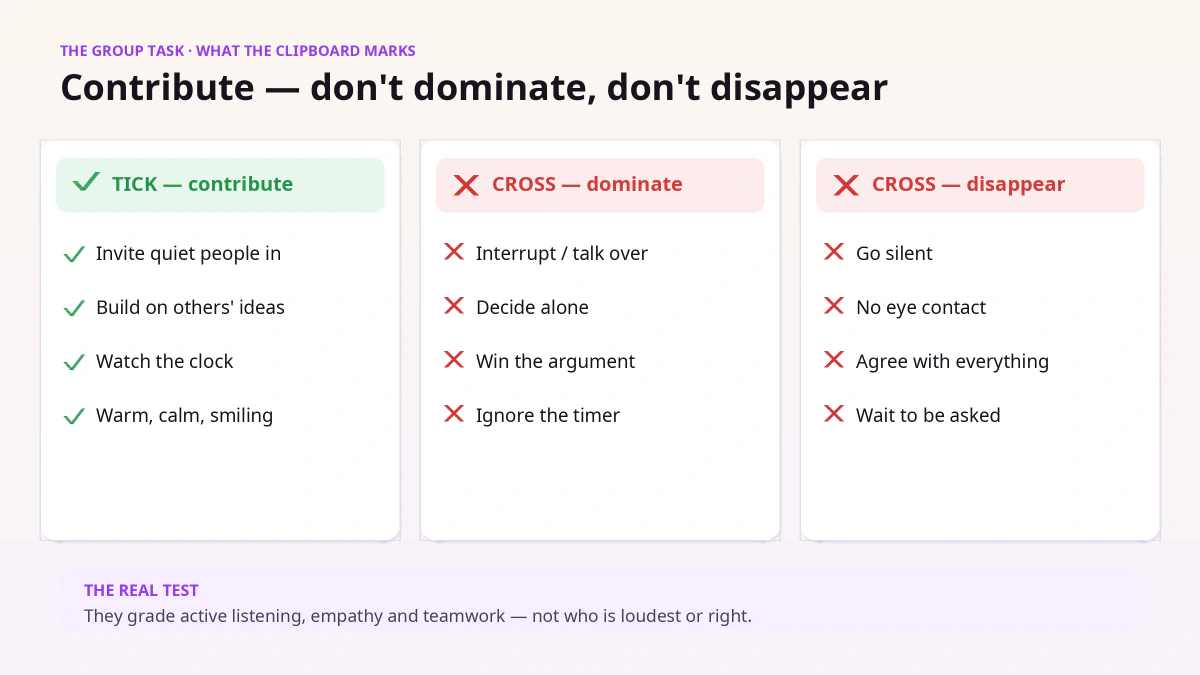
Aim for the middle lane. Contribute a clear idea, then pull someone else in. Build on what others say instead of replacing it. Watch the clock so the group actually finishes. If you do only one thing well, make it this: invite the quiet person to speak. Assessors love it, because it is exactly what a good crew member does with a nervous passenger.
The loudest person in the group task almost never gets the job. Neither does the quietest. The one who makes the whole group work better does.
Group-task English you can actually use (B1)
Here is the moat for a non-native speaker: you do not need fluent English to shine in the group task. You need a handful of short, warm sentences you can say without thinking. Structure in your head, simple words in your mouth. This is the same principle we use in English for cabin crew — clear beats complex.
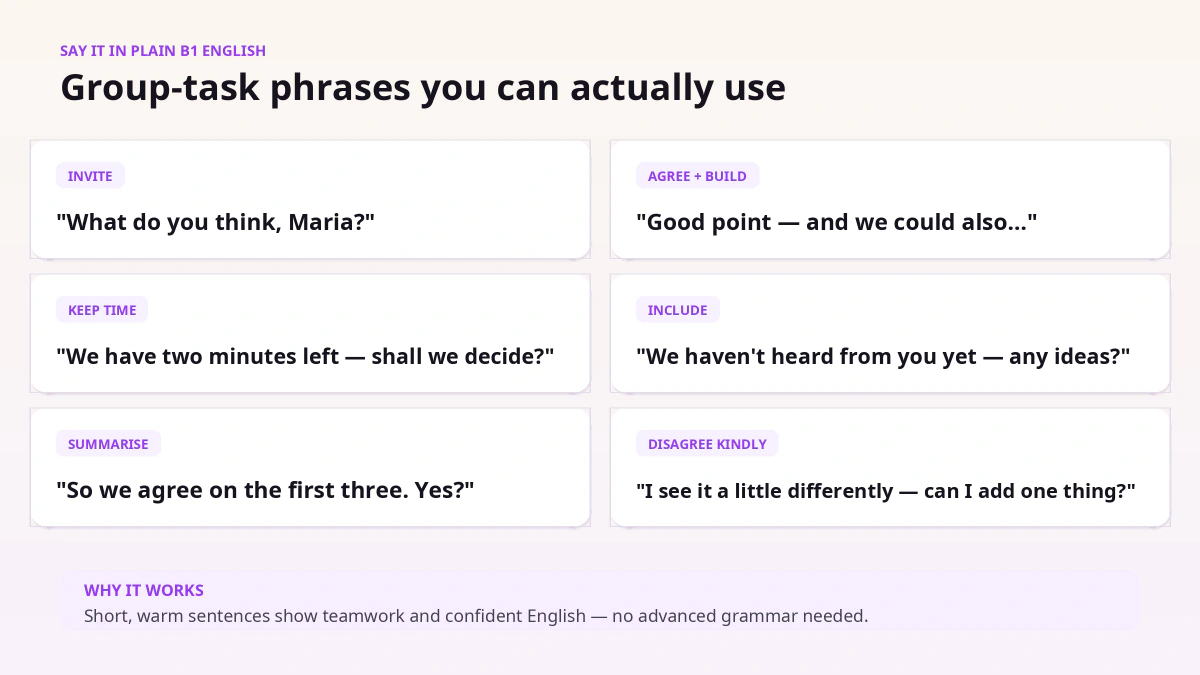
Memorise six functions, one phrase each:
- Invite: "What do you think, Maria?"
- Agree and build: "Good point — and we could also…"
- Keep time: "We have two minutes left — shall we decide?"
- Include: "We haven't heard from you yet — any ideas?"
- Summarise: "So we agree on the first three, yes?"
- Disagree kindly: "I see it a little differently — can I add one thing?"
Each of these is Past-Simple-free, B1-level, and does a job an assessor is literally looking for. Say two or three across the task and you have shown listening, warmth and leadership without a single advanced word.
The English test: what level you really need
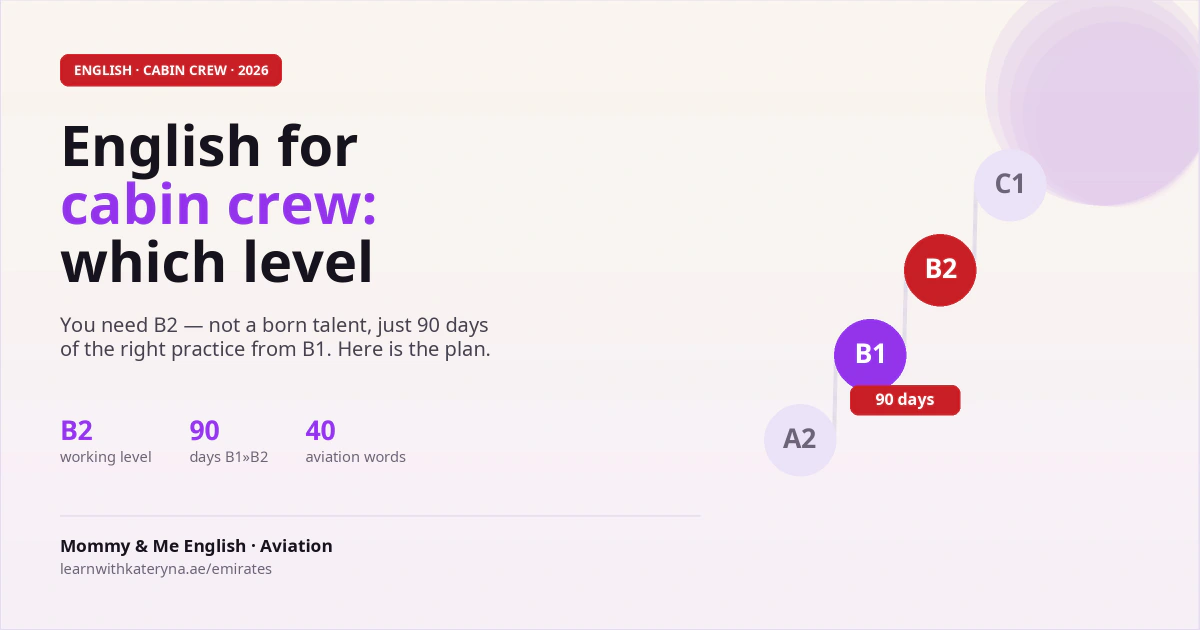
The English test confirms you can work safely in English, not that you sound like a native. In practice the bar sits around CEFR B1–B2: you can read a short passage, handle everyday grammar, and write a few clear sentences. Airlines need crew who can give a safety instruction that a frightened passenger understands instantly — precision matters more than a big vocabulary.
If your reading and grammar are shaky, that is fixable in weeks, not years. Our level and 90-day plan maps exactly what to study. Do not skip this stage in your prep, because a strong group performance cannot save a failed English test — they are separate gates.
The psychometric / situational judgement test
The psychometric or online test is usually a situational judgement test (SJT): short workplace scenarios with several possible responses. There is a pattern to the "right" answers. The airline wants the response that is safe first, service second, and rules-aware — never the one that bends a safety rule to make a passenger happy, and never the one that is rude to protect a rule.
Here is a typical scenario: a passenger is upset that the meal they wanted has run out. The tempting answer is to promise something you cannot deliver; the cold answer is to state the rule and move on. The scored answer sits between them — acknowledge the frustration, offer the best real alternative, stay warm, and never bend a safety-relevant rule to smooth the moment. That shape repeats across almost every SJT question.
When a scenario forces a choice, ask yourself the crew question: what keeps everyone safe and feels human? Choose calm, choose the procedure, choose the option that a senior crew member would nod at. Reckless kindness and cold rule-following both score low.
The final competency interview
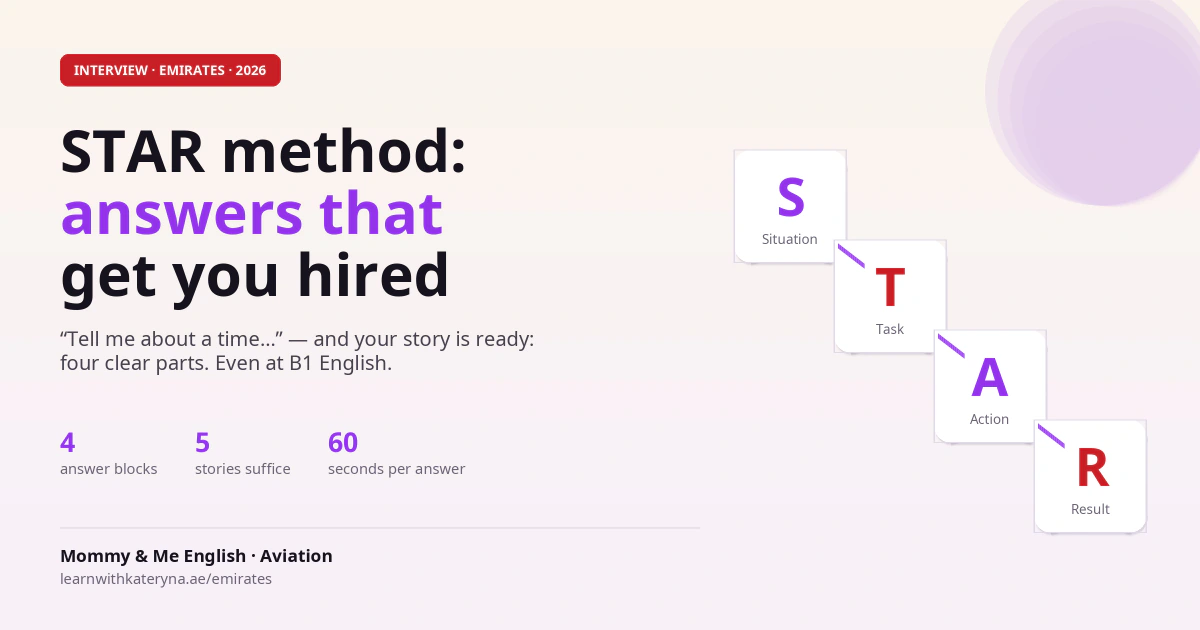
The final interview is a one-to-one, competency-based conversation: "Tell me about a time when…" questions that test six themes — a difficult customer, teamwork, pressure, initiative, a colleague conflict, and your own mistake. The tool that wins this stage is the STAR method (Situation, Task, Action, Result), and it deserves its own preparation.
Prepare five real stories from any people-facing work — a café, a shop, a hospital, tutoring — and you can answer almost any question. We break the whole method down, with B1 templates and a worked example, in our STAR method for cabin crew interviews guide. This is also the stage where your CV and photo get revisited, so make sure they match the person in the room.
Structure the story in your own language, then say it in simple English. A brain trying to invent content and translate at the same time does neither well.
Emirates vs Qatar vs Etihad: what differs
The three big Gulf carriers share the assessment-day skeleton but differ in tone and detail. Knowing the flavour of each helps you prepare the right energy.
| Airline | Base | Day feels like | Watch out for |
|---|---|---|---|
| Emirates | Dubai | Polished, brand-heavy, warm | Group task is the big filter |
| Qatar Airways | Doha | Formal, detail-focused | Grooming and precision checks |
| Etihad | Abu Dhabi | Personable, values-led | "Why Etihad" specifics |
Whichever you target, the winning behaviour is identical: warm, calm, safe, and a genuine team player. For the full application path, start from our pillar guide, how to become Emirates cabin crew. For airline-specific interview questions, the free Emirates, Qatar and Etihad question sets are on our CrewQuest pages.
What to bring and how to present yourself
How you present yourself is the first data point an assessor collects, before you say a single word. Airlines expect business formal: a tailored suit or a knee-length dress, closed shoes, hair neat and off the face, natural makeup, minimal jewellery, and tattoos covered. This is not about beauty. It is about looking like someone a frightened passenger will trust in three seconds during an emergency.
Come over-prepared with your paperwork. A missing document can end your day before the first exercise even starts.
- Two or three printed copies of your CV, in English.
- Your passport and any ID the invitation asks for.
- The airline's requested photos — usually one full-length and one headshot.
- A working pen for the on-site forms.
- A bottle of water and a small snack — it is a long day.
Arrive 20–30 minutes early; latecomers are frequently turned away at the door. For the exact wardrobe and grooming rules each airline expects, read our cabin crew grooming standards, and make sure your photos follow the rules in our CV and photo guide.
7 mistakes that end an assessment day
- Dropping your guard on the break. The moment you think no one is watching is the moment they are.
- Treating the group task as a debate. Winning the argument loses the day.
- Going silent to play safe. Invisible is a fail, not a neutral.
- Ignoring the timer. A group that does not finish reflects on everyone who let it drift.
- Over-complicating your English. Reaching for fancy words creates mistakes and hides your warmth.
- Bending safety to please a passenger in the SJT. Safe first, always.
- Reusing one story for every competency question in the final interview. Recruiters spot it instantly.
Your 2-week practice plan
You cannot cram warmth, but you can rehearse the moving parts until they feel automatic. Here is a compact, drillable plan.
- Days 1–3 — the day's map. Learn the five stages cold so nothing surprises you. Re-read this guide and the interview questions hub.
- Days 4–6 — the phrasebank. Memorise the six group-task phrases above. Say them out loud until they are reflex.
- Days 7–9 — English. 30 minutes a day of reading and grammar to lock in B1+, using the 90-day plan as your source.
- Days 10–12 — STAR stories. Write and record five stories with the STAR method.
- Days 13–14 — full rehearsal. Drill randomised airline questions and a mock interview in the free CrewQuest trainer until answering feels calm.
CrewQuest turns this static checklist into practice: it plays through the group scenarios, difficult-passenger situations and a final mock interview, and scores your choices the way an assessor would.
What if you don't pass — and when to reapply
Not passing an assessment day is the normal outcome, not the end of the road. The competitive maths is brutal: most people who attend do not progress, and being cut says far more about the number of seats than about your worth. The three Gulf carriers ask unsuccessful candidates to wait before reapplying — typically around six months for Emirates — and that gap is a gift, not a punishment.
Use it to fix the one gate that closed on you. Be honest about which stage it was. If the group task ended your day, drill the phrasebank and rehearse scenarios until contributing feels natural. If the English test did, follow a structured plan to lift your reading and grammar to a confident B1+. If the final interview did, build a stronger, more varied story bank. Candidates who reapply with one specific, fixed weakness pass at a far higher rate than those who simply try again and hope for a kinder room.
A rejection is data, not a verdict. Name the gate that closed, fix that one thing, and the next assessment day is a different day.
Next steps
An assessment day rewards the candidate who is prepared, warm and calm — not the one with perfect English or the loudest voice. Learn the five stages, rehearse the group-task phrases, prepare five STAR stories, and practise until the day feels familiar rather than frightening.
Start free: play the CrewQuest cabin crew trainer to drill real group scenarios and a mock interview. When you are ready for the full run — the advanced Assessment Day levels (safety, service, difficult passengers, airline deep-dives) and the final mock interview — CrewQuest Premium unlocks all of it in one payment, no subscription. Then work back through the funnel: get your English to level, fix your CV and photo, and follow the full application path.
External references: the official Emirates Group cabin crew careers page for current open days and requirements, and IATA training for the industry standards behind crew competencies.