
Sound familiar?
These are the messages Kateryna gets most. Tap the one that fits — it opens WhatsApp with your question already written.
Key takeaways
- You must reach about 212 cm on tiptoes (it varies slightly by airline).
- It exists so you can access safety equipment in the overhead bins.
- It’s not about height alone — posture, stretch and tiptoe technique matter.
- It’s usually measured against a marked wall, on tiptoes, with one arm up.
- There’s no minimum strength test — it’s purely about reach.
What is the reach test?
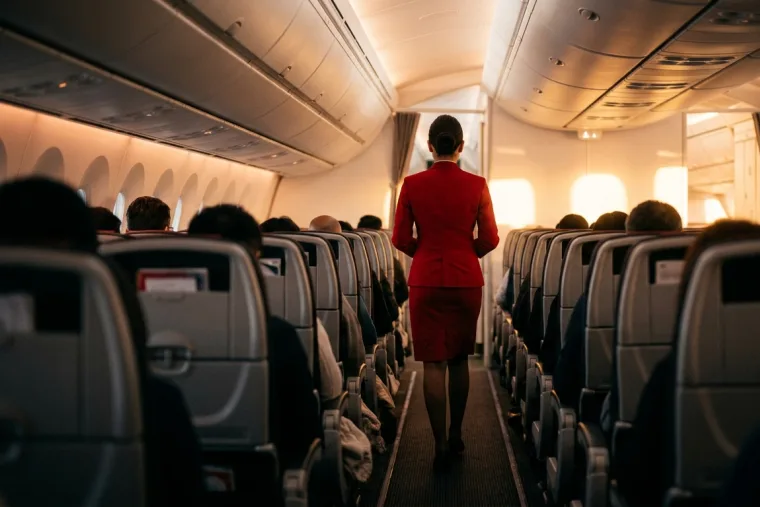
The reach test checks that you can physically reach the safety equipment and controls stowed in the overhead lockers and ceiling of the aircraft — things like fire extinguishers, oxygen and emergency gear. If you can’t reach them quickly, you can’t do the core safety part of the job.
It is typically done by standing flat against a wall and reaching up on tiptoes to touch a marked height, usually around 212 cm.
Why 212 cm?
That height corresponds to the overhead stowage where critical safety equipment lives on most aircraft. Airlines set a consistent reach standard so every crew member can operate that equipment in an emergency, regardless of their height. It is a safety requirement, not an aesthetic one.
How it’s measured

On the day it’s quick and straightforward:
- Stand tall against the wallHeels can leave the floor — you’re allowed to go on tiptoes.
- Reach up with one armStretch your fingertips to the marked line (around 212 cm).
- Hold brieflyYou just need to touch the mark cleanly, not hang from it.
How to maximise your reach on the day

Most people can find a few extra centimetres with technique and preparation:
- Warm up and stretch your shoulders, back and calves beforehand
- Stand as tall as you can — lengthen your spine and neck
- Rise fully onto your tiptoes and push through the balls of your feet
- Reach from the shoulder, not just the hand — let your ribcage lift
- Stay calm; tension shortens your stretch
- Practise at home against a wall so the movement feels natural
Reach requirement by airline

The exact reach standard varies between carriers, so check the airline you are targeting rather than assuming one number. Emirates and Qatar Airways both test an arm reach of about 212 cm on tiptoes on assessment day. Etihad has changed its rule and no longer runs a separate arm-reach test, using a minimum height of around 163 cm instead, while Saudia assesses overall suitability and appearance. If the 212 cm reach worries you, a carrier with a height-based rule may suit you better.
- Emirates — about 212 cm arm reach on tiptoes
- Qatar Airways — about 212 cm arm reach on tiptoes
- Etihad — no reach test; about 163 cm minimum height
- Saudia — appearance and suitability based
Height vs reach: what actually matters
The reach test is not a height test. Two people of the same height can have very different reaches depending on arm and torso length, shoulder mobility and how well they use their tiptoes. That is why airlines measure reach directly instead of setting a tall height minimum — a shorter candidate with long arms and a good stretch often clears 212 cm comfortably.
Many successful crew are around 160 cm tall, so if you are on the shorter side do not rule yourself out. Prepare your stretch and technique first, and measure your real reach against a wall before you decide anything.
A two-week routine to add reach

Reach improves with mobility, not just effort. A short daily routine in the two weeks before your assessment can add the centimetres that matter.
- Shoulder and lat stretchEach morning, reach one arm overhead and lean gently to the opposite side, 30 seconds per side, to open the shoulders and side body.
- Thoracic extensionStretch the upper back gently over a chair or rolled towel so your ribcage can lift higher when you reach.
- Calf and ankle workDo slow calf raises daily so you can rise fully and hold your tiptoes steadily.
- Wall reach practiceMark about 212 cm on a wall and practise the full stretch every day so the movement is automatic on the day.
On the day: shoes, warm-up and posture

Small practical choices protect the reach you have trained:
- Wear shoes you can rise onto tiptoes in easily — nothing stiff or platformed
- Warm up your shoulders and calves discreetly in the waiting area
- Stand tall the whole time — good posture between exercises keeps you loose
- Breathe out as you reach; tension and a held breath shorten your stretch
- Reach from the shoulder and lift through the ribcage, not just the hand
What the assessor is actually checking
On the day the assessor is not judging elegance — they are confirming one thing: that you can reach the overhead safety equipment cleanly and repeatably. A confident, controlled reach reads better than a strained lunge, so touch the mark calmly and keep your balance. It is a safety check, so there is no partial credit, but there is also no trick to it beyond preparation.
What if I can’t reach 212 cm?
If you’re close, technique and practice often bridge the gap — so it’s worth preparing properly rather than assuming you’ll fall short. Requirements also differ slightly between airlines, so check each carrier’s exact figure. The reach standard is fixed for safety reasons, so it’s one requirement you can’t talk your way around — but for most candidates it’s very achievable.
What CrewQuest actually is
CrewQuest is a free browser game that turns the cabin crew assessment day into levels — real interview questions, instant feedback, no login.
Free Levels 1–4 · optional one-time Premium for Levels 5–10 & the mock interview
Who is behind this
Kateryna Ivanova flew as Emirates cabin crew for over three years and now prepares candidates for the same assessment day she passed. She holds a Trinity College London CertTESOL and a Level 6 CertPT with Distinction (Ofqual 603/5432/X) and a NILE Norwich qualification, and has taught for more than nine years.
Reviews were left in Ukrainian by students of the course and translated for the site.
Frequently asked questions
Does Etihad have a reach test?
Can shorter people become cabin crew?
What is the reach height for cabin crew?
Can you go on tiptoes for the cabin crew reach test?
Is there a minimum height for cabin crew?
How can I increase my reach for the test?
Is the reach test pass or fail?
Practise it for real — free
CrewQuest is a free browser game that turns the cabin crew assessment day into levels — real interview questions, instant feedback, no login.
Start training free →Free Levels 1–4 · optional one-time Premium for Levels 5–10 & the mock interview