
 Kateryna Ivanova
Your Emirates cabin crew CV and photos are the first selection filter: up to 80% of candidates are screened out online, before any Assessment Day. The good news — this stage is the easiest to pass, because the rules are known in advance. A one-page English CV in a plain format, a 3.5×4.5 cm headshot and a 13×18 cm full-length photo on a light background — and your application lands in a recruiter's hands instead of the automatic reject pile.
TL;DR:
- Emirates asks for a one-page English CV plus two photos: a business headshot and a full-length shot (formal or casual), JPEG under 500 KB
- Format beats beauty: single column, Arial/Calibri 10–12pt, no tables or graphics — otherwise screening software misreads your file
- No aviation experience required: waitress, nurse, teacher, sales — everything translates into customer service language
- The photos can be taken at home in 20 minutes: a phone, side window light and a plain wall — no studio needed
- Top auto-reject triggers: selfies or filters on photos, a CV without dates, missing height/arm-reach data
The first filter: what happens to your application
The Emirates online application is not a formality — it is a full selection stage. The airline receives hundreds of thousands of applications a year (for the A350 expansion alone, Emirates announced hiring 5,000 cabin crew) and physically cannot invite everyone to an Assessment Day. So two filters work first: automated screening of the form, and a quick human review of your CV and photos.
The software checks the baseline: age 21+, a 212 cm arm reach on tiptoes, education, English. The human looks at the rest: is the photo neat, does the CV read easily, is there people-facing work in the history. Both filters are passed through preparation — which is why the road to Emirates starts at a desk, not at an interview.
The Assessment Day is won in the room — but the invitation to it is won at your desk: the CV and two photos decide whether a recruiter ever sees you.
The recruiter's 5-second scan
A recruiter reviewing hundreds of applications a day spends seconds on the first pass. The eye path is nearly always the same: photo » current role » English » cities and dates. Which means four elements of your application work a hundred times harder than everything else:
- The photo — first impression: smile, posture, neatness. Not beauty — compliance with the standard.
- Current/last role — a line that should shout "service and people," not "office and paperwork."
- English level — its own line under Languages: English — Upper-Intermediate (B2). Don't bury it at the bottom.
- Dates without gaps — unexplained 2–3-year holes raise questions nobody will ask out loud: the application simply gets set aside.
One-page CV structure: 7 blocks
Your Emirates CV is one A4 page, one column, Arial or Calibri 10–12pt, saved as a text-based PDF — no photo inside the file, no tables or two-column templates that screening software misreads. It carries seven blocks: contacts, aviation personal data (height and 212 cm arm reach), a two-line service profile, work experience in reverse order, education, languages with your English level kept high on the page, and 6–8 service skills.
This page focuses on the Emirates photo and the first screen. For the full section-by-section CV template, ATS keywords and a no-experience version, see How to Write a Cabin Crew CV.
No aviation experience: how to translate your jobs
Emirates does not require aviation experience — it requires a service mindset. Waitress, nurse, teacher, sales, reception and volunteering all translate into customer-service language once you end every line with people, not paperwork: "served 100+ guests per shift maintaining service standards," not "performed assigned duties." The full job-title translation table is in the cabin crew CV guide.
The keywords recruiters look for
Screening — human and automated — responds to a specific vocabulary: customer service, hospitality, safety, teamwork, multicultural, communication, grooming standards, English proficiency. Weave these into your experience bullets rather than listing them under Skills. The full keyword method is in the CV guide; you can drill the same service language in our free CrewQuest trainer.
Emirates photo requirements: sizes and format
The photos are a separate application document with precise technical specs (current for 2026 — double-check against the official Emirates Group Careers site before submitting):
| Headshot | Full length | |
|---|---|---|
| Size | 3.5 × 4.5 cm (passport style) | 13 × 18 cm |
| Format | JPEG, under 500 KB | JPEG, under 500 KB |
| Background | plain, light | plain, light |
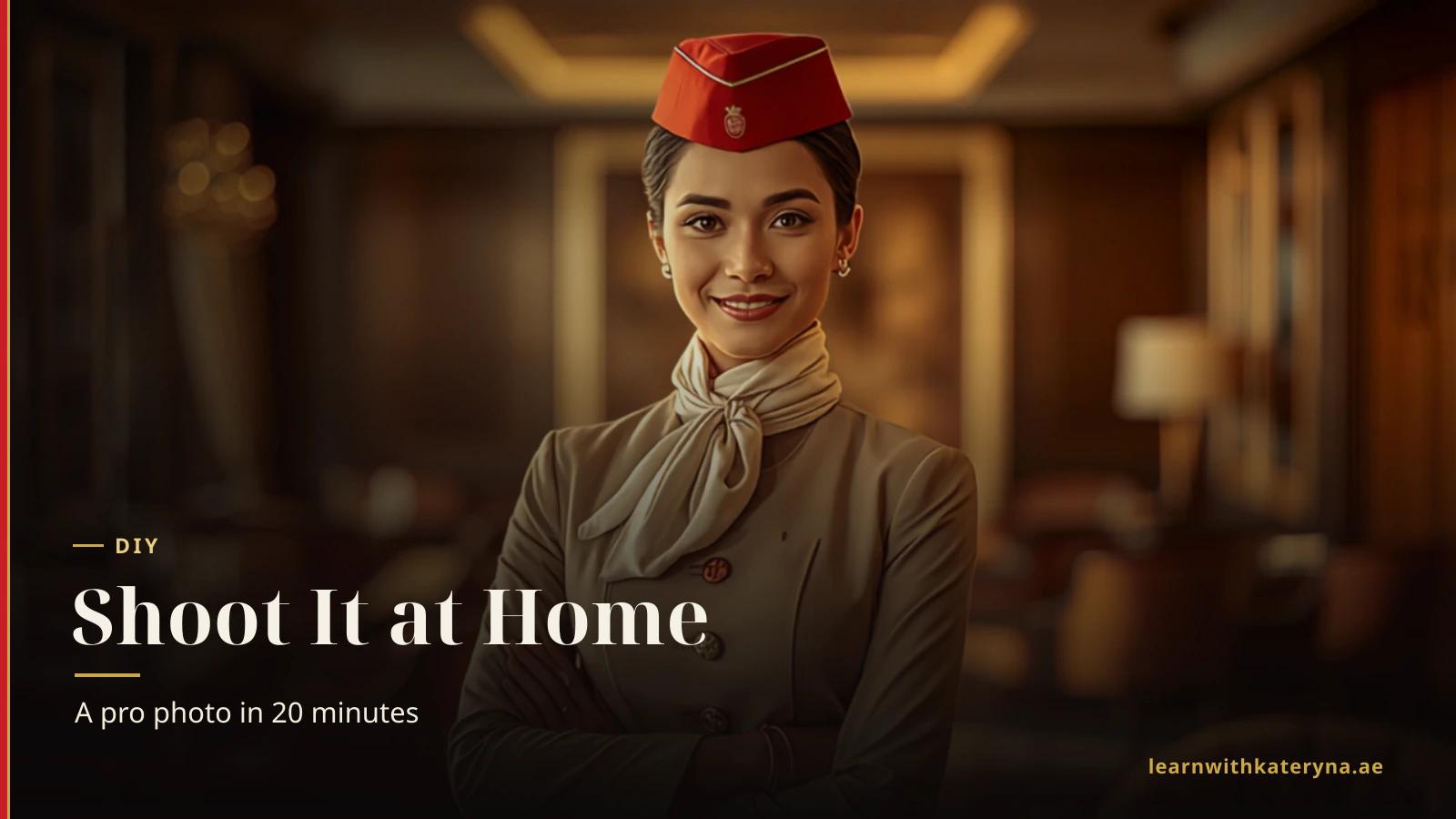
| Attire | business: blouse/jacket | formal: dark pencil skirt + light blouse + heels; casual: neat smart-casual |
| Pose | facing camera, natural smile | standing straight, arms relaxed, feet together, smile |
Hair — tied back (low bun), make-up — daytime business, jewellery — minimal. The full grooming standard your photo should approximate is covered in our Cabin Crew Grooming Standards guide — a photo shot "to standard" instantly signals to the recruiter that the candidate knows where she is applying.
Photos at home in 20 minutes: step by step
A paid studio is optional. A modern phone and daylight produce a shot that passes screening:
- Find a plain light wall with no pictures, sockets or skirting board in frame. Stand 50–70 cm away from it so there is no shadow behind you.
- Light from a window, front-side. Shoot in daytime, no ceiling lights and no flash: mixed light creates yellow patches.
- Phone vertical, at chest height, on a tripod or a stack of books. For full length, camera 3–4 m away, framing from the top of your head to your shoes with margin.
- Attire and grooming to standard: dark bottom, light blouse, hair in a bun, daytime make-up, heels. Dress fully — "waist-up" doesn't work for a full-length shot.
- Take 30–40 frames on a timer with a natural smile (think of something pleasant — the stony "passport face" is not wanted here). Pick the frame with straight posture and an open gaze.
- Crop to size and compress to 500 KB with any online converter. No filters, no skin retouching, no "enhancers" — cropping and brightness only.
7 photo mistakes that cost the application
1. Selfies. The stretched arm is always visible — and instantly says "the candidate didn't read the requirements."
2. Filters and heavy retouching. The recruiter will see you live at the Assessment Day — a gap between photo and reality works against you.
3. A cropped group photo. Someone else's shoulder in frame — an auto-reject classic.
4. Sunglasses, hats, headphones — however stylish. The face must be fully open.
5. Beach or evening wear in the casual shot. Casual for Emirates means jeans-and-blouse neatness, not holiday.
6. Household clutter in the background. A wardrobe, a rug, a door — all of it is noise. Clean wall only.
7. An old photograph. The photo must match today's you: a different haircut or weight at the Assessment Day raises authenticity questions.
CV mistakes specific to the Emirates application
Two mistakes sink an Emirates file in particular: a name that doesn't match your passport spelling (Kate instead of Kateryna — it breaks at the visa stage, so use passport transliteration only), and burying your English level on the last line instead of the top half where a recruiter scans. The wider list — designer templates, multi-page CVs, duties instead of results — is covered in how to write a cabin crew CV.
The Emirates online form: what it asks
Beyond the CV and photos, the Emirates application is a form on the careers portal. Most fields are technical, but a few deserve attention because they act as filters:
- Education: the minimum is completed secondary school. List a college or university degree as it is — Bachelor's degree — no recognition procedures are needed at this stage.
- Work experience: the form mirrors the CV — fill it with identical wording. Discrepancies between form and file read as carelessness.
- The tattoo question: Emirates asks about tattoos visible in uniform (forearms, neck, face, ankles). Answer honestly: a tattoo hidden by clothing is not a problem, while a false answer is grounds for rejection at any later stage.
- Right to work and relocation: confirm willingness to relocate to Dubai — it is the essence of the job; hesitation here reads as doubt about the decision itself.
- Languages: every extra language is a plus. Ukrainian + Russian + English is a strong combination for Emirates' regional routes.
The form can be saved as a draft — but do not submit until the CV and photos meet the standard: the first submission locks the application in the system, and "re-applying better" right away is not an option.
The video interview after applying
A successful application often gets a recorded on-demand video interview before any live stage: 2–3 questions, about a minute to think and 1–2 minutes to record each. Treat it as your photos now speaking — same window light, tidy background, business attire on top, answers as short situation » action » result stories. The full breakdown is in our cabin crew video interview guide, and you can drill the phrasing in the free CrewQuest trainer.
Cover letter: needed or not
Short answer: no — Emirates doesn't ask for a separate cover letter, and the motivation lives in the three profile lines at the top of your CV. If an optional "additional information" field appears, three sentences are enough: who you are in service, why Emirates, ready to relocate. If you do want one for another airline, see our cabin crew cover letter guide.
After you submit: timeline and statuses
After submission the application moves through visible statuses in your account. The rough timeline:
- Applied / Under review — queued for screening. Usually a few days to 3–4 weeks.
- Video interview — if screening is passed: an email with a link and a deadline (typically 5–7 days). Don't leave it to the last evening.
- Invitation to Assessment Day — the in-person stage in your city, or online rounds. From here on, everything from the full selection guide applies.
- Not selected — a rejection. Not a verdict: Emirates does not publish a waiting period on its careers page, so check your candidate account and the rejection email for when you can apply again — and candidates do succeed on a later attempt after fixing exactly the CV and photos.
Silence longer than 6–8 weeks usually means the application didn't clear screening without a formal letter. Use the pause for its real purpose: reshoot the photos to standard, rewrite the CV in service language — and apply again the moment the window opens.
Pre-submission checklist
- CV: one page, one column, Arial/Calibri, text-based PDF or .docx
- Name in Latin letters = passport spelling
- Height + 212 cm arm reach stated
- English — B2 (or your level) in the top half
- Every job: 2–3 bullets in service language, no date gaps
- Headshot 3.5×4.5 and full length 13×18, JPEG ≤500 KB, light background
- Photos unfiltered, face fully open, hair tied back
- Files named neatly: Kateryna_Ivanova_CV.pdf
Next steps
An application with the right CV and photos is your ticket to the next Emirates selection stages: the Open Day, group exercises and the final interview. While you wait for the invitation, drill your answers in the free CrewQuest trainer and work through the typical Emirates questions.
And if you want to walk the path faster and without guesswork — Kateryna's 90-minute 1:1 session goes through your CV and photos, your answers and the stage you are at: from application to a contract in Dubai. The first step happens today, at your desk.


