 Kateryna Ivanova

A cabin crew video interview is a recorded, one-way interview — usually run through HireVue — where questions appear on your screen, a short timer counts down, and you record your answers to a camera with no live person on the other side. To pass it, you set up a quiet, well-lit space, answer each question in about 60 to 90 seconds using a simple structure, and speak to the lens with the same warm, calm energy an airline wants to see in the cabin. It is a filter, not a formality, and preparation beats talent every time.
TL;DR:
- The cabin crew video interview is a one-way recorded interview (often HireVue): questions on screen, a timer, and no live interviewer.
- Expect 3 to 6 questions, roughly 60–90 seconds each, with little or no prep time — sometimes a single take, sometimes one retake.
- Your setup wins or loses marks before you speak: soft front light, camera at eye level, plain background, quiet room, dressed as for an interview.
- Answer with a STAR-lite structure — smile first, keep it short, talk to the lens like a passenger, end warm.
- Clear, confident English and friendly body language matter as much as the words; practise out loud on camera before the real thing.
What a cabin crew video interview is
A cabin crew video interview is a pre-recorded, one-way screening stage that airlines use early in hiring to see and hear many candidates quickly. Instead of a conversation, you are given a set of questions, and you record a short video answer to each one on your own device. Nobody replies, nobody nods along, and you cannot read a recruiter's face — which is exactly what makes it feel strange the first time.
Airlines like Emirates, Qatar Airways and Etihad receive tens of thousands of applications, and the video interview is how they shortlist before investing in a live assessment day. It usually sits after your online application and CV screen but before any group exercise or final panel. Think of it as the gate that decides whether a human ever watches you at all. For the official role and current process, always cross-check the Emirates Group cabin crew careers page.
The recorded interview is not a smaller version of a real interview. It is a first impression captured on video and rewatched later — so every second you record has to earn your place in the next round.
How the recorded interview works
The recorded interview works as a fixed sequence of on-screen questions with a countdown timer. You receive an email invitation with a link and a deadline. When you start, the platform shows one question at a time; you get a few seconds to think, then the camera records your answer for a set window before moving on automatically.
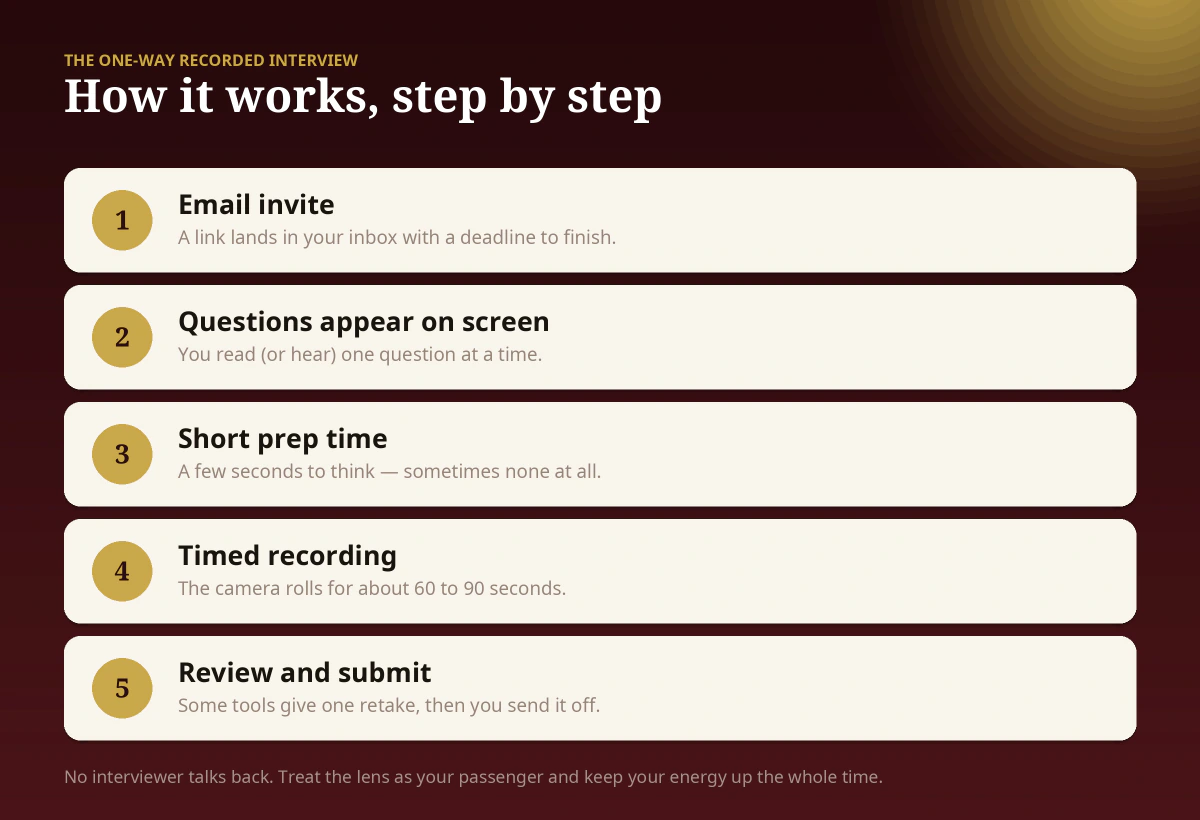
Here is the shape of a typical session, start to finish:
- Email invite — a link lands in your inbox with a deadline (often a few days) to complete the interview.
- System check — the tool tests your camera, microphone and connection, and lets you record a short practice question.
- Question appears — you read or hear one question at a time; you cannot skip ahead or go back.
- Prep window — a short countdown (sometimes 30 seconds, sometimes none) to gather your thoughts.
- Timed recording — the camera records for a set window, commonly 60 to 90 seconds per answer.
- Review and submit — some tools allow a single retake; then you submit the full set and it is gone.
The whole thing rarely takes more than 20 to 30 minutes, but you should block a quiet hour so you are never rushed. Once you submit, you cannot edit anything — which is why the preparation below matters more than raw confidence.
What HireVue is and how it is used
HireVue is the video interview platform most Gulf and international airlines use to collect and review recorded answers at scale. It is not a special "AI judge" that passes or fails you on its own; it is the software that hosts the questions, records your responses, and lets a recruitment team watch and score them afterwards. You can read the vendor's own overview on the HireVue site.
What actually happens on the other side is simpler than the rumours suggest. Recruiters watch your clips — sometimes at speed — looking for the qualities that make good cabin crew: warmth, clarity, composure under a little pressure, and clear spoken English. They are not counting your blinks. They are asking one question about every candidate: would I feel comfortable putting this person in a uniform in front of my passengers?
Do not perform for a robot. Perform for a tired traveller in seat 34C who needs a calm, friendly face. Warmth reads on camera far better than a memorised script.
Your setup checklist
Your setup is the part of the video interview you can fully control, and it silently shapes the recruiter's first impression before you say a word. A candidate who is well lit, centred and calm already looks more hireable than one filmed in a dim, cluttered bedroom — even if their answers are identical.
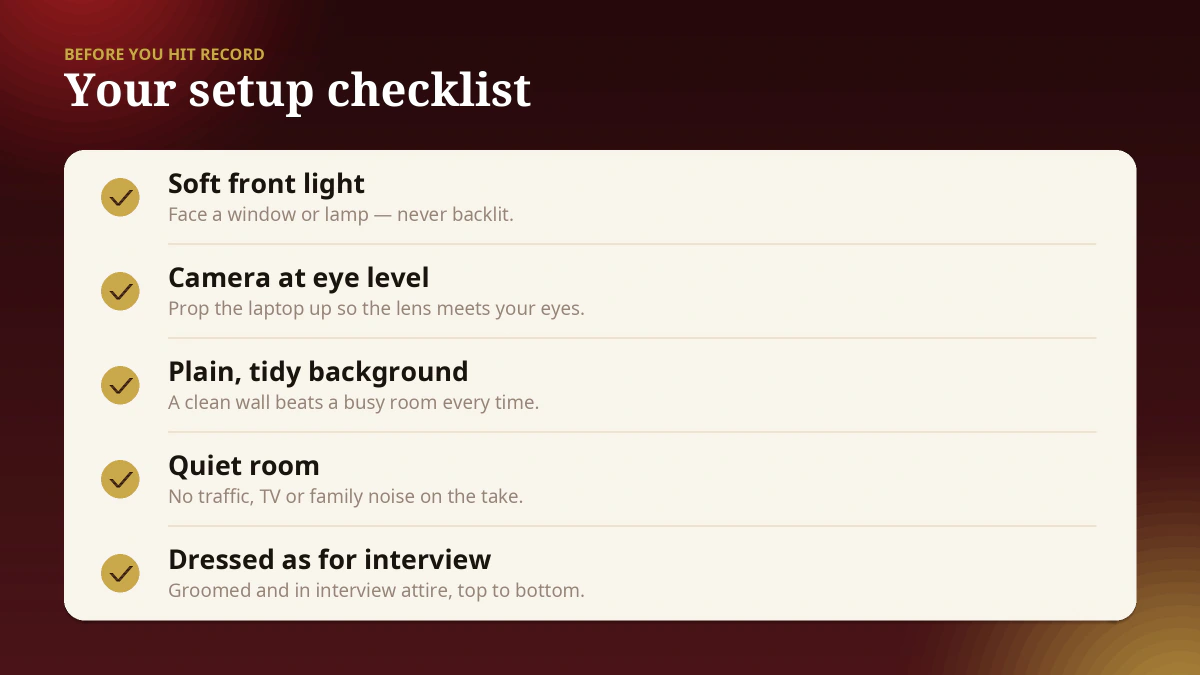
Run through this list before you hit record:
- Soft front light — face a window or a lamp so the light falls on your face. Never sit with a bright window behind you, which turns you into a shadow.
- Camera at eye level — prop your laptop on books so the lens meets your eyes. A camera looking up your nose is unflattering and reads as unprofessional.
- Plain, tidy background — a clean wall or a simple, uncluttered room. Remove laundry, posters and anything distracting behind you.
- Quiet room — no traffic, television, pets or family noise during a take. Tell the people you live with when you will be recording.
- Dressed as for interview — full interview grooming and attire, top to bottom, exactly as you would for an in-person meeting. If grooming standards are new to you, our overview of cabin crew grooming standards covers hair, make-up and uniform-ready presentation.
One small trick from real candidates: put a sticky note with a smiley face right next to the camera lens. It reminds you where to look and, oddly, it keeps your expression warm when there is no human to smile back at you.
How to answer in 60 to 90 seconds
A strong video answer is a short, structured story delivered with a smile, not a speech. With only about a minute, rambling is fatal — you run out of time before you reach the point. The fix is a simple rubric you can run in your head under pressure.
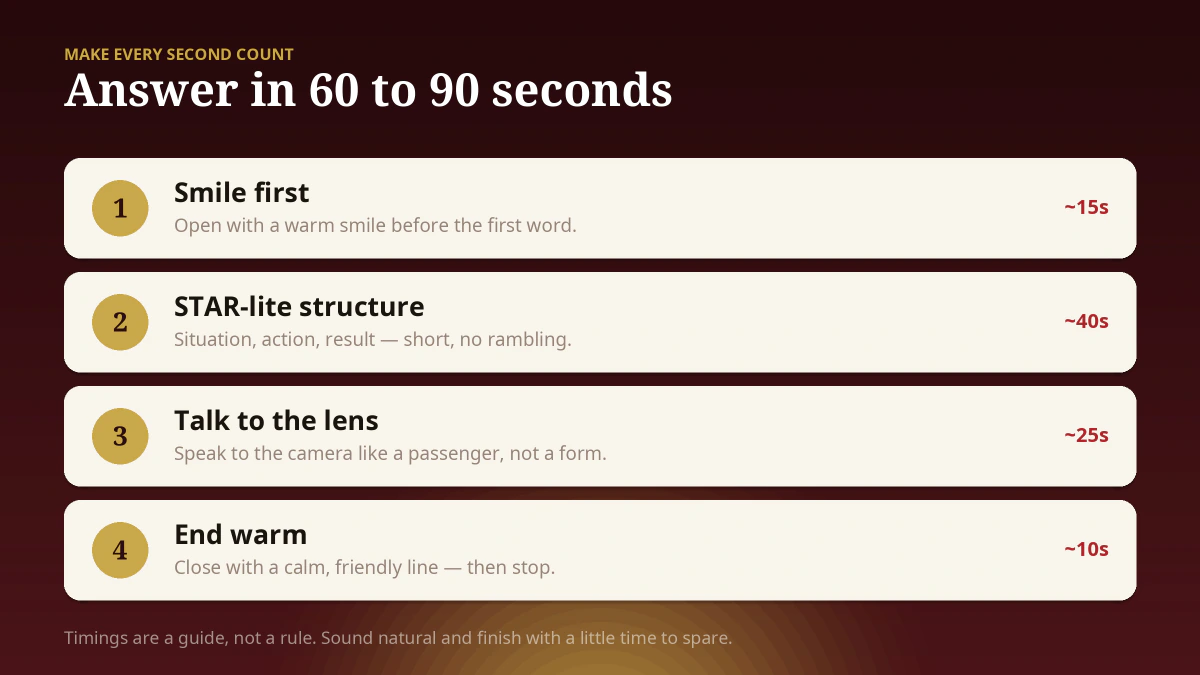
Use this four-beat pattern for every answer:
- Smile first — open with a warm smile before your first word. It sets your tone and settles your nerves.
- STAR-lite structure — for behaviour questions, give a quick Situation, the Action you took, and the Result, without the long build-up. Keep it tight.
- Talk to the lens — speak to the camera as if it were a passenger in front of you, not a form to fill in. Your eyes should meet the lens, not the screen.
- End warm — finish with one calm, friendly closing line, then stop. Do not trail off or apologise for the time.
The full STAR method deserves its own practice, because it is the backbone of every cabin crew interview stage, live or recorded. Work through our detailed STAR method for cabin crew interviews guide and build two or three ready stories you can adapt on the spot. In a 90-second window, a STAR-lite answer — roughly 15 seconds of situation, 40 of action, 25 of result — lands cleanly with a few seconds to spare.
Common video interview questions
Cabin crew video interview questions fall into three predictable families: motivation, behaviour, and situational judgement. You will not know the exact wording, but you can prepare a story or a stance for each family and adapt it live. The table below shows the pattern and a quick way to frame each type.
| Question type | Example | How to frame it |
|---|---|---|
| Motivation | "Why do you want to be cabin crew with us?" | One genuine reason + one thing specific to that airline. |
| Behavioural | "Tell us about a time you handled a difficult customer." | STAR-lite: quick situation, your action, the result. |
| Situational | "A passenger is rude to a colleague. What do you do?" | Calm, safety-and-service first, show teamwork. |
| About you | "Tell us about yourself in one minute." | Present-past-future: who you are, relevant experience, why now. |
Two more that appear often: "What does great customer service mean to you?" and "Describe a time you worked in a team under pressure." Notice that almost every question is really asking the same thing — can you stay warm, safe and clear when things get hard? To rehearse dozens of realistic prompts out loud, drill them free in the cabin crew interview questions library and the CrewQuest trainer, which are built for exactly this stage.
Voice, eyes and body language on camera
On camera, your body language carries as much weight as your words, because the recruiter is watching for the presence a passenger will feel in the aisle. The screen flattens energy, so what feels like "a bit much" to you often reads as just right on video.
Keep your shoulders back and sit slightly forward, as if you are attentive to a guest. Let your hands move naturally at chest height rather than gripping the desk. Above all, look at the lens, not at your own face in the preview window — eye contact with the camera is what makes a viewer feel spoken to. Slow your speech by about ten percent from your normal pace; nerves speed everyone up, and a calm tempo signals control.
Smiling is not decoration here. A genuine smile changes the sound of your voice, softens your delivery and mirrors the exact warmth airlines sell to their passengers. If you smile only once, do it as you begin — but ideally, let it return whenever the answer allows.
The camera rewards calm. Speak a little slower, smile a little more, and leave a breath of silence at the end instead of rushing to fill every second.
Speaking clear English on camera
Clear spoken English is a core requirement for international cabin crew, and the video interview is where it is first tested in real time. You do not need a perfect accent — crew come from everywhere — but you do need to be easily understood, fluent enough not to stall, and confident with the everyday and safety vocabulary of the cabin.
The recorded format actually helps a nervous speaker: there is no fast back-and-forth, so you control the pace. Use that. Speak in short, complete sentences. If you lose a word, pause and rephrase rather than freezing. Avoid memorising long scripts word for word, because the moment you forget one line, the whole answer collapses; a structure you can improvise around is far more robust.
If English is the part you are least sure about, do not leave it to chance. A focused plan closes the gap faster than you expect, and our English for cabin crew guide lays out the level airlines want and a 90-day routine to reach it. Reading answers aloud, recording yourself, and listening back is the single most effective drill — it is uncomfortable and it works.
Common mistakes that fail candidates
Most video interview failures come from a short list of avoidable mistakes, not from a lack of talent. Knowing them in advance is half the battle.
- Bad lighting and framing — filming in the dark, backlit, or with the camera pointing up. It looks careless before you speak.
- Reading from a script — eyes darting off-camera to notes is obvious and kills the connection. Use bullet points at most.
- Rambling past the point — no structure, so the answer runs out of time mid-story. Always land the result.
- No smile, flat energy — a monotone, unsmiling take reads as cold, which is the opposite of what cabin crew must be.
- Leaving it to the deadline — recording tired, at midnight, on the last day, with technical problems and no time to fix them.
- Ignoring grooming — casual clothes or messy hair signals you did not take it seriously. Present as if it were a face-to-face interview.
There is one more that quietly sinks strong candidates: treating the video round as less important than the "real" interview later. It is often the biggest cut of the whole process. More people are rejected here than at any live stage, simply because the numbers are largest at the top of the funnel.
Timers, retakes and technical tips
The technical side of the video interview is predictable once you know the rules, so remove every avoidable risk before you start. Use a laptop or desktop rather than a phone if you can, plug into a stable connection, close other apps, and charge your device. Do the platform's system check honestly and record the practice question to warm up your voice.
On timers and retakes, assume the strictest version. Some questions give you a prep countdown; some start recording immediately. Some tools allow one retake per question; many allow none. Plan as if you get a single take, because then a retake is a bonus rather than a rescue. If a genuine technical fault occurs — the video freezes, the audio drops — contact the airline's recruitment team promptly and calmly; do not simply abandon it.
Finish comfortably inside the time window. An answer that lands at 70 seconds of a 90-second limit looks controlled; one cut off mid-sentence at the buzzer looks panicked. Practising against a real countdown, not a vague sense of time, is what builds that instinct.
What happens after you submit
After you submit, your recording enters a review queue for the airline's recruitment team. Timelines vary widely — some candidates hear back within days, others wait weeks, and a quiet period does not mean rejection. If you pass, the next step is usually an invitation to an assessment day or a further interview stage.
Use the wait well. The video interview and the assessment day test the same underlying qualities, so the preparation carries straight over. Read our full cabin crew assessment day walkthrough so the next round holds no surprises, and make sure your paperwork is ready — a strong application and photo keep the whole pipeline moving, which is why our Emirates cabin crew CV and photo guide matters even at this stage. For the bigger picture of the entire journey from application to wings, the pillar guide on how to become Emirates cabin crew ties every stage together.
Your practice plan and next steps
The best way to pass a video interview is to rehearse the real thing, on camera, out loud — not to read about it. Reading builds understanding; recording builds the calm that recruiters actually reward. Here is a simple plan for the week before your invitation.
- Build three stories — one about great service, one about teamwork under pressure, one about handling conflict, each in STAR-lite form.
- Record yourself daily — answer a random question against a 90-second timer, then watch it back and fix one thing.
- Fix your setup once — find the spot with the best light and background, and keep it ready so you never scramble.
- Polish your English — read answers aloud and smooth the words that trip you, using the 90-day plan if you need it.
- Do a full dress rehearsal — groomed, dressed and lit, record a complete mock set as if it were the real submission.
Want a shortcut through the nerves? Book a free consultation call with Kateryna — a former Emirates crew member — using the planner just below, and we will map your exact prep, review a practice recording, and build your timeline. Then keep working the funnel: drill real prompts in the CrewQuest trainer and the interview questions library, sharpen your English for cabin crew, and see the full programme on the Emirates cabin crew course page. Get the recording right, and you turn the stage that rejects the most people into the one that moves you forward.


