
 Kateryna Ivanova
Becoming Emirates cabin crew in 2026 means applying online or walking into an Open Day, getting through a one-day recruitment event (introduction, group activities with an online test, final interview), receiving the Golden Call, and completing seven and a half weeks of training in Dubai. Emirates' published requirements: at least 21 years old, fluent written and spoken English, at least 160 cm tall with a 212 cm reach, high-school (Grade 12) education, at least one year of hospitality or customer-service experience, and no tattoos visible in uniform. Emirates puts average monthly pay for a new Grade II crew member at AED 11,244 (USD 3,061), tax-free, with free furnished accommodation in Dubai. This guide is written by a former Emirates cabin crew member with three years of service who now prepares candidates for Assessment Day.
How to read this guide: every official fact below was checked against Emirates' own careers page, emiratesgroupcareers.com, on 17 September 2026. Everything else — how the day feels, what trips candidates up, the technique drills — is experience, and it is written as experience. Emirates does not publish pass rates, so you won't find invented percentages here.
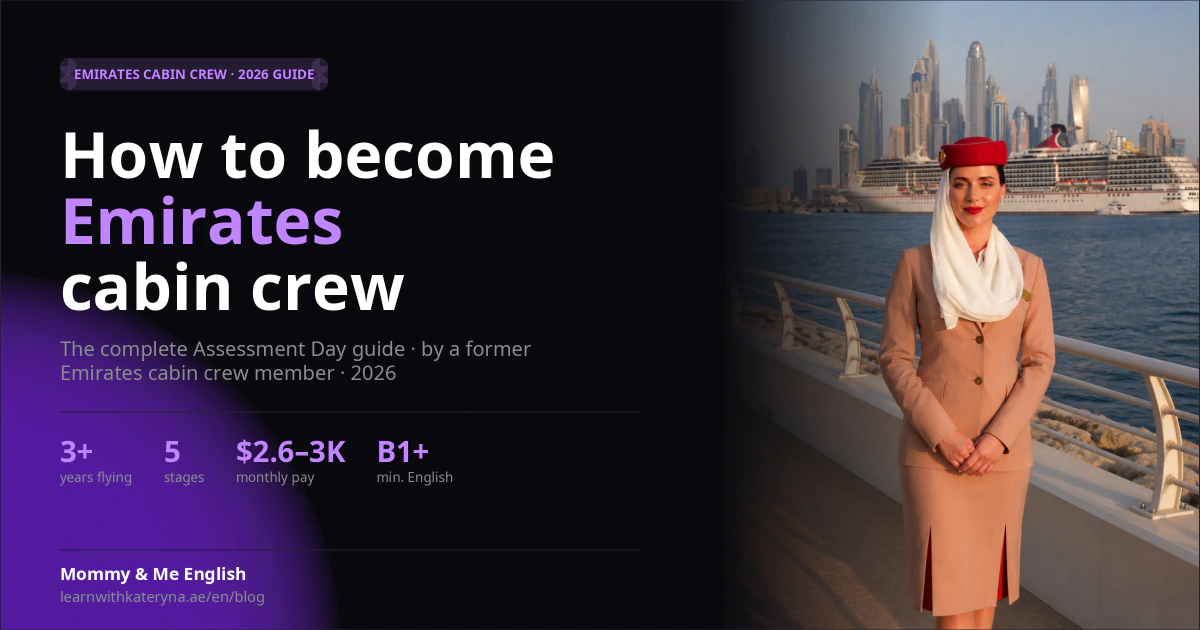
By the numbers
In 2024, Emirates announced it would recruit 5,000 additional cabin crew for its expanding fleet — a sense of the hiring scale behind these stages.
Source: Gulf News (2024). A 2024 figure — recruitment volumes change year to year.
What's in this article
- What does Emirates cabin crew do?
- The Emirates recruitment process, step by step
- 2026 requirements: age, height, English, tattoos
- Open Day and Assessment: what really happens
- The 212 cm reach test: technique
- The group exercise: where strong candidates slip
- Final Interview: 12 questions to prepare
- Aviation English: what level you really need
- Emirates pay and benefits 2026
- Emirates vs Qatar vs Etihad vs flydubai
- What to do if you don't pass
- Career progression at Emirates
- Ukrainian candidates: real strengths to prove
- The real timeline: from "I've decided" to your first flight
- Next steps
- Frequently asked questions
What does Emirates cabin crew do?
Emirates cabin crew are safety professionals who also deliver the service Emirates is known for. On every flight the job is the same two things in one: getting everyone through the flight safely, and making the cabin feel like the brand people paid for. Emirates calls the role cabin crew; job sites write flight attendant, and in everyday speech people still say air hostess or stewardess. It is one job, and everything in this guide applies to all four words.
A normal duty runs roughly like this:
- Before the flight: a briefing on the aircraft, the route, the passengers and the safety equipment, followed by security and equipment checks on board.
- Boarding: welcoming passengers, managing bags and the cabin, and the safety demonstration.
- In the air: the service — meals, drinks, duty free — plus looking after nervous, unwell or unhappy passengers, and staying ready for a medical or a security problem at any moment.
- On the ground: a layover in the destination city, then the same again on the way home. Emirates pays the hotel and the transport.
Which cabin you work — Economy, Business or First — depends on your grade, and that is what moves your pay over the years. The safety half never changes: it is why the training is seven and a half weeks and why the requirements exist at all.
The Emirates recruitment process: step by step from application to contract
Emirates recruitment is a funnel: fewer candidates remain at each step. Emirates itself publishes the core of it — apply, attend a recruitment day, receive an offer, train in Dubai. The steps below add what candidates meet in practice, and they say clearly which part is official and which is reported experience.
Stage 1: Online Application (about 30 minutes)
Apply on the official portal emiratesgroupcareers.com — Cabin Crew → Apply. You need: business-style photos (a face-shot and a half-body in a white blouse), a CV in English, and answers to short motivation questions. Emirates also says it will tell registered candidates when it is recruiting near them. Emirates does not publish how applications are screened, so don't write for an imagined keyword filter — write a plain-English CV built around what the role actually is ("customer service", "multicultural team", "team collaboration") and back each phrase with a concrete example.
Stage 2: Video Interview (reported by candidates)
Many candidates report a one-way recorded interview before the recruitment day, commonly on HireVue: a few questions answered to camera, with short, timed windows to prepare and to answer. Emirates' careers page does not describe this step, and formats change — so follow the instructions in your own invitation rather than a number of seconds you read online. Typical questions: "Why Emirates?", "Tell us about a time you handled a difficult customer", "How do you work in a multicultural team?" There is a full walkthrough in our cabin crew video interview guide.
Stage 3: Open Day or Assessment Day (one day, from 9 AM)
An in-person event. Emirates lists them city by city: walk-in Open Days need no invitation, while invite-only events require an online application first. Events in Ukraine are currently invitation-only through Emirates' appointed agency; in the listing checked on 17 September 2026, walk-in Open Days nearby included Warsaw, Krakow, Bucharest, Chisinau and Tbilisi. The list changes every month — check it before you book anything (more in our Open Day guide).
Emirates publishes three parts to the day: Introduction, Assessment (group activities and an online test at the venue) and Final Interview. In practice that includes the checks candidates ask about most:
- Brief Presentation — the Introduction: recruiters talk about the role, the company and life in Dubai
- CV Drop — candidates commonly hand their CV to a recruiter in person with a short self-introduction; keep digital copies of your CV, education certificate and passport on your phone, as Emirates asks
- Reach Test — touch the 212 cm mark with your hand on tiptoes
- Group Exercise — a small group solves a situational task against the clock
- English Test — the online test Emirates lists as part of the Assessment
Stage 4: Final Interview
Emirates lists the Final Interview as the last part of the recruitment day and describes it as a relaxed one-on-one about your motivation, your customer-service experience and why you suit the role. Expect behavioural questions you can answer on the STAR model (Situation–Task–Action–Result), plus questions about living far from family and coping with long flights. A mock interview before this stage is key.
Stage 5: Golden Call and Joining Offer
The "Golden Call" is the call from a recruiter with an offer. Before joining you complete a self-declaration medical form and a dental form — at your own cost, Emirates says — and Emirates handles the work permit and UAE visa. Further medicals follow in Dubai. Training takes seven and a half weeks, and you live in the free crew accommodation from the start. Your first flights are supernumerary: you are observed and given feedback before your first operational flight.
Emirates cabin crew requirements 2026: full checklist
Emirates' published list is short — and the two items candidates most often get wrong are the height minimum and the experience requirement. A university degree is not on it; Grade 12 is. The first two columns below are Emirates' wording (checked 17 September 2026); the third is practical advice.
| Requirement | What Emirates publishes | What it means in practice |
|---|---|---|
| Age | At least 21 years old | Check your date of birth against the event date before you travel |
| Height / Reach | At least 160 cm tall and able to reach 212 cm | Two separate conditions — a good reach does not replace the height minimum |
| Education | High school (Grade 12) | University not required, but a degree on the CV still helps |
| English | Fluent in written and spoken English; additional languages are an advantage | No level or certificate is named; my working benchmark is confident B1+, ideally B2 |
| Tattoos | No visible tattoos while in uniform | No list of zones is published — assume anything that could show in uniform counts |
| Covered tattoos | Not excluded by the published wording | Judge by what shows when you move, reach and serve, not when you stand still |
| Vision | Not in the published requirements | Medical fitness is assessed through the pre-joining medical forms and the medicals in Dubai |
| Grooming | A published dress code for the event | Skin, hair, nails, teeth — noticed from the moment you arrive |
| Swimming | Not in the published requirements | Safety training covers emergencies and evacuation; be comfortable in water, but no distance is published |
| Work experience | At least 1 year of hospitality or customer service | A requirement, not a bonus — describe your customer-facing roles in service terms |
| Visa | Able to meet UAE employment visa requirements | Emirates processes the work permit and visa once you are selected |
"Most candidates think Emirates screens on looks. That's a myth. They screen out a lack of robustness — the ability to hold your tone of voice and your smile after 14 hours on a plane. A recruitment trainer sees it almost immediately."
Emirates Open Day: the full anatomy of the day
The Emirates Open Day is a one-day filter: it starts at 9 AM and ends, for those who get that far, with the final interview. Emirates publishes neither attendance nor pass rates, so any precise percentage you see quoted is a guess. What is certain is that many candidates leave before the final interview — and knowing the structure of the day is the part of that you control. Candidates who arrive unprepared tend to get lost at the CV Drop or in the group exercise.
The morning: first impressions
Events start at 9 AM — arrive early enough to queue calmly, with a valid ID and your documents ready on your phone. If you don't have a passport yet, Emirates accepts a photo ID such as a driver's licence or national ID card at this stage. Behave as if the assessment has already begun: how you treat other candidates, whether you smile, how you handle nerves are all visible long before the first exercise.
Midday: Reach Test + English Test
The Reach Test — your hand must touch the 212 cm mark. You stand on tiptoes, arm fully extended, body straight. If you miss the mark, stay calm and ask politely whether you may try again after warming up — whether that is possible is the recruiter's decision, not a rule to rely on.
The English Test — the online test Emirates lists as part of the Assessment. Emirates does not publish its length, format or pass mark; candidates generally describe multiple choice grammar, vocabulary and short reading tasks. What matters here is NOT perfectionism but steady speed and confidence.
The finale: group exercise and "yes/no"
You're split into small groups. You're given a scenario — for example, "your plane is delayed 4 hours by a storm; the passengers include a VIP, a family with a child, and a business traveller who's missing a connection. How do you allocate resources?" The discussion is timed. Recruiters walk around recording observations.
After the group activities, candidates either continue to the Final Interview ("yes") or are thanked and let go ("no"). Emirates lists the Final Interview as part of the same recruitment day; the offer itself — the Golden Call — comes later, and Emirates publishes no fixed waiting time for it.
The 212 cm reach test: technique that uses your full reach
Emirates asks for two separate things: a height of at least 160 cm and a reach of 212 cm. If you are close to the height minimum, the reach is the check to rehearse. Nobody publishes how many centimetres technique is worth — but the mistakes below are visible and correctable, and each one costs you reach you already have. On a borderline reach, that can decide between "passed" and "didn't pass".
Common mistakes that cost reach
- Standing flat-footed instead of rising onto full tiptoes
- Not fully extending the fingers
- Not engaging the core — the body leans forward, losing height
- Not coordinating the breath — reaching on a held, tense breath instead of a controlled exhale
The correct 5-second sequence
- Stand by the wall, feet hip-width apart
- Take a deep breath, engage your core muscles (as before lifting a weight)
- Rise onto full tiptoes — not halfway
- On the exhale, reach your arm up as far as possible, fingers fully open
- Touch the mark. Hold for 1 second — for the recruiter to record
Home preparation: 2 weeks before Assessment Day
Every day, touch the highest mark on a wall at home and record it. Two weeks won't make you taller, but calf strength, balance on full tiptoe and a routine you can repeat under pressure turn your best reach into your normal reach — which is what counts when the one attempt that matters is being watched. Measure honestly, too: if your reach is still clearly below 212 cm after practice, know that before you pay for travel to an Open Day.
The group exercise: where strong candidates most often slip
The group exercise isn't a knowledge test — it's a test of group dynamics. Recruiters assess: do you listen, do you speak to the point, do you avoid dominating, do you avoid being passive. Emirates describes this part as your chance to show teamwork, communication and problem-solving. In my experience the mistake that sinks otherwise strong candidates is trying to be "the smartest in the room".
4 roles that work (and one that kills your chances)
Roles that get a "yes":
- Connector — turns to quiet members: "And what do you think?" The recruiter sees a leader through inclusiveness.
- Synthesizer — sums up: "So we agreed on A and B, but we need to decide C." Keeps the group focused.
- Idea-builder — adds to someone else's idea: "Interesting what you said about X — what if we also add Y?"
- Time-keeper — watches the clock: "We have 5 minutes left, let's decide this quickly."
The role that gets a "no":
- Dominator — talks the most, interrupts, forces their solution. However good the ideas, shutting others out demonstrates the opposite of the teamwork and communication this exercise exists to see.
"In my group of 10, the most active girl didn't pass. Not because she had bad ideas, but because she didn't let others speak. The recruiter later told me: 'I'm looking for someone I'm comfortable flying 14 hours in a tube with. Not someone who constantly interrupts.'"
Final Interview: 12 questions to prepare for
The Final Interview is a one-on-one that Emirates describes as a relaxed discussion about your motivation, your customer-service experience and why you suit the role. Expect behavioural questions; the exact questions vary, which is why prepared stories in the STAR structure (Situation–Task–Action–Result) are your best chance. These twelve cover the themes that come up again and again.
Category 1: Customer service under pressure
- "Tell me about the most difficult customer you've worked with. What did you do?"
- "Tell me about a time you exceeded a customer's expectations."
- "How do you react when a customer shouts at you unfairly?"
Category 2: Teamwork and culture fit
- "Describe a team conflict you helped resolve."
- "How do you adapt to colleagues from different cultures?"
- "Tell me about a time you bent the rules to help a customer."
Category 3: Resilience and motivation
- "Why Emirates, not Qatar or Etihad?"
- "Are you ready to live far from family for 2–3 years? How do you handle stress?"
- "Tell me about a failure. What did you take from it?"
Category 4: Situational (safety awareness)
- "A passenger refuses to fasten their seatbelt during turbulence. What do you do?"
- "Two passengers are arguing loudly. How do you intervene?"
- "A child passenger suddenly becomes aggressive. What do you do?"
Aviation English: what level you really need
Officially Emirates asks for fluent written and spoken English and names no level or certificate; my practical benchmark is Cambridge B1+ with confident spoken communication. Written grammar isn't decisive — communicative confidence and aviation terminology matter more.
3 levels of English they check
- Conversational — small talk with the recruiter and colleagues. B1 is enough here.
- Customer service — politeness, a neutral tone, phrases for complaints/requests. Needs a wider, B2-type service vocabulary.
- Safety / Emergency — precise commands ("brace, brace", "evacuate, evacuate"), standard announcements, medical phrases. Here you don't need B2 — you need precise pronunciation.
What screens out even candidates with a good level
- A strong accent on safety words (the recruiter wants to be sure a passenger will understand under stress)
- A quiet or shaky delivery during the self-introduction
- An inability to say "I don't know" clearly without a neurotic reaction
- An inability to ask politely to repeat: "Could you repeat that, please?"
The Emirates Cabin Crew preparation works exactly on these three levels, with a focus on situational scenarios rather than general grammar.
Emirates cabin crew pay 2026: the real numbers
Emirates publishes the new-joiner package itself: a basic salary of AED 4,980 a month plus flying pay of AED 69.6 per hour, based on an average of 80–100 flying hours — an average monthly pay of AED 11,244 (USD 3,061) for Grade II (Economy Class). Figures checked on emiratesgroupcareers.com on 17 September 2026. Emirates updates that page without announcement, and the previous published set — AED 4,430 basic, reported by Gulf News in July 2025 — is why many guides still quote lower figures. There is no personal income tax in the UAE. The full breakdown, including what changed, is in our Emirates cabin crew salary guide.
Pay and benefits (as published by Emirates)
| Component | Amount | Details |
|---|---|---|
| Basic salary | AED 4,980 / month | Fixed, regardless of flights |
| Flying Pay | AED 69.6 / hour | Paid for operated flights |
| Average flying hours | 80–100 / month | The basis of Emirates' average; set by the roster |
| Average monthly pay | AED 11,244 (USD 3,061) | Emirates' own approximate figure for Grade II |
| Meal allowance | for overseas night stops | Credited to salary the following month; no per-city amounts are published. Layover hotel and airport transport are paid by the company |
| Insurance | life + personal accident | 24-hour worldwide cover for all cabin crew |
| Free accommodation | furnished, utilities included | A 2–3 bedroom apartment shared with same-gender colleagues, each with their own bedroom |
| Free transport | to/from work and the Training College | Provided by the company |
| Medical | medical and dental | At designated Emirates clinics |
| Leave | 30 calendar days a year | Plus one free annual leave ticket to your country of origin |
| Travel benefits | concessional tickets | Under the Staff Travel Manual — no discount percentage is published |
| End of service | lump sum (EOSB) | Paid on completing your contract, based on salary scale |
How the pay grows
Emirates publishes pay for new joiners only — not for later grades. Any grade-by-grade salary table you find online is a third-party estimate, not an Emirates figure, and this guide doesn't repeat those numbers. What Emirates does publish: promotions are based on assessment of performance, and high-performing crew have reached Purser within five years. Each step up the ladder brings more responsibility and more pay; the amounts are not public. On top of salary, Emirates has paid a profit share in strong years — for 2025-26 it was a 20-week salary bonus, announced in May 2026 (The National). It depends on the year's results and is not guaranteed.
Emirates vs Qatar vs Etihad vs flydubai: which to choose
For candidates who want the Gulf, Emirates isn't the only option. The preparation methodology is similar for all four, but each has its own character:
- Emirates — the best-known brand of the four and a huge long-haul network (Emirates says it flies to over 120 destinations, with crew from over 120 nationalities). It is also the most published package: pay, benefits and requirements are all on its own careers page. Maximum competition.
- Qatar Airways — Doha hub and a similar long-haul lifestyle. Its requirements and package differ in detail from Emirates', so compare its own careers page directly rather than forum summaries.
- Etihad — Abu Dhabi hub and a smaller network than Emirates, which in practice means you fly the same routes more often.
- flydubai — Dubai-based, flying shorter routes, so the job has a different rhythm and fewer long layovers. Its package and housing arrangements are not the same as Emirates' — check them on its careers page. Many candidates treat it as a first step into Gulf aviation.
What to do if you don't pass
A rejection is not a lifetime verdict. Emirates' careers page does not publish a waiting period before you can apply again — a "six-month rule" circulates widely online, but it isn't stated there — so check your candidate account and any rejection email for the terms that apply to you. Candidates do succeed on later attempts. The key is to understand exactly where you were cut and fix it.
How to get feedback
Emirates rarely gives detailed feedback. But from the stage where you were cut, you can reconstruct it:
- Rejected after the Video Interview — a problem with pronunciation, answer structure or the motivation story.
- Rejected after Open Day without a Final — a failure at CV Drop, Reach Test, English Test or Group Exercise.
- Rejected after the Final Interview — culture fit, robustness, or the recruiter's doubts about a 3-year outlook.
A six-month plan for a second attempt
- Months 1–2: raise English from B1 to B2 (especially pronunciation on safety words)
- Months 3–4: a mock interview weekly with feedback
- Months 5–6: group-exercise simulations, reach-test training, robustness scenarios
Structured preparation with an ex-Emirates mentor targets exactly the stage where you were cut, instead of repeating everything. That's how the Emirates Cabin Crew preparation works — a methodology from someone who passed Assessment Day herself and worked as Emirates cabin crew for 3+ years.
Career progression at Emirates: the published ladder
Emirates cabin crew isn't "just another job" but a career track with clearly named levels. Emirates publishes the ladder itself and says promotions are based on assessment of performance. It publishes no fixed timetable — but it does say that high-performing crew have been able to reach Purser within five years.
5 career levels
- Economy Class (Grade II) — where every new joiner starts, and the grade Emirates' published pay applies to. The first six months are probation. Emirates' description: a personalised service in which hospitality shines through your personality, attitude and interactions.
- Business Class — creating "signature moments" and noticing the opportunities customers will remember; on the A380 this includes the Onboard Lounge.
- First Class — tailor-made service that sets the benchmark for the brand.
- Cabin Supervisor — leads and manages a team, focusing on service excellence and product knowledge. Your first real management role.
- Purser — the on-board leader, with a key role in making sure safety and security standards are met on the flight.
What opens up after cabin crew
Emirates says many crew have become trainers in cabin service, and that many people now in middle and upper management joined the airline as cabin crew before moving to other departments. For someone who starts at Grade 12, that makes the cabin a genuine route into aviation management — earned on performance rather than on a degree.
"Many people in middle and upper management joined the airline as Cabin Crew and now work in other departments." — Emirates Group Careers, cabin crew FAQ
Ukrainian candidates: real strengths, and what you still have to prove
No one publishes pass rates by nationality — not Emirates, not any agency — so there is no statistic showing that Ukrainian candidates do better. What does exist are concrete strengths many Ukrainian candidates bring. Each one counts only if you show it on the day, so each comes with how to prove it.
4 strengths to show — and how to prove each one
- Resilience under pressure — since 2022 many Ukrainian women have lived through years of real disruption. That isn't a free pass: a recruiter can only credit what you turn into a clear STAR story — a specific situation, what you did, what changed.
- More than one language — Ukrainian, often Russian, sometimes Polish or German on top of English. Emirates states that additional languages are an advantage, so list each one on your CV with an honest level.
- Real service experience — work in hotels, restaurants, beauty, retail or tourism, in Kyiv, Lviv, Odesa or abroad, counts toward Emirates' one-year customer-service requirement. Describe it in guest-facing terms, with examples, and it shows at the CV Drop.
- A commitment you can explain — Emirates asks every new joiner to move to Dubai and live in crew accommodation. A calm, concrete answer about why you're ready for that — family arrangements, what you've already researched, how you handle distance — persuades far more than any claim about nationality.
3 typical Ukrainian mistakes (fix before Assessment)
- Too-modest small talk — Ukrainian culture says "don't boast". In American-English customer-service culture that reads as "unsure". Practise telling your achievements without modesty, with a smile.
- Not smiling all the time — in our culture a constant smile = insincerity. In cabin-crew culture = professionalism. The smile should be your default state.
- A strong accent on safety words — "thirteen" vs "thirty", "evacuate" vs "evaluate". Drill a short list of these safety words until they are automatic — a small accent elsewhere is okay, but the safety vocabulary must be clear.
The real timeline: from "I've decided" to your first flight
The only fixed block Emirates publishes is training: seven and a half weeks in Dubai. Everything before it depends on your preparation and on when events run near you, so treat the durations below as a planning estimate from experience, not an Emirates schedule:
| Phase | Duration | What happens |
|---|---|---|
| Preparation | 2–4 months (estimate) | English to B1+, reach-test training, mock interviews, robustness |
| Application + Video | varies | CV submission, a recorded interview if you're invited to one, waiting for an event near you |
| Recruitment day | 1 day, from 9 AM | Introduction, group activities and online test, final interview |
| Decision | varies | Emirates publishes no fixed waiting time for the Golden Call |
| Joining process | varies | Contract, medical and dental forms, work permit and visa handled by Emirates, move to Dubai |
| Initial Training | 7.5 weeks (published) | Induction, safety and emergency, medical, security, hospitality, uniform, service |
| Supernumerary flights | first flights | You fly observed and receive feedback before your first operational flight |
| Operating crew | onward | A monthly roster and, per Emirates, about eight days off a month in Dubai |
Add those blocks together and the honest answer is many months, not a few weeks — so start preparing well ahead of the date you have in mind. If you haven't applied yet — that's okay. Better to add another 2–3 months of preparation and pass first time than to rush and be cut.
Next steps
The full Emirates guide map
This guide is the overview. Each stage has its own detailed walkthrough:
- Emirates cabin crew requirements — the published checklist, and the two items candidates get wrong.
- CV and photo — the first filter, with the formats recruiters expect.
- The video interview — the recorded round before the event.
- Open Day — how the day runs, the official dress code, what to bring.
- Assessment Day — every stage decoded, including the group exercise.
- The final interview — the one-to-one and the STAR answers.
- The Golden Call — what happens after the offer.
- Salary — what Emirates publishes, in AED, pounds and euros.
- Aviation English — the level you need and a 90-day plan.
- Training in Dubai — the seven and a half weeks after you sign.
If you've read this far, you have serious motivation. Here are three practical steps for this week:
- Check your reach — ask someone to measure the mark you reach on tiptoes. If it's under 212, start the technique from this article daily.
- Assess your English — take the free Cambridge English test. Below B1 — start with the basics; B1–B2 — focus on situational/safety English.
- Create an account on emiratesgroupcareers.com — even if you're not applying now, get email alerts about Open Days in Europe.
If you want systematic preparation from someone who went through the process herself, take a look at the Emirates Cabin Crew preparation with Kateryna. Mock interviews, insider tips, aviation English — in 4–8 weeks from "unsure" to "ready for Assessment Day".


