 Kateryna Ivanova

Quick answer
Six Gulf airlines publish cabin crew requirements, and not one of them publishes a different age, height, reach, education, experience or English rule for men. The lists are written for everyone: Emirates asks for 160 cm and a 212 cm reach, Etihad for 163 cm, flydubai for 158 cm, Qatar Airways for the 212 cm reach alone. The only male-specific rule any of them publishes is a styling card for the recruitment day — Emirates' "Male" card reads hair neatly presented, clean shaven, suit/smart business attire, formal work shoes. The widely repeated "men need 165–170 cm" does not appear on a single airline page. All sources below were read on 24 September 2026.
TL;DR:
- Same requirements, same list. Emirates, Etihad, Qatar Airways, flydubai, Air Arabia and Gulf Air all publish one set of criteria, not two. Nothing in them is addressed to men or to women.
- The male height rule is invented. "165 cm", "170 cm" and "male minimum" come from aggregator sites and forum posts, never from an airline. Emirates publishes 160 cm for everyone.
- One genuine male-specific rule exists. Emirates' recruitment event dress code has a separate Male card: clean shaven, suit or smart business attire, formal work shoes, hair neatly presented.
- Beards are a recruitment-day answer, not a career answer. Emirates asks for clean shaven at the event. No Gulf carrier publishes an on-board facial-hair policy on its careers pages.
- Pay is published as one figure. Emirates publishes AED 4,980 basic, AED 69.6 per flying hour and about AED 11,244 a month for a new joiner — with no gendered variant anywhere.
- Accommodation is the one thing that is sorted by gender. Emirates states that two or three colleagues of the same gender share an apartment, each with their own bedroom.
- Your application is judged on the same things. English under pressure, the group activity and the final interview — exactly where most candidates of any gender are rejected.
By the numbers
Published minimum heights: Emirates 160 cm · Etihad 163 cm · flydubai 158 cm · Qatar Airways none, 212 cm reach instead · Air Arabia none. Published male-specific requirements across all six airlines: one — the Emirates recruitment dress code card. Airline pages stating a separate male height: zero.
Do airlines have different requirements for men?
No. Every Gulf carrier that publishes cabin crew criteria publishes one list, and that list never mentions gender. This is the single most useful fact for a man considering the job, because almost everything written about male cabin crew online starts from the opposite assumption.
Read the Emirates page as it stands on 24 September 2026 and you get: fluent written and spoken English, a natural team player, at least 160 cm tall and able to reach 212 cm high, able to meet the UAE's employment visa requirements, at least 21 years old, at least one year of hospitality or customer service experience, a minimum of high school (Grade 12) education, and no visible tattoos while in Emirates cabin crew uniform. Nine criteria. Not one of them is written for a man or for a woman.
The same is true at Etihad, at flydubai, at Qatar Airways and at Air Arabia. If you meet the published list, you are eligible — that is the whole test. What changes for men is not the requirement. It is the preparation for one afternoon, and we come to that below.

The six published lists, side by side
Here is what each airline puts in writing, checked at the source. Where a cell says "not published", the airline genuinely does not state it — which means nobody can quote it to you as a rule.
| Airline | Age | Height / reach | Anything gender-specific? |
|---|---|---|---|
| Emirates | At least 21 | 160 cm and reach 212 cm | No — only a recruitment-day dress code card |
| Etihad | 21 at time of application | 163 cm, no reach test | No |
| Qatar Airways | Not published | 212 cm reach, no height figure | No |
| flydubai | At least 21 | 158 cm, no reach figure | No |
| Air Arabia | Not published | Not published | No |
| Gulf Air (archived listing) | 21–30 | 160 cm, swim 50 m unaided | No |
The Gulf Air row needs a date stamp, because honesty about sources is the point of this page. Those figures come from the airline's own vacancy GF1103, "Flight Attendant — Bahrain", read on its recruitment portal on 24 September 2026 — but the posting's closing date of 31 December 2023 has passed, so treat it as evidence of how Gulf Air wrote its criteria, not as a live rule. It is still worth reading, because it contains no gender and no nationality restriction of any kind, which is the opposite of what forum posts claim about the airline.
Our requirements by airline guide keeps the full version of this table updated, and the Emirates requirements page goes through the nine criteria one by one.
Where "men need 165–170 cm" comes from
It comes from aggregator websites that copy each other, and it has no airline source. Search for male cabin crew height and you will be told, confidently and repeatedly, that women need 158–160 cm while men need 165 cm or 170 cm. Go to the airline pages themselves and the number does not exist.
Emirates publishes 160 cm, full stop. Etihad publishes 163 cm, full stop. flydubai publishes 158 cm, full stop. There is no second paragraph on any of those pages that raises the bar for men. The invented figure survives because it sounds plausible — men are on average taller, so a taller minimum feels right — and because nobody clicks through to check.
The practical damage is real. A man of 162 cm reads "men need 170 cm", decides he is ineligible, and never applies to an airline whose published minimum he clears by two centimetres. If you are anywhere near the published numbers, measure yourself properly in the morning, without shoes, and apply against the figure the airline actually prints.
We had a version of this error on our own site and have corrected it: an earlier edition of our requirements comparison repeated the 165–170 cm claim without a source. It should not have been there.
The one published rule that really is male-specific
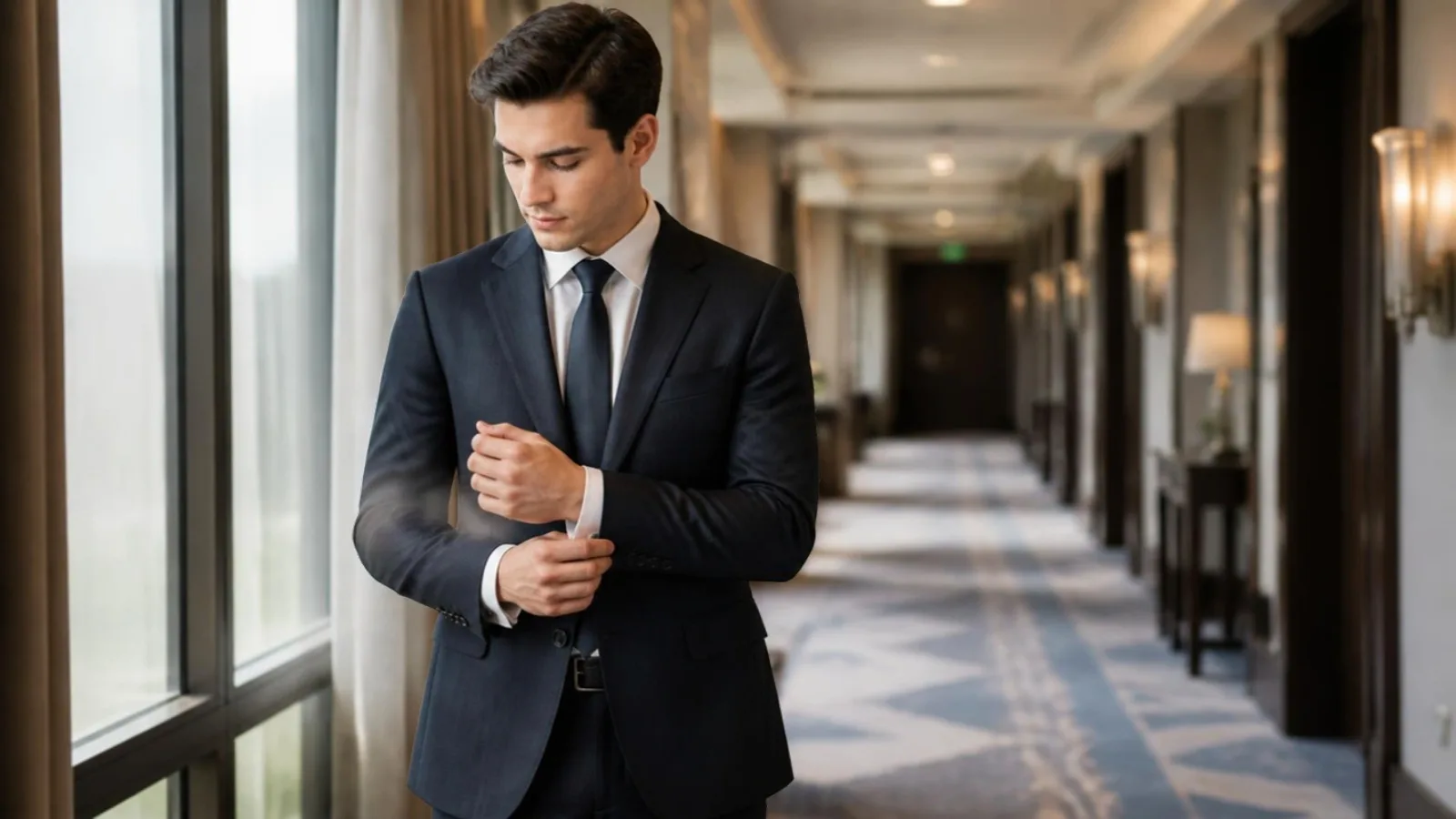
Emirates publishes a recruitment event dress code with two cards, Female and Male, and the male card is the only genuinely male-specific requirement any Gulf airline puts in writing. It has exactly four lines:
- Hair: neatly presented.
- Face: clean shaven.
- Dress code: suit / smart business attire.
- Shoes: formal work shoes.
That is the complete list, quoted from the card on the Emirates cabin crew careers page on 24 September 2026. No tie colour is specified, no suit colour, no hair length in centimetres. A dark, well-fitted suit, a plain shirt, polished formal shoes and a clean shave meet it completely.
Two details are worth planning around. First, "clean shaven" means shaved that morning, not shaved yesterday — a recruiter assessing grooming standards at 4 pm is looking at a full day of stubble. Second, "smart business attire" is a floor, not a ceiling: candidates who turn up in chinos and an open collar are the ones who stand out in the wrong direction. Bring the suit.
Everything else on the day is identical: the same documents (CV in English, education certificate copy, passport copy in PDF), the same introduction, the same group activities, the same online English test at the venue and the same final interview. Our Open Day guide walks through the running order, and the assessment day breakdown covers what each stage is actually scoring.
Beards, moustaches and stubble
For the recruitment day the answer is published and unambiguous: clean shaven. For life on the line afterwards, no Gulf carrier publishes a facial-hair policy on its careers pages at all. That gap is where the internet does its worst work.
You will find detailed rules circulating about moustache width, permitted stubble length and which airline allows a full beard. None of them carry a source. The one documented development is that trade press reported in 2019 that Etihad had become the first Middle East carrier to let male cabin crew wear beards — but Etihad's own cabin crew careers page carries no such statement today, and a link on that page labelled as style and image guidelines leads nowhere, so there is nothing current to quote.
So the honest position is this. Turn up clean shaven, because that is what is published and it costs you nothing. Ask about facial hair after you have an offer, when the answer comes from your own airline's grooming manual rather than from a forum. Do not let a beard question stop you applying — and do not arrive with one because a website said it was fine.
What male cabin crew wear on board
Male crew wear the airline's male uniform — typically a suit with a shirt and tie — but note that Gulf carriers do not publish a male uniform specification on their careers pages. The famous Emirates red hat and white veil belong to the female uniform, and it is the image the airline markets with, which is a large part of why the job reads as female-coded to outsiders.
What you can rely on is the recruitment dress code above, because the airline published it. What you should not rely on is a detailed description of collar, cut or shoe style from a third party — if an airline does not publish it, neither will we. You will be fitted for the uniform during training, which at Emirates is seven and a half weeks in Dubai, covering safety and emergency procedures, service, security and the medical side.
The 212 cm reach, and who it actually favours
The 212 cm arm reach is a safety requirement about overhead lockers and emergency equipment, and it is the one criterion where being a taller man genuinely helps. Emirates publishes it alongside the 160 cm minimum; Qatar Airways publishes the reach without any height figure at all; Etihad and flydubai do not test it.
Measure it the way it is measured: stand flat against a wall, no shoes, reach up with one arm, and mark the highest point your fingertips touch. Standing on tiptoes is allowed at some airlines and not at others, so measure both and know your two numbers. If you clear 212 cm flat-footed, the reach will never be your problem.
Where candidates lose this one is in the room, not in the body: they are asked to reach and they do it hesitantly, half-stretched, in a stiff suit jacket. Practise it once at home in the jacket you plan to wear.
Do male cabin crew get paid the same?
Yes — and at Emirates the figures are published, which means there is nothing to negotiate and nothing to guess. A new joiner's package is stated as a basic salary of AED 4,980 per month, flying pay of AED 69.6 per hour and an average total of around AED 11,244 per month at about 90 flying hours, alongside free shared accommodation and travel benefits.
There is no male or female variant of that package anywhere on the page, and cabin crew pay at these airlines is structured — basic plus hourly flying pay plus allowances — rather than individually negotiated. Two men and two women on the same roster earn the same. What varies is hours flown, aircraft type and how quickly you progress.
flydubai publishes its own numbers as well: a basic with housing and transport allowance of AED 8,275 plus flying pay averaging around AED 4,500, with a first-year training bond of about USD 2,650 if you leave early. Our Emirates salary breakdown and the salary by airline comparison show exactly which airline publishes what.
Living in Dubai as male crew
Accommodation is the one part of the job that Emirates genuinely does organise by gender, and it is published: two or three colleagues of the same gender share a two or three-bedroom apartment, each with their own bedroom, sharing kitchen and living area. Furnished, free of charge, utilities included. In some three-bedroom apartments two people share a second bathroom.
Practically, that means you will be sharing with other men, and that visitors are not allowed past 01:00 unless they are Emirates crew — a rule driven by colleagues sleeping on opposite rosters rather than by anything else. After probation you may request a move to another apartment, subject to availability.
The rest of the picture is the same for everyone: six months of probation, a roster that moves, and promotion routes that Emirates describes as reaching Flight Purser within five years for strong performers, with many senior staff having started as cabin crew. If you want a realistic picture of the rhythm before you commit, read our day in the life in Dubai.

Steward, air host, male flight attendant: what to call it
The airlines call it one thing — cabin crew — and use it for everyone. "Steward" and "air steward" are the older British terms, "male flight attendant" is the American phrasing, and "air host" is a coinage that no Gulf carrier uses. "Male air hostess" is not a job title at all, although a remarkable number of people search for it.
This matters for two small, practical reasons. On your CV and cover letter, use the airline's own words — cabin crew — because that is what recruiters and their screening tools read. And in the interview, do not describe yourself as a steward if you are applying to an airline that says cabin crew; matching an employer's vocabulary is free and it signals that you have read their material.
Applying as a man: the eight-point check
Run yourself against the published list, in this order, before you spend an evening on the application.
- Age: 21 or over at Emirates and flydubai; 21 at the time of application at Etihad.
- Height: against the number the airline prints — 160, 163 or 158 cm — measured without shoes.
- Reach: 212 cm at Emirates and Qatar Airways; not tested at Etihad or flydubai.
- Education: high school, Grade 12 or equivalent, with the certificate copy ready as a file.
- Experience: one year of hospitality or customer service at Emirates and flydubai; Qatar Airways prefers two; Air Arabia encourages fresh graduates to apply.
- English: fluent, written and spoken, and tested on the day — this is where applications are really lost.
- Tattoos: nothing visible in uniform; Etihad states that cosmetic or bandage coverings are not permitted.
- The day itself: suit, clean shave, formal shoes, CV in English, education certificate and passport copy on your phone.
If all eight are green, the remaining work is preparation, not eligibility. Our complete guide to becoming Emirates cabin crew covers the full route, and the cabin crew English guide targets the assessment that actually decides it.
Mistakes male applicants make
- Believing a height rule no airline published. The 165–170 cm figure has ruled out men who were eligible all along.
- Arriving with stubble. Emirates publishes "clean shaven" for the event. It is the easiest criterion on the list to meet and a strange one to fail.
- Under-dressing. Smart business attire means a suit, not a blazer over jeans, and formal shoes, not clean trainers.
- Assuming it is a woman's job. Airlines hire mixed crews for practical reasons, including handling disruptive passengers and heavy equipment on long sectors.
- Talking about aviation instead of service. The interview asks for customer situations you handled; a love of aircraft is not an answer.
- Going quiet in the group activity. Dominating the exercise fails, but so does saying nothing — assessors are scoring how you include other people.
- Paying an academy for eligibility. Etihad states plainly that it is not affiliated with any cabin crew academy. No diploma shortens this process.
Your next steps
If you are a man who has been putting this off because the requirements looked like they were written for someone else, check the published list once and you will see that they are not. Open the airline's own careers page, read the nine criteria, and measure yourself against those numbers rather than against a site that copied them wrong.
Then prepare for the part that actually eliminates candidates. It is not your height, your gender or your CV template — it is English under pressure, in a group activity and a final interview, in front of a recruiter who has heard the same rehearsed answers all day. Kateryna flew as Emirates cabin crew and now teaches exactly that: the English, the structure and the presence the assessment day tests. Her Emirates cabin crew preparation course is built around the day itself, and the free CrewQuest trainer lets you rehearse the questions before you ever walk into a hotel ballroom.
Book the next Open Day in a city you can reach, bring the suit, shave that morning, and apply against what the airline printed.


