
 Kateryna Ivanova
Cabin crew training is the intensive safety course every new flight attendant must pass before their first flight — typically seven to nine weeks at the airline's own academy, covering emergency procedures, firefighting, evacuations, ditching, first aid and service. It is paid, accommodation is usually provided at the Gulf carriers, and it ends with a wings ceremony. It is also genuinely hard: exams commonly require around 80% to pass, and safety-equipment diagrams often require 100%. This guide explains exactly what happens, what fails people, and how to arrive ready.
TL;DR:
- What it is: airline-run initial training you complete after being hired — safety first, service second. You cannot fly until you pass.
- How long: about 7–9 weeks. Etihad ~7, Emirates ~8, Riyadh Air ~8, Qatar ~8–9 weeks.
- What you learn: Safety and Emergency Procedures (SEP), firefighting, evacuations and slides, ditching and survival, first aid with CPR and AED, security, then service and grooming.
- The exams are real: written papers typically need ~80%, and the aircraft safety-equipment diagram often needs 100%.
- It is paid, accommodation is normally provided at the Gulf airlines, and you graduate with your wings.
What is cabin crew training?
Cabin crew training is the mandatory initial course an airline runs for newly hired flight attendants before they are allowed to operate a commercial flight. It is a regulated safety qualification, not an induction week. Airlines deliver it at their own academies — Emirates Aviation College in Dubai, the Etihad Aviation Training Centre in Abu Dhabi, Qatar Airways' facilities in Doha, the Turkish Airlines Flight Academy in Istanbul, or the Riyadh Air Academy — and you must pass every module to earn your wings.
The order tells you what the job really is. Safety comes first, service comes second. Most of the course is spent on emergencies you hope never to see: fires, decompression, evacuations, water landings and medical crises. The charm and service polish people associate with the role is taught later, and it is the shorter part of the syllabus.
Airlines hire you for your personality, then train you for the emergency. Training is where the job stops being glamorous and starts being a safety role — and that shift surprises many new joiners.
How long is cabin crew training?
Cabin crew initial training usually takes seven to nine weeks, full-time, five to six days a week. Days are long — typically 8am to 6pm — with study and revision on top. Here is how the major carriers compare.
| Airline | Training length | Where |
|---|---|---|
| Etihad Airways | ~7 weeks | Etihad Aviation Training Centre, Abu Dhabi |
| Emirates | ~8 weeks | Emirates Aviation College, Dubai |
| Riyadh Air | ~8 weeks | Riyadh Air Academy, Riyadh |
| Qatar Airways | ~8–9 weeks | Doha training facilities |
| Turkish Airlines | Full initial programme | Turkish Airlines Flight Academy, Istanbul |
| Saudia | Paid initial training | Saudi Arabia |
The differences are small because the safety content is driven by regulation, not branding. What varies is the service module, the aircraft types you are qualified on, and the airline's own culture programme.
What you actually learn, week by week
Every airline sequences it slightly differently, but the shape is consistent. A typical eight-week course runs like this:
- Weeks 1–2 — Foundations. Aviation basics, airline structure, aircraft types, terminology, crew roles and regulations. You start learning the aircraft door by door.
- Weeks 3–5 — Safety and Emergency Procedures. The core of the course: equipment, evacuations, fire and smoke, decompression, and emergency briefings, with practical drills.
- Week 5–6 — Water survival and medical. Ditching practice in a pool, life rafts and jackets, then first aid, CPR and AED training.
- Weeks 6–7 — Service and product. Cabin service flows, meals and beverages, premium cabins, difficult passengers, cultural awareness and the airline's service model.
- Week 7–8 — Grooming, exams and line prep. Uniform and grooming standards, final written and practical exams, then a supervised familiarisation flight before you start flying the line.
Assessment is continuous. You are not judged once at the end — you are tested throughout, and falling behind early is difficult to recover from.
Safety and Emergency Procedures (SEP)
SEP is the heart of cabin crew training and the part most likely to fail you. It is the body of knowledge and drills that lets you handle an in-flight emergency correctly and fast, and it is examined strictly because lives depend on it. Typical SEP modules include:
- Safety equipment — every extinguisher, oxygen bottle, life jacket, torch and megaphone, and exactly where each is stowed on each aircraft type.
- Standard operating procedures — the drills and commands you follow in each scenario.
- Decompression and hypoxia — recognising it and reacting in seconds.
- Fire and smoke — classification, containment and firefighting.
- Evacuations — commands, door operation, slide deployment and crowd control.
- Pilot incapacitation and emergency briefings — what crew do when the flight deck is compromised.
- Ditching and survival — water landings, rafts and survival at sea.
SEP is memory-heavy and unforgiving of vagueness. You do not "roughly" know where the extinguisher is; you know exactly. This is also why the training is intensive rather than long — the volume is large and the standard is absolute.
Firefighting, evacuation and ditching drills
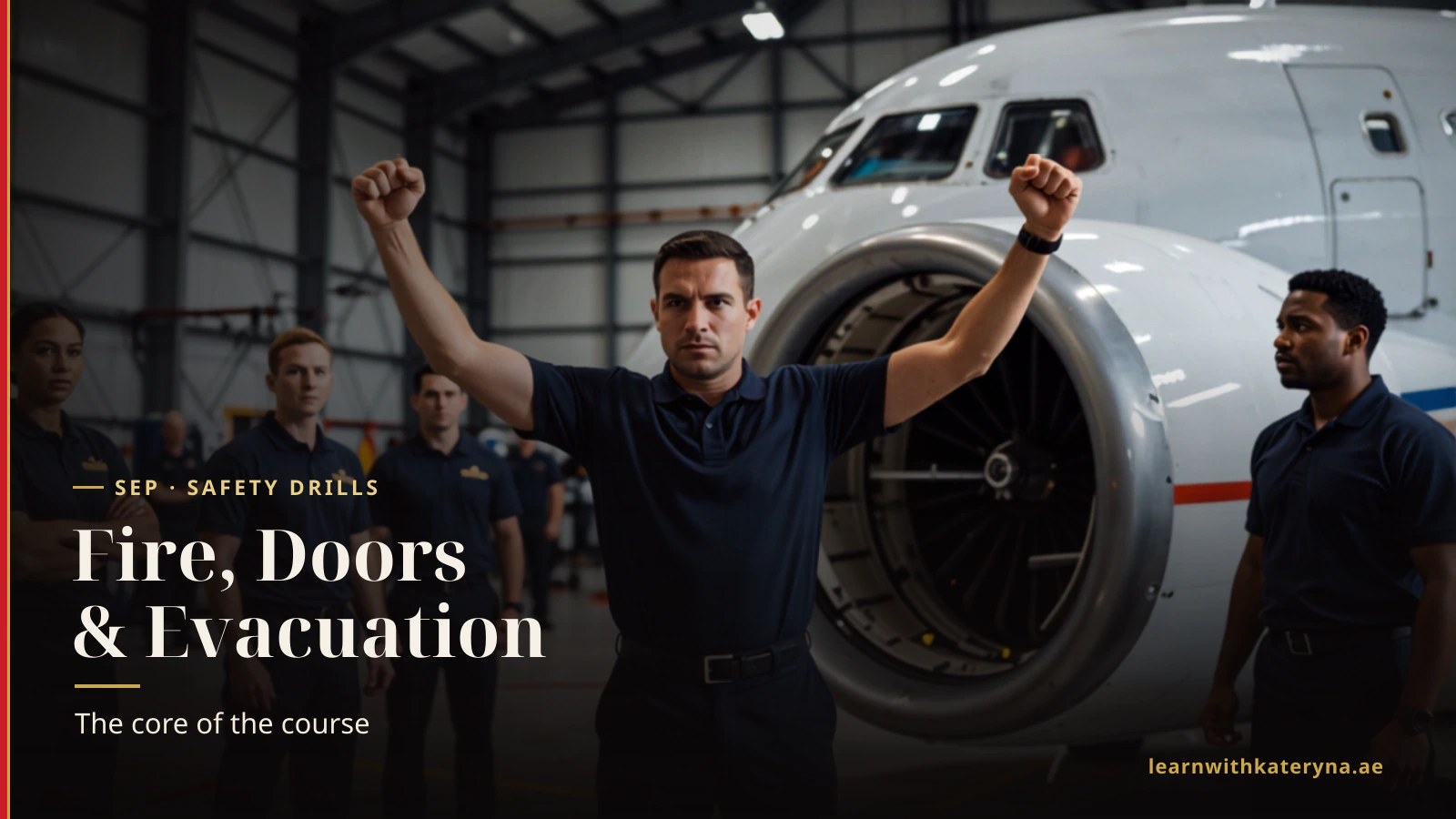
The practical drills are what people remember. Airlines run them in purpose-built facilities: firefighting simulators filled with real smoke, door trainers and full cabin mock-ups for different aircraft types, evacuation slides you actually jump onto, and a pool for ditching practice with life rafts and jackets.
These sessions are physical and loud by design. Instructors add smoke, darkness, noise and time pressure so that your commands and movements become automatic under stress. You will shout evacuation commands until your voice is hoarse — because on the day, hesitation costs seconds you do not have.
First aid, CPR and AED
Medical training prepares you to be the first responder at 38,000 feet, where no ambulance is coming. You learn the primary survey — checking response, airway, breathing and circulation — plus CPR and the use of an automated external defibrillator (AED), taught to recognised resuscitation guidelines such as those of the American Heart Association.
Beyond cardiac emergencies, you cover the situations crew actually meet: fainting, allergic reactions, asthma, burns, choking, panic attacks and births. You also learn the onboard medical kits and when to call for a doctor on board or divert. It is a compact but serious medical qualification, and it is examined.
Service, grooming and airline culture
Service training is shorter than safety training, but it is where the airline's brand lives. You learn the cabin service flow from boarding to landing, meal and beverage service, premium-cabin standards, duty-free, and how to handle difficult passengers and cultural differences across a cabin of many nationalities.
Grooming is taught to the airline's exact standard — uniform, hair, make-up, nails and presentation — and it is checked, not suggested. Each carrier adds its own culture module: Riyadh Air teaches "The Riyadh Way", Emirates builds around its Dubai-based multicultural identity, and each expects you to represent that brand from your first flight. If grooming is your weak point, our grooming standards guide covers the bar you will be held to.
The exams: pass marks explained
Cabin crew training is pass/fail, and the marks are higher than most people expect. Written exams typically require around 80% to pass, and the aircraft safety-equipment diagram — where you mark the location of every piece of emergency equipment — commonly requires 100%. There is no partial credit on a fire extinguisher you cannot find.
You are usually allowed a limited number of retakes on a failed paper, but repeated failures end the course. Practical assessments — door operation, evacuation commands, firefighting, CPR — must also be performed correctly under observation. The standard is not cruelty; it is that a cabin is a workplace where a wrong answer has consequences.
Exams that demand 100% on safety equipment are the clearest signal of what this job is. You are not being trained to serve coffee. You are being trained to get everyone out.
What actually fails people in training
Very few people fail because they lack intelligence. They fail for predictable, preventable reasons:
- English under pressure. The training is delivered fast, in technical English, and examined in English. Non-native speakers who are comfortable in conversation can still struggle with the vocabulary and pace.
- Underestimating the volume. Trainees who treat evenings as free time fall behind in week two and never catch up.
- Freezing in practical drills. Knowing the theory but hesitating when the smoke and noise start.
- Grooming and professionalism slips. Lateness, uniform standards and attitude are assessed alongside knowledge.
- Homesickness and burnout. A new country, a shared flat and a 10-hour training day is a real adjustment.
Notice how many of these are language and preparation problems rather than aptitude problems. That is genuinely good news, because both are fixable before you ever arrive.
Is training paid? Housing and conditions
Yes. At the major Gulf carriers, initial training is paid and provided free of charge, and accommodation is arranged from the day you arrive. Etihad, Emirates, Qatar, Saudia and Riyadh Air all house new joiners in company accommodation during training, usually with transport to the academy.
You should still budget sensibly for the first month or two. Pay during training is typically lower than a full flying salary, because flying-hour pay and layover allowances only begin once you start operating flights. Airlines also cover your visa and relocation, so the upfront cost to you is low. For the full pay picture per airline, see our cabin crew salary by airline breakdown.
The wings ceremony and your first flight
Training ends with a wings ceremony — a graduation where successful trainees receive their certificate and the airline's wings pin, usually with family and colleagues watching. It is the moment you formally become cabin crew, and for most crew it is the proudest day of the process.
After graduation you fly a supervised familiarisation flight, then begin flying the line on a probationary period during which your performance, grooming and attendance continue to be monitored. Your qualification is not permanent either: crew complete recurrent training and re-examination every year for the rest of their career. To see what the job looks like once you are flying, read our day in the life guide.
How to prepare before training starts
You cannot pre-learn the airline's SEP manual — it is proprietary and taught in-house. What you can do is arrive with the skills that make the course survivable. Do these before day one:
- Lift your English to a comfortable working level. Aim for a solid B2 so technical vocabulary and fast instruction are manageable, not exhausting. Our 90-day English plan is built for this.
- Learn to swim confidently. Ditching practice takes place in a pool, and airlines expect basic water competence.
- Build study habits. Practise memorising structured information quickly — you will need it nightly.
- Get your grooming to standard. Arrive already meeting the uniform and presentation bar, so it is never a distraction.
- Prepare physically and mentally. Sleep, fitness and a plan for living abroad make the adjustment far easier.
Cabin crew course or airline training — which do you actually need?
You need the airline's training, and it is free: the airline pays for it once you are hired. A paid "cabin crew course" is something else entirely, and mixing the two up costs candidates real money. Here is the difference in one look:
- Airline training (Emirates, Qatar, Etihad, flydubai): mandatory, runs after you sign, paid by the airline — Emirates' is seven and a half weeks in Dubai. You cannot buy it, and you cannot skip it.
- Private cabin crew courses and air hostess courses: optional preparation sold by academies and coaches. Useful ones prepare you for the selection: English, the group exercise, the interview, the grooming standard.
- Aviation diplomas (IATA-style, often advertised as a cabin crew course in Dubai): classroom qualifications from private institutes. No Gulf airline lists a diploma in its published requirements — Emirates asks for Grade 12 and one year of customer service, nothing more.
So the honest answer to "do I need a course?" is: not to be eligible. What decides your day is preparation — the English level, the group behaviour and the interview answers. That is exactly what our Emirates cabin crew interview preparation covers, and what you can drill free in the CrewQuest trainer.
Preparation courses vs airline training
These two things are often confused, so let us be precise. Airline training happens after you are hired, is run by the airline, is free and paid, and qualifies you to fly. A preparation course happens before you apply, is run independently, and exists to help you pass the recruitment process and arrive ready for the airline's course.
No legitimate preparation course can qualify you as cabin crew or guarantee a job — only an airline can do that. What a good course does is close the gaps that actually stop candidates: English level, interview answers, group-exercise behaviour, CV and grooming. If you see a "training school" promising certification that replaces airline training, treat it as a red flag.
Frequently asked questions
Short answers to what candidates ask most about cabin crew training.
Next steps and support
Cabin crew training is demanding, but it is not mysterious: seven to nine weeks, safety first, high exam standards, and a wings ceremony at the end. The people who struggle are usually the ones whose English or study habits were not ready — not the ones who lacked talent. Everything that matters can be prepared in advance.
If you want a former Gulf cabin crew member — accepted by Emirates, Qatar, Etihad and Saudia — to get you through recruitment and arrive at the academy genuinely ready, the 1:1 interview preparation prepares you for any airline. Book a 90-minute 1:1 session with Kateryna to assess your English and plan your application.


