 Kateryna Ivanova

Becoming Emirates cabin crew in 2026 is a 5-stage process lasting 4–12 weeks: online application → video interview → Open Day with the reach test and group exercise → final interview → Golden Call. Basic requirements: age 21+, English at a minimum of B1, a 212 cm reach on tiptoes, completed secondary education, no visible tattoos. Starting pay is 9,500–11,000 AED a month (~$2,600–3,000) tax-free with free accommodation in Dubai. This guide is written by a former Emirates cabin crew member with three years of service who now prepares candidates for Assessment Day. Here are the real numbers, the exact order of the stages, and the insider details that aren't on the official site.
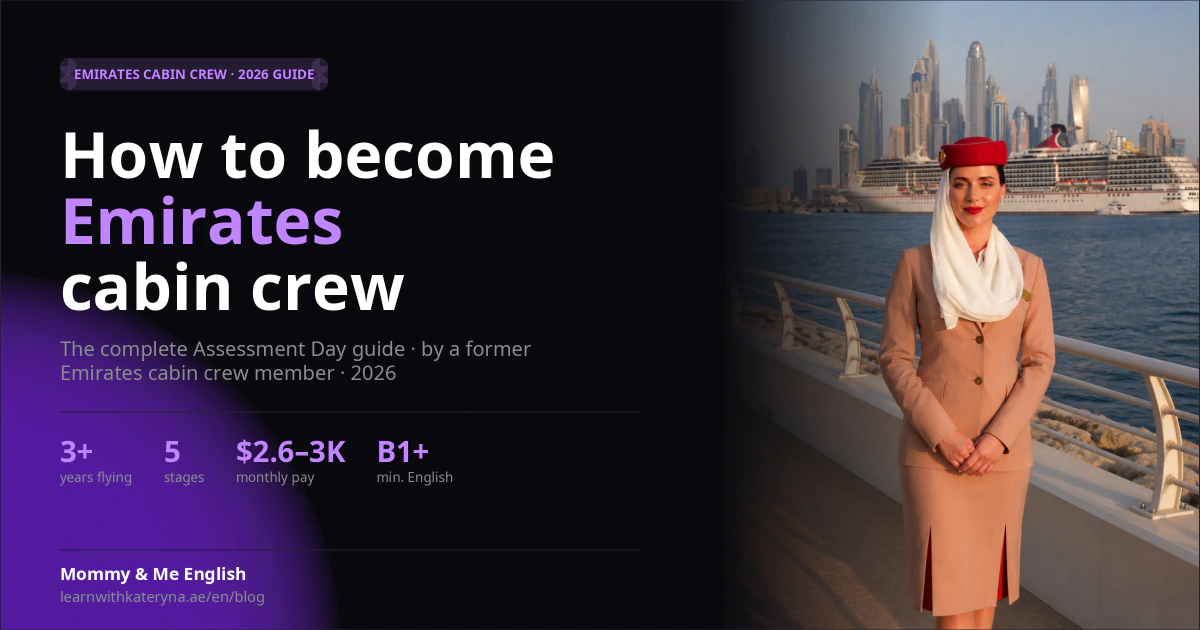
By the numbers
In 2024, Emirates announced it would recruit 5,000 additional cabin crew for its expanding fleet — a sense of the hiring scale behind these stages.
Source: Gulf News (2024). A 2024 figure — recruitment volumes change year to year.
What's in this article
- The Emirates recruitment process: 5 stages
- 2026 requirements: age, height, English, tattoos
- Open Day and Assessment: what really happens
- The 212 cm reach test: technique
- The group exercise: why 70% are cut here
- Final Interview: 12 questions you'll definitely hear
- Aviation English: what level you really need
- Emirates pay and benefits 2026
- Emirates vs Qatar vs Etihad vs flydubai
- Career progression: a 5-year outlook
- The Ukrainian advantage on Assessment Day
- The real timeline: from "I've decided" to your first flight
- What to do if you don't pass
- Frequently asked questions
The Emirates recruitment process: 5 stages from application to contract
Emirates recruitment is a structured 5-stage funnel where fewer candidates remain at each successive stage. Understanding the exact order is the first condition of success.
Stage 1: Online Application (30 minutes)
Apply on the official portal emiratesgroupcareers.com — Cabin Crew → Apply. You need: business-style photos (a face-shot and a half-body in a white blouse), a CV in English, and answers to short motivation questions. The Emirates AI filter screens out CVs without the right keywords — be sure to add "customer service", "multicultural", "team collaboration".
Stage 2: Video Interview (20 minutes)
Via HireVue — a one-way interview where you answer 3–5 questions to camera. 30 seconds to prepare, 90 seconds to answer. Typical questions: "Why Emirates?", "Tell us about a time you handled a difficult customer", "How do you work in a multicultural team?" A recruiter reviews the recording manually over 2–3 weeks.
Stage 3: Open Day or Assessment Day (4–6 hours)
An in-person event in Dubai or one of the hub cities (Kyiv was a venue until 2022; the nearest now are Warsaw, Berlin, Tbilisi). Structure:
- Brief Presentation — recruiters talk about the company (45 min)
- CV Drop — each candidate hands their CV to a recruiter in person with a 30-second self-introduction
- Reach Test — touch the 212 cm mark with your hand on tiptoes
- Group Exercise — 8–12 candidates solve a situational task in 20 minutes
- English Test — a short online test on grammar, vocabulary and situational reading
Stage 4: Final Interview (45 minutes)
1-on-1 with an Emirates recruiter or manager. Behavioural questions on the STAR model (Situation–Task–Action–Result). Here they check: whether you'll stay 3+ years, whether you'll cope with a 14-hour flight, if you are ready to live far from family. A mock interview before this stage is key.
Stage 5: Golden Call and Joining Offer (2–4 weeks to start)
The "Golden Call" is a phone call from a recruiter with an offer. After signing the contract — a medical in Dubai, a UAE work visa, and paid flights plus a hotel for 6 weeks of training. The first flight is roughly 8–10 weeks after acceptance.
Emirates cabin crew requirements 2026: full checklist
Emirates updated its basic requirements in 2025 — the standards became stricter on realistic assessment but softer on experience. A university degree is no longer required. Instead, more weight went to soft skills and culture fit.
| Requirement | 2026 standard | What it means in practice |
|---|---|---|
| Age | 21+ at joining | You can apply from 20.5 — the process takes time |
| Height / Reach | 212 cm reach on tiptoes | Height ~157 cm and above usually reaches with the right technique |
| Education | Completed secondary | University not required, but a degree on the CV is a bonus |
| English | Fluent (min. B1, ideally B2) | All training and onboard communication is in English |
| Tattoos | Not visible in uniform | Neck, wrists, ankles, behind the ears — not allowed |
| Covered tattoos | Allowed | Checked in the summer (short-sleeve) uniform variant |
| Vision | Glasses/lenses OK | Colour blindness is a disqualifier |
| Grooming | High standards | Skin, teeth, manicure — assessed on Open Day |
| Swimming | 50 m non-stop | Tested during training in Dubai |
| Work experience | 1+ year customer service | Not required, but a strong advantage |
"Most candidates think Emirates screens on looks. That's a myth. They screen out a lack of robustness — the ability to hold your tone of voice and your smile after 14 hours on a plane. A recruitment trainer sees it in 30 seconds."
Emirates Open Day: the full anatomy of the day
The Emirates Open Day is a 6-hour filter where, of 200–300 candidates, 15–25 progress (~7–10%). Knowing the day's structure is a huge advantage — most people arrive unprepared and get lost at the CV Drop or the group exercise.
First 60 minutes: atmosphere and a look-based cut
Registration from 8:00. Recruiters assess you already in the queue — how you interact with other candidates, whether you smile, how you handle nerves. About 60% of candidates remain after the visual assessment and CV Drop.
Midday: Reach Test + English Test
The Reach Test — your hand must touch the 212 cm mark. You stand on tiptoes, arm fully extended, body straight. If you can't reach — ask for a second attempt in 10 minutes (after a warm-up); it's allowed and often works.
The English Test — a 30-minute computer test: multiple choice on grammar, vocabulary, and reading a short paragraph. Level: Cambridge B1+ / IELTS 5.0. What matters here is NOT perfectionism but speed and confidence.
The finale: group exercise and "yes/no"
You're split into groups of 8–12. You're given a scenario — for example, "your plane is delayed 4 hours by a storm; the passengers include a VIP, a family with a child, and a business traveller who's missing a connection. How do you allocate resources?" 20 minutes to discuss. Recruiters walk around recording observations.
After the group exercise — a short 1-on-1 with a recruiter (5 minutes) and a decision: an invitation to the Final Interview ("yes") or a polite rejection ("no"). A "yes" comes by email within 24–48 hours.
The 212 cm reach test: the technique that adds 2–3 cm
The Reach Test is the most common reason for failing an Open Day for women 155–162 cm tall. The right technique adds 2–3 cm and often decides between "passed" and "didn't pass".
Mistakes 80% of candidates make
- Standing flat-footed instead of rising onto full tiptoes
- Not fully extending the fingers
- Not engaging the core — the body leans forward, losing height
- Not coordinating the breath — an exhale before the reach adds 1–2 cm
The correct 5-second sequence
- Stand by the wall, feet hip-width apart
- Take a deep breath, engage your core muscles (as before lifting a weight)
- Rise onto full tiptoes — not halfway
- On the exhale, reach your arm up as far as possible, fingers fully open
- Touch the mark. Hold for 1 second — for the recruiter to record
Home preparation: 2 weeks before Assessment Day
Every day, touch the highest mark on a wall at home. Record your progress. In 14 days, +1–3 cm is realistic through calf development and better coordination — which often decides between "212" and "210".
The group exercise: why 70% of failures happen here
The group exercise isn't a knowledge test — it's a test of group dynamics. Recruiters assess: do you listen, do you speak to the point, do you avoid dominating, do you avoid being passive. The most common mistake is trying to be "the smartest in the room".
4 roles that work (and one that kills your chances)
Roles that get a "yes":
- Connector — turns to quiet members: "And what do you think?" The recruiter sees a leader through inclusiveness.
- Synthesizer — sums up: "So we agreed on A and B, but we need to decide C." Keeps the group focused.
- Idea-builder — adds to someone else's idea: "Interesting what you said about X — what if we also add Y?"
- Time-keeper — watches the clock: "We have 5 minutes left, let's decide this quickly."
The role that gets a "no":
- Dominator — talks the most, interrupts, forces their solution. Recruiters mark these "TC" (too controlling) — an automatic cut.
"In my group of 10, the most active girl didn't pass. Not because she had bad ideas, but because she didn't let others speak. The recruiter later told me: 'I'm looking for someone I'm comfortable flying 14 hours in a tube with. Not someone who constantly interrupts.'"
Final Interview: 12 questions you'll definitely hear
The Final Interview is a 45-minute 1-on-1 on the STAR model (Situation–Task–Action–Result). The recruiter asks 6–8 behavioural questions. Prepared stories + the STAR structure are your best chance.
Category 1: Customer service under pressure
- "Tell me about the most difficult customer you've worked with. What did you do?"
- "Tell me about a time you exceeded a customer's expectations."
- "How do you react when a customer shouts at you unfairly?"
Category 2: Teamwork and culture fit
- "Describe a team conflict you helped resolve."
- "How do you adapt to colleagues from different cultures?"
- "Tell me about a time you bent the rules to help a customer."
Category 3: Resilience and motivation
- "Why Emirates, not Qatar or Etihad?"
- "Are you ready to live far from family for 2–3 years? How do you handle stress?"
- "Tell me about a failure. What did you take from it?"
Category 4: Situational (safety awareness)
- "A passenger refuses to fasten their seatbelt during turbulence. What do you do?"
- "Two passengers are arguing loudly. How do you intervene?"
- "A child passenger suddenly becomes aggressive. What do you do?"
Aviation English: what level you really need
Officially Emirates requires fluent English; in practice that's Cambridge B1+ with confident spoken communication. Written grammar isn't decisive — communicative confidence and aviation terminology matter more.
3 levels of English they check
- Conversational — small talk with the recruiter and colleagues. B1 is enough here.
- Customer service — politeness, a neutral tone, phrases for complaints/requests. Needs a B2 vocabulary (~3,000 words).
- Safety / Emergency — precise commands ("brace, brace", "evacuate, evacuate"), standard announcements, medical phrases. Here you don't need B2 — you need precise pronunciation.
What screens out even candidates with a good level
- A strong accent on safety words (the recruiter wants to be sure a passenger will understand under stress)
- A quiet or shaky delivery during the self-introduction
- An inability to say "I don't know" clearly without a neurotic reaction
- An inability to ask politely to repeat: "Could you repeat that, please?"
The Emirates Cabin Crew preparation course works exactly on these three levels, with a focus on situational scenarios rather than general grammar.
Emirates cabin crew pay 2026: the real numbers
A new Emirates cabin crew member's starting pay in 2026 is 9,500–11,000 AED/month (~$2,600–3,000) tax-free. The structure: a fixed base + flying pay per flying hour + free accommodation and transport.
Pay structure (2026)
| Component | Amount | Details |
|---|---|---|
| Base salary | 4,430 AED | Fixed, regardless of flights |
| Flying Pay | 63–70 AED / hour | Paid for actual flying hours |
| Average flying hours | 80–100 / month | Set by the roster |
| Layover allowance | 50–250 AED / day | Depends on the city (New York = more) |
| Loss of Licence insurance | covered | Free for all crew |
| Free accommodation | 2–3 rooms with 1–2 colleagues | Furniture, utilities, internet — Emirates |
| Free transport | airport ↔ home | Crew buses 24/7 |
| Medical insurance | 100% cover | Including dental |
| Travel benefits | 90% ticket discount | For yourself + 1 family member |
How the pay grows
After 1 year — a rise to Grade 2 (~+1,000 AED). After 3 years — Senior Crew Member (+15–20% loading). After 5–7 years — Purser (shift lead on a flight, +30–40%). As a Purser the pay reaches 18,000–22,000 AED/month (~$5,000–6,000).
Emirates vs Qatar vs Etihad vs flydubai: which to choose
For candidates who want the Gulf, Emirates isn't the only option. The preparation methodology is similar for all four, but each has its own character:
- Emirates — the highest status, the best route network (~150+ destinations), the highest pay. Maximum competition.
- Qatar Airways — Doha hub, a slightly better flight schedule (fewer night flights). English requirements a bit higher (B2 required).
- Etihad — Abu Dhabi, a smaller but newer fleet. A strong safety culture. A smaller network = more repeated routes.
- flydubai — the fastest entry for a beginner (a lower bar, short-haul, home every week). Lower pay, no free accommodation. A good springboard for a later move.
What to do if you don't pass
Emirates allows you to re-apply 6 months after a rejection. It's not a "verdict" — many pass on their 2nd or 3rd attempt. The key is to understand exactly where you were cut and fix it.
How to get feedback
Emirates rarely gives detailed feedback. But from the stage where you were cut, you can reconstruct it:
- Rejected after the Video Interview — a problem with pronunciation, answer structure or the motivation story.
- Rejected after Open Day without a Final — a failure at CV Drop, Reach Test, English Test or Group Exercise.
- Rejected after the Final Interview — culture fit, robustness, or the recruiter's doubts about a 3-year outlook.
6-month preparation for a re-attempt
- Months 1–2: raise English from B1 to B2 (especially pronunciation on safety words)
- Months 3–4: a mock interview weekly with feedback
- Months 5–6: group-exercise simulations, reach-test training, robustness scenarios
Structured preparation with an ex-Emirates mentor over 8 weeks realistically moves you from "cut" to "passed first time". That's how the Emirates Cabin Crew preparation course works — a methodology from someone who passed Assessment Day herself and worked as Emirates cabin crew for 3+ years.
Career progression at Emirates: a 5-year outlook
Emirates cabin crew isn't "just another job" but a career track with clear grade levels. Every 12–18 months there's an assessment, after which you either move up or stay at your current level. Most reach Senior Crew in 3–4 years.
5 career levels
- Grade 2 Crew (0–12 months) — economy cabin, base pay ~9,500 AED/month. The first 6 months are a probation period with strict monitoring.
- Grade 1 Crew (12–30 months) — economy + business cabin. Pay ~11,000–12,500 AED/month. Serious independence culture begins here.
- Senior Crew Member / SCM (30–60 months) — first class + leading junior crew in your cabin. Pay 14,000–17,000 AED/month. Your first real management experience.
- Purser (5+ years) — shift lead on a flight. Responsible for the whole cabin crew (8–25 people), communication with the cockpit, hard decisions. Pay 18,000–22,000 AED/month.
- Cabin Supervisor (7–10+ years) — long-haul wide-body aircraft (A380, B777), full responsibility for serving 400+ passengers. 22,000–30,000 AED/month + leadership bonuses.
What opens up after cabin crew
Many crew, after 3–5 years, move into ground roles at Emirates Group: Cabin Crew Training (trainer for new hires), Recruitment (recruiter at Open Days), Customer Experience Manager. It's a path into management with no need for a university degree.
"After 4 years at Emirates I had a choice: keep flying or move into Training. I chose Training — a stable schedule, the same pay, but no jet lag. Emirates is a trampoline into aviation management, not just the job on board."
The Ukrainian advantage: why we pass above the statistics
Ukrainian candidates have several statistically proven advantages on Emirates Assessment Day compared with the average candidate. This isn't marketing — it's an observation from 2022–2026 recruitment sessions.
4 advantages of Ukrainian candidates in Emirates recruitment
- Resilience under pressure — since 2022 many Ukrainian women have real life-experience of stress tolerance that recruiters read immediately. It's velocity at the Final Interview.
- Multilingual baseline — Ukrainian + Russian + English (often Polish/German). Emirates flies to 150+ cities; multilingual crew is a competitive edge right on the CV.
- A customer-service culture — after the European market of 2014–2024 (Kyiv, Lviv, Odesa), Ukrainian hospitality standards rose to a European level. It shows in the CV Drop.
- Orientation toward a long contract — Ukrainian candidates less often leave Emirates after 6 months, as happens with candidates from some other markets. Recruiters know and value this.
3 typical Ukrainian mistakes (fix before Assessment)
- Too-modest small talk — Ukrainian culture says "don't boast". In American-English customer-service culture that reads as "unsure". Practise telling your achievements without modesty, with a smile.
- Not smiling all the time — in our culture a constant smile = insincerity. In cabin-crew culture = professionalism. The smile should be your default state.
- A strong accent on safety words — "thirteen" vs "thirty", "evacuate" vs "evaluate". Special pronunciation of these 50–100 words — a small accent on other words is okay, but the safety vocabulary must be perfect.
The real timeline: from "I've decided" to your first flight
From "I want to join Emirates" to your first commercial flight realistically takes 8–14 months. The breakdown by phase:
| Phase | Duration | What happens |
|---|---|---|
| Preparation | 2–4 months | English to B1+, reach-test training, mock interviews, robustness |
| Application + Video | 2–4 weeks | CV submission, video interview, waiting for a reply |
| Assessment Day | 1 day + 1–2 weeks wait | Open Day in Europe or Dubai, "yes/no" within a week |
| Final Interview | 1–3 weeks | Wait + 1-on-1 interview, wait for the decision |
| Joining process | 2–4 weeks | Golden Call, contract, flight to Dubai, medical, visa |
| Initial Training | 6–8 weeks | Intensive training in Dubai: safety, service, grooming, swimming |
| Supervised Flying | 2 weeks | The first 5–10 flights with a mentor |
| Solo Crew | onward | Regular flights, full pay |
This means: if you start preparing now, in May 2026, a realistic date for your first commercial flight is January–June 2027. If you haven't applied yet — that's okay. Better to add another 2–3 months of preparation and pass first time than to rush and be cut.
Next steps
If you've read this far, you have serious motivation. Here are three practical steps for this week:
- Check your reach — ask someone to measure the mark you reach on tiptoes. If it's under 212, start the technique from this article daily.
- Assess your English — take the free Cambridge English test. Below B1 — start with the basics; B1–B2 — focus on situational/safety English.
- Create an account on emiratesgroupcareers.com — even if you're not applying now, get email alerts about Open Days in Europe.
If you want systematic preparation from someone who went through the process herself, take a look at the Emirates Cabin Crew course with Kateryna. Mock interviews, insider tips, aviation English — in 4–8 weeks from "unsure" to "ready for Assessment Day".


