 Kateryna Ivanova

Shapes in English for kids means eight words: circle, square, triangle, rectangle, star, heart, oval and diamond. Most children start noticing shapes in play from around 18 months and can match or sort by shape well before they can name one. The easiest first word is circle — it has no corners and no sides to count, which is also why children can usually draw one before they can draw a square or a triangle. For a Ukrainian-speaking family there is a second, more useful reason to teach shapes early: it is one of the few vocabulary sets where English is grammatically simpler than Ukrainian, because the adjective never changes. That single fact — not flashcards — is the fastest way in.
Which shapes to teach first
Early-years practice generally sequences shapes from simple, continuous outlines toward shapes with corners and crossing lines — not because one shape is "more important" than another, but because a toddler's hand and eye can trace a curve before it can manage a sharp turn. That is why circle almost always comes first, followed by square, then triangle. Shapes with more sides or asymmetry — star, heart, diamond — tend to arrive later, once the child is comfortable naming the first three on sight.
You do not need to teach them in strict order, and you do not need to wait for one to be "finished" before starting the next — most children are learning two or three shapes at once, at different stages of confidence. The order matters only for what you introduce first, not for how you structure a whole program.
A 30-second check: does your child already know shapes?
Before you start, find out what is already there. Point to a plate, a window and a ball, one at a time, and ask "what shape?" in either language. A child who can sort a shape-sorter toy correctly already understands the concept of shape — matching by outline — even with zero English words for it. That is good news: you are teaching labels for something the child's brain has already organised, not teaching a new idea from nothing.
The 8 basic shapes, with a real-world anchor
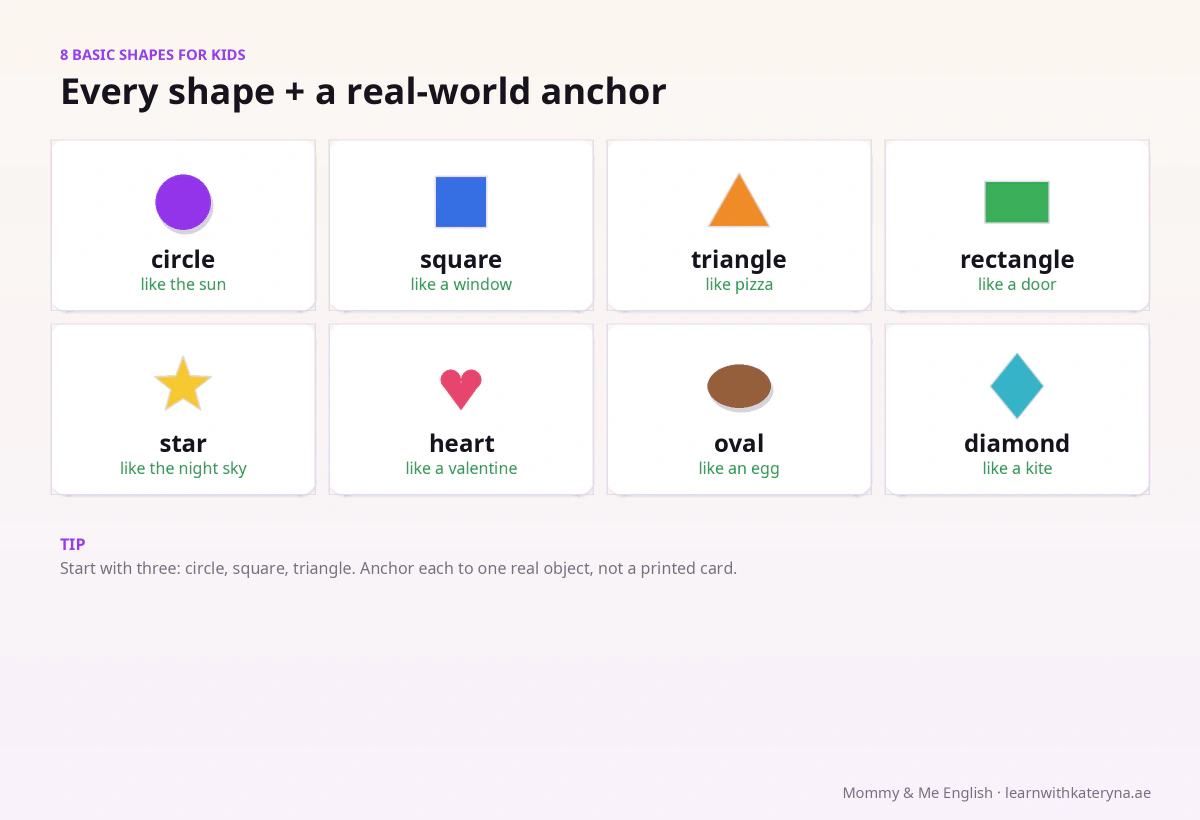
Every shape below is tied to one constant object in a young child's world — the same anchoring method used for colors. Say the shape word and the object together every time, at least for the first two weeks.
| Shape | Real-world anchor | Why this object |
|---|---|---|
| circle | like a ball, like the sun | round in every direction, no corners to count |
| square | like a window | four equal sides, easy to trace with a finger |
| triangle | like a slice of pizza | three straight sides, one obvious point |
| rectangle | like a door | familiar object, distinguishes "long sides" from square |
| star | like the night sky | points make it instantly recognisable, even upside down |
| heart | like a valentine card | emotionally anchored, easy to draw with two curves |
| oval | like an egg | the "stretched circle" — teach right after circle for contrast |
| diamond | like a kite | a rotated square; teach after square is solid |
Eight is enough. Children's books and nurseries sometimes add pentagon, hexagon or crescent, but those rarely appear in a toddler's daily environment and can wait until school-age geometry.
A note on letter shapes. "Shape" gets used two different ways on this site, and it is worth keeping them apart. This article is about geometric shapes — circle, square, triangle and the rest, taught as vocabulary. A separate, narrower problem is letter shapes — why a Ukrainian-speaking child sees the Latin letter P and reads it as the Cyrillic Р, because the shapes are identical but the sounds are not. That is a reading-readiness issue, covered on its own in why kids confuse English and Cyrillic letters, and it has nothing to do with whether your child knows a triangle from a square.
The Ukrainian grammar trap: one English word, three endings
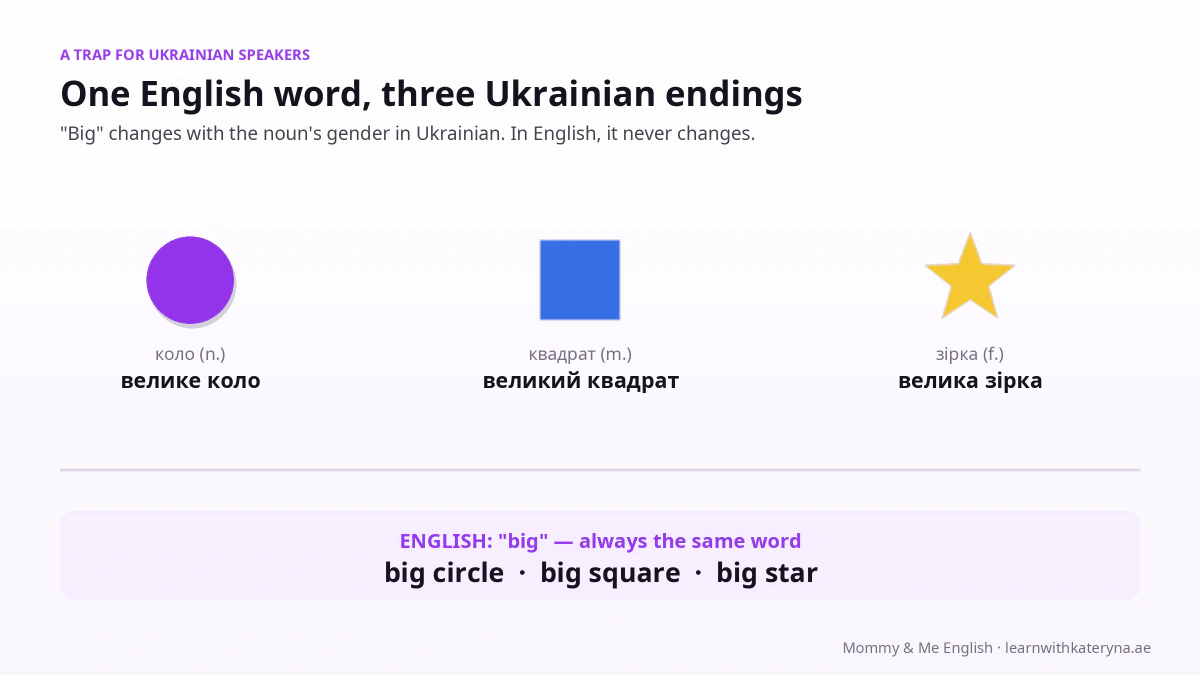
This is the part no generic "shapes for kids" resource can tell you, because it only exists for a Ukrainian-speaking parent teaching English. Ukrainian nouns carry grammatical gender, and an adjective describing them must agree with it. Коло (circle) is neuter, квадрат (square) is masculine, зірка (star) is feminine — so "big" becomes three different words: велике коло, великий квадрат, велика зірка. Say all three out loud and the pattern is obvious: the adjective bends to match the noun every single time.
English does none of this. "Big" is big in front of every one of the eight shapes above, with no exceptions and nothing to memorise. For a child (and a parent) used to an ending changing with every noun, an adjective that never changes is one of the simplest grammar facts in English — and shapes are a clean place to notice it, because you say the same adjective eight times in a row.
Practically: when you introduce a shape, always pair it with one adjective first — "a big circle", "a small square" — and repeat the same adjective across several shapes in one sitting. The repetition is what makes the invariance audible.
30-second shape hunts around your home
Shapes are the one vocabulary set your home already contains, fully assembled, without buying anything. A 30-second hunt works anywhere: point, name the shape, move on.
- Kitchen: a plate (circle), a cracker (square), a slice of toast cut diagonally (triangle), the fridge door (rectangle).
- Bathroom: the bath mat (oval or rectangle), a soap bubble (circle), a folded towel corner (triangle).
- Bedroom: a picture frame (rectangle or square), a cushion (circle or heart), a kite poster or sticker (diamond).
- Outside: a manhole cover (circle), a road sign (triangle, diamond or rectangle depending on the sign), a window (square or rectangle).
Keep each hunt to two or three objects. A child who hears "circle" said about four completely different round things in one week generalises the word far faster than one who sees only a printed worksheet circle.
Shapes and colors together
Once your child has a few shape words and a few color words from the colors article, combine them: "a red circle", "a blue square". English adjectives before a noun follow a fairly fixed order — size, then colour, then shape describe the same noun without any punctuation or agreement between them ("a big red circle"), which is exactly the ordering question covered in more depth in the describing-words guide. For shapes specifically, keep the combination to two words maximum at first ("red circle") and only add a size word once both the color and the shape are solid alone.
Shape songs and movement
Shapes respond very well to Total Physical Response — drawing the shape in the air with a whole arm, walking the outline of a rug or a tile on the floor, or making the shape with two people holding hands. The TPR method guide covers the underlying technique; for shapes specifically, the physical action is the label: "circle" is the word you say while your arm draws a circle in the air, not before or after. A handful of shape-themed songs exist in the same simple, repetitive, English-nursery style as the songs collected in the songs article — look for ones that name a shape and then move the body into it.
Shape sorters, puzzles and matching play
A shape sorter is one of the few toys worth buying specifically for this topic, and it works before your child says a single word: matching the block to the hole teaches the concept, and you supply the label in English while they do it — "circle... in it goes." Chunky wooden shape puzzles work the same way. Cutting shapes out of coloured paper and matching them to an outline drawn on card is a free equivalent. The general principle — that play beats flashcards for building real vocabulary — is argued in full in the play article; if you are deciding what is actually worth buying for English at home more broadly, the buying guide covers it.
Shapes in books and on your daily walk
Board books built entirely around shapes exist in English and are genuinely useful here, because unlike most vocabulary topics, shapes hold up to being taught from a flat page — a printed circle is still a circle. Outside, a walk to the shop becomes a running shape count: name one shape per block rather than pointing at everything, so the words do not blur together.
What to expect at 2, 3, 4 and 5
The table below separates what is officially documented (the CDC's Learn the Signs. Act Early. milestone checklists, checked 2026-09-20) from what is common early-years teaching practice but not a formal published norm. Individual children vary widely, especially across two languages — treat this as orientation, not a checklist to worry over.
| Age | What is commonly seen | Source |
|---|---|---|
| 18–24 months | Notices shapes in play; begins matching a shape to its outline (e.g. a shape-sorter) before naming any shape | Early-years teaching practice |
| 2–2.5 years | Sorts and matches shapes reliably through play | Early-years teaching practice |
| 3 years | Draws a circle when shown how | CDC, 3-year milestones |
| 3–4 years | Names circle and square on sight; triangle and rectangle often still inconsistent | Early-years teaching practice |
| 4 years | Names a few colours of items | CDC, 4-year milestones |
| 4–5 years | Names most of the eight shapes above, including star, heart, oval and diamond | Early-years teaching practice |
Two things are worth saying plainly. First, the CDC's own published checklists name a drawn circle at three and named colours at four — they do not publish a "names all shapes by age X" milestone, so treat any resource that gives you a precise universal age for every shape with some scepticism. Second, a bilingual child is very often ahead in the concept (matching, sorting) and behind in the English label simply because the label has had less total exposure time — that is a timeline question, not a delay.
4 myths about teaching shapes early
| Myth | What is actually true |
|---|---|
| "My child must know all 8 shapes in Ukrainian first." | Not necessary. Matching and sorting (the underlying concept) transfers between languages instantly; only the label needs teaching per language. |
| "Flashcards are the fastest way." | A flashcard shows a shape with no size, texture or context. A real plate or window gives the child three cues at once — sight, touch and use — which is why real objects are taught first here. |
| "Rectangle and square are basically the same, teach them together." | Teaching them side by side too early is a common source of the square/rectangle mix-up covered below — space them out until square is solid. |
| "If my child can't say 'triangle' cleanly, they haven't learned it." | Recognising and pointing to the right shape when you say the word (receptive vocabulary) reliably comes before being able to say the word clearly (expressive vocabulary) — this is true for every vocabulary topic on this site, not only shapes. |
6 mistakes parents make teaching shapes
- Starting with a worksheet instead of an object. A printed shape has no size, weight or use — always point to a real thing first.
- Teaching all 8 shapes in one sitting. Three at a time, spaced across days, sticks far better than eight in a single session.
- Introducing square and rectangle together. This is one of the most common confusions (see the FAQ below) — give square two or three solid weeks alone first.
- Only using flat, printed shapes. A child who only ever sees a paper circle may not immediately recognise a round plate as "the same shape" — always include at least one 3D or real-world example per shape.
- Correcting the word before the concept is secure. If your child points to a square and says "circle," check whether they can sort the shapes correctly before worrying about the word — the label often lags the understanding by weeks.
- Translating the adjective literally. A parent who has just said велике коло / великий квадрат / велика зірка in Ukrainian may reach for three different English "big" words out of habit. There is only one — say it the same way every time.
A 2-week starter plan
| Days | Focus | What to do |
|---|---|---|
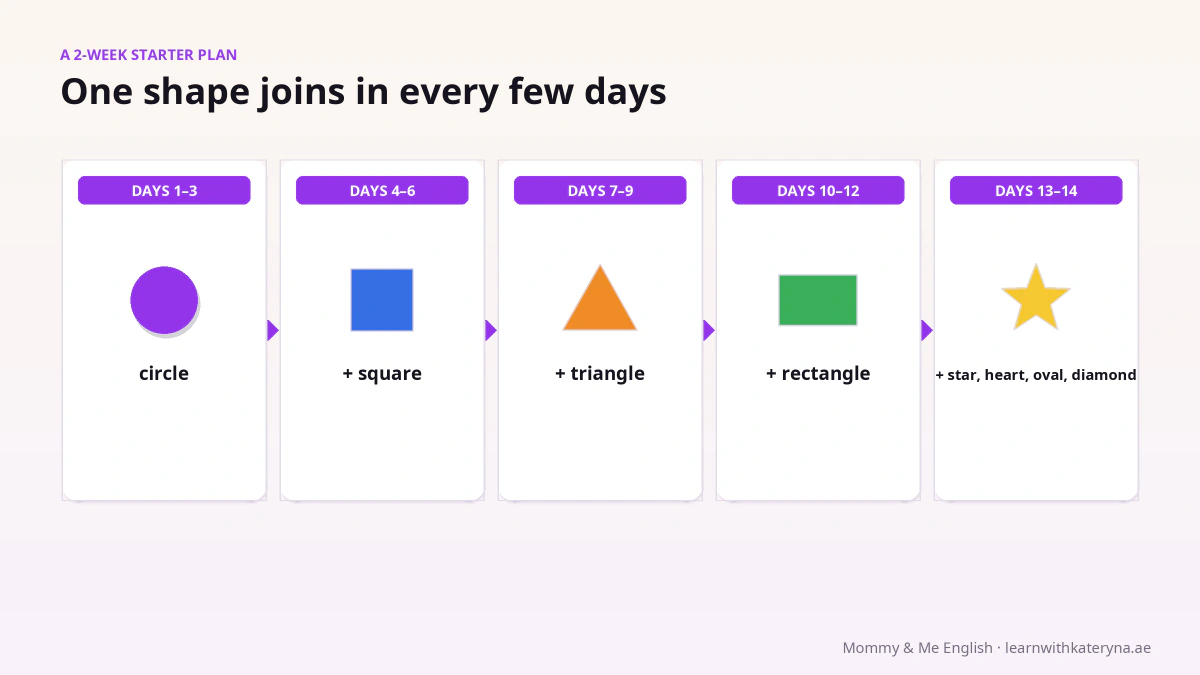
| 1–3 | Circle only | Name every round object you touch: plate, ball, sun, clock face. No other shape yet. |
| 4–6 | Square joins in | Add square via a window or a cracker. Keep circle running alongside it — do not drop it. |
| 7–9 | Triangle + "big/small" | Introduce triangle (pizza slice). Start pairing any of the three shapes with "big" or "small" — always the same word. |
| 10–12 | Rectangle + a shape sorter | Add rectangle (door, book). If you have a shape sorter or puzzle, this is the week to bring it out daily. |
| 13–14 | Star, heart, oval, diamond — lightly | Introduce the remaining four in passing, without expecting mastery yet. Review all eight in one shape hunt on day 14. |
Five scripts you can use today
Real sentences beat rules. Here are five you can start using in the next five minutes, matched to the moments where they fit naturally.
- Handing something round over: "Here's your ball. It's a circle. Round and round!" — trace a circle in the air with your finger as you say it.
- At the table: "Your cracker is a square. Look — one, two, three, four sides." Touch each side as you count, even before your child can count along.
- Cutting food: "I'm cutting your toast into a triangle. Look, a point at the top!" — say it as the shape appears, not after.
- Tidying up: "This block is a big square, this one is a small square." Repeat with the same two words on two more shapes before you finish tidying.
- Bedtime: "Goodnight, circle moon. Goodnight, square window." A one-line shape scan of the room is a calm way to close the day without adding a new activity.
Notice that "big" and "small" never change form across circle, square or block in any of these lines — that repetition, said out loud in front of your child, is doing more grammar teaching than any explanation would.
Next steps
Shapes sit naturally between two vocabulary sets your child may already have some of: pair them with the colors already learned, and once both are solid, borrow the adjective-order logic from the describing-words guide to start building short phrases like "a big red circle." If you have not yet built a daily rhythm for English at home at all, the numbers article uses the same real-object method and is a natural next stop. And if you are wondering what is actually worth buying to support any of this — a shape sorter included — the buying guide gives an honest answer.


