
 Kateryna Ivanova
A child confuses English and Ukrainian letters because six Latin letters look exactly like Cyrillic ones but read completely differently: B, H, P, C, X, Y. A Ukrainian child who already knows that "Р says /r/" sees the English P and reads it as "r" out of habit, even though it says /p/. This isn't a developmental error or an "inability" — it's the normal interference of two alphabets. It's fixed in a few days if you name each trap out loud and show the contrast. This article gives the full look-alike-letter table, the "contrast pair" method, and 7 games to lock in the difference without drilling.
It's a problem no English-language alphabet guide describes — because there, the child doesn't know Cyrillic. But for a Ukrainian-speaking child it's the main obstacle at the start of reading. Let's break down why it happens, exactly which letters are dangerous, and how to explain the difference so the child remembers it the first time.
What look-alike letters are and why a child confuses them
Look-alike letters are letters with the same shape in the Latin and Cyrillic alphabets that stand for different sounds. The English P and the Ukrainian Р are the same graphic sign, but the first says /p/ and the second /r/. A child's brain, having already learned the Cyrillic meaning, automatically "substitutes" it when it sees the familiar shape.
Linguists call this interference — when knowledge of one language gets in the way of another. It's not a defect or laziness: it's the logical result of the child already knowing something. Paradoxically, the better a child knows the Ukrainian letters, the stronger the trap with the English look-alikes at the start.
The child isn't "making a mistake" — they're applying the rule they learned first. Your job isn't to correct an error but to add a new rule: "this same shape says a different sound in English."
Good news: once the child understands the principle — that one shape can have two sounds depending on the language — the confusion clears quickly. The science is simple: reading is built on the "alphabetic principle" — understanding that letters represent sounds (Reading Rockets, The Alphabetic Principle). Look-alikes just add a nuance: which language decides which sound.
Trap words: where look-alikes break reading most
Look-alike letters become a real problem not in the alphabet but in the first words a child tries to read. Here are the most common words where the trap "fires" — knowing them, you can prepare the child in advance.
| Word | Trap | How the child misreads | Correct |
|---|---|---|---|
| pig, park, play | P → "r" | "rig", "rark", "rlay" | pig, park, play |
| hat, hello, hand | H → "n" | "nat", "nello", "nand" | hat, hello, hand |
| ball, bear, big | B → "v" | "vall", "vear", "vig" | ball, bear, big |
| cat, car, cake | C → always "s" | "sat", "sar", "sake" | cat, car, cake |
| box, fox, six | X → "kh" | "bokh", "fokh", "sikh" | box, fox, six |
| yes, yellow | Y → "u" | "ues", "uellow" | yes, yellow |
Note: words with P, H, B in first position are the trickiest, because a mistake on the first letter throws the child off the whole word. So the first reading books are best chosen so the critical look-alikes appear gradually, not all at once. A ready list of safe first words is in the article on a child's first 100 English words.
The 6 main trap letters: B, H, P, C, X, Y
Of the 26 Latin letters, only six create real confusion. They're the ones with a Cyrillic twin that has a different sound. Remember exactly these — the rest of the alphabet is no danger.
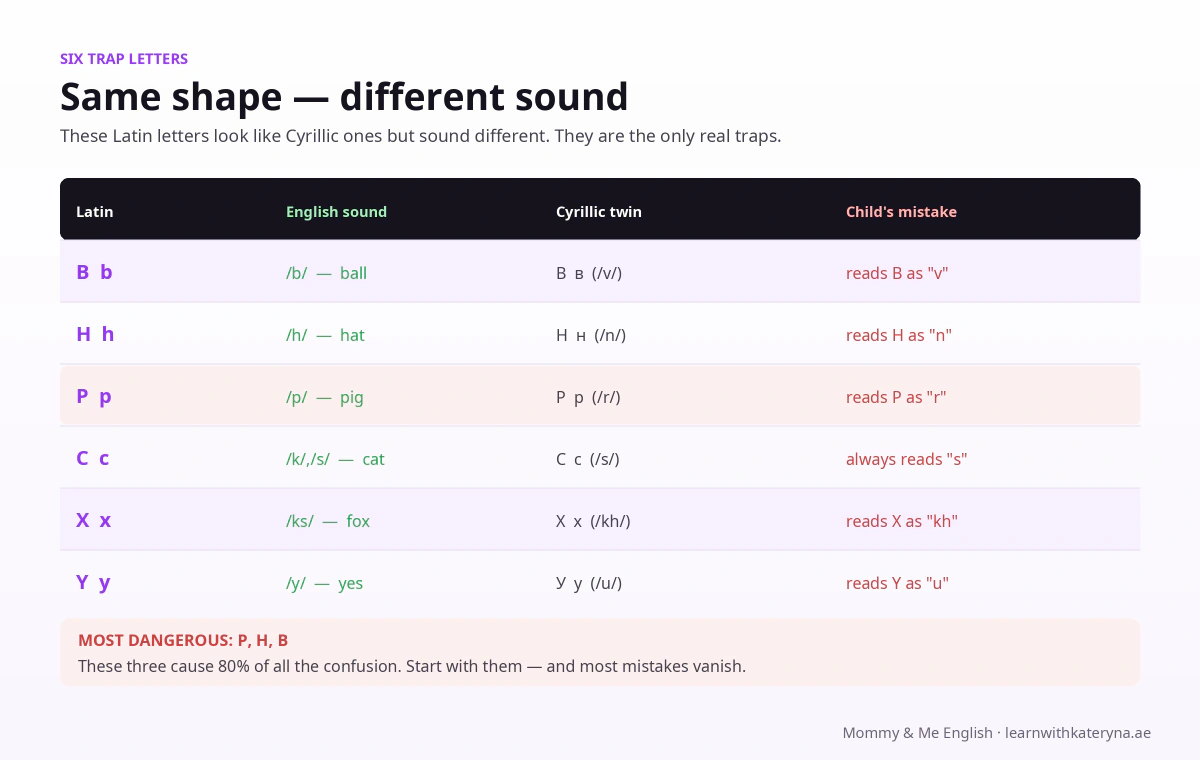
| Latin | English sound | Cyrillic twin | The child's mistake |
|---|---|---|---|
| B b | /b/ — ball | В в (/v/) | reads B as "v" |
| H h | /h/ — hat | Н н (/n/) | reads H as "n" |
| P p | /p/ — pig | Р р (/r/) | reads P as "r" |
| C c | /k/,/s/ — cat | С с (/s/) | always reads as "s" |
| X x | /ks/ — fox | Х х (/kh/) | reads X as "kh" |
| Y y | /y/,/ai/ — yes | У у (/u/) | reads Y as "u" |
The most dangerous is P. It appears in hundreds of first words (pig, play, park, apple), and the "p → r" mistake breaks the whole word. Next are H and B: hat becomes "nat", bat becomes "vat". Three letters — P, H, B — cause 80% of all the confusion. Start with them.
If you fix only three letters — P, H, B — you'll remove most of the mistakes. It's the fastest way to "unlock" reading for a Ukrainian-speaking child.
"Quiet" look-alikes that barely interfere
There's a second group of look-alikes — letters that also look identical but sound close to Cyrillic, so they barely create traps. It's useful to know about them, but no need to correct them deliberately.
- M, K, T — the Latin /m/, /k/, /t/ practically match the Cyrillic ones. The child reads them correctly by habit.
- A, O, E — vowels that sound similar (though in English they have several variants). No trap at the start.
- Y — borderline: as a consonant (yes) it sounds like /y/, and here a slight confusion with "u" is possible. But it's a rare case.
So of the 12 identically-shaped letters, only 6 are really dangerous, and only 3 are critical (P, H, B). This makes the problem quite manageable: you don't re-teach the whole alphabet, you work on specific points.
Why it's harder for Ukrainian-speaking children than for English natives
An English-speaking child never meets this problem — they don't know Cyrillic, so for them P is simply "pee" with the sound /p/, no competition. A Ukrainian-speaking child comes to the English alphabet with the shapes already "occupied": their brain has seen for years that this squiggle is "Р" with the sound /r/.
This creates what psycholinguists call negative transfer: a firmly learned rule of the native language is automatically applied to the foreign one. The older the child and the better they read in Ukrainian, the stronger the transfer. So a 5-year-old who already reads Cyrillic confidently gets confused more at first than a 3-year-old who has no firm associations yet.
The paradox: the better a child knows the Ukrainian letters, the stronger the trap with the English look-alikes. It's a sign of development, not a delay — the brain simply applies what it knows well.
The practical takeaway: don't wait for the confusion to "clear on its own". It won't, because every read in Ukrainian reinforces it. You have to consciously "override" it with contrast — more on that below.
Building an English routine at home? The free Mommy & Me English starter guide lays out the daily rituals step by step.
What age the confusion appears — and when it clears
The look-alike confusion appears exactly when a child starts to recognise Cyrillic letters by sound — usually at 3–5 years. Before that age the letter shape is neutral to the child, and the English sound lands without resistance.
- 2–3 years: almost no confusion — the letters aren't "voiced" in the head yet. The ideal time to introduce the English look-alikes first, before Cyrillic.
- 3–5 years: the peak of confusion. The child is actively reading in Ukrainian, and transfer is strongest. This is where the contrast-pair method is needed.
- 5–7 years: the confusion decreases as the child realises "there are two languages with different rules". This metacognitive understanding removes the problem.
How long does it last? In our experience, with a daily 5-minute contrast the critical letters (P, H, B) "settle" in 1–2 weeks. Full clearance across all six — 3–6 weeks. Without conscious work it can drag on for years.
The contrast-pair method: how to explain the difference in one go
The contrast-pair method is a technique where you show a look-alike letter in both languages at once, saying both sounds side by side. A child's brain remembers the difference best through direct contrast, not through isolated "remember that this is p".
Here's how it works with the most dangerous letter P:
- Show the shape. "Look, this letter looks like our Р, doesn't it?" — the child agrees, the trap is named out loud.
- Give the Ukrainian sound. "In Ukrainian it says /r/ — Р-r-rak." Run a finger along the letter.
- Give the English sound. "And in English the same letter says /p/ — P-p-park." The same gesture.
- Lock it in with contrast. "Р — rak. P — park. One letter, two languages, two sounds." Repeat 2–3 times.
- Check with a game. Show the letter: "This is English. What sound?" — the child says /p/. Victory.
The secret is the word "in English". The child doesn't need to remember an abstract rule — they only need to know which language the letter is in right now. The context ("we're reading an English book") prompts the sound itself. It's the same logic as the OPOL method — one person, one language: clear boundaries remove the confusion.
7 games to lock in the difference
The difference between look-alikes is locked in not by explanation but by play — when the child "switches" the sound many times in different contexts. Here are seven ways, with no desk and no flashcards.
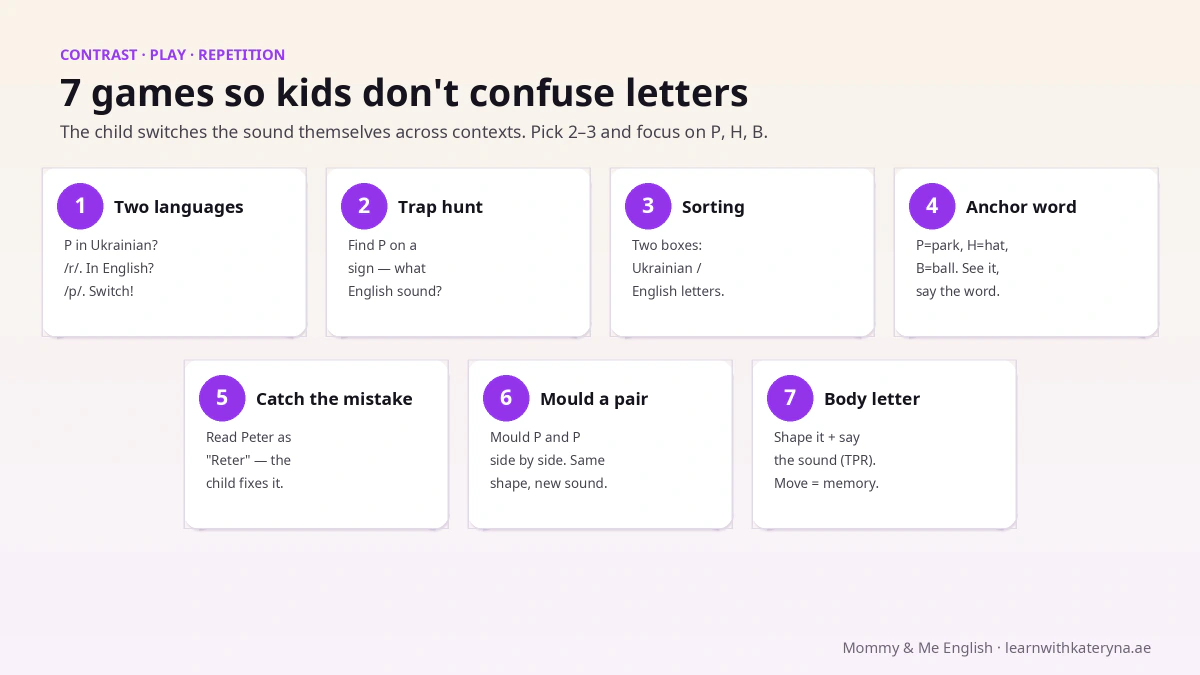
- "Two languages." Show the letter P and ask: "In Ukrainian?" — /r/. "In English?" — /p/. Fast switching trains flexibility.
- Trap hunt. On a walk, look for P on signs: "We found an English P! What sound? /p/!"
- Sorting. Two boxes — "Ukrainian letters" and "English letters". The child places a card and names the sound.
- Anchor word. Give each trap an English anchor: P = park, H = hat, B = ball. See the letter — recall the word — hear the sound.
- "Catch the mistake." Deliberately read Peter as "Reter". The child laughs and corrects you: "No! P is /p/!" Correcting an adult is a favourite game.
- Moulding a pair. Mould a P and a Р from dough side by side. Same shape — different sounds. Touch locks it in.
- Body letter. Shape the letter with your hands and say both sounds — movement ties the difference to the body (the TPR method).
Don't do all seven at once. Choose 2–3 a week and focus on the three critical letters P, H, B. Repetition beats variety.
Parent mistakes that make the confusion worse
- Ignoring the trap. "It'll clear on its own" — it won't. Every read in Ukrainian reinforces the old association. The trap must be named out loud.
- Introducing all 26 letters at once. The child drowns. Start with three critical ones — P, H, B — and add the rest gradually.
- Shaming the mistake. "Come on, it's a P!" — lowers the desire to try. A look-alike mistake is normal; react calmly.
- Mixing the languages yourself. If you read an English word with Ukrainian sounds, the child copies. Keep the English clean in "English time".
- Teaching names instead of sounds. The child must know that P says /p/, not just that it's "pee". For reading, the sound matters. Details in the article on phonics and letter sounds.
What to do if the child already reads P as "r"
If the confusion has already set in — no problem, it's fixable. But you have to act consciously, because the old association is strong. Here's a four-step re-learning plan.
- Name the problem directly. "You're reading this letter in Ukrainian. Right now we're reading in English — here it says a different sound." Awareness is half the battle.
- Isolate one letter. Work with only P for a week. Don't scatter. Anchor word park, the "catch the mistake" game, sign hunting.
- Create a visual anchor. Draw a card: a big P + a park picture + a small note "Eng. /p/". Put it somewhere visible.
- Move to the next. When P is confident, take on H, then B. One letter a week. In a month the three critical letters settle.
The main thing is not to re-teach everything at once and not to panic. Look-alike confusion is a technical detail against the backdrop of the child mastering reading in two alphabets at all. That's an achievement, not a problem.
Next steps
Confusing English and Ukrainian letters isn't a defect but normal interference that's easy to remove with contrast. Remember the six traps (B, H, P, C, X, Y), start with the three critical ones (P, H, B), name each out loud with the contrast-pair method, and lock it in with play. In a few weeks the look-alikes will stop getting in the way of reading.
This topic is part of a wider start with the alphabet. The full guide with letter order, the pronunciation of all 26 and a 4-week plan is in the article on the English alphabet for kids. And once the letters are confident, the next step toward reading is sounds: phonics for kids.
Want a ready-made system instead of guesswork? The free Mommy & Me English starter guide gathers the alphabet, look-alikes, first words and sounds into one step-by-step plan. Download the free starter guide and begin today. And for the foundation — the first 100 words and English from age 1 without a tutor.


