English for cabin crew means level B2 (Upper-Intermediate): the entire Emirates, Qatar or Etihad selection and all training run in English, so confident communication is unavoidable. But B2 is not a "born talent" — it is the result of 2–4 months of the right work from B1. This guide gives you an honest 2-minute self-check, a 90-day B1-to-B2 plan and the 40 aviation words that actually appear at the interview and on board.
TL;DR:
- You need level B2 — confident understanding and speaking; Emirates names no certificate but tests English at every stage
- English is tested not as an exam but through tasks: reading aloud, group discussion, form-filling, final interview
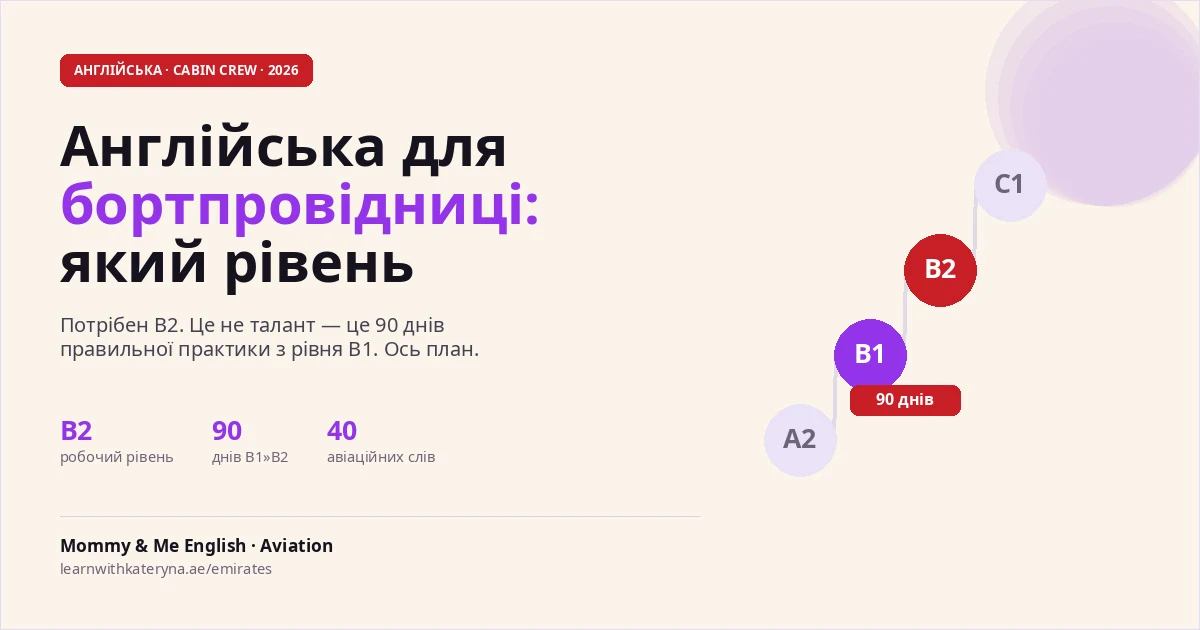
- The most common starting point for Ukrainian candidates is B1: reaching B2 is realistic in 90 days of daily practice
- The real gap is not grammar but speed and confidence in speaking — cured by talking, not by textbooks
- Aviation vocabulary is only ~40 words (galley, jumpseat, brace, PA) — learned in a week
Which English level you actually need
The minimum working level for a cabin crew member is B2 on the CEFR scale: an "independent user" who understands fast speech, holds a conversation without long pauses and explains safety rules clearly. Gulf carriers phrase the requirement differently — "fluent written and spoken English" at Emirates, an explicit "B2" at some low-cost carriers — but the core is one: all work and all selection happen in English, so below B2 a candidate simply cannot keep pace.
It matters to know what is not required. Not a native level: an accent is fine, and Ukrainian-accented English is perfectly acceptable. Not an IELTS or TOEFL certificate for most airlines — Emirates, for one, asks for no such document (check current requirements on the official Emirates Group Careers portal). What is required is different — functional B2: not "pass a test," but work freely.
Cabin crew are not paid for perfect grammar — they are paid so a passenger understands "fasten your seatbelt" the first time and hears calm in the voice. That is B2 in action.
A 2-minute self-check: where you are now
CEFR describes levels through "can-do" statements — what you can actually do. Find the row that honestly describes you today:
| Level | You can | For crew |
|---|---|---|
| A2 | understand simple phrases, speak in memorised chunks, get lost in fast speech | too early — 4–6 months to B2 |
| B1 | understand the gist, speak with pauses and word-searching, manage familiar topics | the starting point: 90 days to B2 |
| B2 | understand fast speech, speak fluently with small errors, discuss abstract things | working level — you can apply |
| C1 | speak almost fluently, catch jokes and subtext, near-effortless | an advantage, not required |
A quick listening check: play a continuous English video (interview, vlog) with no subtitles for 3 minutes. Follow the general sense without strain — you are at B2. Catch single words but the thread keeps breaking — B1. That is your starting point for the plan below.
How English is tested in selection
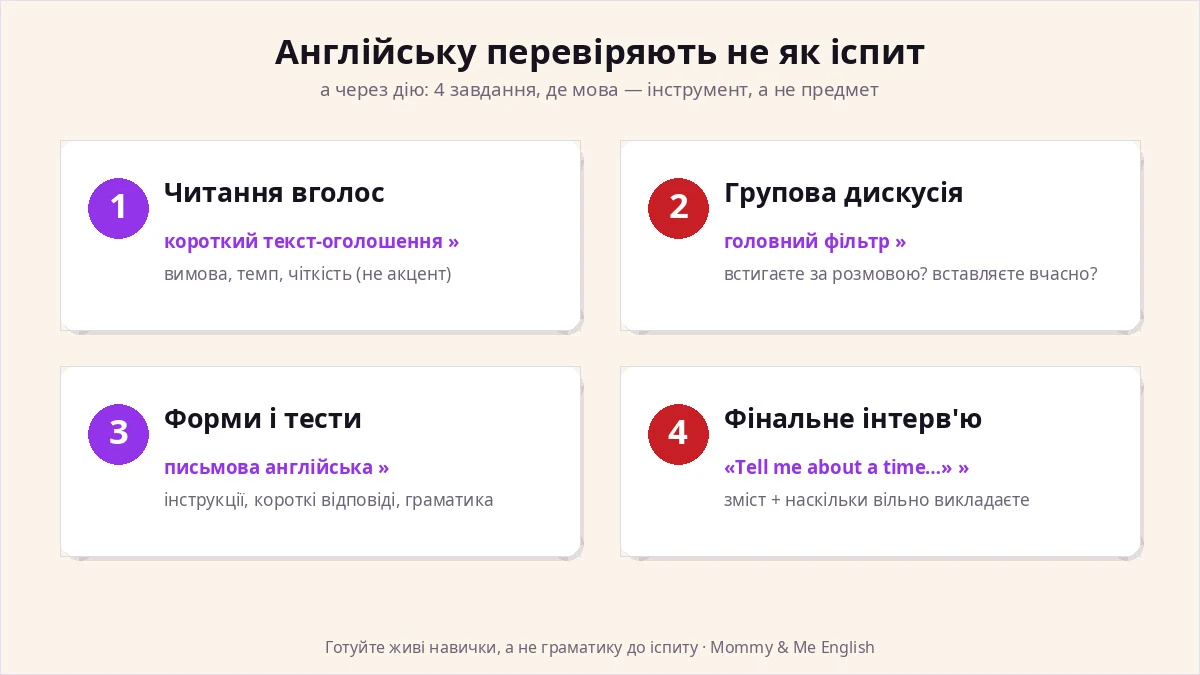
The key insight missing from every "requirements list": airlines do not run an English exam. They test it indirectly — through tasks where language is a tool, not the subject. At the Assessment Day it looks like this:
- Reading aloud. You get a short text (often a passenger announcement) and read it. They score pronunciation, pace and clarity — not accent.
- Group discussion. The main language filter: do you keep pace, chip in on time, understand others? This is where monologue-strong, dialogue-weak candidates fall.
- Forms and tests. A check of written English: instructions, short answers, sometimes a simple grammar test.
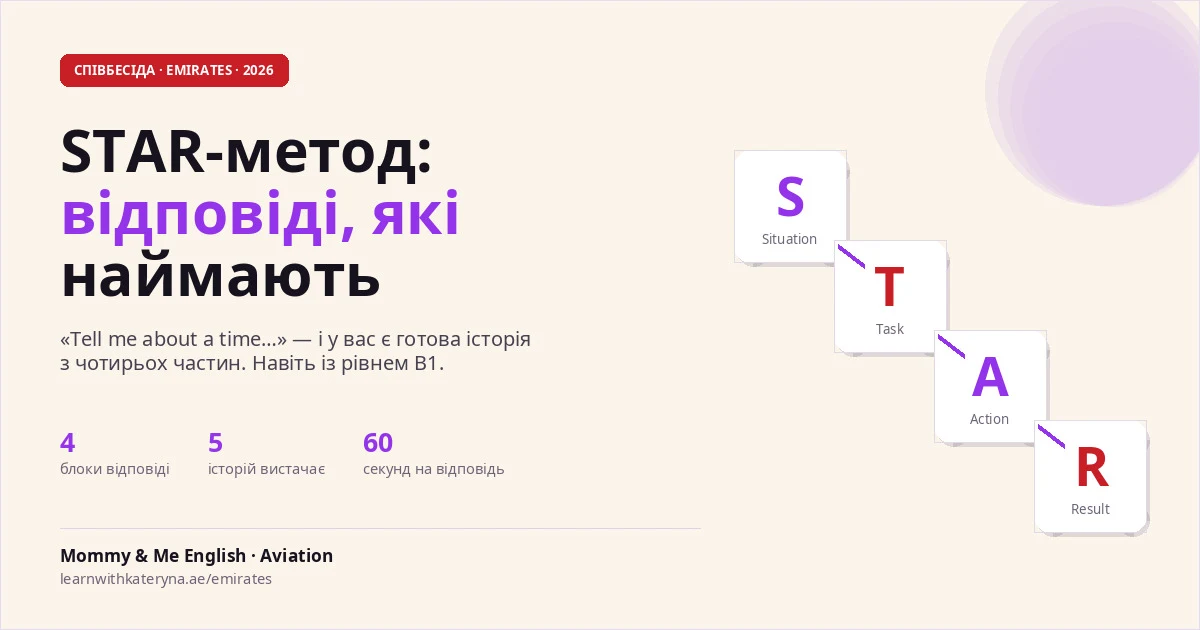
- Final interview. Behavioral "Tell me about a time…" questions — scoring both content and how fluently you deliver it. How to build those answers is in our STAR method guide.
The takeaway: prepare not "grammar for an exam" but live skills — reading aloud, joining a discussion, reacting fast. These are exactly what the course trains and exactly what is easiest to underrate while cramming rules.
The real gap: not grammar but speed
Ukrainian schooling and courses build solid grammar and reading — so many candidates "on paper" know English at B2 yet freeze at B1 in live conversation. The gap is always in one place: fluency — speed and confidence of speech. The brain knows the right answer but assembles it too slowly, and in dialogue that reads as weak English.
This gap is fixed not by new rules but by volume of speaking. Language-acquisition research (e.g. Cambridge on fluency) agrees: speaking speed grows from producing language, not from passive input. In plain terms — you must speak a lot, even with mistakes, until phrasing becomes automatic. The same principle, incidentally, underlies how children acquire language in our TPR method: action and meaning first, precision later.
Perfect grammar with long pauses loses to plain English that flows with confidence. The recruiter hears speed, not flawlessness.
The 90-day B1-to-B2 plan
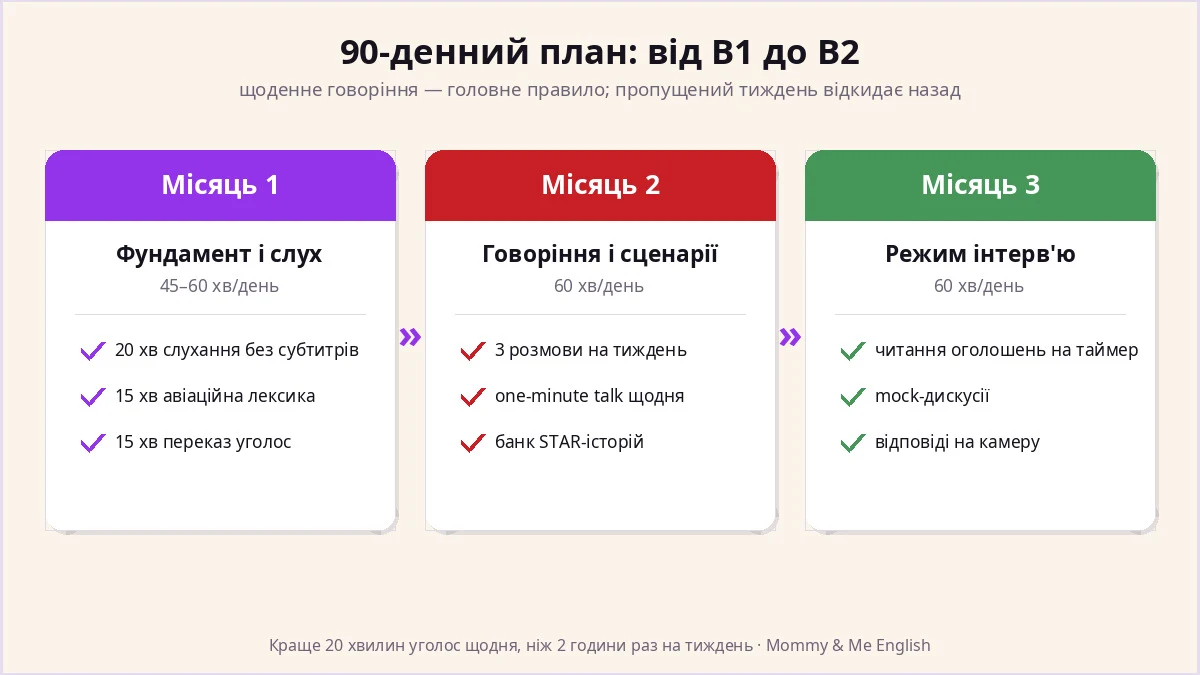
The B1 » B2 move in three months is realistic if you work daily and hit the actual gap — speaking. Month by month:
- Month 1 — foundation and ear (45–60 min/day). 20 min active listening (podcasts, interviews without subtitles), 15 min aviation vocabulary (list below), 15 min speaking aloud: retell what you heard in your own words. Goal — warm up the ear and lose the fear of your own voice.
- Month 2 — speaking and scripts (60 min/day). Add 3 conversations a week with a partner or tutor; a daily one-minute talk on a random topic; start building your STAR story bank in English. Goal — speed and structure.
- Month 3 — interview mode (60 min/day). Simulations: reading announcements aloud against a timer, mock discussions, answers recorded on camera. Goal — carry the skill into the stress of selection.
The plan's key rule: speak every day, no exceptions. A missed listening day is nothing; a missed speaking week sets you back. Better 20 minutes aloud daily than two hours once a week.
Aviation English: the 40 words that matter
Aviation English sounds intimidating, but it is only about 40 words and phrases, learnable in a week. They fall into three groups:
On board (space and equipment): galley (crew kitchen module), jumpseat (crew fold-down seat), aisle, overhead bin, lavatory (toilet), tray table, seatbelt, oxygen mask, life vest, trolley/cart.
Actions and procedures: to board, to disembark, to fasten, to stow (secure/put away), brace position, turbulence, pushback, boarding, safety demonstration, PA announcement (over the loudspeaker).
Service and people: passenger, crew, purser (senior cabin crew), duty-free, special meal, assistance, complaint, refreshment, "Is there a doctor on board?", "Cabin crew, prepare for landing."
Learn them not as a list but inside phrases: not "seatbelt" but "Please fasten your seatbelt." That way the word arrives with its grammar "frame" — the same principle that works in children's topics like ready-made phrases: you absorb the block, not the single unit.
The daily-ritual method — for adults
Our site is built on the idea that children learn English through daily rituals — short, tied to moments of the day. The surprising insight: for adult self-study this works the same way. The adult brain, too, prefers regularity over heroic marathons.
Attach English to habitual moments: a podcast with your morning coffee, a one-minute talk aloud on a walk, five aviation phrases aloud before bed at the mirror (the same mirror trick as in children's emotions). Three 15-minute micro-sessions built into the day beat one "hard" hour — and, crucially, don't collapse when you are tired.
Written English: forms and CV
Written English is underrated, yet it is tested too — and it starts before the Assessment Day, in the application. Here you need simple, clear, error-free sentences, not complex constructions. Three anchors:
- Short sentences. One thought, one sentence. Long comma-strung periods multiply mistakes.
- Active voice, past tense. "I served guests," not "Guests were being served by me." Simpler = more correct.
- Read aloud to check. Reading what you wrote aloud catches calques and clumsy sentences better than the eye.
Exactly how to format an English aviation CV is in our guide to the Emirates CV and photos: one page, service language, English on a visible line near the top.
Reading announcements aloud: a mini-drill
Reading aloud is the one Assessment Day task you can drill to automatic at home — and the one almost nobody prepares. A five-minute daily exercise removes half the first-stage stress. Take any real cabin announcement — plenty are freely available — and work it in three passes:
- The comprehension pass. Read silently, translate unknown words. Announcements are simple in vocabulary but carry their own turns: "We kindly ask you to…", "for your safety and comfort."
- The pronunciation pass. Read aloud slowly, clearly voicing word endings. Ukrainians "swallow" ends (seatbelt » "sitbel") — which is exactly what loses marks.
- The pace-and-smile pass. Read at a natural tempo, with a "smile in the voice." The announcement should sound reassuring, not like dictation. Record yourself — you will hear where the pace breaks.
A practice sample: "Ladies and gentlemen, welcome on board. Please make sure your seatbelt is fastened, your tray table is stowed, and your seat is in the upright position. Cabin crew, prepare for take-off." Three sentences, all the topic's key vocabulary — a week's material.
Reading aloud is the cheapest win at the Assessment Day: five minutes a day, and the task that scares others becomes your strength.
4 myths about English level for crew
Myth 1: "You must speak with no accent." No. Emirates crew span over 130 nationalities, and accents are everywhere. Clarity is scored, not "Britishness." A Ukrainian accent with clear pronunciation is a perfectly working option.
Myth 2: "No IELTS, no job." Most airlines require no certificate — they see your level at the Assessment Day. IELTS may help for a visa or CV, but it is not a crew-selection condition.
Myth 3: "You must know all aviation terminology." Technical terminology is taught in training after hiring. Selection needs ~40 everyday aviation words and, above all, service English — "How can I help you?", not aircraft-system names.
Myth 4: "Your level either exists or not — you can't change it fast." The most harmful myth. Level is a skill, not a personality trait: the B1»B2 gap closes in 90 days of focused practice. Thousands of candidates pass exactly this way.
Free resources for daily practice
The 90-day plan needs no paid schools — free tools are enough, sorted by skill:
| Skill | What to use | How |
|---|---|---|
| Listening | YouTube interviews, English podcasts, TED Talks | 3–20 min daily without subtitles, then with subtitles to check |
| Speaking | phone voice recorder, mirror, language tandem apps | a one-minute talk aloud, record and listen back |
| Aviation vocab | real cabin announcements, safety cards | learn in phrases aloud, not as single words |
| Reading aloud | news articles, announcements, children's books in English | 5 min daily in three passes (see above) |
| Interview practice | the CrewQuest trainer, mock with a partner | random questions + STAR answers against a timer |
What matters is not the number of tools but the daily habit. One podcast and one voice recorder, used every day, beat a dozen apps opened once a week.
6 mistakes in English preparation
1. Cramming grammar instead of speaking. The classic "top-of-the-class" trap: perfect tense tables and silence in dialogue. Speaking should be 60% of prep time.
2. Fearing mistakes. Staying silent "so as not to err" slows fluency more than any error. Mistakes are fuel for progress, not a mark of defeat.
3. Passive input instead of production. Hours of series are pleasant, but that is input, not output. Without speaking, speed doesn't grow.
4. Skipping reading aloud. It is on the Assessment Day — yet almost nobody practises it at home. Five minutes aloud daily removes half the stress.
5. Learning "general" English with no aviation. Forty domain words give a sense of "my" vocabulary and topic confidence. A week's work, big payoff.
6. Irregularity. "I'll catch up at the weekend" doesn't work for language. Daily 20 minutes beat a three-hour weekly sprint.
Next steps
Start today with two actions: take the 3-minute listening self-check (a video without subtitles) and write out your first 10 aviation words inside phrases. Tomorrow add a one-minute talk aloud. In 90 days of daily practice the gap between "know it on paper" and "speak it freely" closes — and English stops being the thing standing between you and the uniform. Keep the neighbouring guides handy: the STAR method for answers, the CV and photos for the application and the full Emirates selection guide.
And if you want structure instead of going it alone — Kateryna's Emirates Cabin Crew course gathers aviation English, mock discussions and a Mock Interview into a system with feedback: you don't guess whether you "measure up," you hear your level through a recruiter's ears. Your B2 is closer than it seems — 90 days of the right practice away.