 Kateryna Ivanova

Yes — you can apply to Emirates cabin crew from Ukraine or anywhere in Europe without leaving home. The whole early process is remote: you submit an online application, attend an open day or a video assessment, and only relocate to Dubai once you have a firm job offer. Emirates then sponsors your UAE work visa, pays for your one-way flight and gives you a furnished flat — so you never fund the move yourself. You do not need a UAE visa to apply, and there is no local address requirement.
TL;DR:
- You apply 100% online from abroad — a Ukrainian or EU passport is enough; no UAE visa or residency is needed to apply.
- The path is: online application → open day or video assessment → the Golden Call (offer) → medical and visa → paid training in Dubai.
- Emirates sponsors your work visa, books your one-way flight and provides a furnished shared flat — relocation costs you nothing.
- Core requirements: English at B1+, arm reach ~212 cm on tiptoes, minimum age 21, no tattoos visible in uniform.
- From application to first flight typically takes 2–6 months; the parts you control are your CV, your photo and your spoken English.
Can you apply to Emirates from abroad?
Applying to Emirates from abroad means starting and completing the entire recruitment process from your home country, with relocation happening only at the very end. Emirates hires cabin crew from more than 130 nationalities, and the recruitment model is built for international candidates: the application is online, assessments run both as travelling open days and as video sessions, and the airline sponsors the visa. You do not need to be in Dubai, hold a UAE visa, or have a Gulf address to be considered. A valid Ukrainian or EU passport, the right profile and strong spoken English are what open the door.
This is the single biggest thing candidates from Ukraine and the EU get wrong: they assume they must first move to Dubai, find a job, or arrange their own visa. You do not. The airline wants to recruit globally, so it removed those barriers. Your job is to present well on paper, pass the assessment, and be ready to move fast once the offer lands. For the official, current requirements always cross-check the Emirates Group cabin crew careers page before you apply.
You are not applying for permission to move to Dubai. You are applying for a job that moves you to Dubai — visa, flight and flat included — the day you say yes.
The application journey, step by step
The application journey is a fixed sequence of five stages, and only the last one happens in Dubai. Knowing the order removes most of the anxiety, because you can see exactly what comes next and prepare for it in advance rather than reacting.
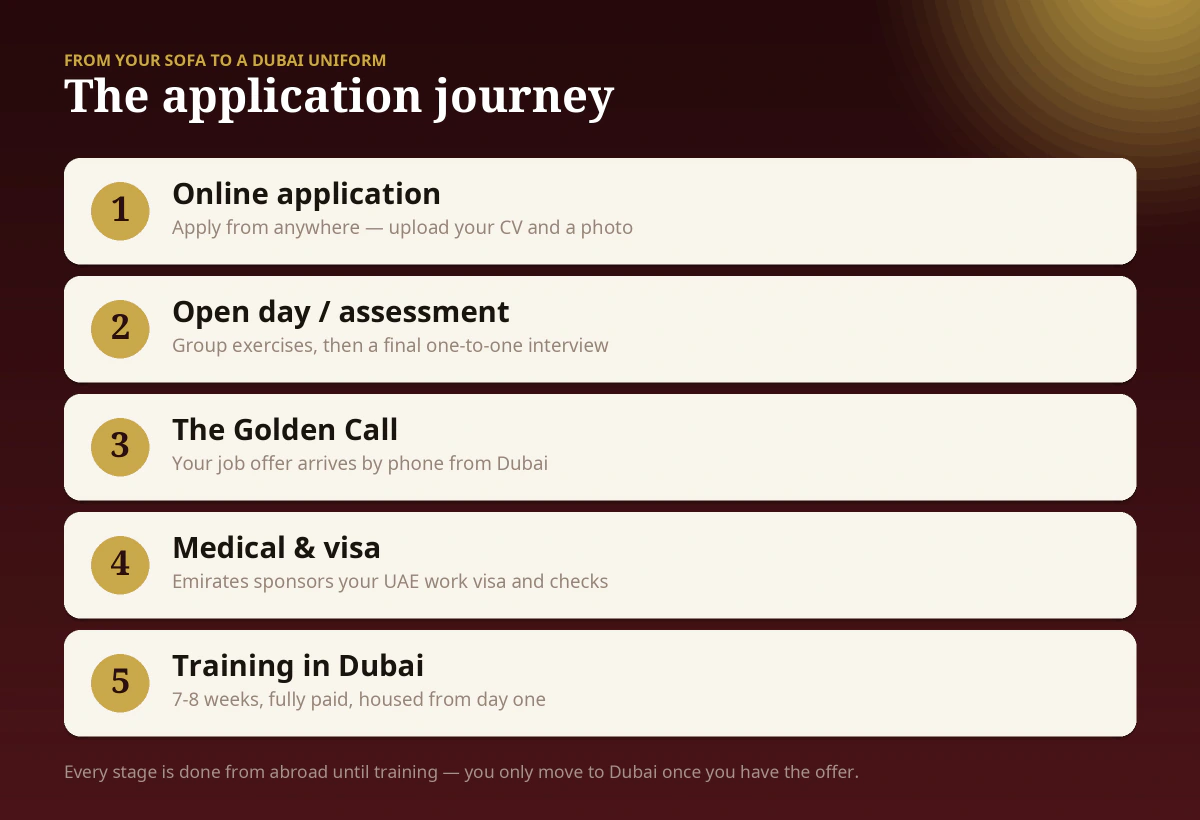
- Online application — you register on the Emirates careers portal and submit your CV and a photo from home, from anywhere in Ukraine or Europe.
- Open day or video assessment — you are invited to a recruitment event, either in person in a European city or online, with group exercises and a final interview.
- The Golden Call — if you pass, a recruiter phones you from Dubai with a conditional job offer. Crew call it the Golden Call for a reason.
- Medical and visa — you complete a medical check and Emirates begins sponsoring your UAE work visa. This is when the airline takes over the paperwork.
- Training in Dubai — you fly out on an Emirates-paid ticket, move into crew accommodation, and start roughly seven to eight weeks of paid ab-initio training.
Everything up to the medical is done from your home country. You only pack your bags after the offer is confirmed — which is exactly why applying from abroad is far less risky than people fear. You are never asked to move on a maybe.
Who is eligible to apply from abroad
Eligibility to apply from abroad is the same as for any Emirates cabin crew candidate — nationality and location do not change the bar. The core requirements are physical, linguistic and about presentation, and every one of them can be checked before you spend a single hour on the application.
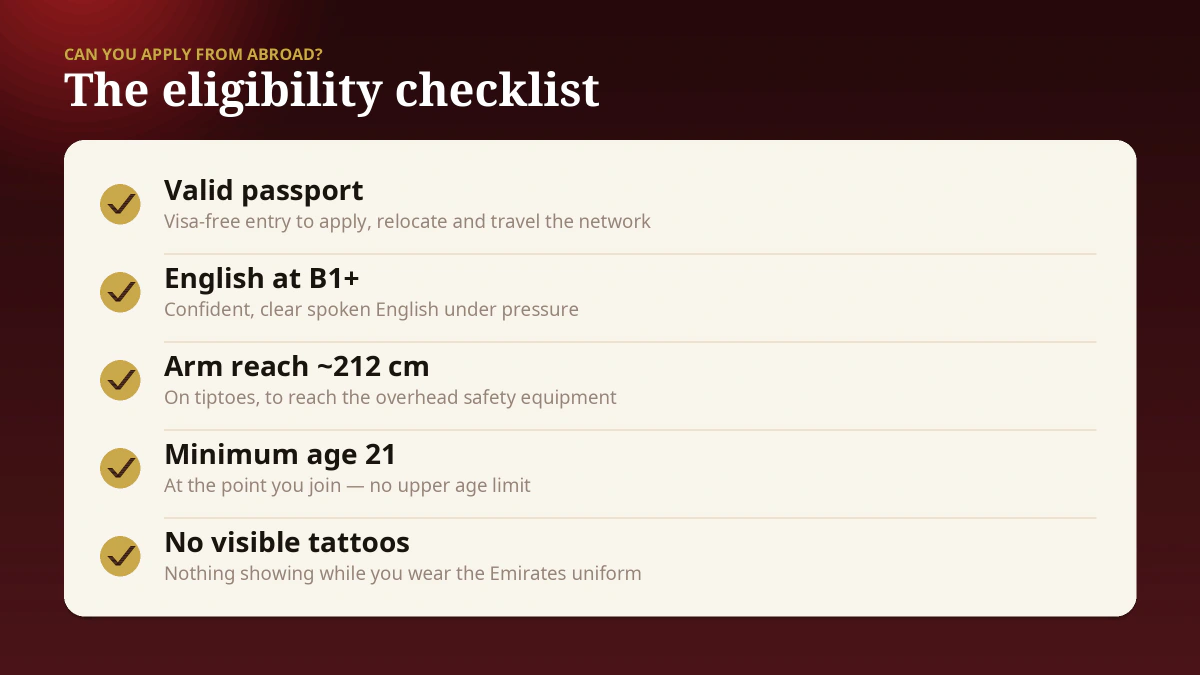
- A valid passport — a Ukrainian or EU passport is fine; you apply and travel on it.
- English at B1 or higher — you must hold a confident, clear conversation and be understood under pressure.
- Arm reach of about 212 cm — measured on tiptoes against a wall, so you can reach overhead safety equipment. This usually pairs with a minimum height of around 160 cm.
- Minimum age 21 — at the point you join. There is no upper age limit.
- No tattoos visible in the uniform — including when you wear short sleeves; covered tattoos are generally acceptable.
You should also be able to swim, be medically fit, and have finished secondary education. The reach requirement surprises the most people, so measure it early — stand flat against a wall, rise onto your toes, and stretch one arm straight up. If you are close, you are fine; if you are well short, it is better to know now. You can practise the exact motion with our cabin crew reach test.
Submitting the online application from home
The online application is your first screen, and it is entirely self-service. You create a profile on the Emirates careers site, upload your CV, add a recent photograph and answer a short set of questions. There is no fee and no interview at this stage — a recruiter reviews your submission and decides whether to invite you to an assessment. Because thousands apply, this document sift is genuinely competitive, and most rejections happen here rather than at interview.
Two things carry the most weight: your CV and your photo. The CV must be a clean, one-page, aviation-style document that shows customer service, teamwork and reliability — not a generic office résumé. The photo must look like the polished, groomed professional Emirates is hiring, not a casual selfie. We break both down, with examples, in our guide to the Emirates cabin crew CV and photo. Get these right and you clear the hardest filter in the whole process.
Most people are not rejected at the interview. They are rejected at the upload screen, by a CV and photo that never made a recruiter look twice.
Open days and video assessments
An open day is a live recruitment event where Emirates screens candidates in person, and a video assessment is its online equivalent. From abroad you may be invited to either. Open days are held in cities across Europe throughout the year — you travel to the venue for the day — while video assessments let you complete the early rounds from your own home, which is the most convenient route for candidates in Ukraine and smaller EU cities.
The assessment itself follows a well-known shape: a welcome and presentation, group exercises that test teamwork and communication, a reach check, and a final one-to-one interview for those who progress. The group work is where many strong candidates stumble, because it is not about being the loudest — it is about being the person recruiters can picture calming a nervous passenger. We walk through every stage, including the group exercise and the questions, in the cabin crew assessment day guide, and you can rehearse real scenarios free in the CrewQuest trainer.
The Golden Call: your offer from Dubai
The Golden Call is the phone call in which an Emirates recruiter offers you the job, usually a few days to a few weeks after a successful final interview. Crew across the world use the nickname because it is the moment everything changes — the call comes from a Dubai number and confirms a conditional offer, subject to your medical, documents and references.
When it comes, you say yes and the airline takes over. You will be asked to supply documents — passport, education certificates, references and photos — and to book or complete a medical. From this point the relationship flips: instead of you chasing an application, Emirates is now processing you as a future employee, arranging the visa and your joining date. If you miss the call, recruiters do try again, but treat any Dubai number in the weeks after your interview as important and answer it.
Visa, relocation and what Emirates pays for
Relocation is where applying from abroad stops feeling risky, because the expensive, complicated parts are handled and paid for by the airline. Emirates sponsors your UAE residence and work visa — you do not arrange it, and you do not pay for it. The airline also books your one-way flight to Dubai and places you in furnished, shared crew accommodation with bills and transport to the airport covered from day one.
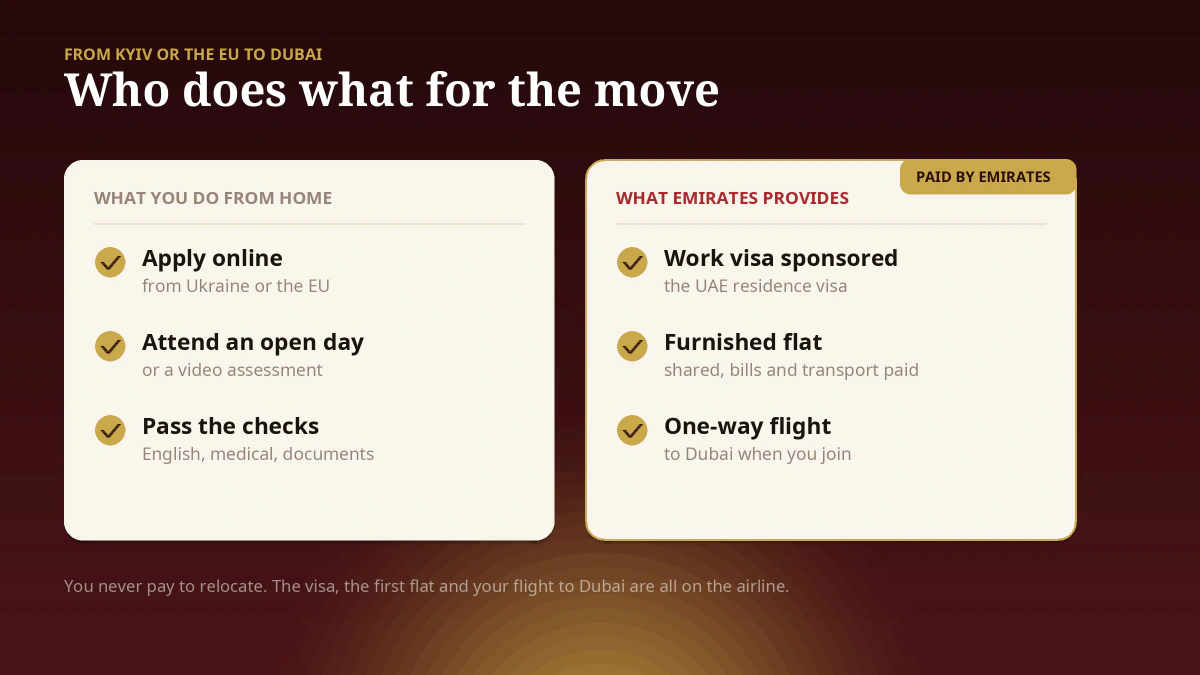
| What you do from home | What Emirates provides |
|---|---|
| Apply online from Ukraine or the EU | Sponsors your UAE residence and work visa |
| Attend an open day or video assessment | Books your one-way flight to Dubai |
| Pass the medical and submit documents | Furnished shared flat, bills and transport paid |
| Pack for a warm climate and a new life | Paid training and an allowance from day one |
The UAE also has no personal income tax, confirmed on the UAE government's taxation page, so the salary you are quoted is the money you keep. Because your visa, flight and housing are covered, your first month abroad does not begin with a deposit or a plane ticket you had to fund. That is the practical difference between relocating for an ordinary overseas job and relocating with Emirates. For the full picture of pay once you land, see our breakdown of the Emirates cabin crew salary.
The English level you need to apply
The English requirement to apply is functional B1 or higher — clear, confident spoken English, not perfect grammar or a native accent. Emirates operates entirely in English on board, so the assessment is looking for someone who can give a safety briefing, calm an anxious passenger and work in a mixed-nationality crew without hesitation. Your accent is not a problem; your fluency and clarity are what count.
For candidates from Ukraine this is usually the real gap between "I want to apply" and "I am ready to apply". Reading English is easy; speaking it under pressure, in a group exercise, with recruiters watching, is different. The fix is spoken practice, not more grammar drills — role-play the assessment out loud, record yourself answering common questions, and get comfortable thinking in English rather than translating. Our English for cabin crew guide gives a 90-day plan and the exact phrasebank the assessment rewards.
Applying specifically from Ukraine
Applying from Ukraine works exactly like applying from any other country — the portal, the assessment and the visa sponsorship are identical. What differs is a handful of practical points worth planning around. A Ukrainian passport is fully accepted, and Emirates has long recruited Ukrainian crew, so nationality is not a barrier. If in-person open days near you are limited, prioritise the video assessment route, which lets you complete the early rounds from home.
Keep your documents current: a valid passport with plenty of remaining validity, and, if you have them, references from any customer-facing or service jobs. Given travel disruption, being flexible about where you attend an assessment — a nearby EU city, or online — widens your options. And because English is the deciding factor for most Ukrainian candidates, treat spoken practice as the main project, not an afterthought. The airline is hiring globally and actively wants international crew; a well-prepared applicant from Kyiv, Lviv or anywhere in Ukraine competes on the same footing as anyone else.
A Ukrainian passport does not hold you back. What holds most candidates back is walking into the assessment before their spoken English is ready. Fix that, and geography stops mattering.
Applying from elsewhere in Europe
Applying from elsewhere in Europe follows the same route, with the advantage that open days are held more frequently across major European cities. If you hold an EU passport or already live in the EU, you may find an in-person assessment within easy reach, which some candidates prefer because it lets recruiters meet them face to face. The choice between an open day and a video assessment does not change your chances — pick whichever is more practical for you.
One point applies to everyone applying from Europe: do not wait for a "perfect" open day in your own city. Emirates recruits continuously, and being willing to travel to a neighbouring country for an assessment, or to complete it online, can shorten your timeline by months. Treat the search for events as an active task, check the careers portal regularly, and apply when you are genuinely assessment-ready rather than when a local date happens to appear.
How long the whole process takes
The full process from application to first flight usually takes between two and six months, though it varies with recruitment schedules and how quickly your documents and medical clear. The stage you control is the front end; the visa and joining date are on the airline's timeline once you have the offer.
| Stage | Typical timing |
|---|---|
| Online application to assessment invite | A few days to a few weeks |
| Assessment day or video rounds | 1 day (plus any follow-up interview) |
| Assessment to the Golden Call | ~1–3 weeks |
| Offer to visa, medical and joining date | ~4–8 weeks |
| Training in Dubai to line flying | ~7–8 weeks |
The lesson from those numbers is simple: the sooner your CV, photo and English are ready, the sooner the whole chain starts. Nothing rewards preparation like this process, because being assessment-ready is the one lever entirely in your hands.
Common mistakes when applying from abroad
Three mistakes cost candidates from abroad the most opportunities, and all three are avoidable:
- Assuming you must move first. You do not relocate, arrange a visa or find a Dubai address before applying. The job funds the move — applying from home is the correct order.
- Applying before your English is ready. A weak spoken assessment ends the process fast. Practise out loud for weeks before you attend, not the night before.
- Treating the CV and photo as a formality. They are the hardest filter. A generic CV or a casual photo gets you screened out before a human ever speaks to you.
A quieter fourth mistake is going in alone with no idea what the assessment day actually looks like. Candidates who have rehearsed the group exercise and the interview questions walk in calm, and calm is exactly what recruiters are scoring. Preparation is not optional here — it is the difference between the applicants who get the Golden Call and the ones who do not.
Is it worth it? Next steps
For most candidates in Ukraine and Europe, applying from abroad is absolutely worth it: a tax-free salary, a sponsored visa, a paid flight and a furnished flat make Emirates one of the few careers that funds your entire relocation. The barrier is never geography — it is readiness. The applicants who succeed are simply the ones who prepared their CV, their photo and their spoken English before they applied.
Ready to move from reading to doing? Book a free consultation call with Kateryna — a former Emirates crew member — using the planner just below, and we will map your exact path from your city to Dubai, with a realistic timeline. Then work the funnel: read the full how to become Emirates cabin crew pillar, get your English to level, fix your CV and photo, prepare with the assessment day guide, and see the full course on the Emirates cabin crew course page. You can also drill real interview scenarios free in the CrewQuest trainer.


