 Kateryna Ivanova

Most cabin crew candidates get rejected for reasons that have nothing to do with talent: weak spoken English, a photo or CV that fails the first screen, dominating or disappearing in the group exercise, generic answers with no real example, low energy, arrogance, or a story that does not hold up. The good news is that almost every one of these reasons is fixable before you ever apply.
TL;DR:
- Rejection can happen at five stages: the CV and photo screen, the English test, the group exercise, the video and final interview, and the medical and reach check.
- The most common reasons are weak English, a poor photo or CV, dominating the group, generic answers with no examples, low energy, arrogance and dishonesty — behaviour and preparation, not raw ability.
- The group exercise cuts more candidates than any other stage, because it exposes how you treat people under pressure.
- Recruiters rarely tell you the real reason. A "we will keep your details on file" email almost always means a specific, fixable gap.
- You can remove most rejection reasons with a phrasebank, a lift in English, six prepared STAR stories, tidy grooming and genuine warm energy — then reapply and pass.
Why good candidates still get rejected
A cabin crew rejection is a signal that one specific part of your application did not meet the standard on the day — not a verdict on whether you are good enough for the job. Airlines like Emirates receive far more strong applicants than they have seats, so the assessment is designed to cut, not to pass. That means capable, warm, hard-working people are turned away every single week, often by a small, correctable gap.
The mistake most candidates make is treating rejection as a personal judgement. It is not. It is feedback about a moment: a rushed answer, a photo that looked untidy, a group task where you talked too much or too little, a sentence of English that came out shaky. Once you see rejection as a list of fixable moments rather than a closed door, the whole process becomes something you can prepare for and control.
Airlines do not reject people for being ordinary. They reject candidates who gave them a reason to say no — and almost every reason is something you can remove before you apply.
Where you can be cut: the whole funnel
The cabin crew hiring funnel is a sequence of five filters, and you can be cut at any one of them. Unlike a single interview, the process tests different things at each stage, so a candidate who is brilliant in conversation can still fail on a group task, and a strong group player can still fail on English. Understanding the whole funnel is the first step to not being surprised by it.
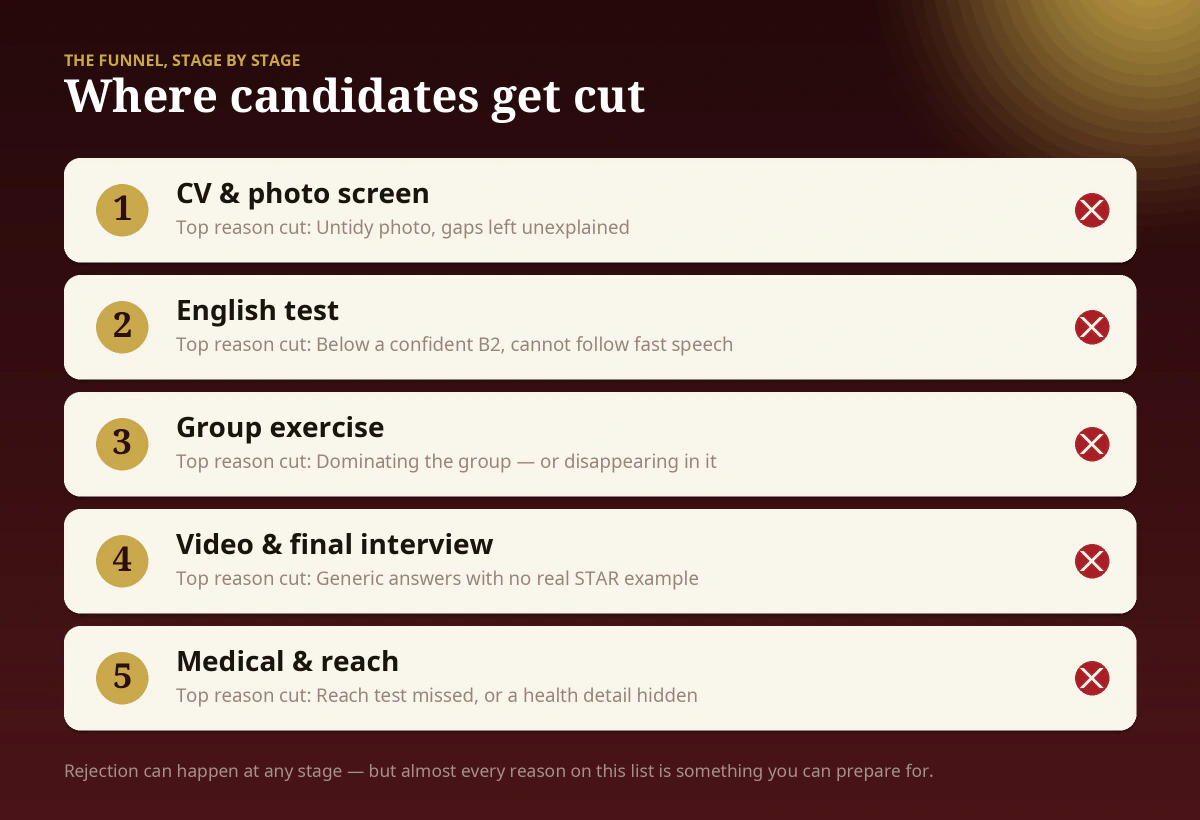
The table below maps the stage, what it really tests, and the single reason that cuts the most people there. If you only prepare for the interview, you have prepared for one of five filters — and probably not the one that will end your application.
| Stage | What it tests | Top reason cut |
|---|---|---|
| CV & photo screen | First impression, presentation, gaps | Untidy photo or unexplained CV gaps |
| English test | Comprehension and confident speech | Below a working B2 level |
| Group exercise | Teamwork and behaviour under pressure | Dominating — or disappearing |
| Video & final interview | Motivation, examples, warmth | Generic answers with no real story |
| Medical & reach | Fitness to fly, honesty, arm reach | Reach missed or a health detail hidden |
Notice that only two of the five stages are about "talking to a recruiter". The others reward preparation you can do quietly at home — a better photo, stronger English, a rehearsed way of behaving in a group. That is why so many rejections feel unfair: the candidate prepared for the wrong filter. For the full stage-by-stage walkthrough of the day itself, read our cabin crew assessment day guide.
Rejected at the CV and photo screen
The CV and photo screen is the first and fastest filter, and it rejects candidates before a human ever speaks to them. A recruiter or an automated system scans hundreds of applications, so anything that looks careless — a blurry photo, a heavily filtered selfie, a CV with unexplained employment gaps or spelling mistakes — is an easy reason to move on. You are not competing on experience here; you are competing on presentation and clarity.
The two things that quietly sink applications are the photo and the gaps. Your photo should look like a groomed, approachable professional in good light, not a holiday snap or a glamour shot. Your CV should account for your time honestly and cleanly, because unexplained gaps make a recruiter wonder rather than trust. We break down exactly what a passing photo and CV look like in our guide to the Emirates cabin crew CV and photo — this is the cheapest rejection to prevent, because it costs only care and a retake.
Rejected on English
English rejection happens when your spoken comprehension or fluency sits below the level the cabin needs, regardless of how good your written English looks on paper. Cabin crew have to understand fast, accented speech, read a situation, and respond calmly and clearly — often about safety. A candidate who hesitates, mishears an instruction, or cannot keep up with a natural-speed conversation is a risk the airline will not take, however warm and willing they are.
The bar is roughly a confident B2: you can follow a group discussion at natural speed, ask and answer without long pauses, and be understood the first time. Many candidates over-estimate where they sit, because their reading and grammar are strong but their listening and speaking under pressure are not. This is the single most common quiet rejection, and it is also one of the most fixable with structured practice. Our English for cabin crew guide and 90-day plan shows exactly how to close the gap.
You are not rejected for having an accent. You are rejected when the recruiter has to work to understand you — because in the cabin, a passenger or a colleague would have to work too.
Rejected in the group exercise
The group exercise is the stage that cuts more candidates than any other, because it reveals how you treat people when you are under pressure and competing for a place. You are put in a small team and given a task, and assessors watch not whether you "win" but how you behave: do you listen, include quieter people, build on ideas and stay warm — or do you talk over others, push your own view, and treat teammates as obstacles?
There are two ways to fail here, and they are opposites. The first is dominating: talking too much, interrupting, steamrolling the group to look like a leader. The second is disappearing: going so quiet that assessors never see you contribute at all. Both are instant rejections, because cabin crew work is a team job in a small space, and neither the loud nor the invisible candidate is safe to put on a real flight. The winning behaviour is quiet leadership — bringing others in, keeping the group on track, and being visibly kind.
You can rehearse this. Practise real group and interview scenarios, and the feedback loop that comes with them, in our free CrewQuest trainer — it is built specifically to drill the behaviours assessors reward and the ones that get people cut.
Rejected in the final interview
Final-interview rejection is almost always about the same thing: generic answers with no real example behind them. By this stage the recruiter already believes you can do the job on paper; what they are testing is whether you can prove it with specific, true stories from your own life. A candidate who says "I am a great team player" without a single concrete example sounds identical to every other candidate — and identical is forgettable, which is a soft rejection.
The fix is structure. Strong candidates answer competency questions with the STAR method — Situation, Task, Action, Result — so every claim is backed by a short, specific story. "Tell me about a time you handled a difficult customer" should never be answered in the abstract; it should be a thirty-second scene with a real person, a real problem, and a real outcome. Prepare six of these before you walk in and you will never be caught empty. Our STAR method guide shows how to build them.
The other quiet interview killers are arrogance and low energy. Arrogance — correcting the recruiter, name-dropping, acting like the job is beneath you — signals you will be hard to work with in a crew. Low energy — a flat voice, no smile, short answers — signals you will be hard for passengers to warm to. Both are read as culture risks, and both end applications that were otherwise strong.
Rejected at medical and reach
Medical and reach rejection happens at the final gate, and it catches candidates who were otherwise cleared. The reach test — usually touching a marker around 212 cm with your fingertips, often flat-footed or on tiptoe depending on the airline — checks you can reach the emergency equipment stowed in the overhead bins. It is a genuine safety requirement, not a preference, and there is no negotiating it on the day.
The more avoidable failure is honesty. Candidates sometimes hide a health condition, a past surgery or a medication, believing disclosure will cost them the job. In reality, undisclosed issues discovered later are far more damaging: they can void your application entirely and end your credibility with the airline. Aviation medicals follow strict civil-aviation standards, so the safe strategy is full honesty combined with proper documentation. Check the official role requirements on the Emirates Group cabin crew careers page before you apply, and treat the medical as something to prepare for, not to hide from.
The top 8 rejection reasons
The top rejection reasons cluster into a short, repeatable list, and once you see them written down the pattern is obvious: almost all of them are about behaviour and preparation rather than something you were born without. Here are the eight that end the most applications.
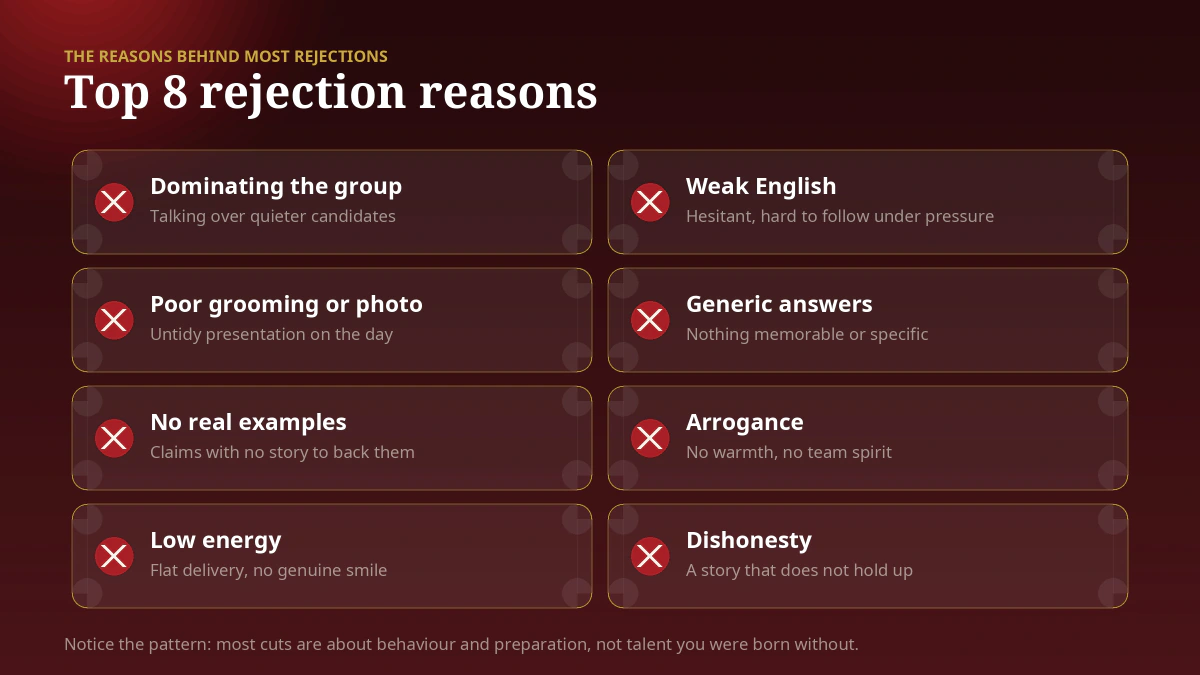
- Dominating the group — talking over quieter candidates and treating a team task as a contest to win.
- Weak English — hesitant, hard to follow, or unable to keep up with natural-speed speech.
- Poor grooming or photo — untidy presentation that fails the first screen or the day.
- Generic answers — nothing memorable, nothing specific, indistinguishable from everyone else.
- No real examples — claims about your character with no story to back them up.
- Arrogance — no warmth, no team spirit, an air that the job is beneath you.
- Low energy — flat delivery and no genuine smile, which reads as "not a people person".
- Dishonesty — an exaggerated CV or a story that falls apart under a follow-up question.
Look closely and you will see that six of the eight are entirely within your control before you even apply, and the other two — English and grooming — are fixable with focused effort. There is no line here that says "not tall enough personality" or "not the right face". The people who pass are simply the people who removed these eight reasons first.
How to fix each reason
Fixing rejection reasons is a checklist, not a mystery, because each reason maps to a specific piece of preparation you can do in the weeks before you apply. You do not need to become a different person; you need to remove the small, concrete things that give a recruiter permission to say no.
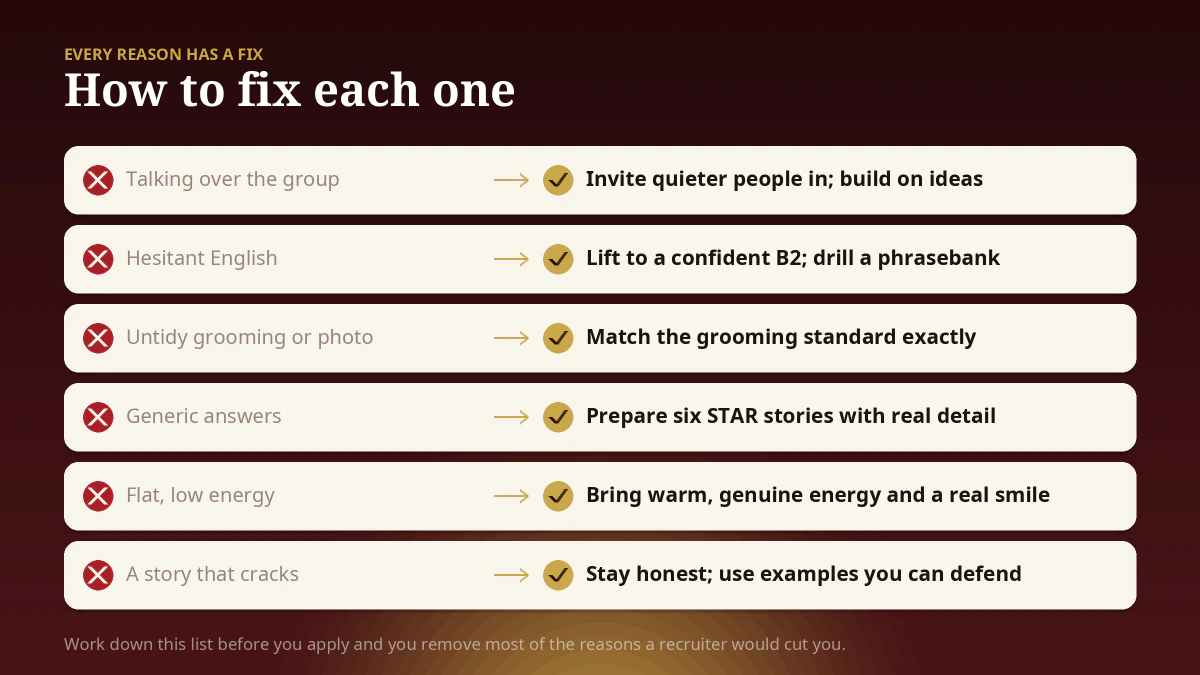
Work down the list in order. Replace talking over the group with quiet leadership — invite quieter people in and build on their ideas rather than override them. Replace hesitant English with a confident B2 by drilling a phrasebank of the exact phrases you will need. Replace an untidy photo or grooming by matching the standard exactly; our cabin crew grooming standards guide shows the precise look airlines expect. Replace generic answers with six prepared STAR stories, replace flat energy with warm, genuine energy and a real smile, and replace any shaky story with honest examples you can defend under a follow-up. Do these six things and you have removed almost every reason a recruiter would cut you.
Preparation is not about tricking the assessor. It is about becoming, genuinely, the calm, warm, capable person the cabin needs — and then letting them see it clearly.
What a rejection email really means
A cabin crew rejection email is almost never honest about the real reason, because airlines send the same polite template to thousands of people and cannot give individual feedback. Lines like "we were impressed but will not be progressing your application" or "we will keep your details on file" are standard wording, not a clue. This is why candidates spiral: they read a generic email looking for a specific answer that was never in it.
The useful move is to reconstruct the likely reason yourself, honestly. Where in the funnel were you cut? If you were rejected before any conversation, it was the CV or photo. If you were let go after the group task, look hard at your behaviour in the team. If it was after the final interview, your examples were probably too thin. The email will not tell you, but the stage you reached almost always will — and that is the gap to fix before your next attempt.
Reapplying after a rejection
Reapplying after a cabin crew rejection is not only allowed, it is common, and many serving crew were rejected at least once before they were hired. Most airlines ask you to wait a set period — often around six months — before applying again, which is not a punishment but a chance to come back visibly stronger. A reapplication that looks identical to the last one will get the same result; a reapplication that fixes the specific gap usually does not.
Use the waiting window deliberately. Pick the one or two stages where you were weakest and rebuild them: lift your English by a real level, rebuild your photo and CV, drill group behaviour, or write and rehearse your STAR stories until they are second nature. Then apply again as a candidate who solved the problem rather than one who simply tried again. For the full path from first attempt to offer, our pillar guide on how to become Emirates cabin crew maps every step.
Common rejection myths
Three myths cause candidates the most needless worry:
- "They rejected me because of my looks." Airlines hire for grooming and warmth, not beauty. An untidy photo is a real reason; your face is not.
- "One rejection means I am not cut out for it." No — a rejection is feedback on one attempt at one stage. Serving crew are full of people who were rejected first.
- "There is nothing I could have done differently." Almost always there is: a stronger example, a better photo, a calmer group performance, another level of English. The gap feels invisible only because the email hid it.
Are you ready? Next steps
Being ready means you have quietly removed every reason on this page before you apply — your English is at a confident level, your photo and CV pass the screen, you know how to behave in the group, and you have six real stories ready. Getting hired is the hard part of this career, not the job itself, and the candidates who pass are simply the ones who prepared for all five filters instead of one.
Ready to move from reading to doing? Book a free consultation call with Kateryna — a former Emirates crew member — using the planner just below, and we will find the exact stage that would cut you and fix it before you apply. Then work the funnel in order: get your English to level, fix your CV and photo, prepare with the assessment day guide, rehearse in the free CrewQuest trainer, and see the full course on the Emirates cabin crew course page.


