
 Kateryna Ivanova
Days of the week is the topic where parents most often start from the wrong end: making the child recite "Monday, Tuesday, Wednesday…" like a poem. The child recites — and cannot answer what day it is today. The problem isn't English: the concept of time is one of the latest abstractions the child brain develops, and «вівторок» in Ukrainian is exactly as foggy for a three-year-old as Tuesday. This guide covers all seven days, an honest answer about when a child is actually ready for this topic, the "day = ritual" method that makes the abstraction touchable, the hit song, and 6 games. Plus a bonus for parents: why Sunday is the day of the sun — and how that story helps you remember all seven words.
When a child is ready for days of the week
Let me say honestly what the "first 100 words" lists never do: days of the week are not an early topic. Time cannot be touched like a nose and cannot be performed like a jump. Child psychologists agree: a stable grasp of the weekly cycle forms around 4–5, and before that children live in "now — later — some time."
That doesn't mean "don't start." It means calibrating expectations by age:
2.5–3.5 years: the days-of-the-week song as a melody + the word Sunday as "the special day." No expectations about knowing the order.
3.5–4.5 years: the morning "Today is…" ritual + days anchored to events ("Saturday — park!"). The child starts noticing that days repeat in a circle.
4.5–6 years: the full order, "What day is it today?", yesterday/tomorrow, first reasoning like "two more days until Saturday!" The topic closes completely.
If your child is two and a half — don't put the article away: the song and the "special Saturday" work right now. Just don't expect a two-year-old to answer what day it is — that's not a delay, that's neurodevelopment.
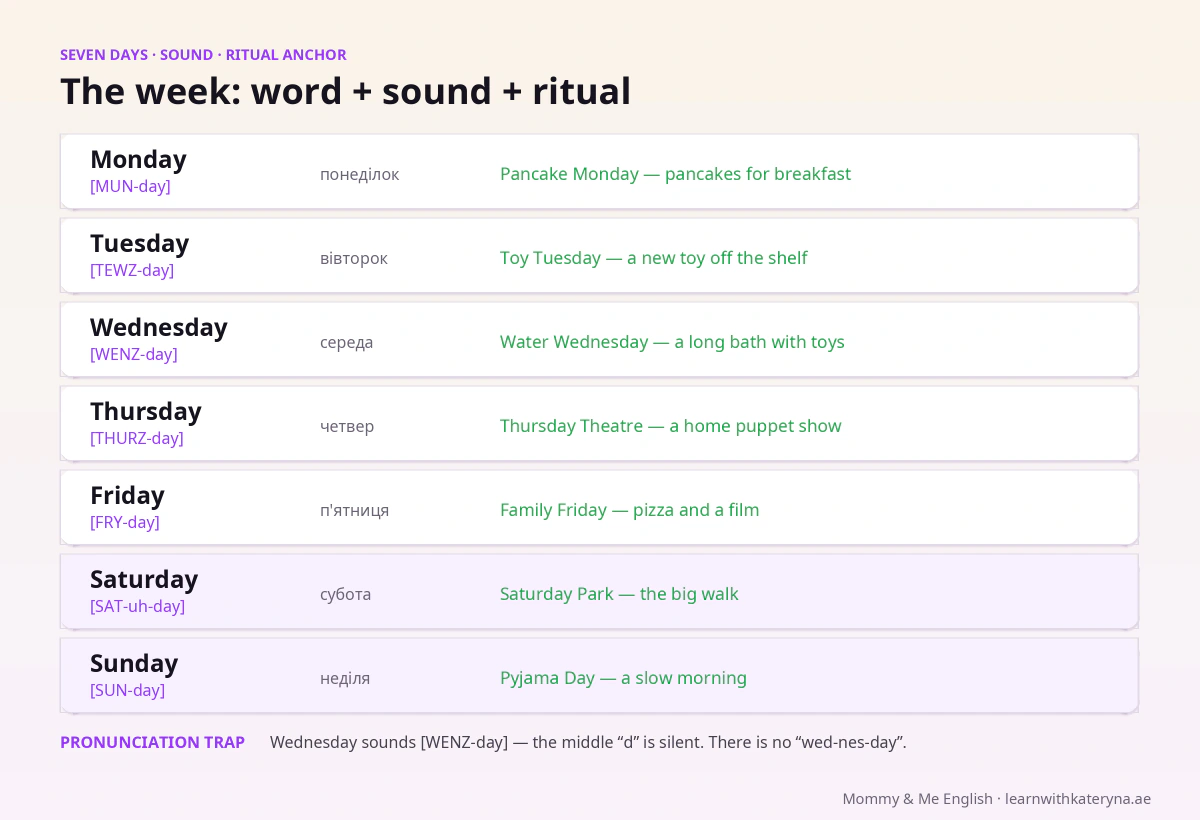
The seven days
| Day | Ukrainian | Ritual anchor (example) |
|---|---|---|
| Monday | понеділок | Pancake Monday — pancakes for breakfast |
| Tuesday | вівторок | Toy Tuesday — a new toy comes off the shelf |
| Wednesday | середа | Water Wednesday — a long bath with toys |
| Thursday | четвер | Thursday Theatre — a home puppet show |
| Friday | п'ятниця | Family Friday — pizza and a film together |
| Saturday | субота | Saturday Park — the big walk |
| Sunday | неділя | Sunday Pyjama Day — a slow morning in pyjamas |
Two pronunciation traps for Ukrainian-speaking families. First — Wednesday: long in writing, short in speech — [wenz-day], the middle "d" is silent. Don't teach "wed-nes-day" — that pronunciation doesn't exist. Second — Tuesday/Thursday: they start differently, but children (and adults) mix these two up most of all. Keep their rituals as contrastive as possible.
A small detail that isn't small: the capital letter
In Ukrainian, days of the week are lowercase: понеділок, субота. In English they are always capitalised: Monday, Saturday. For a toddler who doesn't read yet this doesn't matter — but keep it in mind for later: when writing starts at 5–6, this is exactly where Ukrainian children make a systematic error. If you make a home "week calendar" (and below I'll explain why you should), write the days correctly capitalised from the start. The child's eye will get used to the right picture long before the first writing lesson — the same way it gets used to letters through the alphabet in daily life.
The "day = ritual" method
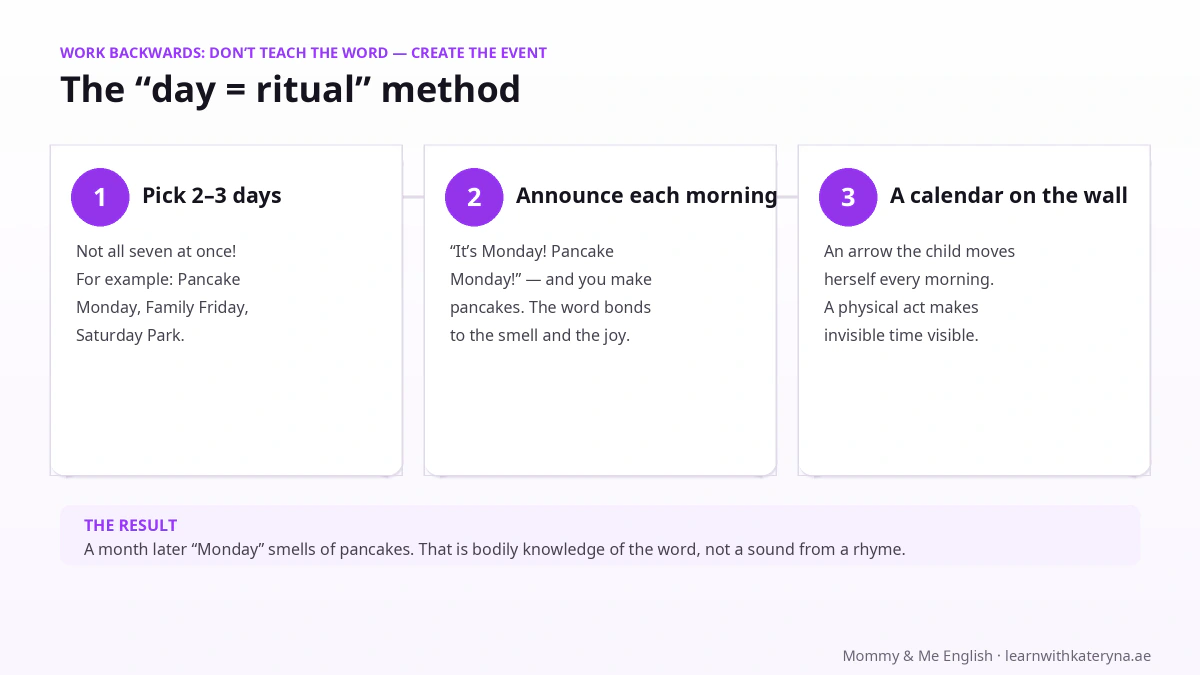
Here is the topic's core secret: a child memorises not the names of days but the events that repeat. For a toddler, "Saturday" is not the seventh day of the week — it is "the day we go to the park." So we work backwards: we don't teach the word Saturday, we create a Saturday ritual and name it in English.
In practice: pick two or three days (not all seven at once!) and tie a small repeating joy to each: Pancake Monday, Family Friday, Saturday Park. On those mornings, announce: "It's Monday! Pancake Monday!" — and make the pancakes. A month later, hearing "Monday," your child will remember the smell of pancakes — and that is real, bodily knowledge of the word, not a sound from a rhyme.
Add a wall week calendar: seven pockets or circles and an arrow or clothes-peg the child moves herself every morning. The physical act of "moving the arrow" makes invisible time visible and movable. It is the same principle as the daily English rituals: don't teach — embed into life.
Today, tomorrow, yesterday: three words worth more than seven
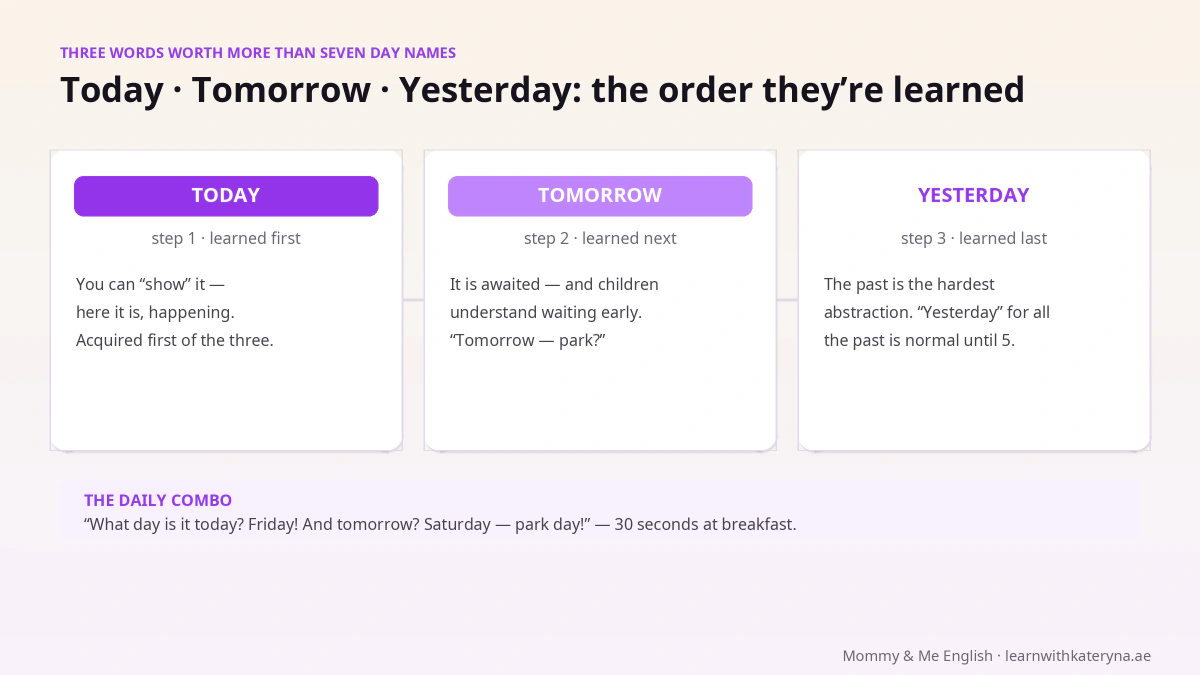
The paradox of the topic: three "auxiliary" words bring a child more value than all seven day names. Today, tomorrow and yesterday are the words a toddler actually uses: "Tomorrow — park?" asks a four-year-old, and that is already a real conversation about time.
The acquisition order is always the same — build it into your expectations: first today (it can be "shown" — here it is, happening), then tomorrow (it is awaited — and children understand anticipation early), and only last yesterday (the past is the hardest of the three abstractions). A three-year-old who says "yesterday" about everything that ever happened — from yesterday's ice cream to last year's seaside — is normal, not wrong. "Yesterday" will narrow down to the actual yesterday on its own, closer to five.
The daily working combo: "What day is it today? It's Friday! And tomorrow? Saturday! Park day!" — thirty seconds at breakfast that cover the entire topic.
Parent bonus: the day of the sun and the day of the moon
This knowledge is for you, not the child: word history anchors words in adult memory beautifully, and you will stop mixing up Tuesday and Thursday. English weekdays are a small museum of mythology: Sunday — the Sun's day, Monday — the Moon's day, Tuesday — the day of Tiw, god of war, Wednesday — Woden's day (there's your silent "d"!), Thursday — Thor's day, god of thunder, Friday — the day of Freya, goddess of love, Saturday — Saturn's day.
With a 5+ child you can tell this as a fairy tale: "Thursday is the day of the giant with the hammer who makes thunder!" Children adore "secret stories hidden inside words" — and a Thursday with a thunder god living in it is remembered forever.
The song that does half the work
The topic's biggest hit is "Days of the Week" to the Addams Family tune (with the double finger snap: "Days of the week — *snap-snap*"). It is the fastest way to lay the seven-day order into memory: the snap creates a hook-pause children await with delight, and the melody holds the sequence tighter than any repetition.
Use the song through the same levels as every teaching song: first just listen and snap together, then sing with gaps ("Monday, Tuesday, …?" — the child fills in), then the child leads and you snap. The full method of working with songs is in the guide to English songs for kids.
Building an English routine at home? The free Mommy & Me English starter guide lays out the daily rituals step by step.
6 days-of-the-week games
1. The day arrow. A wall circle of seven sectors — every morning the child moves the peg and announces: "Today is Tuesday!" The topic's main game, 20 seconds a day.
2. The week train. Seven carriages (blocks, toy cars) in a row — each "carries" its day. Monday always first, Sunday always last. The order becomes a physical row you can touch.
3. "Which day is missing?" For 4.5+: day cards in a row, the child closes her eyes, you hide one. "What's missing?" Trains the order better than recitation ever will.
4. Day in reverse. You name the day — the child names what happens on it: "Saturday!" — "Park!" Then flip it: "Pancakes?" — "Monday!" The day=event link in both directions.
5. Day-island jumps. Seven sheets of paper on the floor — day "islands." "Jump to Friday!" The child jumps, hunting for the right one. Movement + order + first-letter reading (for 5+) — three skills in one game, in the spirit of the TPR method.
6. The weekend planner. For 5+: on Friday you "plan" the weekend together, saying it aloud: "Saturday — park. Sunday — grandma!" A child who plans is using weekdays for their real purpose — the highest level of owning the topic.
Weekend and weekdays: two umbrella words
Long before a child can tell all seven days apart, she will easily master the week's halves: weekdays and the weekend. This split a toddler feels with her body well before any names: weekdays mean nursery and the morning rush; the weekend means mum at home and a slow breakfast.
That is why weekend is often the first "calendar" word a child starts using unprompted: "Is it weekend?" asks a three-year-old on Friday evening — and that question shows deeper time understanding than a recited seven-day rhyme ever could. Support it with marker phrases: "It's a weekday — nursery day!" and "It's the weekend — pancake morning!"
For a four-year-old, add the counting game "How long until the weekend?": "Today is Wednesday. Thursday, Friday… TWO days until the weekend!" It is the first practical use of counting towards the future — and it drills the day names with the most natural motivation there is: waiting for Saturday.
A DIY week calendar: step by step
I have mentioned the wall calendar several times — here is the full build, because a homemade one beats a bought one: what a child made with her own hands, she uses ten times more willingly.
You need: a large sheet (A3 or a strip of wallpaper), 7 coloured circles or squares, markers, a clothes-peg or cardboard arrow, and photos or drawings of your rituals.
Step 1. Arrange the seven fields in a circle (not a row! — the circle shows that the week repeats, which is the single main idea the calendar must carry). Step 2. Label the days in English — capitalised, as they should be: Monday, Tuesday… The child won't "read" them, but the eye gets used to the correct picture. Step 3. Glue each day's ritual symbol next to it: a pancake on Monday, a tree (park) on Saturday, pyjamas on Sunday. The symbols, not the words, are what make the calendar "readable" for a child. Step 4. The peg marks today. Every morning the child moves it one field forward herself and announces: "Today is…!"
Two field-tested details. First: hang the calendar at the child's eye level, not yours — it is her instrument. Second: on Sunday evening, do the "full circle": run a finger from Monday to Sunday — "Monday, Tuesday… and Sunday — and then Monday AGAIN!" That "Monday again" moment is the understanding of cyclicity the whole project exists for.
What comes next: seasons and months
Once the week works (usually at 4.5–5), the natural question arises: what about months? Seasons? A short map so you don't overload:
Seasons before months. Winter, spring, summer, autumn are not abstractions but sensory experience: snow, puddles, heat, yellow leaves. Introduce them through the window and the walk ("Look, snow! It's winter!"), through clothes ("It's cold — winter jacket!") and seasonal treats. A four-year-old holds four seasons easily, because each one has a taste, a smell and a colour.
Months last — and not all of them. Twelve abstract names in a row are material for age 5–6, and even then only two or three are genuinely needed at first: the child's birthday month ("My birthday is in May!"), December (presents!), and the current one. The rest glue themselves on at school with no effort at all.
And the thread that stitches it all together: the question "What day is it today?" gradually widens — "What season is it? Is it cold or warm?" That is how the calendar topic grows from seven words into a full conversation about time and the world — by the same small daily steps as the whole rituals system.
The child's schedule: the week becomes conversation
The topic's summit is when the days of the week stop being a calendar and become a language for talking about the child's own life. For a nursery-age child it looks like this:
The morning tune-in: "Today is Tuesday. Nursery day! Who will you see? Your teacher! Your friends!" A child who knows what awaits her walks into the day calmer — and English becomes the language of that predictability.
The evening recap: "Today was Tuesday. You went to nursery… you played… you sang! And tomorrow? Wednesday — swimming day!" The "film of the day," familiar from the verbs topic, now gets a calendar frame — training the past (today was), the future (tomorrow) and the day names at once, in the most natural context there is: talking about one's own life.
Weekly planning with a 5+ child: on Sunday, sit by the calendar and "walk" the week: "Monday — nursery. Tuesday — nursery and swimming. Saturday — grandma!" A child who takes part in the planning, first, holds the week's structure without any memorising, and second, gains the sense of control over her own time that psychologists count among the foundations of confidence. Language does double duty here: teaching words and building the child's relationship with time.
And the finishing touch — the "wrong schedule" for laughs: "Today is Saturday. Nursery day!" — "NO! Park day!" A child who corrects your schedule owns the topic completely — the same check as in every other topic, and just as much fun.
4 parent mistakes
1. Demanding the order from a three-year-old. Reciting seven days in a row is rhyme memory, not time comprehension. Don't push and don't worry: the weekly cycle "clicks" at 4–5 — and with rituals, earlier than without.
2. Teaching all seven days at once. Seven abstractions in one go is guaranteed overload. Two or three ritual days to start; the rest glue themselves on through the song and the calendar.
3. Skipping today/tomorrow/yesterday. Day names without these three words are a dead list. It is "What day is it today?" that turns the topic into a living daily conversation.
4. Teaching "wed-nes-day." Wednesday sounds [wenz-day] — the middle "d" is silent. Check pronunciation with the speaker button in Google Translate before cementing a non-existent variant.
Next steps
Start with three things this week: pick two ritual days (say, Pancake Monday and Saturday Park), hang a homemade week circle with an arrow, and put on the snapping song. A month later add the morning "What day is it today?" — and the topic starts living on its own. Days of the week land best when the basics already work: if you haven't covered the everyday phrases and numbers yet, start there and leave the week for year four or five.
The ready-made system — video lessons, audio, a printable week calendar and a day-by-day plan — is in the Mommy & Me English starter guide: 10 minutes a day with mum in the leading role.


