 Kateryna Ivanova

There is a moment almost every mother teaching English at home hits somewhere in the second week. It is about four in the afternoon. You have said "Let's go", "Good girl", "Where is your shoe?" and "Time for lunch" so many times that the words have gone flat in your mouth. Your child is on the floor with a plastic dinosaur. You want to speak English to her. You open your mouth — and nothing comes.
So you fill the silence in Ukrainian, and you feel the small drop in your chest that means I am not doing this properly.
I have been teaching English to children for over nine years, and I have coached hundreds of mothers through exactly this. Here is what I have learned: the mothers who keep going are not the ones with better English. They are the ones who stopped trying to remember phrases and learned to generate them instead.
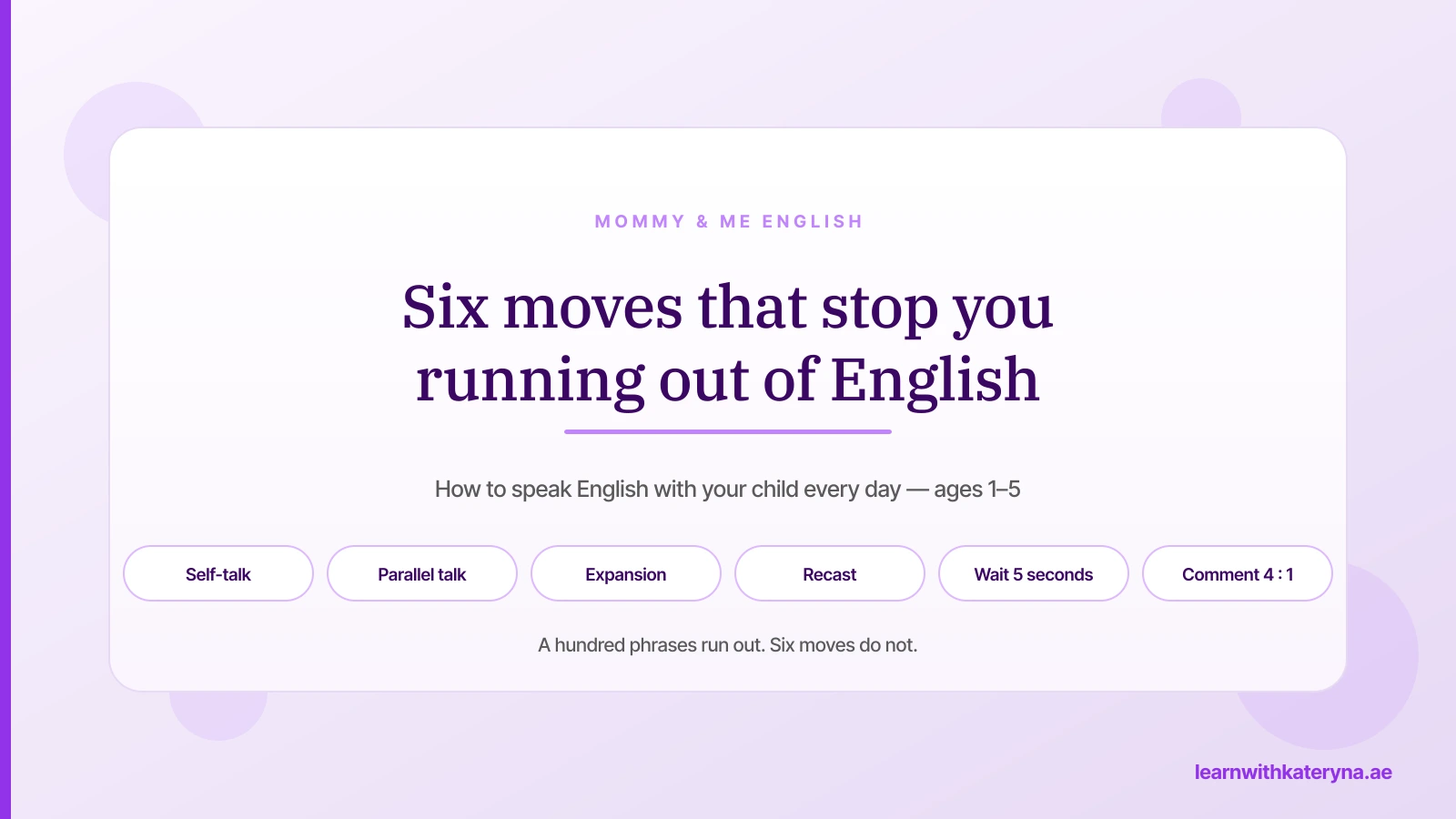
There is a difference between knowing a hundred phrases and knowing six moves. A hundred phrases run out. Six moves do not.
Quick answer
To speak English with your child every day without running out of words, stop hunting for phrases and use six repeatable moves: describe what you are doing (self-talk), describe what your child is doing (parallel talk), add one word to whatever they say (expansion), say their sentence back correctly inside your reply (recast), wait five seconds after you speak, and comment more than you question. Aim for back-and-forth turns, not word count — children with more conversational turns show stronger language skills and greater activity in the brain's language region than children who simply hear more words (Romeo et al., Psychological Science, 2018). Four daily rituals of six minutes each is enough to build a real English environment at ages 1–5.
Why you run out of words by 4pm
You are not running out of English. You are running out of script.
Most advice for parents teaching English at home hands you a list: 50 phrases for the morning, 30 for mealtimes, 20 for the bath. Lists are useful — I have written one myself, and you can take the phrases from it here — but a list is a finite resource. You spend it. Once the morning list is gone by nine o'clock, the rest of the day is silence with a guilty conscience attached.
Native-speaking parents do not work from lists. They do something structurally different: they attach language to whatever is physically in front of them. The dinosaur on the floor is a sentence. The wet sleeve is a sentence. The child reaching for the wrong cup is three sentences. They are not remembering language, they are producing it from the room.
That skill is not a talent, and it is not fluency. It is a small set of techniques that speech and language therapists teach parents of late-talking children every day, and that early-years teachers are drilled in during training. I learned them twice — once studying speech therapy, and again on the Trinity College London CertTESOL and the NILE Young Learners course. They transfer to a second language almost unchanged.
The reframe that makes the rest of this article work is this: your job is not to teach English. Your job is to keep a conversation going in English. The teaching happens inside the conversation, by itself.
The number that matters more than your vocabulary
For twenty years, the headline advice to parents was talk more. It came from the famous "30-million-word gap" study, and it produced a generation of parents anxiously counting words. That study is now heavily contested — a 2019 replication attempt by Sperry and colleagues found far more variation inside social groups than between them, and argued the original research undercounted speech from grandparents, siblings and bystanders.
The argument that followed clarified something far more useful for you. What predicts a child's language is not the number of words in the room. It is the number of words directed at the child, and above all the number of times the child gets a turn.
The clearest evidence comes from a 2018 study at MIT and Harvard. Researchers recorded 36 children aged four to six at home, counted their conversational turns, then scanned their brains while they listened to stories. Children who took more turns scored higher on vocabulary, grammar and verbal reasoning — and showed stronger activation in Broca's area, the brain's language production region. Crucially, turn-taking predicted these outcomes far better than the raw number of words heard, and the effect held regardless of family income or parental education.
A second line of work makes the practical point even sharper. At the University of Washington, Naja Ferjan Ramírez, Sarah Roseberry Lytle and Patricia Kuhl coached one group of parents in how to talk to their babies and left a control group uncoached. By 18 months, children of coached parents had roughly 100 words in their vocabulary against about 60 in the control group (PNAS, 2020). Nobody bought a curriculum. The parents simply changed how they spoke.
And in a study specifically about a second language, Ferjan Ramírez and Kuhl gave children aged 7 to 33 months one hour a day of play-based English for 18 weeks. By the end, those children were producing an average of 74 English words and phrases per child per hour, against 13 in the control group.
What this means for you
Your English does not have to be rich. It has to be aimed at your child and structured so they answer. A mother with 300 English words who gets 40 turns out of her toddler at breakfast is doing more for that child's English than an audio course playing in the background all day.
The six moves that generate language
These are the six. Each one takes a situation and turns it into speech, which means you never need to have prepared anything. Learn them in order — the first two do most of the work.
Move 1 — Self-talk: describe what you are doing
You narrate your own actions out loud, in short sentences, as you do them. You are not talking to your child so much as talking near her, in her hearing, about things she can see happening.
"I'm washing the cup. Hot water. The cup is clean. Now I put it here. Done."
This feels absurd for about three days and then it becomes automatic. It is the single highest-yield habit in this article, because it works when your child is not looking at you, not answering, or not talking yet. It also solves the blank-mind problem completely: you always know what you are doing, so you always have something to say.
Move 2 — Parallel talk: describe what your child is doing
The same move, pointed at her instead of you. You become the commentator on her play.
"You've got the blue one. You're putting it on top. Oh — it fell. You're picking it up again. Up it goes."
Parallel talk is more powerful than self-talk for one reason: it labels the thing your child's attention is already on. Vocabulary sticks when the word arrives at the same moment as the object, and the surest way to guarantee that is to let your child choose the object and you supply the word. This is exactly what the Harvard Center on the Developing Child calls serve and return — share the focus, then name it.
Move 3 — Expansion: add one word
Whatever your child says, say it back with one or two elements added. Not a correction — an extension.
| Your child says | You say | What you added |
|---|---|---|
| "Car." | "A big car!" | An article and an adjective |
| "Big car." | "A big red car is coming." | Colour, verb, tense |
| "Doggy run." | "The doggy is running fast!" | Article, auxiliary, -ing, adverb |
| "Want that." | "You want the yellow spoon." | Subject, specific noun |
The rule of thumb from language therapy is one step above where your child is. If she uses single words, you answer in two. If she uses two, you answer in three or four. Reply far above her level and the sentence becomes noise; reply at her level and she learns nothing new.
Move 4 — Recast: give the correct form inside your reply
Your child says something wrong. You answer the meaning, and the correct version simply appears in what you say back.
Child: "I want apple." — You: "You want an apple? Here's an apple."
No "say it properly", no repetition drill, no pause. Your child hears the right form at the exact moment she is thinking about the meaning, which is when it is most likely to be absorbed. Direct correction buys a little accuracy at the cost of willingness to speak, and at ages 1–5 willingness is the scarce resource. I have written about this in full in should you correct your child's English mistakes.
Move 5 — The five-second wait
This is the move mothers skip, and it is the one that produces turns.
After you say something, stop. Count to five in your head. Look at your child with an expectant face and say nothing at all.
Adults typically leave about one second before filling a silence. A two-year-old processing a second language needs considerably longer — the word has to be recognised, understood, and a response assembled, all in a language she uses a fraction of the time. Most "my child never answers in English" problems are, in practice, waiting problems. Give five seconds and a surprising number of children answer at second four.
Move 6 — The open hand: comment more than you question
The instinct of every teaching parent is to quiz: "What's this? What colour is it? How many? What does the cow say?" Test questions have one right answer, and every one your child cannot answer is a small failure inside what should be play.
Comments invite; questions examine. Aim for roughly four comments to every one question, and when you do ask, prefer questions that cannot be got wrong.
| Instead of the test question | Try the open one |
|---|---|
| "What colour is this?" | "Ooh, I like this red one." |
| "How many apples?" | "Let's count them — one, two…" |
| "What's this called?" | "You found the spoon!" |
| "Say 'thank you'." | "Thank you, Mummy — that's what I say." |
| "Do you want juice?" | "Juice or water?" (a real choice, two words to copy) |
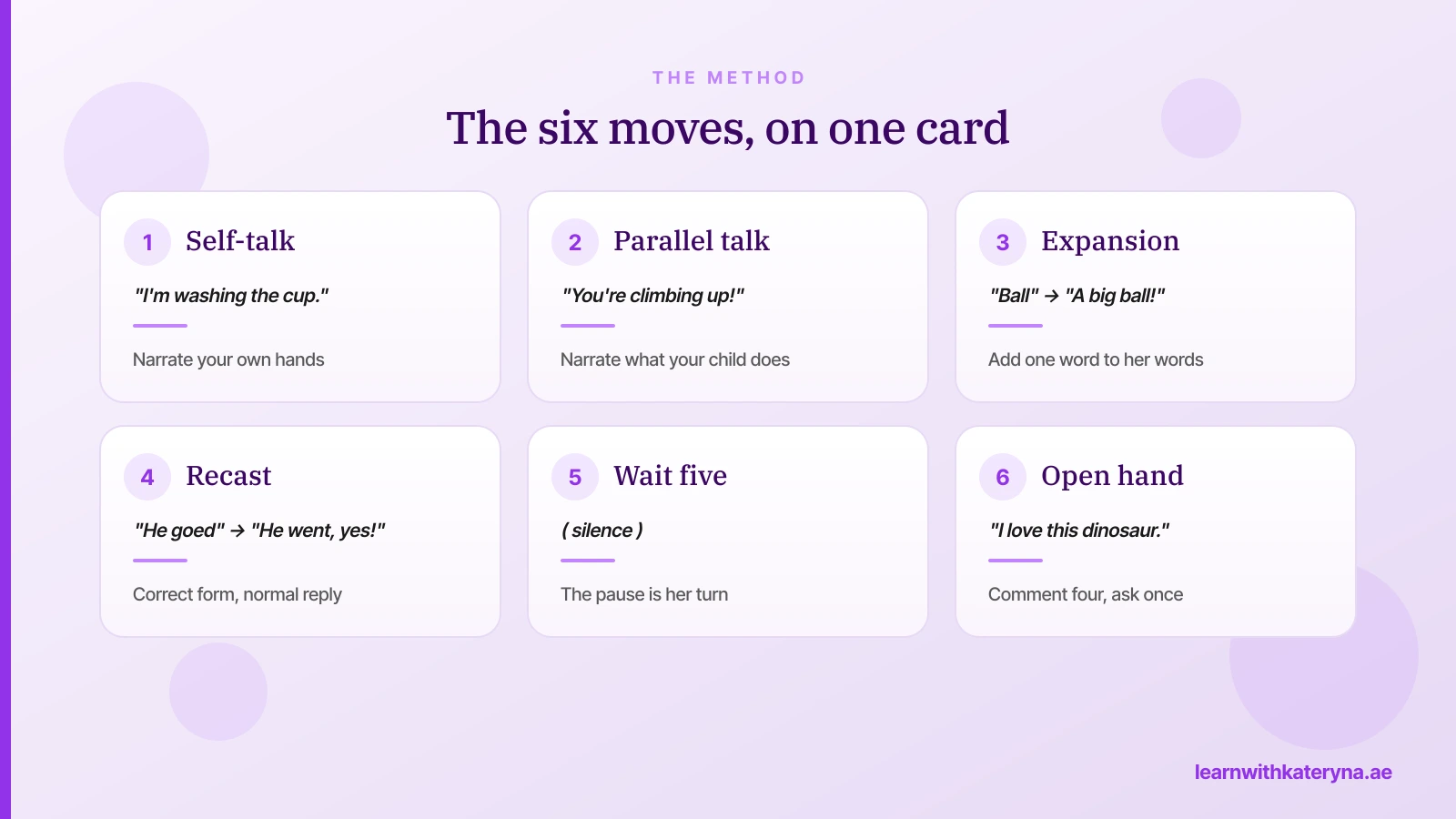
The six moves on one card
| Move | What you do | Example | What it builds |
|---|---|---|---|
| 1. Self-talk | Narrate your own actions | "I'm cutting the bread." | Verbs, sentence rhythm, input when your child is silent |
| 2. Parallel talk | Narrate your child's actions | "You're climbing up!" | Vocabulary attached to their attention |
| 3. Expansion | Add one element to what they said | "Ball" → "A big ball!" | Longer sentences, grammar |
| 4. Recast | Correct form inside a normal reply | "He goed" → "He went, yes!" | Accuracy without cost to confidence |
| 5. Five-second wait | Stop and look expectant | (silence) | Turns — the thing that predicts outcomes |
| 6. Open hand | Comment 4×, question 1× | "I love this dinosaur." | Willingness to speak |
How you say it: parentese is not baby talk
The delivery matters as much as the content, and there is a specific style that works. It is called parentese, and it is not the same thing as baby talk.
- Baby talk uses invented words and broken grammar: "oo want da wa-wa?" It gives your child nothing to learn from.
- Parentese uses real words and correct grammar, delivered with a higher pitch, a slower tempo and exaggerated, sing-song intonation: "Doooo you want some waaater?"
In the Washington research, parentese was the mechanism: coached parents used more of it, that pulled more responses out of their babies, and more responses meant more turns. The higher pitch and slower tempo act as a social signal — this is for you, and it is your go next.
For a mother speaking a second language, parentese has an extra advantage that nobody mentions: the slower tempo hides an accent and buys you thinking time. Stretching your vowels and leaving space between phrases makes your English clearer to your child and easier for you to produce. If your pronunciation worries you, the effect is far smaller than you fear — here is what actually matters and what does not.
What a real day sounds like: four transcripts
The moves are abstract until you hear them run. Below are four ordinary moments with a two-and-a-half-year-old. Each one takes about six minutes. Notice how little vocabulary is involved — and how many turns.
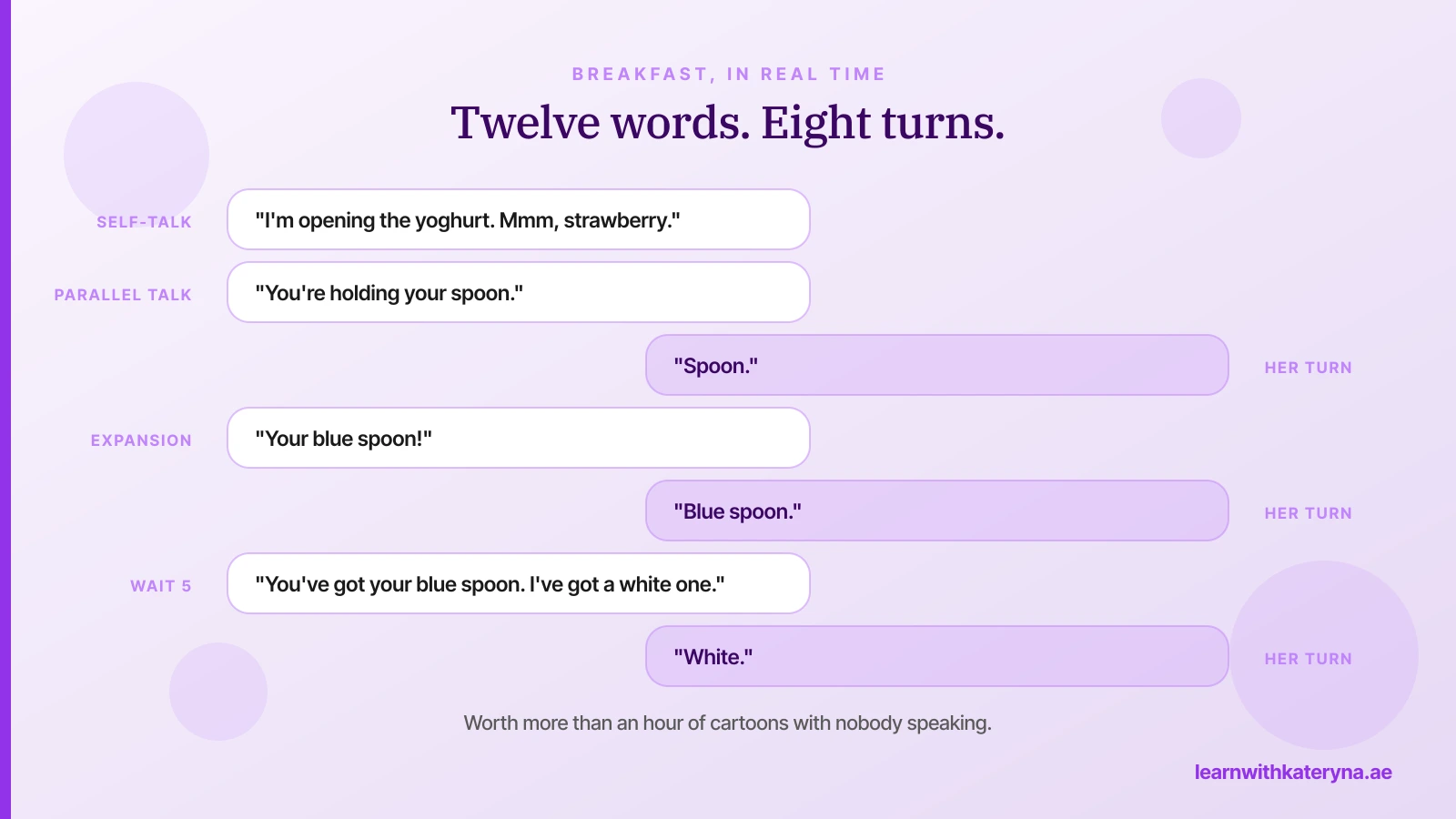
Breakfast (self-talk + parallel talk + expansion)
You: "I'm opening the yoghurt. Mmm, strawberry." (self-talk)
You: "You're holding your spoon." (parallel talk) [wait five]
Child: "Spoon."
You: "Your blue spoon!" (expansion) [wait five]
Child: "Blue spoon."
You: "You've got your blue spoon. I've got a white one." [wait]
Child: (points) "White."
You: "White, yes. Big white spoon for Mummy."
Vocabulary used: about twelve words. Turns produced: eight. That single exchange is worth more than an hour of English cartoons playing while nobody speaks.
Getting dressed (routine language + real choices)
You: "Time to get dressed. Socks first." (routine phrase, same every day)
You: "The red socks or the white socks?" (a choice — two words to copy) [wait five]
Child: "Red."
You: "The red socks. Good choice. One foot… two feet." (expansion + counting inside the action)
Child: "Two feet!"
You: "Two feet in two socks. Now the T-shirt. Arms up!"
Choices are the cheapest turn-generator in English. Every choice you offer hands your child two ready-made words and a reason to use one.
The walk (parallel talk at pace)
You: "You're running! Fast, fast, fast."
Child: "Doggy!"
You: "A big doggy. The doggy is walking." (expansion) [wait]
Child: "Doggy walking."
You: "The doggy is walking with his man." (recast + one more element)
Child: "Bye doggy."
You: "Bye-bye, doggy! See you tomorrow."
Bath (repetition inside a fixed ritual)
You: "Bath time! In you go. Splash, splash." (the same three phrases every night)
You: "Where's the duck? …I can't see the duck." [wait five]
Child: (holds it up) "Duck!"
You: "There he is! The yellow duck was hiding."
You: "Wash your tummy. Wash your toes. All clean."
Bath time is the best place to start, because it is short, physically bounded and identical every night. Repeated language inside a repeated routine is how the first words arrive. If you want the full set of rituals mapped across the day, that is what the daily English rituals guide covers.
What to do the second you don't know a word
This is the fear that stops most mothers before they start, and it deserves a straight answer: you will not know some words, and it will not matter, because you have five ways out and all of them are legitimate.
- Substitute upward. You do not know "colander"? Say "the thing with the holes" or simply "this". Children learn general words before specific ones anyway. "Bowl" is more useful to a three-year-old than "colander".
- Describe the action instead of the object. If the noun is gone, use the verb: "I'm pouring the water out. Look, the water is going away." Verbs carry more meaning than nouns at this age.
- Say it in Ukrainian and move on. One word in Ukrainian inside an English sentence does not undo anything. Stopping the conversation does.
- Look it up in front of your child. "I don't know that word. Let's find out." This is not a failure — it is the single best model of a learner you will ever give her, and children of parents who do this openly are noticeably less afraid of not knowing.
- Keep a pocket list. Three words a week, written on the fridge, chosen from moments where you got stuck yesterday. Fifteen minutes of preparation a week removes almost every blank you will hit.
If your English feels genuinely limited rather than just rusty, that is a smaller obstacle than it feels — you do not need to be fluent to do this explains why, and what the minimum actually is.
How many minutes actually count
Two numbers circulate and they appear to contradict each other. Teaching organisations say ten to fifteen minutes a day is plenty for a toddler. Researchers talk about an hour a day, or 30% of waking hours, or a 60% exposure threshold for a bilingual child to match monolingual peers on language tests.
Both are right, because they are counting different things.
| What is being counted | Realistic target | What it looks like |
|---|---|---|
| Focused "lesson" time — a book, a song set, a game | 10–15 minutes a day | One story or three songs. More than this and a toddler's attention is gone |
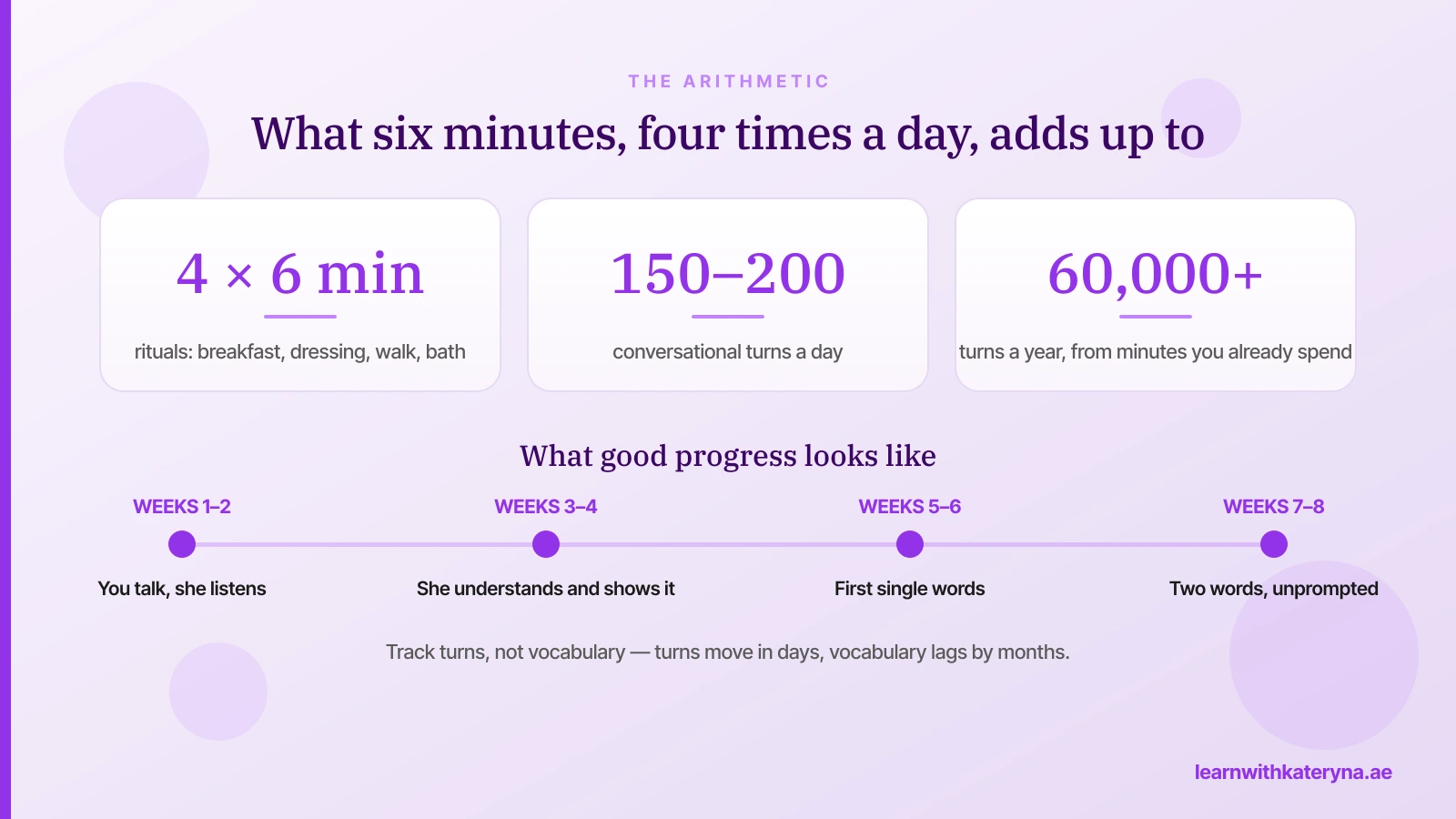
| Directed speech — you talking to your child in English, in and around activity | 20–40 minutes a day, split across rituals | Four rituals × 6 minutes: breakfast, dressing, walk, bath |
| Total exposure — everything in English including songs and passive audio | 1 hour+ where possible | The above plus songs in the car and a story at bedtime |
| Exposure needed to match a monolingual peer on standardised tests | ~60% of waking hours | Not the goal here, and not required for a strong bilingual foundation |
The arithmetic that matters is the middle row. Four rituals of six minutes each, with the six moves running and a five-second wait after every prompt, produces somewhere near 150–200 conversational turns a day — roughly 1,200 a week, more than 60,000 a year. That is a language environment, built out of minutes you were already spending.
What does not count: audio playing in a room where nobody is speaking to your child. The Sperry–Golinkoff debate settled this much for parents, whatever else it left open — speech directed at the child is the active ingredient. Background English is not harmful, it is just not the thing doing the work.
If you have ten minutes, not forty
Pick one ritual and make it fully English every single day, rather than spreading five minutes thinly across four. Consistency inside one routine beats scattered effort, because your child learns to expect English at a particular moment and starts arriving ready for it. If your day is genuinely full, the 12-minute day for working mothers is built for exactly that constraint.
The same six moves at 1, 2, 3, 4 and 5
The moves do not change with age. What changes is the ratio between them and what you expect back.
| Age | Lead with | What to expect back | Watch out for |
|---|---|---|---|
| 1–2 | Self-talk and parallel talk, single words, heavy parentese | Gestures, pointing, sounds, first words. Understanding runs far ahead of speech | Expecting speech. Do not. Comprehension is the whole job at this stage |
| 2–3 | Parallel talk plus expansion. Two-word answers. Choices | Single words and two-word phrases, lots of repeating after you | Repeating-only is normal and is the stage before speaking, not a dead end |
| 3–4 | Expansion and recast. Real questions start to work | Short sentences, invented forms like "goed" and "foots" — a sign of rule-learning | The refusal phase. If it appears, handle it by lowering the stakes, not raising them |
| 4–5 | Open questions, storytelling, past and future tense | Connected talk, opinions, "why" questions of their own | Drifting into quizzing. Keep the 4:1 comment-to-question ratio |
If you want the milestones themselves rather than the technique, the age-by-age roadmap lays out what to teach at each stage, and the progress guide gives you a home check for whether it is working.
Seven habits that shut a conversation down
- Quizzing. "What's this? And this? What colour?" Three test questions in a row will end most conversations with a two-year-old. Comment instead.
- Filling the silence. You ask, your child pauses, you answer for her. The pause was where her turn was going to be.
- Asking for repetition. "Say it. Say 'apple'. Say it for Mummy." This converts play into performance, and performance is where refusal is born.
- Switching to Ukrainian the moment she does. Your child answering in Ukrainian is normal and expected. Stay in English, answer her meaning, keep going. She is still receiving the input.
- Talking far above her level. Long, complex sentences stop being learnable and become background noise. One step above where she is, no more.
- Only doing English during "English time". Twenty minutes of lesson followed by silence for the rest of the day teaches your child that English is an activity, not a way of speaking to you.
- Making her perform for other people. "Show Grandma how you count in English." The cost of one bad performance in front of an audience can be weeks of quiet.
The 14-day plan: one move at a time
Do not attempt six moves on Monday. Add one every two days and let each become automatic.
| Days | Add this | Where to practise it |
|---|---|---|
| 1–2 | Self-talk only | While cooking and tidying. Ten sentences about what your hands are doing |
| 3–4 | Parallel talk | Ten minutes of floor play. Commentate, do not direct |
| 5–6 | The five-second wait | Every question you ask. Count silently on your fingers if you need to |
| 7–8 | Expansion | Mealtimes. Add one word to everything she says |
| 9–10 | Recast | All day. Never ask her to repeat the corrected form |
| 11–12 | The 4:1 comment ratio | Count your questions for one ten-minute play session. Most mothers are shocked |
| 13–14 | All six inside one fixed ritual | Bath or breakfast. Same time, same phrases, every day |
How to know it is working
Vocabulary is a lagging indicator — it moves months after the behaviour that produced it. Turns move within days, which makes them the thing to watch.
The three-minute recording. Once a fortnight, put your phone face-down on the table during breakfast and record three minutes. Later, count two things: how many times you spoke, and how many times your child responded in any form — a word, a sound, a gesture, a look. That second number is your score.
What good progress looks like over eight weeks, roughly:
- Weeks 1–2: your own talking increases; your child mostly does not respond. This is the normal shape of the start.
- Weeks 3–4: non-verbal responses appear — pointing, bringing you the object you named, following an English instruction. This is comprehension arriving, and it is the real milestone.
- Weeks 5–6: single words, usually the ones tied to a ritual. "Bath." "More." "Shoes."
- Weeks 7–8: two-word combinations, spontaneous rather than prompted.
If your child understands but will not produce, that is not failure — it is a documented stage with its own name, and it has a specific way through it.
If you take one thing
Stop trying to remember what to say. Describe what is happening, add one word to whatever your child says, and then wait five seconds. Those three habits alone will carry a mother with modest English further than a fluent parent who quizzes.
Frequently asked questions
These are the questions mothers bring me most often once they start. The thread running through the answers is the same: your child needs turns far more than she needs your vocabulary, and turns are something you can produce today.
Where to go next
For the raw material to run these moves with, 100 everyday phrases for parents gives you the phrases and the daily rituals guide gives you the slots to use them in. If play is where you want to start, games that teach English is the practical companion to this article. My free starter guide has ready-made phrases for each moment of the day — get it here — and Mommy & Me English is the full course that teaches these six moves inside real filmed rituals, so you can see them run before you try them.


