
 Kateryna Ivanova
A mother wrote to me in March, and I could hear the worry in how carefully she built the sentence. Her daughter, three and a half, had been doing English with her since Christmas. "She repeats everything. Everything I say, she says back — beautifully, better than me. But she has never once said an English sentence that I didn't say first. I think I have taught her to be a parrot."
Then came the line that told me exactly where she had spent the previous evening: "I looked it up, and now I'm frightened."
I want to take the frightening part first, because it is the reason this article exists at all. Type "my child only repeats what I say" into a search box and you will get echolalia. You will get autism screening checklists, speech-delay warning signs, and clinical pages from hospitals and speech therapy practices. Almost every one of those pages is written about a child's first language — about a child who repeats instead of communicating, in the only language they have.
That is not what is happening at your kitchen table. Your child has a first language. They communicate in it all day. What they are doing in English is something else entirely, and it has its own research literature, and it says something close to the opposite.
Quick answer
In a second language, repeating is not a symptom — it is the mechanism. Children build a new language out of whole memorised phrases first, then slowly break those phrases apart into pieces they can recombine. Your child is not stuck at the copying stage; copying is the stage before speaking. The job is not to stop the repeating. It is to vary one element at a time until the borrowed phrase becomes a frame your child can fill themselves.
What you are actually seeing
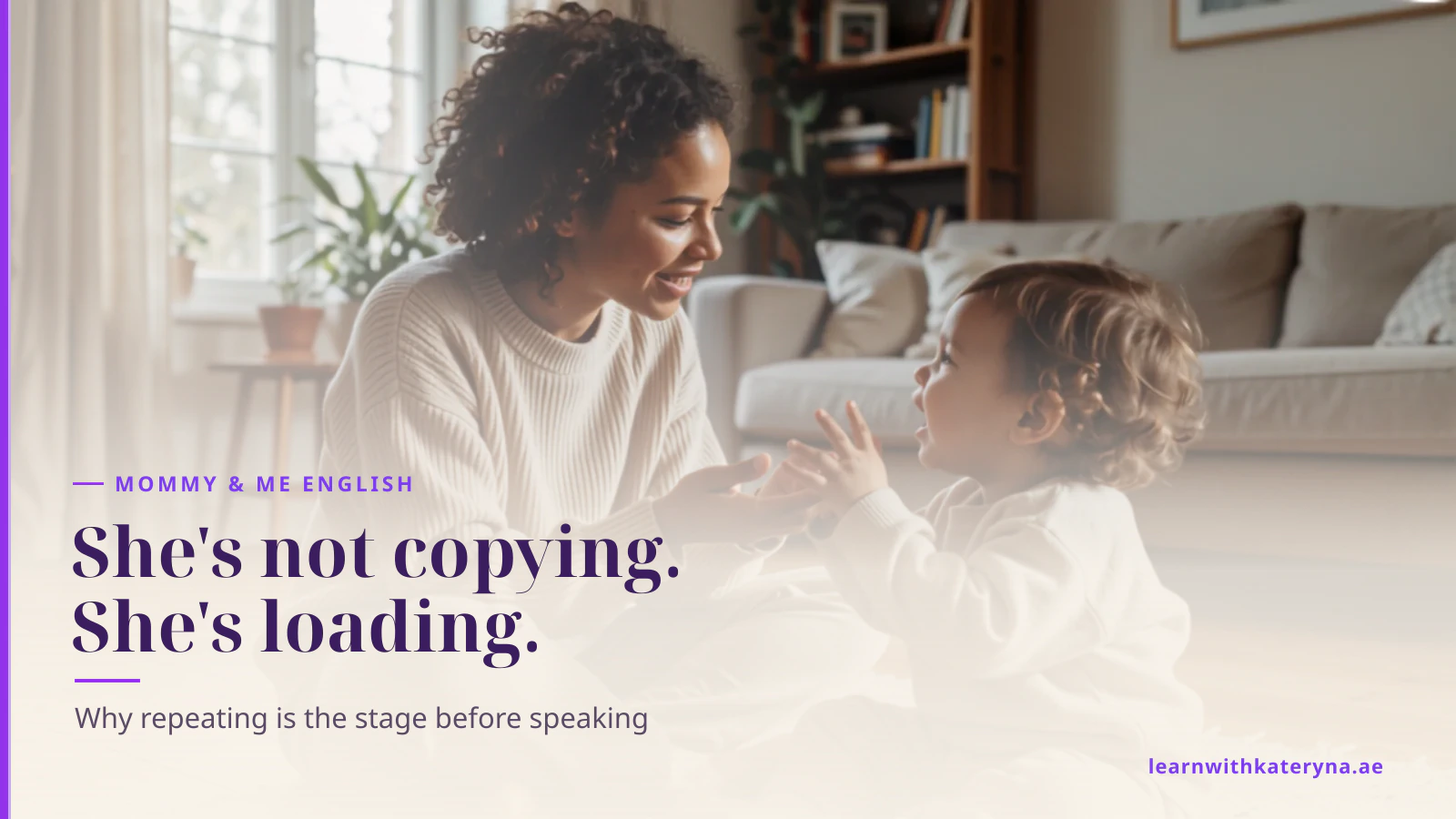
Here is the scene almost every mother describes to me, in nearly the same words. You say "Do you want an apple?" Your child says "Want an apple." You say "Let's put on your shoes." Your child says "On your shoes." It is accurate. The rhythm is right. Sometimes the accent is better than yours. And then you wait to see whether anything comes back that you did not put there first — and nothing does.
What makes this particular worry so heavy is that it looks like evidence of nothing. A child who says no English at all is at least honestly at the beginning. A child who produces fluent-sounding English that is entirely borrowed feels like a trick — like the appearance of progress with none of the substance. Mothers tell me they feel slightly foolish, as if they have been fooled by their own child.
You have not been fooled. You are watching storage. Before a child can build a sentence in a new language, they have to have material to build it out of, and they collect that material in the largest pieces they can hold. A phrase is a bigger, more useful piece than a word — and it comes with its melody, its rhythm and its situation attached. Your child is not failing to produce. They are still loading.
Why repeating is the mechanism, not the problem
The classic work here is Lily Wong Fillmore's, from the 1970s. She followed children who arrived in an English-speaking school with no English, and she found that they did not build the language the way a textbook does — word, then two words, then grammar. They grabbed whole phrases they had heard adults and other children use in specific situations — "I don't wanna," "Lookit," "How do you do dese?" — and used them as single units, with no idea what the pieces inside them were.
Those chunks did two jobs at once. Socially, they let the child stay in the game: a child who can say "I wanna play" gets to play, and gets more input as a result. Linguistically, they became raw material. Over months, the children began to notice that "How do you do dese?" shared something with "How do you do dat?" — and the phrase cracked open along that seam. What had been one lump became a frame with a slot in it.
That is the whole story of this stage, and it is why the repeating matters. The chunk has to exist before it can be broken. A child who has memorised twenty English phrases has twenty things to take apart. A child who has memorised none has nothing.
Recent work on bilingual children points the same way: chunks are not a detour on the road to grammar, they are the road. Researchers analysing early bilingual speech find children recycling and recombining stored patterns long before anything you could call a rule is in place. The grammar grows out of the phrases, not before them.
So when you hear your child return your sentence to you, the honest translation is not "I have nothing of my own." It is "I have got this one. Give me more."
Four kinds of repetition — and what each one means
Not all repeating is the same, and the differences are easy to hear once you know what you are listening for. Over a couple of days, try to notice which of these your child is doing — most children do several.
| Type | What it sounds like | What it means | What to do |
|---|---|---|---|
| Immediate echo | You say it, they say it back within a second or two | Practice. They are running the sound through their own mouth to feel how it works | Nothing. Let it happen, then continue the conversation |
| Delayed chunk | A phrase from yesterday's book or song appears in a new moment | Storage plus retrieval — a genuinely good sign. The phrase has been kept and is being tried out | Respond to it as if it were meant. Extend it by one element |
| Chunk with a swap | "I want milk" becomes "I want banana" | The phrase has cracked open. This is the transition happening in front of you | Feed the slot: offer more things to put in it |
| Filler echo | They repeat your last words while thinking, then answer | Buying time — exactly what adults do in a foreign language | Wait. Do not fill the silence for them |
If you are hearing the third kind at all — even once a week, even clumsily — the stage is already ending. Most mothers who write to me about "only repeating" are, when we look closely, already getting swaps and had not registered them as anything, because a swap sounds like a mistake rather than an achievement.
Why the search results frightened you
It is worth naming precisely what happened when you searched, because otherwise the worry comes back at three in the morning.
The clinical term for repeating another person's words is echolalia, and it is a real and well-described phenomenon. But nearly all the material you found shares a set of assumptions that do not apply to your situation:
- It is about a child's first and only language, not an additional one being learned at home.
- It describes repetition that replaces communication — a child who has no other way to respond, in any language.
- Its age markers are set for first-language development, where a typical child mixes repeated phrases with original words from around 18 to 24 months and moves past heavy repetition by about three.
- Even in that literature, repetition on its own is explicitly not a diagnosis of anything. It is one observation among many.
Your child is at a different starting line. They have been learning English for months, not years, and they have a full language they use to tell you what they want. Judging their English by first-language timelines is like judging a person who started running in January by the standards of someone who has run all their life. The measurements are real; they are just being applied to the wrong runner.
There are things genuinely worth checking, and I have not skipped them — they are further down, in when a check genuinely is worth it. They look nothing like what you are seeing.
From borrowed phrase to own sentence: five steps
The route from echo to original speech is not a single leap. It has recognisable stages, and knowing them lets you see movement in a week where you thought you were seeing none.
| Step | What you hear | What has changed inside |
|---|---|---|
| 1. Whole chunk | "Doyouwantsomemore" as one unbroken lump | Stored as a single unit, attached to a situation |
| 2. Chunk used well | The same lump, but produced at the right moment without you | Attached to meaning and purpose, not just to your voice |
| 3. Chunk with a swap | "Do you want some water" | One position inside the chunk has become a variable |
| 4. Frame plus slot | "I want ___" filled with anything to hand | The pattern is productive: it generates new sentences |
| 5. Free combination | Sentences you have never said in that form | Grammar, built out of the pieces |
Almost every child who is "only repeating" is somewhere between steps one and three. The work of this article is entirely about getting from two to four, and that transition responds very well to a small number of deliberate moves.
The one-word swap test
Before you change anything, spend five minutes finding out where your child actually is. This takes one session and settles the question far better than watching anxiously for a week.
- Pick a phrase your child says often and confidently in English — a favourite from a book, a song line, a routine sentence like "open the door."
- Set up the same situation, and use the phrase yourself with one word changed. If they always say "open the door," stand at the cupboard and say "open the box."
- Then create the situation again — the fridge, the jar, the bag — and say nothing. Just look at the thing, and wait. Count to ten in your head.
- Note what comes out: the original phrase unchanged, the new one you just modelled, a swap of their own, or silence.
A swap of their own — even a wrong one, even "open the milk" — means the frame is live and your child is at step three or four. The phrase has become a pattern. If you get the original phrase unchanged every time, they are at step one or two, and everything below is aimed exactly at you.
Do this test once a fortnight rather than daily. It measures something that moves in weeks, and watching it hourly only makes you anxious.
Seven ways to turn an echo into language
These are the moves that actually shift a child from borrowing to building. None of them takes extra time in your day; they change what you do in minutes you were already spending.
- Vary one word, keep everything else. This is the single most effective thing on this list. Take the phrase they echo most and run it with different endings across the day: "I want milk," "I want bread," "I want the ball." You are showing them the seam along which the phrase splits. Change one element only — if you change two, the pattern disappears.
- Stop in the middle and wait. With any phrase your child knows cold — a song line, a book refrain — say it up to the last word and then stop. "Twinkle twinkle little…" The gap does the work. Most children fill it before they have decided to.
- Be wrong on purpose. Hold up their shoe and say, cheerfully, "Here's your hat." Correcting an adult is one of the most reliable ways to get a child to produce language that is unmistakably their own — because there is no model to copy. The answer has to be constructed.
- Ask questions you do not know the answer to. "What colour is it?" when you can both see it is a test, and tests invite echoes. "Which one do you want?" has no answer sitting in the room for them to copy.
- Recast, do not correct. When your child produces something imperfect, say the fuller version back as a normal reply and move on. Child: "Want apple." You: "You want an apple — here you are." No "say it properly." The correction is delivered as conversation, which is the only form children absorb at this age.
- Keep the frame, change the room. A phrase locked to one situation stays a chunk. Take "where is it?" to the bath, the car, the shop and the park within a week. Every new context loosens the phrase from the moment it was learned.
- Leave silence after you speak. Adults fill gaps in about one second. A child assembling a second language needs closer to five or ten. If you rephrase, repeat or answer for them, you take the turn they were about to use. Count to ten before you say anything else — it feels absurdly long and it is the cheapest change on this list.
The question that cannot be echoed
One technique deserves its own section, because it does something none of the others do.
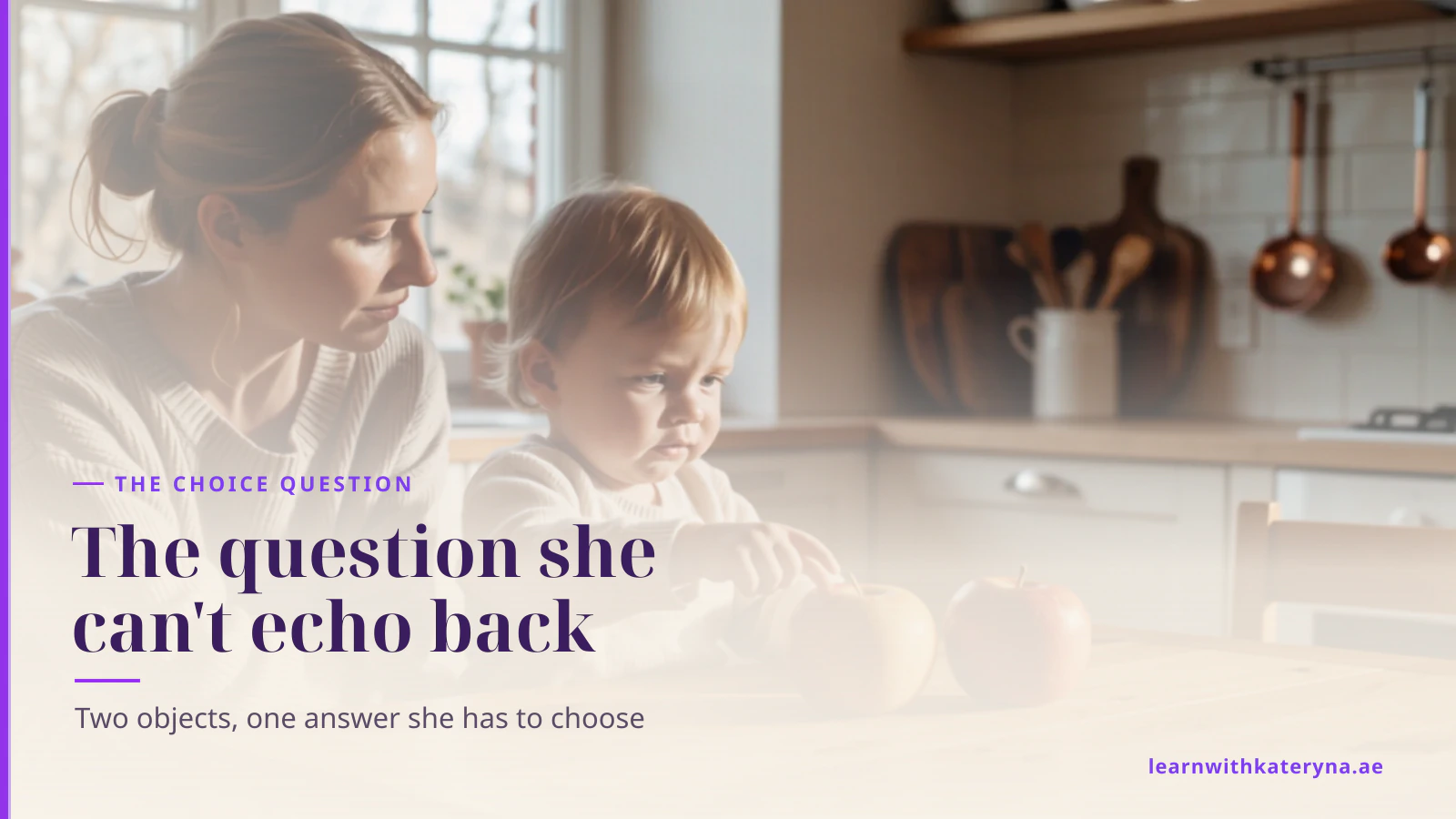
Hold up two things — two fruits, two socks, two toys — and ask: "Apple or banana?"
What makes this powerful is not the vocabulary. It is that the question cannot be answered by copying you. If your child repeats the whole thing back, it does not work as an answer, and they know it does not, because the two objects are still sitting there waiting. To get what they want, they have to select. Selection is the smallest possible act of original language — the first moment where the child, not the model, decides what comes out.
Yes, most children will start by echoing the last word, and yes, they may be choosing it because it was last rather than because they want it. That is fine, and it is still a step up: they have produced one word in response to a real situation, not a copy of a sentence. Within a week or two you will see them pick the first option instead — and that is the moment you know the answer is genuinely theirs.
Build choices into things you already do. Two shirts in the morning. Two fruits at snack. Two books at bedtime. Two routes on the walk. Ten of these a day costs you nothing and gives your child ten obligatory acts of choosing.
What makes echoing last longer
Some very natural, well-meant responses keep a child in the borrowing stage. These are the ones I see most.
| Instead of this | Do this | Why |
|---|---|---|
| "Say it after me: I want juice." | Put the juice in view and wait | Direct imitation prompts train the exact behaviour you want to move away from |
| "No, not like that — say it properly." | Recast it correctly as your reply | Correction makes the child quieter, not more accurate |
| Asking questions you both know the answer to | Ask real questions and choices | Test questions have a copyable answer in the room |
| Filling the silence after two seconds | Count to ten | You are taking the turn they were assembling |
| New phrases every day | Same few phrases, varied one word at a time | A chunk cannot crack open if it is never repeated in variants |
| Praising the repetition itself | Respond to the meaning | "Good repeating!" tells the child copying is the goal |
The one at the bottom is worth a moment. When a child echoes and we say "clever girl!", we are rewarding the echo. When they echo and we simply hand them the apple, we are rewarding the communication. The second teaches faster, and it is less work.
How long this stage actually lasts
The most common question I get is some version of "how long before I should worry?" — so here is the honest shape of it, with the caveat that the range between children is genuinely wide.
For a child doing ten to fifteen focused minutes of English a day at home, the usual pattern is: heavy pure echoing for roughly the first two to four months, first swaps somewhere between months three and six, and a recognisable frame-and-slot stage — sentences you clearly never said — between months five and nine.
Three things move that timeline more than anything else. How consistent the daily contact is matters far more than how long each session lasts; five minutes every day beats forty minutes on Sunday. How much of the input is repeated material matters enormously — the same five books and songs on rotation produce swaps much sooner than a constant stream of new content, because a chunk needs to be heard many times in slightly different forms before its seams show. And how much silence you leave decides how many chances your child gets to try.
If you are three weeks in and worried that your child only repeats: three weeks is not a plateau. That is still the loading phase, and it is doing exactly what it should.
What it sounds like at 2, 3, 4 and 5
The same behaviour means slightly different things at different ages, mostly because of what the child can do in their first language at the time.
| Age | What repeating looks like | What to aim for next |
|---|---|---|
| 2 | Single words and fragments, often just the stressed syllable. Much of it sounds like babble with English melody | One-word choices. Do not expect swaps yet — the same is barely happening in their first language |
| 3 | Whole phrases, accurately, with good rhythm. The classic "parrot" age, and the age I get the most letters about | Swaps inside familiar frames. Choices, pauses, deliberate mistakes |
| 4 | Long chunks, sometimes whole book sentences, used in fitting situations | Recombining two chunks; answers to real questions; short original sentences |
| 5 | Fluent-sounding stretches that are mostly memorised, with original bits threaded through | Retelling in their own words; explaining; describing something you cannot see |
The three-year-old row is the one most mothers arrive at. At three, a child's first language is fluent enough that the contrast is glaring — they negotiate in Ukrainian and echo in English — and it feels like a deficit. It is not. It is a nine-month-old English learner standing next to a three-year-old Ukrainian speaker.
When a check genuinely is worth it
I would rather write this section plainly than leave a mother reassuring herself with an article when something else is going on. Repetition in English, at these ages, after a few months of learning, is expected and is not a warning sign in itself. What is worth a professional opinion is anything about your child's language across all their languages, including the one you speak at home:
- No words at all, in any language, by around 18 months.
- No two-word combinations, in any language, by around two and a half to three.
- Words or skills your child clearly used before and has since lost.
- Little response to their own name, and limited pointing, showing or shared attention with you.
- Repetition that is unchanging and does not communicate — the same phrase in situations where it does not fit, in every language, with no variation over months.
- Your own persistent sense that something is different, even if you cannot name it. This is a legitimate reason on its own.
Two practical notes if you do seek advice. First, count across both languages together: a child with thirty Ukrainian words and ten English words has forty words, and a professional who counts only one language will underestimate them. Second, ask for an assessment that takes the home language into account — a child assessed only in their weaker language will look delayed when they are not. Seeking an opinion is not an admission that something is wrong; it is how you replace a worry with information.
A two-week plan to break the echo
Nothing here adds time to your day. It changes what happens in minutes you already spend.
Week one — build the frames.
- Choose three phrases only, tied to daily routines: one for wanting, one for finding, one for finishing. For example "I want ___," "where is the ___?" "all done."
- Use them in the same moments every day, and vary one word each time. Do not add a fourth phrase this week.
- Build in ten choices a day — clothes, snacks, books, routes. Two options, held up, named.
- After anything you say to your child in English, count to ten before saying anything else.
Week two — make them build.
- Keep the same three phrases. Still no new ones.
- Start stopping before the last word in songs and book refrains, and wait.
- Make one deliberate mistake a day — the wrong object, the wrong name — and let your child correct you.
- Once a day, ask a question you genuinely do not know the answer to, and accept any answer at all, including a single word or one in Ukrainian.
- At the end of the week, run the one-word swap test and write down what you get.
Two weeks will not finish the process, and it is not meant to. What it reliably produces is the first swap — and once you have heard one, you stop needing the reassurance, because you can hear the mechanism working.
If you take one thing
Stop trying to get new sentences out. Take the sentences your child already borrows and change one word at a time until the phrase becomes a frame. Everything else on this page is a variation on that.
Frequently asked questions
The questions below come up in almost every conversation I have about this stage. If yours is not here, the pattern behind most of them is the same: the repeating is not the problem to solve, the missing variation is.
Where to go next
If your child understands English but produces nothing at all, that is a different stage with different moves — read understands but won't speak. If they actively push English away, read when a child refuses English. To see where this stage sits on the whole road, read what progress actually looks like, and for words that fade between sessions, why children "forget" English words. My free starter guide has twenty ready-made phrases you can start varying today — download it here — and Mommy & Me English is the full course built on exactly this method.


