
 Kateryna Ivanova
It usually arrives at about the four-month mark, often late at night. You have been singing the songs, naming the socks, doing bath time in English, and your child still answers you in Ukrainian — or says nothing at all. So you start counting words. You count them again the next week. And because the number barely moves, you conclude the obvious thing: it isn't working.
In nine years of teaching young children and coaching the mothers who teach them at home, this is the single most common reason families quit — not lack of time, not lack of method, but measuring the wrong thing and drawing the wrong conclusion from it. This guide fixes that. It explains why no honest "English milestone chart" exists for a child learning English at home, what genuine progress actually looks like at each age, and gives you a repeatable ten-minute home check so you can stop guessing.

Quick answer
There is no official milestone chart for English as a second language learned at home, because progress depends almost entirely on how many hours of interactive exposure a child gets. Clinical milestones measure a child's overall language across every language they know — not English on its own. So the right question is not "how many English words should she have by three?" but "is she moving through the stages in the right order, at a rate her exposure predicts?" Progress in a second language reliably appears in this sequence: comprehension first, then single words, then memorised chunks, then original sentences — and the first stage is usually invisible for six to twelve weeks. Check monthly, never weekly, and measure understanding and response speed, not just words spoken.
Why no honest English milestone chart exists
Search for "English milestones for a 3-year-old" and you will find dozens of confident charts. Nearly all of them are one of two things: speech-and-language milestones for monolingual English-speaking children, or marketing from a tutoring company. Neither describes your child.
Here is the reason, and it matters more than any number. A monolingual English child hears English for essentially every waking hour — somewhere between 10,000 and 13,000 words per hour of surrounding speech, in every context, from multiple speakers. Your child, learning English at home through you, might get twenty focused minutes a day from one speaker. Those two children are not on the same curve, and comparing them tells you nothing except that you will feel bad.
Second-language progress at this age is a function of four things:
- Interactive exposure hours — minutes where language is directed at your child and a response is invited, not background audio.
- Conversational turns — the back-and-forth. Research on early language development consistently finds that the number of turns taken between adult and child predicts language outcomes better than the raw number of words a child hears.
- Consistency — daily distributed contact beats concentrated weekend blocks, every time.
- Emotional safety — a child who feels tested produces less language than a child who feels played with. This is the practical core of what Krashen called the affective filter.
So instead of a milestone chart, what you need is a baseline of your own child, re-measured monthly. That is what the rest of this guide builds.
The two numbers almost every parent confuses
This single distinction resolves most of the panic I see.
When a paediatrician or speech therapist asks how many words your child has, they are asking about total vocabulary — every word the child can produce, in any language, counted once per concept. When you count how many English words your child says, you are measuring something completely different: the English share of that total.
A three-year-old with 700 Ukrainian words and 120 English words does not have "only 120 words". She has roughly 800 concepts she can name, which is squarely within the normal range. Her English share is 15% — which is exactly what you would expect from twenty minutes a day against a full day of Ukrainian.
| Age | Typical total vocabulary (all languages) | What this number is for |
|---|---|---|
| 12 months | First words appearing; 1–5 words | General development check |
| 18 months | Around 50 words; two-word combinations beginning | General development check |
| 2 years | Roughly 200–300 words; two-word phrases established | General development check |
| 3 years | Several hundred to around 1,000 words; short sentences | General development check |
| 4–5 years | Well over 1,000 words; connected narrative speech | General development check |
These are broad, widely used developmental ranges for a child's language as a whole, and individual variation at these ages is enormous. They are never a target for English alone.
The practical rule: use total vocabulary to judge whether your child's development is on track, and use the English share to judge whether your method is working. Confusing the two is what turns a normal, healthy trajectory into a night of worry. If bilingual development itself is the thing worrying you, I have written about the evidence in detail in does bilingualism delay speech.
The order English arrives in: four stages
Children acquiring a second language in early childhood move through a well-documented sequence. The description most useful to parents comes from Patton Tabors' work on young second-language learners, and it maps almost perfectly onto what mothers describe to me.
| Stage | What you actually see | Typical duration | What to do |
|---|---|---|---|
| 1. Home language | Child keeps answering you in Ukrainian, even when you speak English | Days to a few weeks | Keep going. Do not translate yourself immediately |
| 2. Silent / observation | Little or no English output. Watching your mouth, following instructions, pointing correctly | Commonly 6–12 weeks, sometimes longer | Reduce questions, increase narration. This is the stage families quit in |
| 3. Chunks & telegraphic speech | "More milk", "I want it", "let's go" — whole memorised phrases, used correctly | Several weeks to months | Expand what they say by one or two words, don't correct |
| 4. Productive language | Original sentences the child has never heard as a unit; errors appear | Ongoing | Errors here are a good sign — the child is building rules |
Two things about this table change how you read your own child.
First, stage two produces no visible output and is the longest stage. A parent counting spoken words during stage two will record zero progress for two or three months while the child is, in fact, building the entire comprehension base that stage three runs on. This is the single most common point of abandonment. If your child understands but won't speak, that is a specific, normal, well-understood situation — I covered it fully in my child understands English but won't speak it.
Second, errors in stage four are evidence of progress, not decline. When a child moves from a memorised "I want it" to an invented "I wanted it yesterday" or even "I goed", they have stopped copying and started generating. A child who never makes errors is usually still reciting.
What a realistic rate of progress looks like
Parents almost never have a realistic sense of the timeline, which is why disappointment arrives on schedule at week six. Below is what I actually observe in families doing consistent daily English at home, starting from zero, with a child who has no other English source.
| Daily interactive English | First clear comprehension | First spontaneous words | First chunks / phrases |
|---|---|---|---|
| 10–15 min | 3–5 weeks | 8–16 weeks | 5–8 months |
| 20–30 min | 2–4 weeks | 6–12 weeks | 4–6 months |
| 45–60 min | 1–3 weeks | 4–8 weeks | 3–4 months |
| Nursery/school in English + home | 1–2 weeks | 3–6 weeks | 2–3 months |
These are the patterns I see in practice, not published norms. Starting age matters too: a child of four typically produces first words faster than a child of eighteen months, because their overall language system is further along — while the younger child usually ends up with the better accent.
Read that table honestly and one thing becomes obvious: at fifteen minutes a day, being at week seven with nothing spoken yet is not failure. It is the middle of the expected range. If you want to move up a row, the lever is minutes and turns, not new materials — the practical structure for that is in my age-by-age roadmap for English at home.
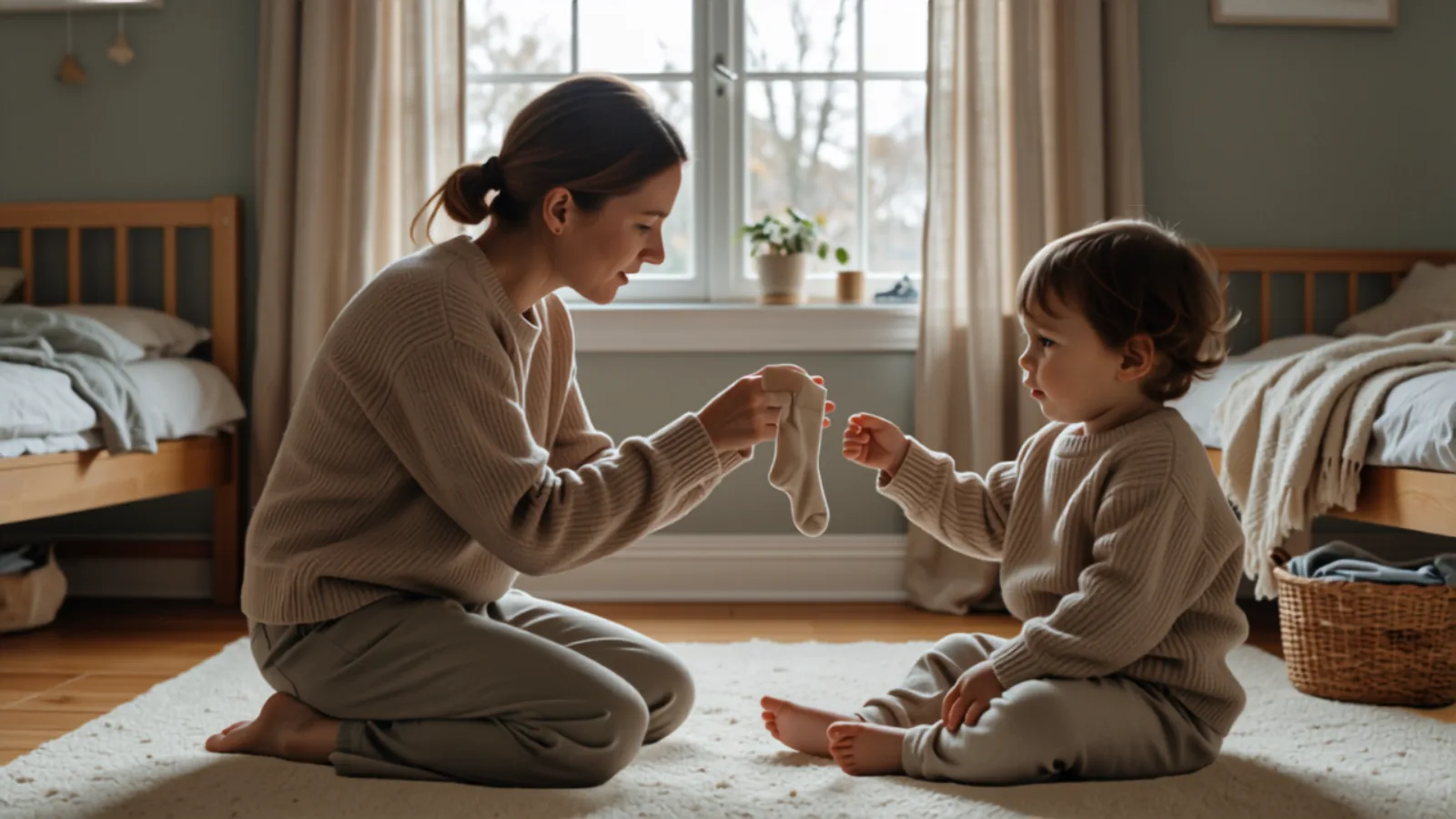
The 10-minute home check
Do this once a month, never weekly, and never on a day your child is tired, hungry or unwell. Frame it as a game. The moment it feels like a test, you are measuring your child's willingness to be tested, not their English.
Part 1 — Comprehension (3 minutes)
Put five familiar objects on the floor. Sit beside your child, not opposite — opposite reads as an examination. Give five instructions in English, with no gestures and no pointing, spaced well apart:
- "Give me the spoon."
- "Put the ball in the box."
- "Where is the cup?"
- "Touch the book."
- "Give the sock to teddy."
Record: how many of the five she acts on correctly without help. This is the number that moves first and matters most.
Part 2 — Naming (2 minutes)
Hold up six familiar objects, one at a time, and ask "What's this?" Count how many she names in English. Then — this is the part most parents skip — count how many she names in Ukrainian. If she names all six in Ukrainian and two in English, you have a vocabulary that exists and an English share of 33%, which is a completely different diagnosis from "she doesn't know these words".
Part 3 — Chunks (2 minutes)
Through the month, note any whole phrases she uses without prompting: "I want it", "all done", "let's go", "one more". Write them down when they happen; you will not remember them at the end of the month. Chunks are the bridge between understanding and speaking, and their arrival is the strongest single sign the method is working.
Part 4 — Spontaneous use (3 minutes)
Simply observe during ordinary play. Note any English produced without you initiating: to a toy, to a sibling, to herself, in a song. Self-directed English during play is a very reliable indicator, because nobody is asking for it.
How to read your results
Comparison is only ever against your own child last month. Comprehension rising while speech stays flat is normal, healthy stage-two progress. Comprehension flat for two consecutive months is the one result worth acting on — and the usual cause is minutes, not method.
The one-minute recording memory can't argue with
Human memory is genuinely terrible at tracking gradual change in our own children. You will swear nothing has changed since spring, because you were there for every one of the tiny increments.
So: on the same date each month, record sixty seconds of ordinary interaction in English — bath time, a book, getting dressed. Do not stage it. Do not prompt for a performance. Then, every three months, watch the oldest one and the newest one back to back.
What to listen for, in order of usefulness:
- Response latency. How many seconds between your question and any response? In month one it is often five or six seconds. By month three it is usually one or two. This shrinking gap is progress you cannot perceive in the moment and cannot fake.
- Attempts. Not correct words — attempts. Approximations, half-words, English intonation on a Ukrainian word.
- Your own speech. Are you asking fewer test questions and narrating more? Are you leaving pauses? Most mothers improve faster than their children in the first two months, and it is the improvement that drives everything downstream.
Five kinds of progress that don't look like progress
If you only count spoken English words, you will miss all five of these — and all five reliably precede speech.
- Shorter response latency. Covered above, and the most underrated signal there is.
- Understanding without translation. She follows "put your shoes on" without you repeating it in Ukrainian. Comprehension has moved from translation to direct meaning.
- Self-correction. "Me want — I want it." Nobody corrected her. She is running an internal rule check.
- English aimed at toys, not people. Children rehearse new language in low-stakes settings first. Language directed at a teddy is language with the pressure removed.
- Asking what things are called. "What is this in English?" is the moment your child becomes an active participant rather than a recipient. It is worth more than fifty passively memorised nouns.

The six-to-ten week wall
Almost every family hits a stall somewhere between week six and week ten. It is so consistent that I now warn mothers about it in advance, because the families who know it is coming survive it and the families who don't, stop.
Three things are usually happening at once. The novelty has worn off for both of you. You have moved past the easy concrete nouns into harder, more abstract language. And your child has usually just made a leap in their home language, which temporarily consumes their attention.
What to change: the format, not the plan. Swap the naming game for a song, move the English anchor from breakfast to bath, bring in a new book. Novelty in delivery, consistency in schedule.
What not to change: the daily minutes, and the anchors themselves. Rebuilding a routine costs three to four weeks; adjusting one costs nothing. If your rituals need refreshing rather than replacing, the practical options are in daily English rituals at home and English songs for kids.
One genuine exception: if the stall coincides with active refusal — pushing the book away, "no English", covering your mouth — that is a different problem with a different fix, and it is worth reading my child refuses to speak English with me rather than pushing harder.
Seven ways parents measure wrong
- Counting only spoken words. You are measuring the last stage to arrive and ignoring the three that come first.
- Quizzing. "What's this? And this? What colour?" Rapid-fire questioning reliably reduces output. Narrate instead; ask perhaps one question for every five statements.
- Comparing to a monolingual English child. Different exposure by a factor of thirty. The comparison is meaningless.
- Comparing to a nursery child. A child in an English-medium nursery gets 25–30 hours a week. You are not running the same experiment.
- Comparing to a sibling. Second children typically speak later and understand earlier. Same family, different curve.
- Measuring weekly. The signal is smaller than the noise. A bad week means your child was teething, not that the method failed.
- Judging accent. Accent at this age tells you about exposure to varied speakers, not about acquisition. It is the last thing to worry about and the first thing parents mention.
When it genuinely is worth getting checked
Everything above concerns English. This section concerns your child's language overall, and it is the one part of this article where the answer is "please go and see someone" rather than "keep going".
These signs relate to a child's total language across every language they speak, and they warrant a conversation with your GP, paediatrician or a speech and language therapist:
- No babbling, pointing, waving or other gestures by around 12 months
- No single words by around 16–18 months
- No two-word combinations by around 24 months — in any language, counted together
- Loss of speech or social skills the child previously had, at any age
- Consistently not responding to their name, or little interest in interaction
- Speech that close family cannot understand at all by around age 3
- Your own persistent instinct that something is wrong — this is worth acting on
Two things matter enormously if you do seek an assessment. First, ask for assessment across all of your child's languages, or at minimum in their strongest one; testing a bilingual child in their weaker language routinely produces a false picture. Second, be aware that learning two languages does not cause language delay — this is one of the most persistent myths in early childhood, and if you are told to "drop the English", it is reasonable to ask for the evidence. I set out what the research actually shows in does bilingualism delay speech.
I am an English teacher, not a speech and language therapist. If any of the signs above apply, that assessment is the right next step, and it sits outside what any English method can address.
Your 12-week tracker
One page, three entries, five minutes a month. This is the entire system.
| Log monthly | Where it comes from | What good looks like at month 3 |
|---|---|---|
| Comprehension score (/5) | Home check, part 1 | Up by at least 1–2 from baseline |
| English names (/6) and Ukrainian names (/6) | Home check, part 2 | English share rising; total stable or rising |
| Chunks heard this month | Noted as they happen | At least 1–3 appearing |
| Spontaneous English moments | Observation during play | Any at all is meaningful |
| Average daily minutes | Honest estimate | Consistent, not increasing |
| 60-second recording | Same date each month | Response latency visibly shorter |
If after twelve weeks comprehension has risen and chunks have appeared, the method is working, regardless of how much your child is speaking. If comprehension is genuinely flat across three months and daily minutes have been honestly consistent, then something structural needs changing — most often the ratio of questions to narration, or the fact that the exposure is passive rather than interactive.
Frequently asked questions
The questions below are the ones I am asked most often by mothers in exactly this situation.

Where to go next
If you take one thing from this guide, make it this: measure comprehension monthly, not words weekly. That single change turns an invisible three-month stretch into something you can actually see moving — and it is usually the difference between a mother who continues and a mother who concludes she has failed.
If you would like the structure rather than just the measurement, that is what the Mommy & Me English course is: a daily-ritual system for mothers of children aged one to five, built on games, songs and the routines already in your day — no textbooks, no cramming, and no requirement that your own English be perfect. You can see how the method is put together on the Mommy & Me journey page, and there is more about my background and approach here — Trinity College London CertTESOL, NILE Young Learners trained, with a background in speech therapy and primary education, and over nine years teaching young children. The free starter guide gives you tomorrow morning's first sentences if you would rather begin today.
And if you are in the middle of the silent stage right now, counting words and finding none: that is not the method failing. That is the part of the process that happens to have no visible output. Run the check, write down the number, and look again in a month. The mothers whose children end up genuinely comfortable in English are almost never the ones who saw fast results. They are the ones who kept measuring the right thing long enough to see the slow ones.


