
 Kateryna Ivanova
OPOL (One Parent One Language) is a bilingual-parenting strategy where each parent speaks to the child in EXACTLY one language from birth. Mum in Ukrainian, dad in English. The child hears two languages from two consistent sources and naturally separates them by person. The method was described by the French linguist Jules Ronjat in 1913, based on raising his own son Louis, and first formalised by Suzanne Barron-Hauwaert in 2004. Annick De Houwer's survey work showed OPOL is not the only right approach: among the families she studied, one parent using two languages produced 79% active bilinguals and classic OPOL 74%, while a loose mixture of the two produced 59%. This is a full practical guide for a Ukrainian parent raising a child aged 1–5 in a bilingual home — with a 7-day start plan, scripts for the tricky moments, and an honest answer to "what if dad doesn't speak English?"
What OPOL is and how it works
OPOL is the oldest and most researched bilingual-parenting strategy in the world. The principle is simple: each parent speaks to the child only in their own language. Always. In every situation. Without translation.
The child hears Ukrainian from mum and English from dad, and their brain builds two separate "shelves" in one library. Unlike teaching, there are no lessons here — just life, lived in two languages at once.
"A child doesn't learn a language. They bathe in it. If two sources are stable and warm, the brain separates them automatically." — Annick De Houwer, "Bilingual Development in Childhood" (2021)
A short history: from Ronjat to Barron-Hauwaert
In 1913 the French linguist Jules Ronjat published "Le développement du langage observé chez un enfant bilingue" — a diary describing how his son Louis heard French from his father and German from his mother from birth. By age 4 the boy spoke both fluently without confusing them. It was the first documented "OPOL family".
In 1949 Leopold published a four-volume observation of his daughter Hildegard (English + German). In 2004 Suzanne Barron-Hauwaert wrote "Language Strategies for Bilingual Families: The One-Parent-One-Language Approach" — the book that made OPOL mainstream.
Since the 2010s the method has been under pressure from new data: the linguist Annick De Houwer (Harvard University, University of Erfurt) and the psychologist François Grosjean proved that a child's brain can handle far more flexible models. The modern position is that OPOL is effective, but not the only way.
What the science says in 2026
OPOL is a 1913 hypothesis tested by hundreds of studies. Here's what we know for sure as of May 2026:
- Bilingual children don't lag on language milestones. First word at 12 months, first sentence at 24 months, just like monolinguals (De Houwer, 2021).
- The executive-function bonus is disputed. Some studies find bilingual children manage attention and switch tasks better; several large studies find no such advantage. Treat it as an open question, not a selling point — the reliable benefit of bilingualism is the second language itself.
- OPOL isn't always the winner. In De Houwer's data 79% active bilinguals came from one parent using two languages, against 74% for classic OPOL — and minority-language-at-home does best of all where it is possible.
- Balanced exposure is critical. If one language gets less than 20% of waking time, the child becomes a receptive bilingual — understands but doesn't speak.
- Non-natives work too. A parent who is not a native speaker can raise an active bilingual with OPOL. What the research keeps pointing at is consistency of input, not the accent it arrives in.
Conclusion: OPOL works, but it isn't magic. It's a system. Like any system, it's only as effective as it is consistently applied.
Who OPOL suits, and who it doesn't
OPOL isn't a universal formula. It works in some families and fails in others. Here's an honest diagnosis.
OPOL is ideal if:
- Both parents speak their languages fluently (mum in Ukrainian, dad in English, or Spanish, or Arabic).
- Each parent has a substantial share of the waking day with the child. Otherwise the "weaker" voice's language disappears.
- You live in a country where the SECOND language has strong external support (e.g. in the UAE: dad speaks English at home, the child hears it at school and on the street).
- You're ready for 5+ years of consistency. OPOL is a marathon, not a sprint.
OPOL doesn't suit you if:
- Dad doesn't speak the language at an everyday level (e.g. knows 200 words and is shy). In that case both parents speak Ukrainian — and English comes through TPR, cartoons, school.
- One parent is away for long stretches (business trips, a separate country). The child hears the language irregularly — worse than having no method.
- You live in Ukraine and both parents are Ukrainian. Then Time & Place or "English Hour" works — one parent speaks English at a set time or in a certain place.
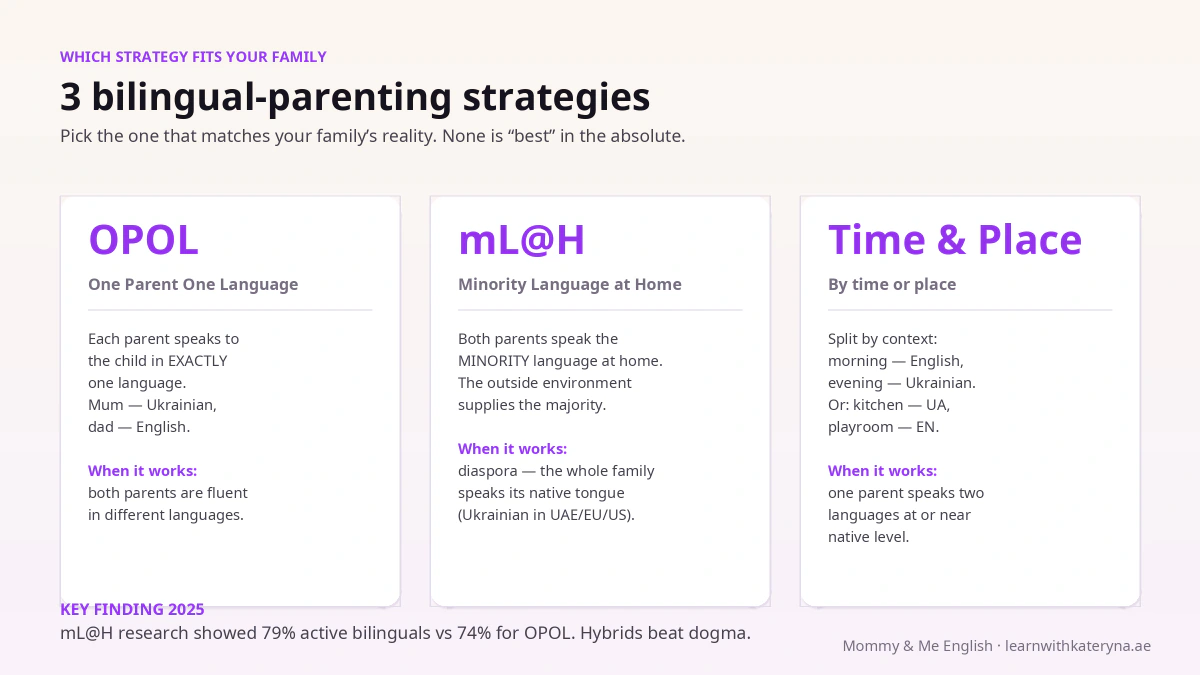
Three bilingual-parenting strategies: OPOL, mL@H, Time & Place
Before diving into OPOL, check whether it's the best strategy for your family. Here are three classic approaches with a scientific basis:
| Strategy | How it works | When to choose it | Risks |
|---|---|---|---|
| OPOL (One Parent One Language) | Mum = language A, dad = language B. Always. | Both parents are fluent in different languages. | Exposure imbalance if one parent is with the child less. |
| mL@H (Minority Language at Home) | Both parents speak the minority language at home. The environment supplies the majority. | Diaspora: Ukrainian families in the UAE, EU, US. | The second language can be late until age 3. |
| Time & Place | Split by time (morning EN, evening UA) or place (kitchen EN). | One person speaks two languages. | Harder consistency — easy to "forget to switch". |
| 2P2L (mixed) | Both parents speak both languages, but by clear rituals. | Families where everyone is polyglot. | The child may start mixing without separating. |
The best strategy is the one you can sustain for 5 years. Don't choose OPOL out of pride if mL@H is realistically simpler for your family.
A 7-day plan to introduce OPOL at home
Don't start OPOL abruptly on Monday. A child needs to adapt, especially at 2–3 years old and used to mixed language. Here's a gentle week-long plan — one rule per day.
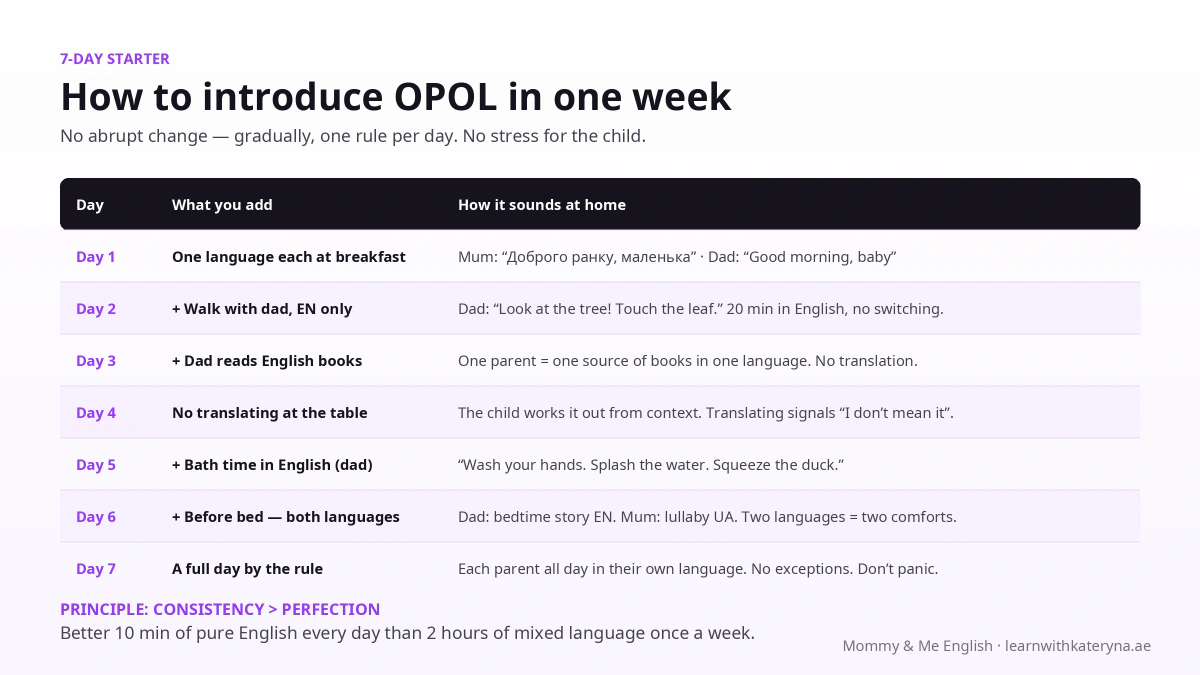
- Day 1. One parent picks one language for breakfast. Dad: "Good morning, baby. Time to eat." Mum: "Доброго ранку, маленька. Час снідати." No translation between you.
- Day 2. Add a walk with dad entirely in EN. 20 minutes in the park, no switching even if the child asks in Ukrainian.
- Day 3. Dad reads only English books. Mum only Ukrainian. One parent = one source of books in one language.
- Day 4. Stop translating. If the child didn't understand, dad rephrases in the same English. Translation is a signal of "I don't really mean it".
- Day 5. Bath time with dad — in English. "Wash your hands. Splash the water. Squeeze the duck." 10 minutes of pure immersion.
- Day 6. Before bed each parent uses their language in their own ritual. Dad — bedtime story in EN. Mum — a lullaby in Ukrainian.
- Day 7. A full day by the rule. Each parent 12 hours in their language. No exceptions. Don't panic if the child protests — it's a phase.
It becomes a habit in about 21 days. On average, after 6 weeks the child stops being surprised and starts automatically switching between parents.
What if dad doesn't speak English?
This is the most common question in the Ukrainian diaspora. The answer: classic OPOL isn't for you. But bilingualism is definitely possible.
Here are three working scenarios when "dad isn't a native speaker":
- OPOL with a non-native (B2+ level). A B2+ parent can raise an active bilingual. The condition is consistency: the parent speaks ONLY English with the child, even with mistakes. The child doesn't "learn the mistakes" — they're corrected by books, cartoons, school.
- mL@H + external English. Both parents speak Ukrainian at home. English comes through cartoons (Bluey, Peppa Pig, Ms Rachel), TPR sessions with mum 10 min/day, nursery or a group. This works if you're in the UAE, EU or US — the environment is English anyway.
- OPOL "light" — bilingual mum. If mum speaks English fluently she can take BOTH roles: morning EN with mum, day UA with dad and mum. That's a Time-and-Place strategy, but not formally OPOL.
The worst option is mixing English with Ukrainian in one sentence. "Give me the ball, мамі." That's not bilingualism — it's pidgin. The child gets no system.
The "age-3 crisis": when the child rejects the minority language
Around age 3 almost all bilingual children go through a phase of rejecting the minority language. Especially if that language is Ukrainian in Dubai or English in Ukraine.
The child starts answering "that" language in their main one. Dad: "What do you want?" Child: "Я хочу яблуко." Or vice versa.
This isn't an OPOL failure. It's a phase. Here's what works:
- Don't react in Ukrainian. Dad STILL speaks English. Repeat, rephrase, but don't betray the language.
- "I don't understand" — forbid yourself this phrase. The child knows you understand. Pretend you don't, and the child will repeat in English.
- Create a "need" for the language. An English-speaking friend, an online English teacher, an English video with no translation.
- Don't force speaking. Ask for action. "Touch the ball" isn't "say ball". TPR rescues the rejection phase, because language comes out through the body, not through pressure.
If you're at this stage, read in detail about the TPR method and daily English rituals. They complement OPOL perfectly during the "rejection crisis".
Building an English routine at home? The free Mommy & Me English starter guide lays out the daily rituals step by step.
5 myths about OPOL it's time to close
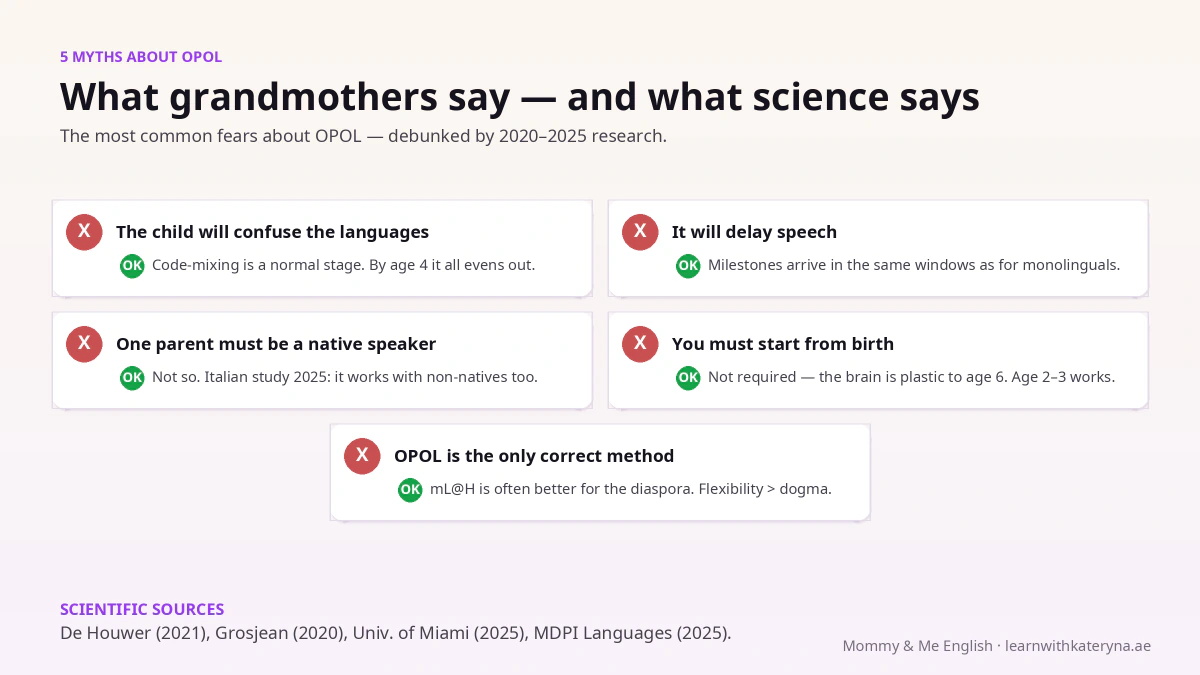
Myth 1: "The child will confuse the languages"
Code-mixing (blending words of two languages in one sentence) isn't confusion but a normal stage up to age 4. The child takes the word from whichever language it's simpler in, or where they learned it first. By around four, children reliably sort the two languages by person and situation on their own — De Houwer's work describes bilingual children building two separate systems from the start rather than one muddled one.
Myth 2: "Two languages = a speech delay"
False. Bilingual children hit language milestones (first word, first sentence, 50-word vocabulary) in the same windows as monolinguals. Details in our piece on bilingualism and speech-delay myths.
Myth 3: "Dad must be a native speaker"
He doesn't. B2+ and full consistency are enough. A child doesn't inherit the accent and errors of one source, as long as there's at least one native in their life (books, cartoons, grandma on Skype).
Myth 4: "You must start from birth or it's too late"
Optimal — yes. But the plasticity window lasts to age 6 with high effectiveness, to 12 with significant. Starting at 2 or 3 works — the child just catches up faster than you expect.
Myth 5: "OPOL is the only correct method"
The 2023–2025 data shows the opposite. mL@H is often more productive for the diaspora. Flexible hybrids work better than dogma. Choose what you can sustain for 5 years.
A real day for a Ukrainian OPOL family in Dubai
To keep this concrete, here's a typical day in one of the families from our Mommy & Me English community in Sobha Hartland:
- 7:00 — Wake-up. Mum (UA): "Доброго ранку, сонечко. Прокидайся." Dad (EN): "Good morning! Up, up, up!"
- 7:30 — Breakfast. Dad with the child at the table — in English. Mum in the kitchen — in Ukrainian (to herself, but she addresses the child in UA too).
- 9:00 — Walk/nursery. If dad takes them — EN. If mum — UA. No switching.
- 13:00 — Lunch. Each by their own rule. The child switches automatically.
- 16:00 — Active time. If together, each speaks their language. The child is at the centre of a bilingual environment.
- 19:00 — Bath. With dad — an EN ritual.
- 20:00 — Bed. Dad reads a bedtime story in English. Mum — a Ukrainian lullaby.
Overall the child hears roughly 50/50 of the two languages every day. After 6–12 months of stable OPOL, most children in such a family are active bilinguals.
How to combine OPOL with other methods
OPOL is only a strategy for dividing languages. Within it you can (and should) use specific teaching methods. Here's how they layer on top:
- OPOL + TPR. Dad gives all commands in English, the child reacts with the body. That's classic TPR in an OPOL wrapper. More on the TPR method for kids.
- OPOL + PEER (reading). Dad reads in English using the PEER technique (Prompt-Evaluate-Expand-Repeat). See how to read English books to your child.
- OPOL + rituals. Each ritual tied to one language (bath — EN, dinner — UA). See daily English rituals at home.
- OPOL + first words. The English-speaking parent focuses on 100 core words. See first English words for a child.
- OPOL + songs. Each language its own repertoire. The English-speaking parent — Twinkle Twinkle, mum — a Ukrainian lullaby. See English songs for kids.
What age to start OPOL
Optimal — from birth. But the window is wide. Here are the practical brackets:
- 0–12 months: the ideal start. The child doesn't notice a difference — to them it's just "mum's voice" and "dad's voice". No resistance.
- 12–24 months: a great time. The child starts speaking — and immediately builds two separate language cards.
- 2–3 years: works, but needs a week or two of adaptation. There may be a "why do you suddenly speak differently?" phase.
- 3–5 years: still works, but the child is already aware. Explain: "Dad is going to speak English now, because it's his language." Acceptance comes in 2–4 weeks.
- After 6 years: no longer classic OPOL — more formal second-language learning. Possible, but no longer "natural".
Trilingual families: when there are three languages
Ukrainian families in the UAE often face trilingualism: Ukrainian + English + Arabic (or Russian). In Europe — Ukrainian + English + German/Czech.
Classic OPOL doesn't fit here — you have two parents but three languages. Strategies:
- OPOL + Community. Mum — UA, dad — EN, nursery/nanny — Arabic (or the third language). The child has three consistent sources.
- 2P1L + 1 extra. Both parents speak Ukrainian at home. English — school. The third language — TV, grandma, a special "situation".
- One parent — two languages. If dad is himself bilingual (EN + AR), he can use Time-and-Place: morning EN, evening AR. A PMC (2025) longitudinal study showed this works.
The main thing in a trilingual family: no language gets less than 20% of waking time. Otherwise it becomes receptive (understood by ear) but not active.
The most common mistakes in OPOL families
- Switching in public. "At home with dad you speak English, but in the shop I'll switch to Ukrainian so we don't stand out." The child reads it — the language isn't serious. OPOL breaks.
- Translating "for clarity". "Touch the ball. Торкни м'яч." The child waits for the translation and doesn't try to understand the EN.
- The weaker parent gives up. Dad switches to Ukrainian because "the child doesn't answer". Two weeks later the English is lost.
- Grandparents break the rule. Grandma comes from Ukraine, speaks Ukrainian with the grandchild, then accidentally "Hello, sweetie". It should be one language per person, not per situation.
- Expecting quick results. Active language comes after 18–24 months of stable OPOL. Not after 3 weeks.
The maths of exposure: how many hours you need
Bilingualism is a question of input. A child's brain doesn't learn a language — it statistically extracts it. The more quality, contextual input, the faster active language forms.
The one figure the research does support is a floor, not a target: in the work of Barbara Pearson and colleagues (University of Massachusetts Amherst), children who heard a language less than about 20% of the time rarely became active speakers of it. Less than that — receptive (understands but doesn't speak).
The calculation for a 2-year-old sleeping 12 hours:
- Waking time: 12 hours = 720 minutes a day.
- That 20% floor works out at about 145 minutes — roughly 2.5 hours a day.
- Aim comfortably above the floor rather than at it: 3–4 hours of real, interactive talk, not background sound.
In practice: if dad is around from 18:00 to 21:00 plus one day off, that's almost 4 hours a day on average across the week. Enough. If dad only sees the child for 30 minutes in the evening — not enough; you need reinforcement (English nursery, 30 min of cartoons, an English-speaking nanny for half a day).
Next steps
OPOL is the strategic skeleton of a bilingual family, but the muscle grows from daily practice. Here's what to do next:
- Assess which of the three strategies (OPOL, mL@H, Time-and-Place) really suits your family. Don't attempt "heroic" OPOL if dad isn't a native speaker.
- If you choose OPOL, start with the 7-day plan above. Gently, not abruptly.
- Layer TPR and daily rituals on top — those are the concrete tools inside the strategy.
- If you live in Dubai and want a live community of other OPOL families, join Mommy & Me Journey — weekly classes for Ukrainian parents with children 1–5 in Sobha Hartland.
- If you need 1-on-1 help with your specific family situation, write to Kateryna via the contact form.
A bilingual child isn't the summit. It's the baseline for a child growing up in the global world of 2026. OPOL is just one of the possible paths there.
Written by Kateryna Ivanova, a mother in a bilingual family in Dubai and founder of Mommy & Me English. Last updated: 25 May 2026. Sources: De Houwer A. (2021), Bilingual Development in Childhood; Grosjean F. (2020), Life as a Bilingual; De Houwer A. (2007), Parental language input patterns and children’s bilingual use, Applied Psycholinguistics 28 — the source of the 79/74/59 figures; Pearson B. Z. and colleagues, University of Massachusetts Amherst, on the proportion of input a language needs.


