 Kateryna Ivanova

The English alphabet for kids is the set of 26 Latin letters (5 vowels and 21 consonants), and each one has both a name and a sound. To teach the alphabet without confusion, don't start with the "A-B-C" song — start with a few letters from your child's own name; teach lowercase letters before uppercase (because that's what children actually see in books); and show, from day one, the difference between a letter's name and its sound. Just 5–10 minutes a day is enough — no tutor, and no fluent English needed from you.
Ukrainian and Russian-speaking parents often teach the English alphabet the way they were taught at school: a table of 26 capital letters and the ABC song. That creates two classic problems — the child confuses Latin letters with Cyrillic ones (В, Н, Р, С look identical but sound completely different), and the child knows the letter names yet can't read a single word. This guide gives you a working system: the right order, the pronunciation of all 26 letters, a look-alike-letter table, and a 4-week plan.
What the English alphabet is — and why it isn't sounds
The English alphabet is the set of 26 Latin letters used to write every English word. Five of them are vowels (A, E, I, O, U) and the other 21 are consonants. Each letter has two properties: a name (what we call it in the alphabet) and a sound (how it reads inside a word). A child needs both, but for different jobs.
Knowing the alphabet means recognising a letter, naming it and finding it among others. That's the foundation — but on its own it does not teach reading. Reading comes from a different skill: phonics, the knowledge of sounds. Researchers call the bridge between them the "alphabetic principle": understanding that written letters stand for spoken sounds (Reading Rockets, The Alphabetic Principle).
The alphabet answers "what is this letter called?" Reading answers "what sound does it make in a word?" A child needs both answers — but you must never confuse the two.
Good news: research shows letter names and sounds can be taught at the same time, and knowing the names actually strengthens letter-sound learning (National Institutes of Health, study PMC2978809). So you don't have to choose "alphabet first, sounds later" — they work as a pair. For how to build the sound side, see our guide on phonics for toddlers: teaching letter sounds at home.
What age to start the English alphabet
Age decides not "whether" but "what" to do with letters. There's no point showing a baby a flashcard with Q, but you can immerse them in the songs and rhythm of the alphabet from age one. Here are the three natural stages.
- 1–2 years — exposure through sound. No "memorise this" flashcards. The child simply hears the alphabet in songs, rhythm and play. The goal is familiarity with the music of the language, not a result.
- 2–3 years — recognition. The child starts recognising individual letters — first the ones that mean something (the first letter of their name, M for "mama"). Magnetic letters, soft puzzles, "find the matching one".
- 3–5 years — names, sounds and writing. The child confidently names most letters, links them to sounds and begins to "draw" letters. This is the age the alphabet turns into a reading tool.
If you're only just starting English with your little one, build their ear and basic vocabulary first — the letters then land on ready ground far more easily. Our step-by-step plan for English from age 1 without a tutor shows what to start with before the formal alphabet.
A letter's name ≠ its sound
This is the main misunderstanding that leaves a child "knowing the alphabet" but unable to read. A letter's name and its sound are different things. The letter b is called "bee" in the alphabet, but in the word bat it says a short /b/. The letter h is called "aitch" but says a breathy /h/.
What does that mean in practice? A child who knows only the names will try to read cat as "see-ay-tee" — and no word appears. That's why the ABC song, which teaches only names, will not teach reading. It's useful for something else — so the child knows the "inventory" of letters and their order.
A letter's name is its "passport name". Its sound is the "job" it does in a word. For a child learning to read, the job matters more than the name.
The practical takeaway: when you play with letters for reading, say the sound more often ("this letter says /m/") rather than just the name ("this is em"). And when you sing the alphabet or hunt for a letter in a book, use the name. A child easily holds both labels at once — as long as you don't mix them up yourself. More on sounds in our article on phonics and the SATPIN sound order.
Lowercase or uppercase first
Short answer: lowercase letters matter more, even though uppercase are easier to write. About 95% of all the text a child sees — in books, on signs, on screens — is made of lowercase letters. They'll meet a capital A at the start of a sentence or in a name, but a lowercase a hundreds of times more often.
At the same time, uppercase letters are easier for a small hand: they're built from straight lines and simple shapes (A, E, H, T), while lowercase letters have tails and circles (a, b, g, q). That's why many educators recommend a compromise.
| Aspect | Lowercase (a, b, c) | Uppercase (A, B, C) |
|---|---|---|
| How common in text | ~95% of all print | ~5% (sentence starts, names) |
| For reading | critically important | secondary |
| For handwriting | harder (tails, circles) | easier (straight lines) |
| When to introduce | for recognition — right away | for first writing — in parallel |
The working approach: emphasise lowercase for recognition (reading), and let the child start writing with uppercase, because they're easier to draw. Don't demand perfect handwriting at age 3 — at this stage what matters is that the hand feels the shape, not calligraphy.
What order to introduce letters
The worst order to teach letters is the alphabet order A–Z. It's handy for a song but not for a child's mind: A, B, C, D mean nothing in their life. A better principle is meaningful first, then useful.
- The letters of your child's name. The first letter of their name is the most emotional and the easiest place to start. "That's your letter!" works better than any flashcard.
- Family and favourite words. M for mama, D for dad, C for cat if there's a cat at home.
- Frequent, useful consonants. s, t, m, n, p — they build lots of simple words and match the starter group of phonics.
- Vowels. a, e, i, o, u — no word works without them, so introduce them early.
- Rare letters last. q, x, z appear rarely, so don't spend the first weeks on them.
Pace: 2–3 new letters a week for a 3–4-year-old, with constant review of earlier ones. Don't chase "all 26 in a month": 8 letters known solidly beat 26 forgotten by next week.
Look-alike letters: Latin vs Cyrillic
This is the most important part for a Ukrainian-speaking child — and the part missing from every English-language guide. A child who already sees Cyrillic letters around them runs into Latin letters that look exactly the same but sound different. If you don't explain this, you get a stubborn confusion that's hard to fix later.
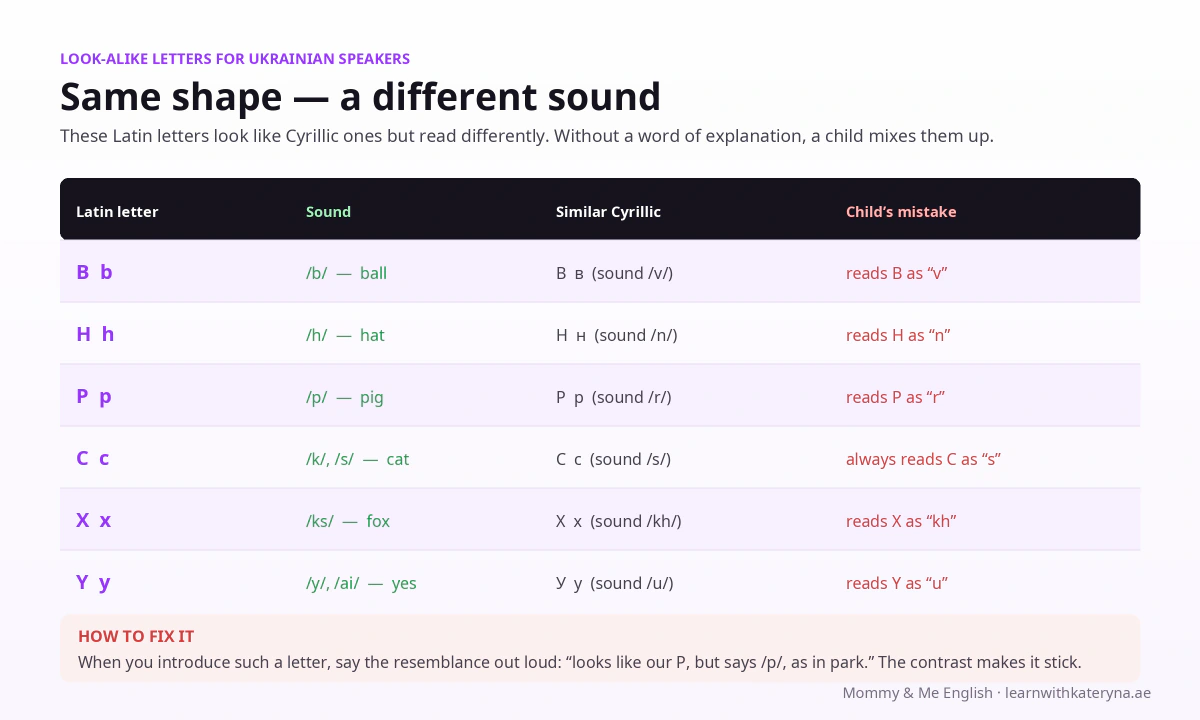
| Latin letter | Its English sound | Similar Cyrillic | The child's mistake |
|---|---|---|---|
| B b | /b/ | В в (sound /v/) | reads B as "v" |
| H h | /h/ (breath) | Н н (sound /n/) | reads H as "n" |
| P p | /p/ | Р р (sound /r/) | reads P as "r" |
| C c | /k/ or /s/ | С с (sound /s/) | always reads C as "s" |
| X x | /ks/ | Х х (sound /kh/) | reads X as "kh" |
| Y y | /y/, /ai/ | У у (sound /u/) | reads Y as "u" |
You can add M, K, T, A, O, E to this list — they also look the same, but luckily sound close to their Cyrillic counterparts, so they cause almost no trouble. The truly dangerous six are B, H, P, C, X, Y.
For a Ukrainian-speaking child, the English letter Р isn't "r" — it's "p". Until you name this trap out loud, the child will read Peter as "Reter". Point it out once and the problem disappears.
How to work with look-alikes: when you introduce one, name the resemblance directly. "Look, this letter looks like our Р, but in English it says /p/ — like in park." Put the two languages side by side: Ukrainian "Р-р-рак" and English "P-p-park". The contrast fixes the difference far better than silent memorising.
Building an English routine at home? The free Mommy & Me English starter guide lays out the daily rituals step by step.
The English alphabet with pronunciation: all 26 letters
Below is the full alphabet with each letter's name and an association word. The association word is an image that "glues" the letter to memory: A — apple, B — ball, C — cat. Associations, not drilling, are what give a lasting result.
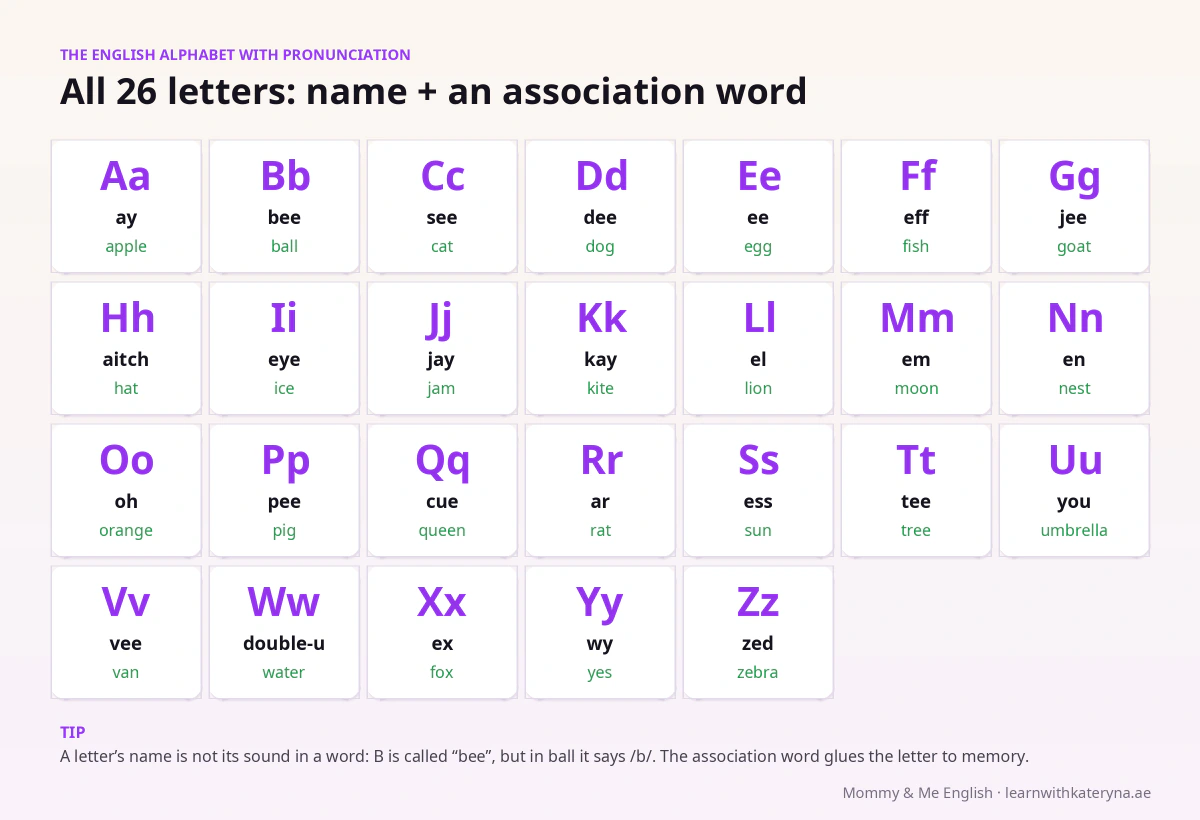
Approximate letter names: A — ay, B — bee, C — see, D — dee, E — ee, F — eff, G — jee, H — aitch, I — eye, J — jay, K — kay, L — el, M — em, N — en, O — oh, P — pee, Q — cue, R — ar, S — ess, T — tee, U — you, V — vee, W — double-u, X — ex, Y — wy, Z — zed (UK) or zee (US).
Two points where people slip most often. First, W is "double-u" (double u), not "double-v"; Ukrainian-speaking parents often say it wrong. Second, the English R is not "rolled" like a Ukrainian "р" — it's softer and made without the tongue vibrating. If you don't fully trust your own pronunciation, lean on native-speaker songs: there's a collection in our article on English songs for kids. And the association words for each letter are easy to pull from the list of a child's first 100 English words.
7 ways to learn letters at home
Letters stick best when a child uses several senses at once: seeing, hearing, touching and moving. This is the multisensory approach — it works far better than a flashcard held in front of a child. Here are seven proven ways, with no tutor and no expensive materials.
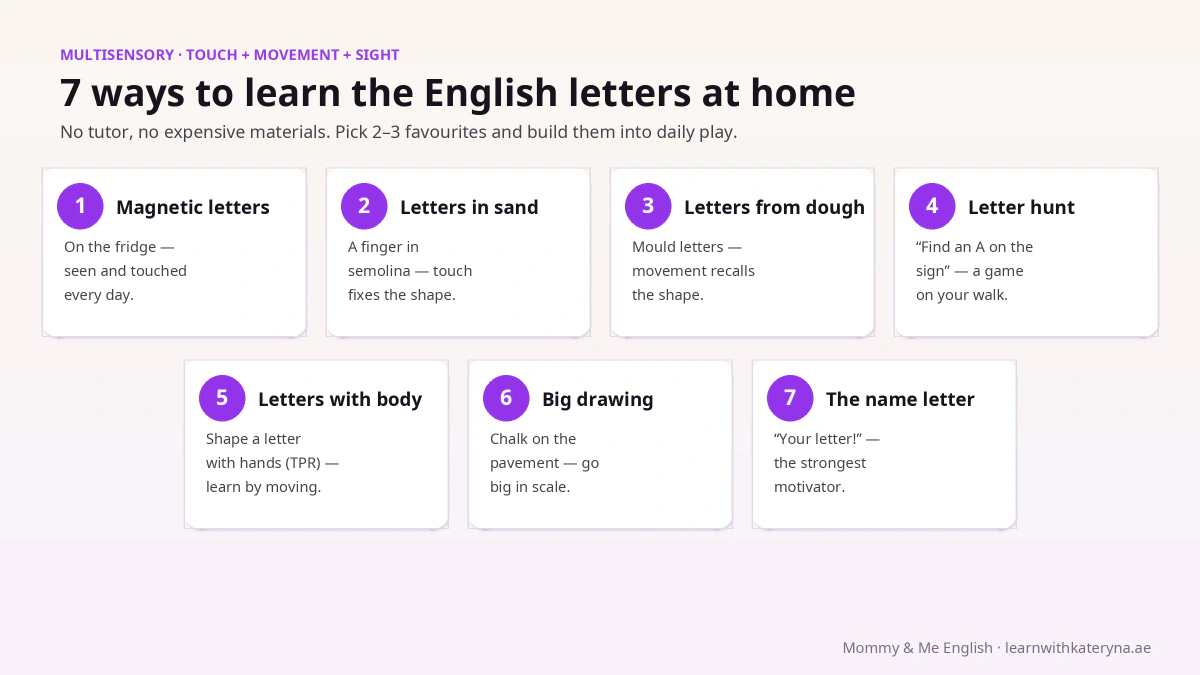
- Magnetic letters on the fridge. The child sees and touches letters every day. Spell their name, simple words, play "find the M".
- Letters in sand or semolina. Spread semolina on a tray and draw letters with a finger. Touch fixes the shape better than a pencil.
- Letters from dough or playdough. Mould letters together. While the child "builds" an S, they memorise its shape through movement.
- Letter hunt. "Find the letter A on this page / on that sign / on the packet." Turns a walk into a game.
- Letters with the body. Shape a letter with the whole body or hands — that's learning through movement. To use it systematically, read our article on the TPR method: English through movement and action.
- Big drawing. Chalk on the pavement, a marker on a big sheet. The bigger the scale, the easier for the hand.
- The name letter — first and foremost. Make a sign with the child's name and come back to it daily. "Your letter" is always the strongest motivator.
You don't have to do all seven at once. Pick 2–3 your child enjoys and build them into the day — in the kitchen, in the bath, on a walk. For how to turn this into an effortless daily habit instead of "lessons at a desk", see our guide on daily English rituals at home.
The ABC song: the benefit and the trap
The ABC song is the fastest way to introduce a child to all 26 letters and their order. The rhythm and melody make the alphabet "sticky": children remember the sequence of letters before they even understand what it is. That's a real benefit — but there's a trap too.
The classic trap is the line "L-M-N-O-P", which is sung quickly and blurs into one "elemenopee". Many children believe for years that this is one letter — "elemeno". The second problem: the song teaches only the letter names, so a child who sings the ABC perfectly still can't read.
The ABC song is a great start but a poor finish. It gives the inventory of letters, but teaches neither sounds nor reading. Treat it as an "introduction", not a method.
How to use the song properly: sometimes sing it slowly, saying "L… M… N… O… P" separately so the child hears five different letters. And always pair the song with visible letters — point to each one as you sing. Then hearing and seeing work together.
Writing letters: when and how to start
Writing letters is a separate skill that comes after recognition, not at the same time. First a child should learn to see and name a letter, and only then reproduce it by hand. Rushing into handwriting worksheets at 2–3 only brings tears: fine motor skills aren't ready yet.
Writing readiness is built from "big" movement to "fine" movement. Here's the logical sequence — from body to pencil.
- The letter in the air. Draw a big letter in the air with your hand — using the whole shoulder, not the fingers.
- The letter on a surface. A finger on semolina, on a foggy window, on each other's backs.
- Big letters with a big tool. Chalk, a thick marker, a wet brush on the pavement.
- Tracing. Ready-made dotted letters — the child follows the lines.
- Independent writing. With a pencil, first big printed letters, then lowercase.
Start with big printed letters made of straight lines (L, T, I, H, E) — they're the easiest. Leave letters with circles (O, Q, G) and tails (g, j, y) for later. And remember: at 3–4 the goal isn't calligraphy, it's the joy of "I drew a letter myself".
A 4-week plan without a tutor
Here's a realistic start for a 3–5-year-old. Just 5–10 minutes a day, no apps and no paid courses — only magnetic letters, a sheet of paper and your attention. You can slow the pace down: better solid than fast.
- Week 1 — the name letters. Learn the letters of the child's name: recognition, name, association word. Make a name sign and put it somewhere visible.
- Week 2 — family and vowels a, o. Add M (mama), D (dad) and two vowels a, o. Play "find the letter" on packets around the house.
- Week 3 — useful consonants s, t, p, n. Four frequent letters that build lots of words. Now show both the name and the sound of each.
- Week 4 — look-alikes and review. Introduce the traps B, H, P with an explanation of how they differ from Cyrillic. Review every letter learned so far in a game.
In four weeks the child will confidently know 12–15 letters — the most useful ones, not random ones. That's a stronger base for reading than a formal "knows all 26" with no grasp of sounds. The next step is moving from letters to reading words through sounds.
Common parent mistakes
- Teaching only letter names. The child sings the ABC but can't read. Add the sound: "this letter says /m/".
- Starting in A–Z order. Alphabet letters aren't connected to the child's life. Start with the name and useful letters.
- Ignoring look-alike letters. Without explanation a child reads P as "r" and H as "n". Name the trap directly.
- Uppercase only. Books are 95% lowercase. The child must recognise those.
- Handwriting too early. Before 3–4 the hand isn't ready. First the letter in the air and in sand, then a pencil.
- Sessions longer than 10 minutes. A toddler's attention is short. Better twice for 5 minutes than once for 20.
Next steps
The English alphabet isn't the "A-B-C" song — it's a system of recognising 26 letters while understanding the difference between a name and a sound. Start with the name letters, teach lowercase for reading, name the Cyrillic look-alikes directly and keep sessions short. In a month your child will have a solid base — with no tutor and without your own perfect English.
Want a ready-made system instead of guesswork? The free Mommy & Me English starter guide brings the alphabet, first words, sounds, songs and rituals into one step-by-step plan for the first months at home. Download the free starter guide and begin today.
Once the letters are learned, the logical next step toward reading is sounds. Read how to teach English letter sounds with phonics, and revisit the foundation: the first 100 words and English from age 1 without a tutor.


