 Kateryna Ivanova

Parents teach toddlers nouns: apple, dog, ball. It's natural — nouns are easy to show on a card. But a sentence is not born from a noun; it is born from a verb: "Give!", "Run!", "Want!" — that is how every child starts speaking, in every language. The verb is the engine of speech, and if it never starts, a vocabulary of fifty nouns stays a list of labels. This guide gives you the first 30 English verbs in the right order, the reason commands (not "repeat after me") are the fastest route to comprehension, the "do — say — swap" game cycle, and the typical mistakes that keep verbs from switching on.
Why verbs matter more than nouns
Count the words in a typical store-bought "toddler vocabulary" set — and count how many are verbs. Usually less than a tenth. Now listen to how a three-year-old actually talks: "Want juice!", "Look!", "Won't!", "It fell!" Half of her speech is verbs. Child speech runs on actions, because a child's life is one continuous action: running, jumping, eating, throwing, hiding.
Researchers of early language noticed the pattern long ago: a child starts building her first two-word sentences when verbs appear in her active vocabulary — regardless of how many nouns she knows. "Ball" is labelling. "Throw ball!" is speech. A noun without a verb is a photograph; the verb turns the photograph into a film.
For English this means one simple shift of priorities: after the first everyday words, introduce not a second hundred nouns but the first thirty verbs. That is what opens the road to sentences — and it opens faster than you expect.
The imperative — nature's first grammar
English verbs hold a gift for beginners that rarely gets mentioned: an English command is the purest form of the verb, with no endings at all. Jump! Run! Sit! For a Ukrainian child who hears six forms of every verb at home («стрибай/стрибаю/стрибаємо»...), English offers a simplified entrance: hear Jump — jump, and that's the whole grammar.
So the first grammar of toddler English is not the Present Simple of a textbook — it is the imperative inside a game. A command is perfect for a toddler for three reasons: it is short (one or two words), it demands immediate action (comprehension is instantly visible), and it is by nature a game. This is exactly what the TPR method is built on — the most effective approach to early learning: the brain records a word bound to a body movement many times more firmly than a word bound to a picture.
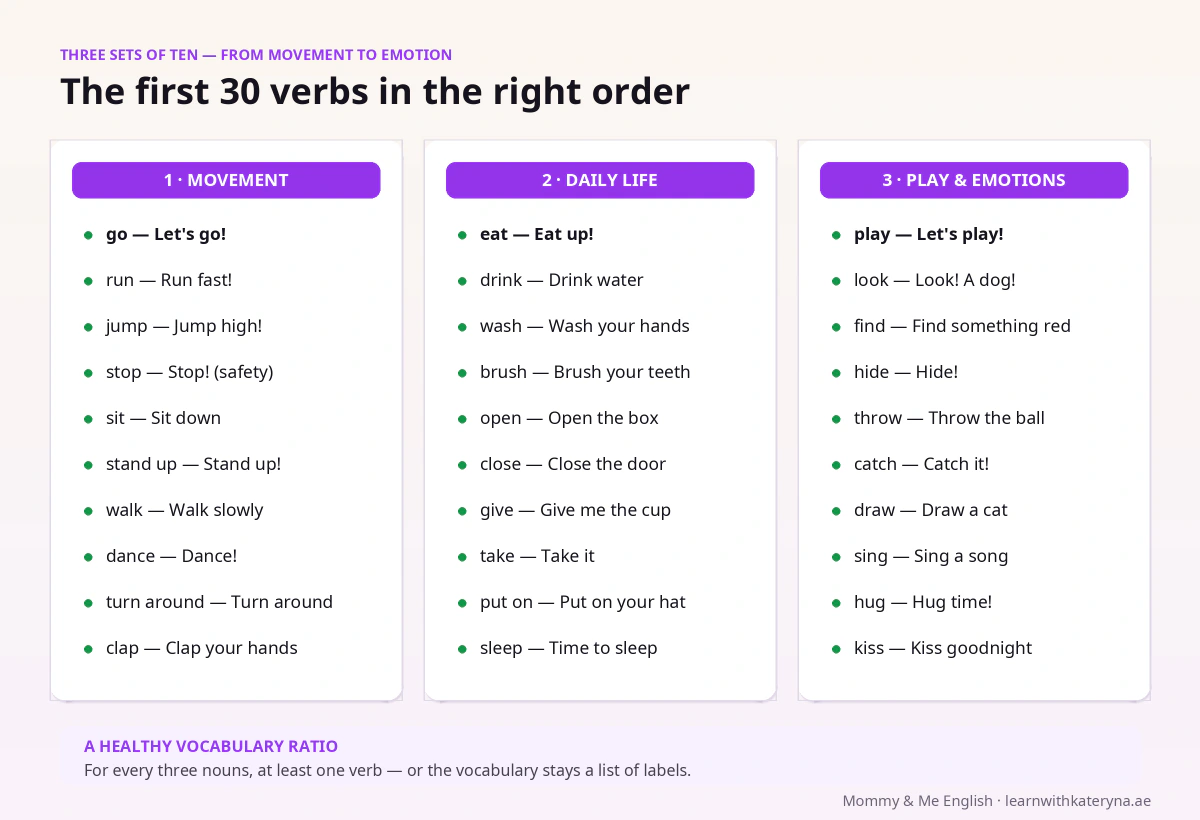
The first ten: movement verbs
Start with movement, because movement needs no explaining — it needs doing:
- go ("Let's go!" — the most frequent verb in all of toddler English)
- run
- jump
- stop (the safety verb — teach it among the very first!)
- sit ("Sit down, please")
- stand up
- walk
- dance
- turn around
- clap ("Clap your hands!")
This ten is a ready-made movement session. Put on a favourite song and fire the commands: "Run! Stop! Jump! Turn around! Sit!" Five minutes of this daily — and within two or three weeks the child executes all ten commands with no gesture hints. That is the true comprehension test: the word works without translation and without demonstration.
The second ten: everyday verbs
The second ten doesn't need separate "studying" — it already lives inside your daily rituals:
- eat
- drink
- wash ("Wash your hands!")
- brush (teeth, hair)
- open
- close
- give ("Give me the cup, please")
- take
- put on
- sleep
The most productive pair here is open/close: doors, boxes, books, cupboards, eyes. A child opens and closes dozens of things a day — every single one can sound in English. And give/take launches the first exchange dialogue I described in the phrases for parents: "Give me the ball, please" — "Here you are!"
The third ten: play and emotions
- play
- look ("Look! A dog!")
- find ("Find something red!")
- hide
- throw
- catch
- draw
- sing
- hug
- kiss
Hug and kiss are not "extra tenderness" — they are strategic words: verbs with strong positive emotion are remembered best of all and build the very "English = warmth" association that carries a toddler's whole motivation. "Hug time!" before bed is a ritual your child will soon start demanding in English herself.
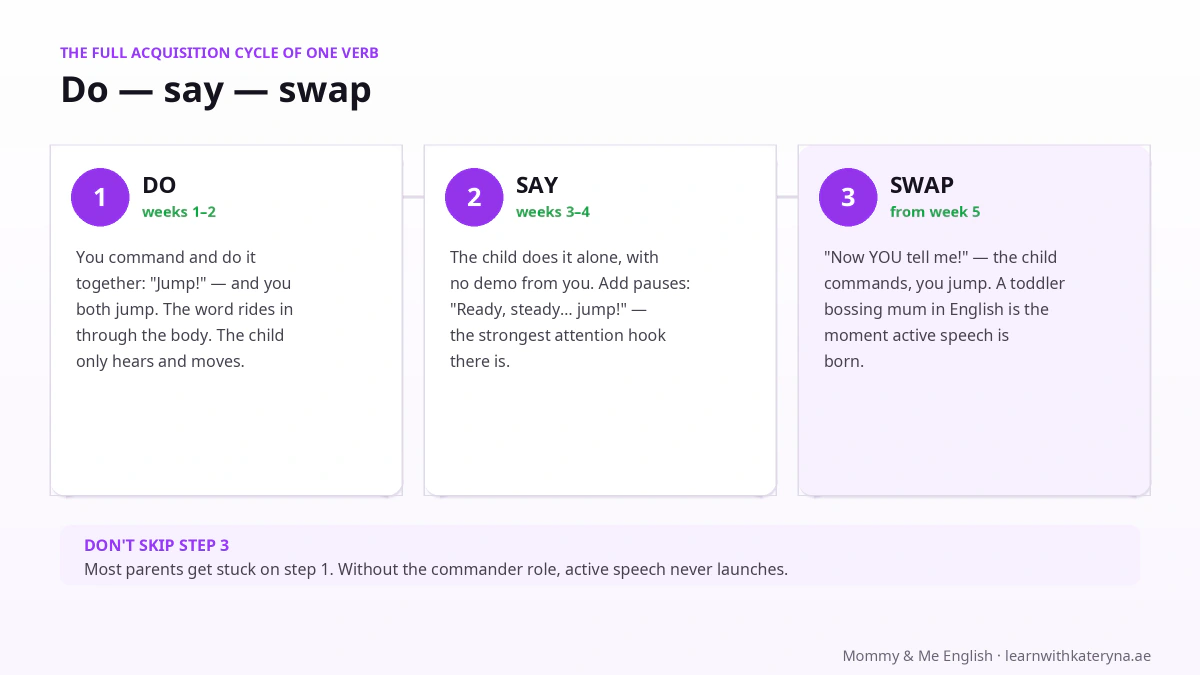
The three-step method: do — say — swap
Here is the full acquisition cycle of one verb — from zero to active use:
Step 1 — do (weeks 1–2). You command and do it together: "Jump!" — and you both jump. The child copies the movement; the word rides in through the body. At this stage the toddler doesn't speak — only hears and moves.
Step 2 — say (weeks 3–4). You command — the child executes alone, without your demonstration. Now add deliberate pauses: "Ready, steady… jump!" A stretched pause before a familiar word is the strongest attention hook there is.
Step 3 — swap (from week 5). The most important step, and the one most parents skip: hand the command over. "Now YOU tell me!" — and the toddler commands "Jump!" while you jump. The moment a child first bosses her mum around in English is the moment active speech is born. That moment is what the whole thing was for.
7 verb games
1. Music movement session. Music plays — commands fly: "Dance! Jump! Stop!" On "Stop!" — freeze. A classic that stays fresh for months.
2. Teddy the student. The toy "can't" jump — the child shows it how: "Jump, Teddy! Like this!" Teaching the toy, the toddler starts commanding without noticing — step 3 in its gentlest form.
3. Slow-fast. "Walk slowly… walk fast! Jump slowly… jump fast!" One verb, two speeds — and your first adverb pair thrown in for free.
4. The forbidden word. For 4+: execute every command except one ("no jumping today!"). The child has to listen to every single word — active recognition at its peak.
5. Action relay. "Run to the door! Touch the window! Bring the ball!" A chain of two or three commands trains not just verbs but sequence memory.
6. Verb hide-and-seek. "Hide!" — the child hides, you search with commentary: "Where is she? I can't find her!" Find and hide get learned as a pair inside one game.
7. The evening "film of the day." At bedtime, replay the day in verbs: "Today you jumped, played, ate, sang… and now — sleep!" A soft bridge to the past tense, which will come in handy later.
Building an English routine at home? The free Mommy & Me English starter guide lays out the daily rituals step by step.
From command to sentence
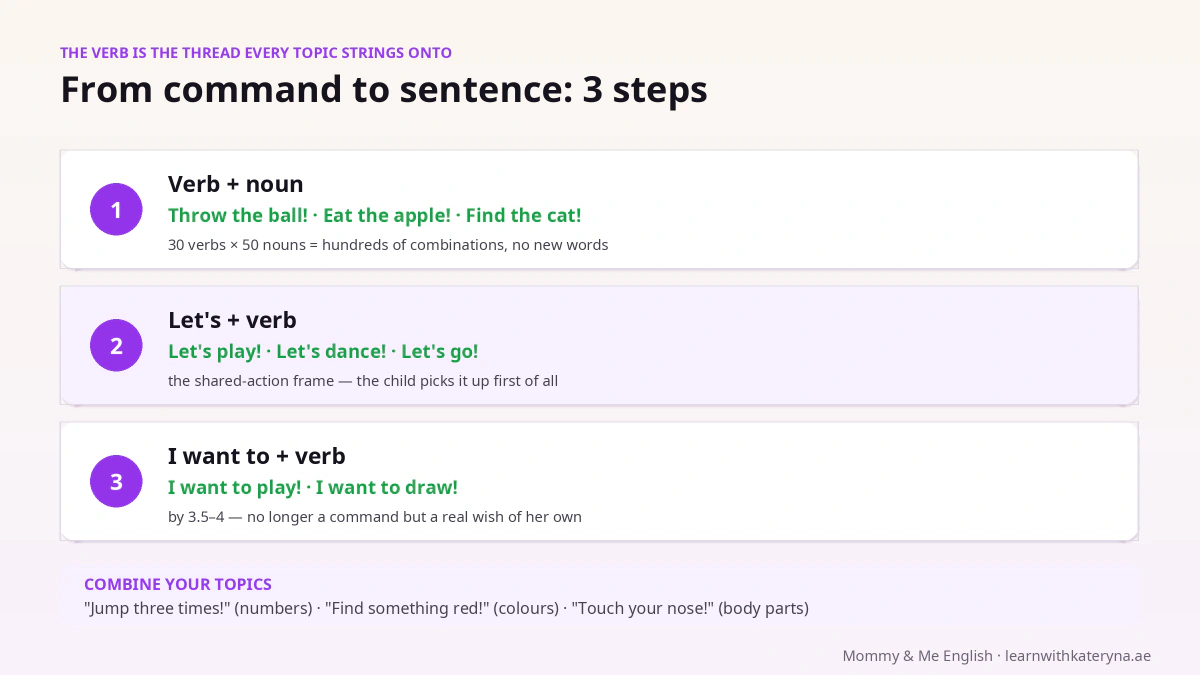
Once the first thirty work as commands, the best part begins — sentence assembly. The natural order:
Verb + noun: "Throw the ball!", "Eat the apple!", "Find the cat!" Every familiar verb multiplies by every familiar noun — thirty verbs and fifty nouns produce hundreds of combinations without a single new word.
Let's + verb: "Let's play!", "Let's dance!" — the shared-action frame a child picks up first, because it always announces something pleasant.
I want to + verb: around 3.5–4 the first "I want to play!" appears — no longer a command but a genuine statement of desire. From this moment the child's English starts growing on its own, asking only to be fed.
The numbers, colours and body parts you have already covered weave in naturally: "Jump three times!", "Find something red!", "Touch your nose!" — the verb becomes the thread onto which every previous topic gets strung (numbers, colours, body parts).
Opposite pairs: open/close, come/go, push/pull
Verbs learn best not alone but in opposite pairs — because opposition creates contrast, and contrast is what a toddler's attention runs on. You already know open/close from the second ten; here are the other pairs worth keeping together:
| Pair | The game in one line |
|---|---|
| come / go | "Come here! …Go-go-go!" — running to mum and away again |
| push / pull | a toy pram or a door: "Push! Now pull!" |
| put on / take off | getting dressed: "Put on your hat! Take off your shoes!" |
| pick up / put down | tidying up — the whole game is these two commands |
| turn on / turn off | the room light: every toddler's favourite "grown-up" job |
Notice: four of the five pairs are phrasal verbs — the very thing adult learners fear most. A toddler learns put on as one action-word, with zero fear — and at school it will turn out that English's "hardest" topic is already in her pocket. One of the most beautiful examples of the early-start advantage.
The game format for pairs is "the switch": the child performs an action, you abruptly command the opposite. "Push the door! …PULL!" The laughter at the sudden reversal is the same mechanism as stop-start games — and it holds attention indefinitely.
The narrating technique: Mummy is cooking
Beyond commands, verbs have a second life — narrating: you simply voice what is happening right now. "Mummy is cooking. Daddy is reading. You are jumping!" This is the gentlest of all techniques: it demands nothing from the child — no action, no answer — which is exactly why it works even with the most cautious children.
What happens linguistically: the child hears living Present Continuous hundreds of times — "is cooking," "are jumping" — at the moment the action is visible. No rules, no explanations about "-ing": the sound of the phrase welds itself to the picture of "action happening now." At school, years later, the teacher will "explain" this tense — and your child will recognise an old friend she has lived with half her childhood.
The practice: pick 2–3 moments a day for "reporting" — cooking dinner ("I'm cutting a tomato… now I'm mixing…"), tidying, the child's own play ("You are building a tower! It's growing!"). Speak slowly, briefly, about the obvious. And wait for the lovely moment that arrives after a few months: the child starts narrating herself — "Mummy is sleeping?" — peering into your eyes. A question built independently, with not one grammar lesson behind it.
Love, like, want: the verbs of the heart
The third category of verbs is not actions but states and desires. You can't demonstrate them with a jump — but they matter most for the child's relationship with the language:
want. The most practical verb of toddler life: "I want juice!", "I want to play!" It grows out of the choice question ("Do you want an apple or a banana?") heard hundreds of times — at some point the child simply "unscrews" want from the question and starts using it herself.
like. Introduced through food and cartoons: "Do you like it?" — with a thumbs-up. Yes → "I like it!" Together with yummy/yucky this is the second floor of the opinion system: the child gains a way to state her tastes, and you gain a way to ask.
love. The warmest verb in the language — and it should sound generously: "I love you" at bedtime, "I love hugs!", "Mummy loves you SO much!" Don't ration love — in English-speaking childhood culture the word flows far more freely than «любити» does in Ukrainian, and a child raised on a daily "I love you" receives not just language but an emotional anchor.
These three verbs are the bridge to the conversations that matter. A child who owns want, like and love can say what she wants, what she enjoys and whom she loves — which, if you think about it, are the three main things anyone ever says in any language.
The verb question: What are you doing?
The topic's final tool is the question "What are you doing?" It converts every learned verb from a reaction-to-command into conversation material.
It enters in three beats. Beat one: you ask and answer yourself, smiling at the child: "What are you doing? You are JUMPING!" She hears the question–answer frame dozens of times with zero pressure. Beat two (a few weeks later): you ask — and pause. If the child names the verb in any form ("Jump!", "Jumping!") — celebrate: that is an answer to a real question, the first step of dialogue. Beat three: the child asks you — it usually happens by itself, often at the funniest moment ("What are you doing, mummy?" — while you are digging under the sofa). Answer fully and seriously: "I'm looking for my phone!" A child whose questions receive real answers asks more and more of them.
Why this question is strategic: it hands the child the core mechanism of conversation — taking turns around shared attention. And it happens to be the most frequent question in any English-speaking nursery: teachers ask it dozens of times a day. A child who owns the frame "What are you doing? — I'm playing!" walks in with a ready key to communication.
5 parent mistakes with verbs
1. A hundred nouns — zero verbs. The most common imbalance: a year of practice, a huge vocabulary of labels — and not one sentence. A healthy toddler vocabulary ratio: at least one verb for every three nouns.
2. Teaching verbs from flashcards. A verb on a card is dead: you cannot draw "jump" the way you can draw "apple." Verbs are learned with the body — through command and movement, not pictures.
3. Demanding repetition instead of action. "Say jump!" is a dead end. The correct test of a verb is not pronunciation but execution: you said "Jump!" with no gestures — the child jumped — the word is acquired, even if she doesn't say it yet.
4. Getting stuck on step 1. Commanding and jumping together for months is comfortable, but without the "swap" step active speech never launches. As soon as the child executes a command alone — hand her the commander's role.
5. Rushing into grammar. "He runs, she runs — remember the -s!" — don't. Before five, all grammar enters through ready-made living phrases, not rules. A child who has heard "Mummy is coming!" hundreds of times will later "recognise" the Present Continuous at school like an old friend — the best possible foundation.
Next steps
Tonight — the first movement session: "Jump! Stop! Dance! Stop!" Five minutes, three verbs, plenty of laughter. Over a month, walk through the three tens with "do — say — swap," and don't skip the step where the child commands. Then verbs will start gluing themselves to nouns into first sentences — and that is when to return to the phrases for parents: they provide ready frames for this new level.
The complete system — video lessons, audio, movement sessions and a day-by-day plan — is in the Mommy & Me English starter guide: 10 minutes a day, no tutors, with mum in the leading role.


