 Kateryna Ivanova

Quick answer
Emirates cabin crew earn a tax-free package worth around AED 9,000–11,000 a month (≈ €2,300–2,800), made up of a fixed basic salary, hourly flying pay and an overseas allowance — plus free furnished accommodation, transport, medical cover and flight benefits on top. The headline number is smaller than many expect; the reason it stretches so far is that nothing is taxed and your biggest cost, rent, is covered.
TL;DR:
- Total monthly take-home is roughly AED 9,000–11,000 (≈ €2,300–2,800), tax-free. It is built from a fixed basic salary + hourly flying pay + an overseas allowance.
- Basic salary is about AED 4,430; flying pay adds ~AED 63.75 per hour for ~80–100 hours; layover allowances top it up.
- The salary comes with free furnished shared accommodation, transport to flights, medical and dental cover, concessional flight tickets, profit share and 30 days paid leave.
- Because the UAE has no personal income tax and housing is free, take-home is far higher than a similar gross salary in Europe.
- Pay rises as you move from economy crew to business/first, then senior and purser — the package grows with rank and hours.
How much Emirates cabin crew earn
Emirates cabin crew salary is a tax-free package, not a single fixed wage. New joiners on economy-class crew report a total of roughly AED 9,000–11,000 per month (≈ €2,300–2,800), and it moves month to month because part of your pay depends on how many hours you fly and where you stop over. The exact figure depends on your roster, your rank and the routes you work.
Two things make the number hard to compare with a normal job. First, none of it is taxed — the UAE has no personal income tax, so gross is take-home. Second, the salary sits on top of benefits that would cost you thousands elsewhere: your flat, your ride to the airport and your healthcare are all provided. For the official role details and current requirements, always cross-check the Emirates Group cabin crew careers page.
The Emirates salary is not the biggest headline number in aviation. It is one of the highest take-home packages, because tax is zero and your rent is not your problem.
The monthly pay, part by part
Your monthly pay is built from three moving parts. A fixed basic salary lands every month whatever your roster. On top of it, flying pay rewards the hours you are actually in the air. Finally, an overseas or layover allowance is paid for time spent away from your Dubai base.
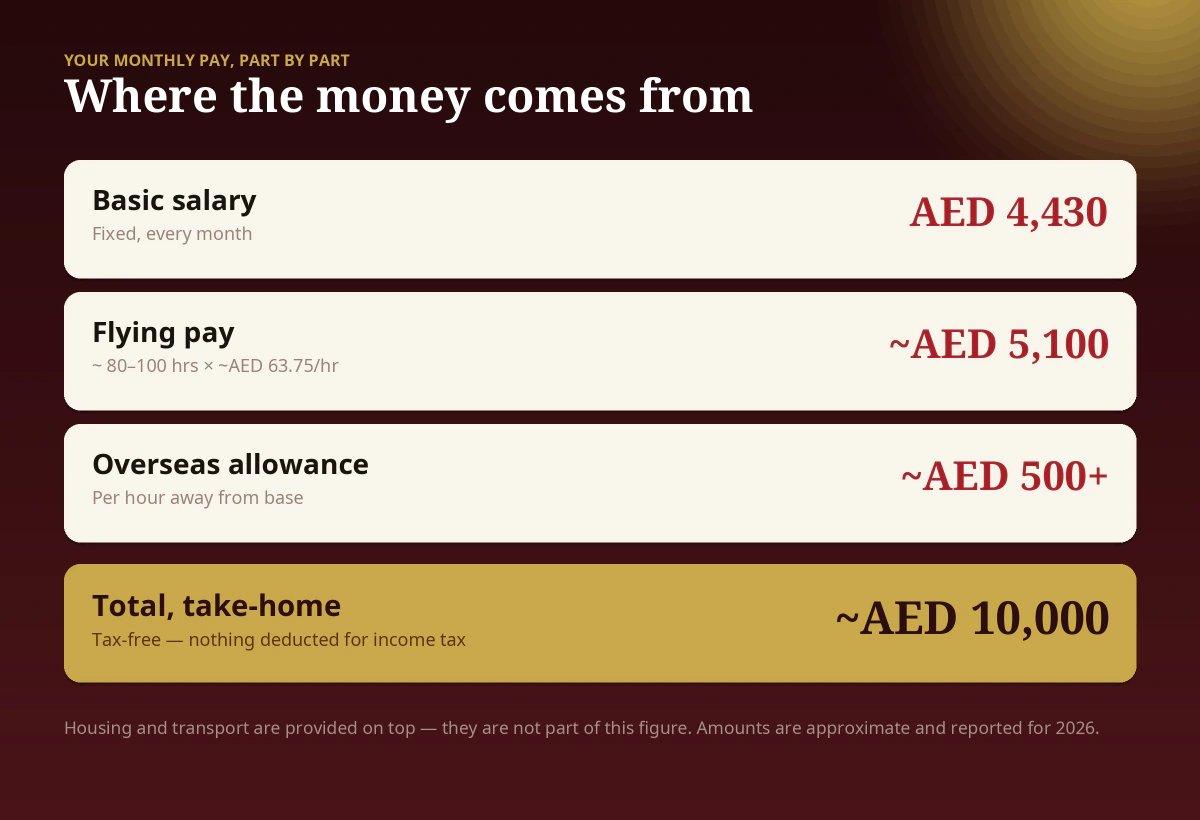
| Component | How it works | Approx. monthly |
|---|---|---|
| Basic salary | Fixed, paid every month | AED 4,430 |
| Flying pay | ~AED 63.75 × ~80–100 hours | ~AED 5,100 |
| Overseas allowance | Per hour away from base | ~AED 500+ |
| Total (tax-free) | Nothing deducted for income tax | ~AED 10,000 |
Fly more hours in a month and your pay rises; a lighter roster pays less. That variability is normal, and it is why crew talk about a range rather than one salary. Figures here are approximate and reported for 2026 — treat them as a planning guide, not a contract.
How your roster shapes your pay
Because flying pay is hourly, your monthly roster is the single biggest lever on what you earn. Emirates crew fly a mix of short-haul (the Gulf and nearby cities) and long-haul (Europe, Asia, the Americas and Australia), and each month's pattern changes the total. A month heavy with long-haul and ultra-long-haul sectors — think Dubai to Los Angeles or Auckland — pays more in flying hours and layover allowances than a month of quick regional turnarounds.
Safety rules set minimum and maximum monthly hours, so your pay moves within a band rather than without limit. As you gain seniority you get more say over your roster through a monthly bidding system, which lets experienced crew shape both their lifestyle and their earnings. For a new joiner the practical takeaway is simple: expect variation, budget around the lower end, and treat a strong long-haul month as a saving opportunity rather than a spending one.
Why "tax-free" changes the maths
Tax-free means the gross figure is the money that reaches your account. The UAE levies no personal income tax, confirmed on the UAE government's taxation page. For a candidate used to European payslips, this is the single biggest difference — and it is easy to underestimate.
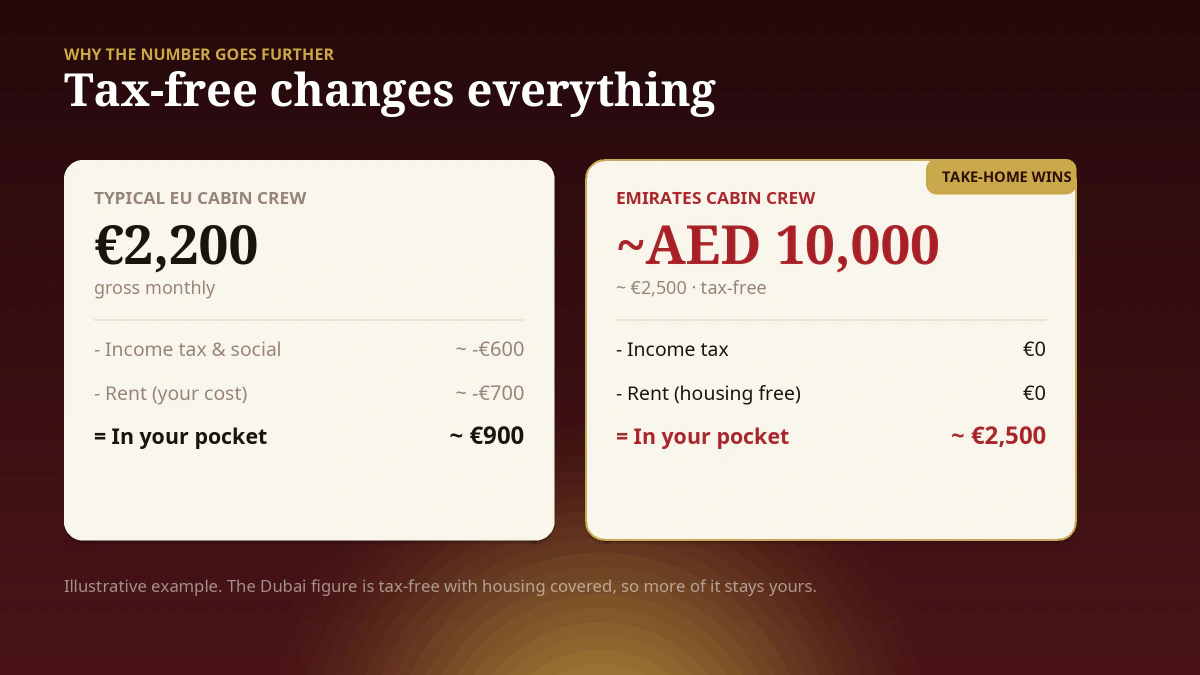
Compare two crew members. One earns €2,200 gross in Europe, loses roughly a quarter to tax and social contributions, then pays €700 rent — leaving under €1,000 to live on. The Emirates crew member on ~AED 10,000 (≈ €2,500) pays no tax and no rent, keeping close to the full amount. The gross figures look similar; the money you actually keep is not.
Do not compare gross to gross. A tax-free salary with free housing can leave you two to three times better off than a higher "on paper" wage in a taxed country.
Beyond salary: the benefits package
The benefits are where the Emirates package quietly beats its headline number. These are not perks you occasionally use — they replace costs you would otherwise pay every month.
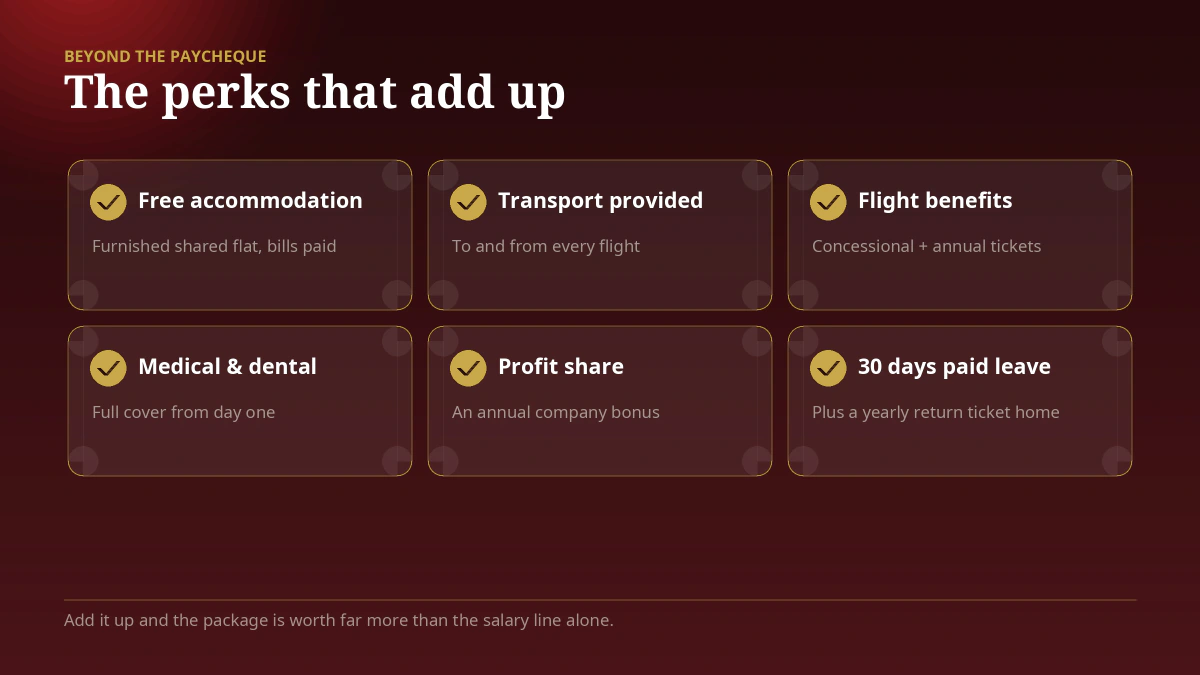
- Free furnished accommodation — a shared flat with bills covered.
- Transport — company buses to and from every flight.
- Flight benefits — concessional tickets for you, plus an annual ticket home.
- Medical and dental cover — from your first day.
- Profit share — an annual bonus when the airline performs.
- 30 days paid leave — with a return ticket to your home country.
Add the rent you are not paying, the healthcare you are not buying and the commute you are not funding, and the effective value of the package is well above the salary line alone.
What "free accommodation" really means
Free accommodation means Emirates provides a furnished flat, shared with other crew, with utilities included. You are typically placed with one or more flatmates in a serviced building, often with a pool and gym. You can choose to move to your own place later and take a housing allowance instead, but most new crew start in company accommodation because it removes the hardest part of relocating: finding and paying for a home in a new country.
This matters most for candidates moving from abroad. You arrive, you have a bed, and your first month's pay is not swallowed by a deposit. If you are planning a move from Ukraine or the EU, read our guide on how to become Emirates cabin crew for the full relocation picture.
Flight benefits and travel perks
Flight benefits are the perk crew talk about most. You get concessional (heavily discounted) tickets on Emirates' global network for yourself and, over time, for nominated family and friends. Once a year you also receive a ticket to your home country as part of your leave. For someone whose family is in Kyiv, Lviv or across Europe, the ability to fly home affordably is a real, recurring benefit — not a one-off.
There are limits: concessional tickets are usually standby or capacity-controlled, so they depend on seats being available. Still, for a job that already pays you to see the world, discounted personal travel on top is a genuine lifestyle upgrade.
What you earn during training
New joiners are paid from the start of ab-initio training, not only once they fly. Training in Dubai runs for roughly seven to eight weeks and covers safety, service, first aid and grooming. During this period Emirates already provides your accommodation and transport, and you receive an allowance while you learn — so you are not spending savings to get qualified.
Your full flying pay begins once you are line-qualified and rostered onto real flights, which is when the variable part of the package kicks in. In practical terms, the first "big" paycheck arrives after you finish training and complete your first month of flying. Budget for a modest first few weeks and a fuller pay cycle once you are operational.
You are paid to train, housed while you train, and flying within about two months. Few career changes fund your relocation and your qualification at the same time.
How pay grows with rank
Emirates cabin crew pay grows in two ways: by flying more hours and by moving up in grade. You start as economy-class crew, then qualify to work business and first class, then progress to senior grades and eventually to Purser (the cabin manager). Each step adds to your basic pay and unlocks higher-paying positions on the aircraft.
- Economy crew — your starting grade after training.
- Business / First-class crew — after you qualify on premium cabins.
- Senior crew (Grade 1) — more responsibility, higher basic.
- Purser — you run the cabin and lead the team, with the highest crew pay.
Progression is based on performance, service record and time, not a fixed calendar. Strong English and calm service under pressure move you up faster — which is exactly what we build in English for cabin crew.
Earning potential over a few years
The salary story gets stronger with time. A crew member who stays three to five years typically moves through premium-cabin qualification and into senior grades, lifting both basic pay and the higher-paying positions they can work. Purser pay sits well above starting crew pay, and by then you also fly with more control over your roster.
Stack that on tax-free income and free housing and the multi-year picture is unusual: crew routinely use the first few years to clear debt, build a serious deposit, or fund a next step — a degree, a business, or a move into airline management or training roles. The job is a strong salary today and, handled well, a financial launchpad for whatever comes after.
Emirates vs Qatar vs Etihad pay
The three big Gulf carriers pay in a similar band, all tax-free with accommodation provided. The differences are in the details rather than the headline.
| Airline | Base | Package feel |
|---|---|---|
| Emirates | Dubai | ~AED 9–11K + housing, largest network |
| Qatar Airways | Doha | Comparable, tax-free, housing provided |
| Etihad | Abu Dhabi | Comparable, tax-free, housing provided |
Choose on lifestyle and network, not a few hundred dirhams. Dubai's size, connections and community are why many crew target Emirates first. Whichever you pick, the interview skills are the same — see our STAR method guide and the assessment day walkthrough.
What you still pay for
Free housing does not mean free living, and an honest budget matters. Emirates covers the big fixed costs — your flat, bills, transport to flights, healthcare, your visa and your uniform. What stays on you is day-to-day life: food and groceries, your phone plan, personal travel between rosters, gym or hobbies, and the social side of Dubai, which can be as cheap or as expensive as you make it.
A sensible new-crew monthly budget for personal spending sits around AED 2,500–4,000, depending on how much you eat out and travel. Because the essentials are handled, this is discretionary money rather than survival money — the difference that lets crew save while still enjoying the city.
A first-year money example
Here is an illustrative first-year picture for a single new crew member who lives sensibly. It is an example, not a promise — your roster and habits will shift the numbers.
| Monthly | Amount (approx.) |
|---|---|
| Take-home pay (tax-free) | ~AED 10,000 |
| Rent | AED 0 (provided) |
| Transport to flights | AED 0 (provided) |
| Personal spending (food, phone, fun) | ~AED 3,500 |
| Possible monthly saving | ~AED 6,500 |
At that rate, a disciplined first year can leave you with roughly AED 70,000–78,000 in savings (≈ €18,000–20,000) — after seeing dozens of countries and paying no rent. On a taxed European salary with rent, saving that much in twelve months is rarely possible. That gap, more than the headline wage, is the real financial case for the job.
What it means for a candidate from Ukraine or the EU
For a candidate relocating from Ukraine or the EU, the real story is savings. With rent, transport and healthcare covered and no tax, a disciplined new crew member can save a large share of their pay — something almost impossible on an equivalent European wage where rent alone eats a third of it. Many crew send money home and still build savings in their first year.
The trade-offs are honest ones: you live far from home, your roster is irregular, and jet lag is part of the job. But the financial head start — no debt for a flat, tax-free income, a free flight home each year — is why so many Ukrainian and European candidates treat the role as a springboard.
Common salary myths
Three myths cause the most confusion:
- "The basic salary is the salary." No — basic is only one of three parts. Flying pay and allowances often add more than the basic itself.
- "It's low pay." The gross looks modest, but tax-free income plus free housing changes the comparison entirely. Judge it by what you keep.
- "Everyone earns the same." No — hours flown, cabin, rank and roster all move the number. Two crew in the same month can earn noticeably different totals.
Is it worth it? Next steps
For most candidates the answer is yes: a tax-free package, free housing, global travel and clear progression make Emirates cabin crew one of the strongest entry points in aviation — especially if you are moving from a higher-tax country. The salary rewards preparation, because getting hired is the hard part, not the pay.
Want the wider picture? See how Emirates pay compares with Qatar, Etihad and Saudia in our cabin crew salary by airline guide.
Ready to move from reading to doing? Book a free consultation call with Kateryna — a former Emirates crew member — using the planner just below, and we'll map your exact path and timeline. Then work through the funnel: get your English to level, fix your CV and photo, prepare with the assessment day guide, and see the full course on the Emirates cabin crew course page. You can also drill real interview scenarios free in the CrewQuest trainer.