 Kateryna Ivanova

Quick answer
Who can become Emirates cabin crew? You must be at least 21, able to reach ~212 cm to a wall on tiptoes (usually a minimum height around 160 cm), have finished secondary school, speak fluent English, carry no tattoos visible in uniform, and be able to swim. Meet those and you are eligible to apply — the rest is preparation, not gatekeeping.
TL;DR:
- You must be 21 or older at the point of joining. There is no upper age limit, so career-changers are welcome.
- The physical rule that trips people up is arm reach: ~212 cm to a wall on tiptoes, which usually means a minimum height of around 160 cm.
- You need secondary education, fluent spoken and written English (roughly B1+), no visible tattoos in uniform, and the ability to swim ~25 m unaided.
- No degree, no IELTS certificate and no prior flying experience are required — but your English and grooming are assessed live throughout.
- The requirements are an eligibility floor. Being eligible gets you into the room; preparation, English and confidence get you the job.
By the numbers
212 cm arm reach on tiptoes · ~160 cm minimum height · 21+ years · secondary education · fluent English.
Source: Emirates Group Careers — Cabin Crew. Emirates can adjust criteria by intake and base, so confirm on their page before applying.
Am I eligible? The full checklist
Eligibility for Emirates cabin crew is a short, fixed list of minimum standards you either meet or you don't. Unlike the interview — which is judged on how you perform — the requirements are objective: your age, your reach, your height, your education and your English either clear the bar or they don't. That is good news, because it means you can check most of them yourself today, before you spend a single evening preparing an application.
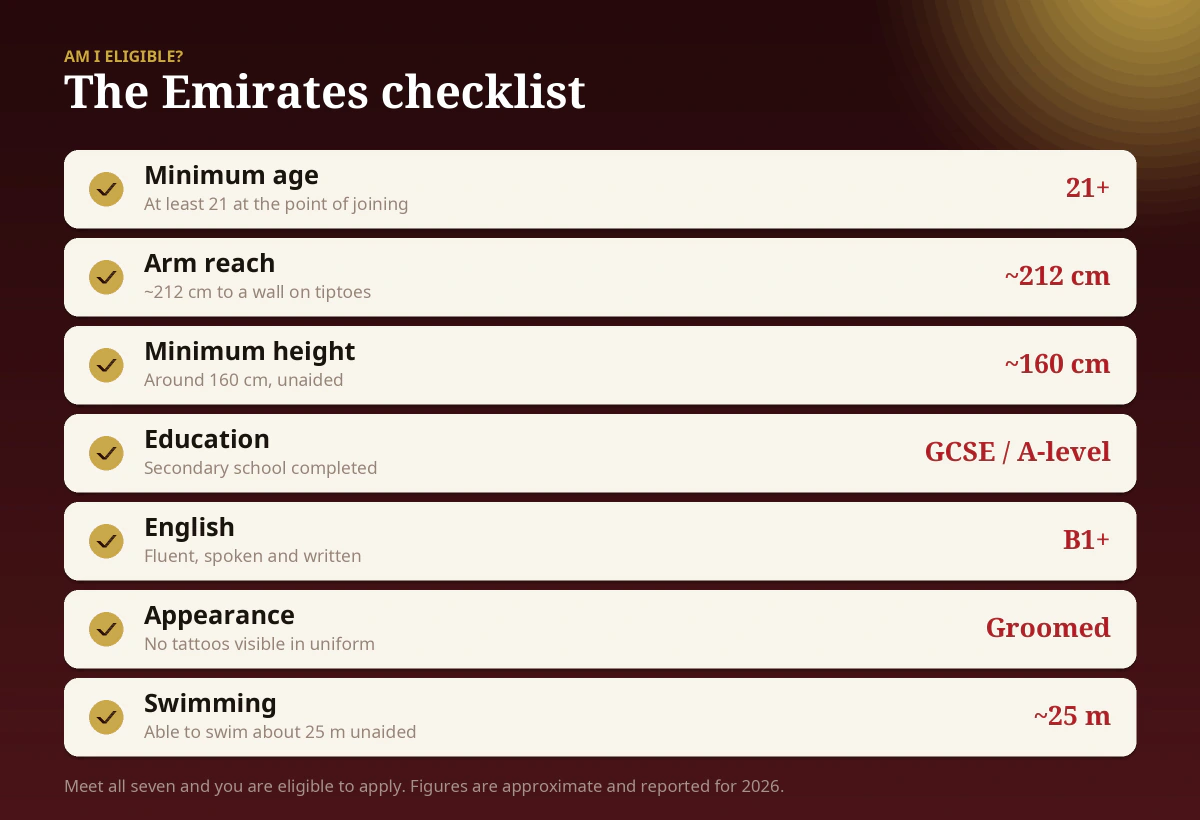
Run through the seven points above honestly. If you clear all of them, you are eligible to apply, and your energy should go into your CV, your English and your assessment-day performance rather than worrying about the basics. If one point is borderline — reach, for instance — it is worth measuring it properly rather than assuming. Once you know you qualify, the next move is the full application walkthrough in our pillar guide, how to become Emirates cabin crew.
The requirements are not there to reject you. They exist because a cabin crew member has a safety role first and a service role second — every rule maps to something you may have to do at 38,000 feet.
Age requirement (and why there is no upper limit)
The Emirates minimum age is 21 at the point of joining, not at the point of applying. That distinction matters: you can apply while you are 20 as long as you will have turned 21 by the time you would start training. The rule exists partly for legal reasons — crew serve alcohol and take legal responsibility for a cabin — and partly because the role demands a level of composure that the airline associates with adulthood.
Just as important is what the rule does not say. There is no published upper age limit. Emirates hires crew in their late twenties, thirties and beyond, and career-changers are common — former teachers, nurses, hospitality staff and retail managers all move into the cabin. What matters at any age is fitness, energy and the ability to handle an irregular roster. If you are worried you have "missed the window," you almost certainly have not; life experience and calm under pressure are assets in this job, not liabilities.
For candidates relocating from Ukraine or the EU, the practical takeaway is that the age rule is one of the easiest to satisfy. Focus your attention on the parts you can actively improve — your English and your interview technique — rather than on a number you cannot change.
Arm reach and height explained
Arm reach is the single physical requirement that surprises candidates most. Emirates asks that you can reach approximately 212 cm up to a wall while standing on tiptoes. This is not about being tall for its own sake — it is because emergency and safety equipment, along with overhead lockers, sit high in the cabin. If you cannot reach the equipment, you cannot do the safety part of the job, and the safety part is the reason the role exists.
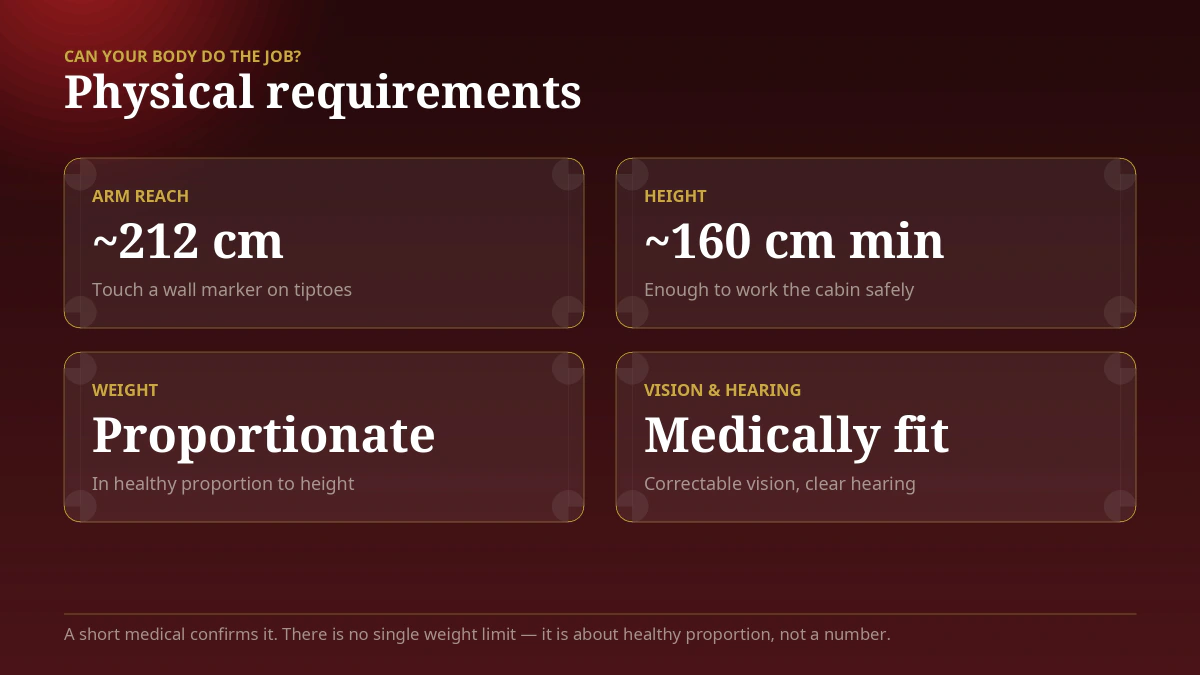
Because reach and height are linked, the arm-reach rule usually translates to a minimum height of around 160 cm — but reach is what is actually measured, not height alone. Someone who is 158 cm with long arms may pass; someone who is 162 cm with a shorter reach may need to check carefully. Do not guess. The exact test, how to measure yourself at home and how to practise it are covered step by step in the CrewQuest reach test tool, which is the right place to confirm this rather than eyeballing it.
One more point candidates miss: the reach is measured on tiptoes, unaided, in a controlled way at the assessment. You cannot use a stool or stretch awkwardly. If you are close to the line, measure honestly against a wall now, so there are no surprises on the day.
Physical and medical fitness
Physical fitness for cabin crew means being healthy, mobile and medically able to work long shifts across time zones, not being athletic. The job is physically demanding in a specific way: you are on your feet for hours, pushing heavy carts, managing jet lag and staying alert during long-haul sectors. You do not need to be a gym regular, but you do need stamina and general good health.
There is no single weight limit. Emirates asks that your weight is in healthy proportion to your height — a proportionate build, not a number on a scale. The reasoning is practical: you must be able to move quickly through a narrow aisle, fit through emergency exits and perform physical safety tasks. A short medical assessment as part of the hiring process confirms your general fitness, vision and hearing. Vision that is correctable with glasses or contact lenses is fine, and clear hearing matters because you must understand and give safety commands over cabin noise.
If you have a managed medical condition, do not self-reject. Many conditions are compatible with flying once assessed. The honest approach is to be open, provide what the medical asks for, and let the aviation-medical process decide — it is designed exactly for that.
The English requirement
The English requirement is the one that quietly decides more applications than any physical rule. Emirates crew must speak and write fluent English — practically, this means a confident level of roughly B1 or above on the European framework: enough to understand safety commands, handle passenger requests under pressure and make clear announcements. English is the working language of the cabin, so it is non-negotiable in a way that height, for many people, is not.
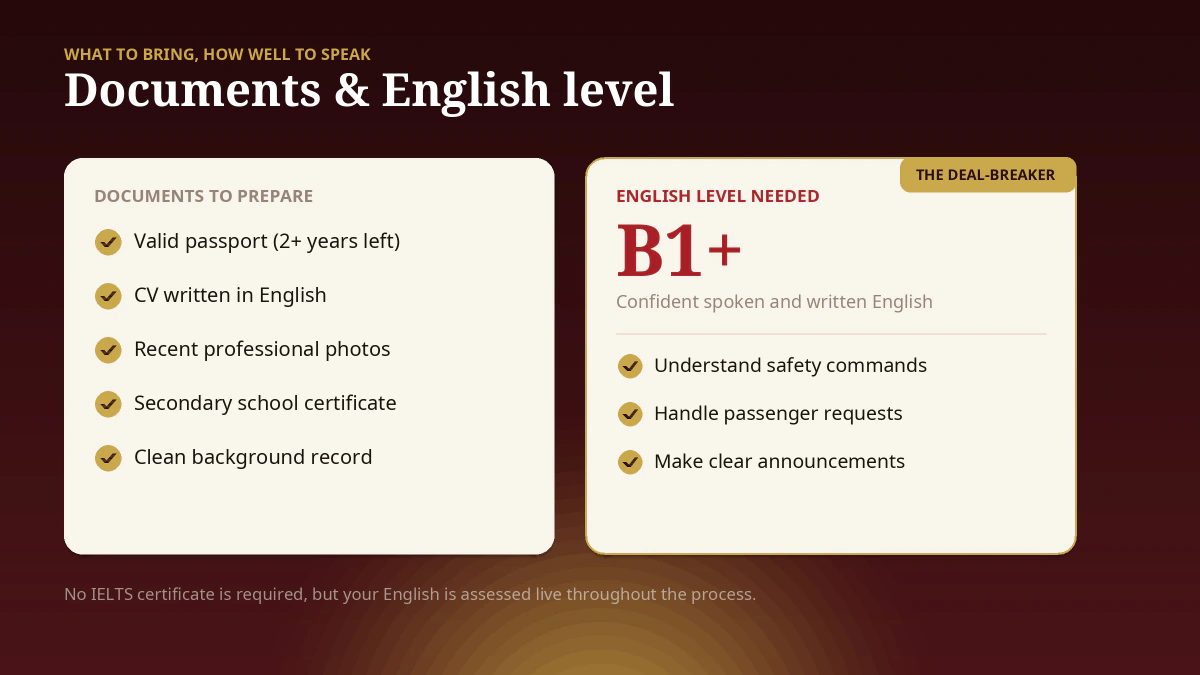
Here is the detail candidates get wrong: no IELTS or formal English certificate is required. There is no exam to pass and no score to submit. Instead, your English is assessed live — in your group exercises, your one-to-one conversation and how you handle role-plays on the assessment day. That is harder to fake than a certificate and easier to prepare for than most people think, because it rewards natural, confident, everyday communication rather than exam grammar.
Two things carry disproportionate weight: pronunciation clear enough to be understood by passengers from anywhere, and the confidence to keep speaking when you are nervous. If your English is your weak point, it is also your biggest opportunity — it is the one requirement you can measurably improve in weeks. That is exactly what our English for cabin crew guide is built to do, focusing on the aviation phrases, announcements and interview answers you will actually use.
You do not need perfect grammar. You need to be understood instantly, stay calm when you are put on the spot, and sound warm while you do it. That is a trainable skill, not a fixed talent.
Education and experience
The education requirement is minimal: you need to have completed secondary school — the equivalent of GCSEs, a high-school diploma or your national school-leaving certificate. A university degree is not required and gives you no automatic advantage. This surprises candidates who assume aviation demands qualifications; in reality, Emirates trains you fully in-house, so what they screen for is attitude and communication, not academic credentials.
Prior flying or aviation experience is also not required. Most successful applicants come from customer-facing roles — hospitality, retail, healthcare, tourism — because those jobs build the exact skills the cabin needs: patience, service under pressure and reading people quickly. If your background is in one of those fields, frame it as an asset. If it is not, the assessment day still gives everyone the same chance to show they can do the job. To see how that day actually runs, read our assessment day walkthrough.
What all of this means is reassuring: the education bar is low on paper and the real selection happens on soft skills. You are not competing on diplomas. You are competing on how you communicate, how you carry yourself and how you handle a group.
Appearance, tattoos and grooming
Grooming standards for Emirates cabin crew are about a consistent, polished uniform image, and the headline rule is simple: no tattoos may be visible when you are in uniform. A tattoo on your upper arm, back or torso that the uniform covers is generally fine; a tattoo on your hands, neck, lower forearm or ankle that shows below a sleeve or above a collar is a problem, and cannot be covered with makeup on the job. Piercings beyond a modest ear stud are also expected to be removed at work.
The reason is brand, not judgement. Emirates presents a single, uniform standard of crew appearance across every flight, and visible individual markings break that consistency. This is worth checking honestly against your own situation before you apply — a tattoo you forgot about on your wrist can end an otherwise strong application at the medical stage. The full expectations for hair, makeup, uniform fit and presentation are set out in the CrewQuest grooming standards guide, which is the place to go for the detail rather than duplicating it here.
The good news is that grooming is entirely within your control. Unlike height, you can meet every grooming standard with preparation: a clean, professional presentation at the assessment day signals that you already understand the role and can hold the standard the airline sells.
Documents you need to prepare
The documents you need are straightforward, but having them ready early removes stress later. At minimum, prepare a valid passport, a CV written in English, recent professional photographs and proof that you finished secondary school.
- A valid passport — ideally with at least two years of validity left, so it comfortably covers training and your first contract period.
- A CV in English — one page, clean, and focused on customer-facing experience. Formatting and photo standards matter more than length.
- Professional photos — usually a formal portrait and a full-length shot, groomed to the standard you would fly in.
- Secondary education certificate — your school-leaving qualification, translated to English if needed.
- A clean background — a clear record and honest history; background and reference checks are standard in aviation.
Your CV and photos do a lot of quiet work, because they are the first filter before any human meets you. Getting them right is a small, high-leverage task — our guide to the Emirates cabin crew CV and photo shows exactly what recruiters expect and the mistakes that get applications skipped.
Swimming and safety readiness
The swimming requirement is a genuine safety rule: you must be able to swim roughly 25 metres unaided. It exists because cabin crew are trained for water evacuations and must be able to help passengers in the extremely rare event of a ditching. You do not need to be a competitive swimmer, and you are not timed against a stopwatch — you simply need to be a confident, capable swimmer who will not panic in water.
If you cannot yet swim 25 metres comfortably, this is one of the most fixable requirements on the list. A few weeks of regular pool practice, or a short course of lessons, will get most adults there. Treat it like any other part of your preparation: identify the gap early, close it before you apply, and arrive at the process with it already handled rather than hoping it will not come up.
Swimming sits alongside the broader theme of safety readiness. Everything in cabin crew training — first aid, evacuation drills, firefighting, the swim test — points at the same truth: the airline is hiring a safety professional who also delivers world-class service, and every requirement is a small proof that you can be trusted with that.
Emirates vs Qatar vs Etihad requirements
The three big Gulf carriers share almost identical eligibility rules, so if you qualify for one, you very likely qualify for all three. The differences are small and rarely decisive.
| Requirement | Emirates | Qatar Airways | Etihad |
|---|---|---|---|
| Minimum age | 21 | 21 | 21 |
| Arm reach | ~212 cm | ~212 cm | ~212 cm |
| Minimum height | ~160 cm | ~157–160 cm | ~160 cm |
| Education | Secondary | Secondary | Secondary |
| English | Fluent (B1+) | Fluent | Fluent |
| Tattoos in uniform | None visible | None visible | None visible |
Because the bar is so similar, your choice between them should come down to base city, network and lifestyle rather than requirements — a point we cover from the money angle in the Emirates cabin crew salary breakdown. Whichever you target, prepare once and you are prepared for all of them, since the assessment skills transfer directly.
Common eligibility mistakes
Most people who fail the requirements do so avoidably. These are the errors that end applications before they start:
- Guessing your reach instead of measuring it. Reach is the most common near-miss. Measure against a wall on tiptoes before you assume you pass or fail.
- Assuming you are "too old." There is no upper age limit. This myth stops strong career-changers from ever applying.
- Thinking you need a degree or IELTS. Neither is required. Secondary school and live-assessed fluent English are the real bars.
- Forgetting a visible tattoo. A small tattoo on the wrist, foot or neck can surface at the medical stage. Check every visible area now.
- Leaving English preparation too late. Fluency is the requirement you can most improve — and the one candidates most often neglect until it is too close to the assessment.
Every one of these is a checkable fact, not an opinion. Spend an hour confirming your reach, your tattoos and your documents, and you eliminate the most common reasons good candidates never make it past the first filter. For the official, always-current statement of the role and its criteria, cross-check the Emirates Group cabin crew careers page, and for the wider legal context of working in the UAE, the UAE government's visa and residency information is the authoritative source.
Am I ready? Next steps
Being eligible is the start line, not the finish. If you clear the checklist — age, reach, height, education, English, appearance and swimming — you have earned the right to apply, and now the work that actually gets people hired begins: sharp English, a clean CV and photo, and calm, confident performance on the assessment day.
Applying to more than one carrier? Compare the eligibility rules across Qatar, Etihad and Saudia in our cabin crew requirements by airline guide.
Ready to turn "eligible" into "hired"? Book a free consultation call with Kateryna — a former Emirates crew member — using the planner just below, and we will map your exact path, confirm any borderline requirements and build your timeline. Then work through the funnel: get your English to level, fix your CV and photo, prepare with the assessment day guide, and see the full programme on the Emirates cabin crew course page. You can also drill real interview and reach scenarios free in the CrewQuest trainer. The requirements let you in the door — preparation is what walks you through it.


