 Kateryna Ivanova

A cabin crew cover letter is a one-page message that tells an airline why you want to fly for them and why they should want you in their cabin. For Emirates and the other Gulf carriers it should be four short paragraphs: a hook, why this airline, one real service story, and a confident close. It is not a summary of your CV — it is the human voice behind it, and it is often what earns you the invitation to assessment day.
TL;DR:
- Keep it to one page and four short paragraphs: hook, why this airline, service proof, confident close.
- Answer the two questions a recruiter really asks — "why you" and "why us" — and answer "why us" with something specific to that airline.
- Prove your service with one concrete story, not a list of adjectives like "hardworking" and "passionate".
- You can write a strong letter with no aviation experience — transferable service, hospitality and customer stories count.
- End by asking for the interview, keep the tone warm and calm, and never just repeat your CV line by line.
What a cabin crew cover letter is
A cabin crew cover letter is a short, tailored letter that sits beside your CV and speaks in your own voice. Its job is narrow and specific: to make a recruiter feel, in under a minute, that you understand the role, that you chose their airline on purpose, and that you would be calm and warm with passengers when a flight goes wrong. A CV lists what you have done. The cover letter — sometimes called a cabin crew motivation letter — explains why you did it and why it points to this cabin.
It is easy to treat the letter as a formality, especially when an online form asks you to paste one in. That is a mistake. Recruiters at Emirates and other carriers read hundreds of near-identical CVs, so a letter that sounds like a real person with a real reason to fly stands out immediately. You are not writing an essay. You are writing four tight paragraphs that a busy person can skim and still walk away thinking, "I want to meet them."
Your CV proves you can do the job. Your cover letter proves you want this job, at this airline — and that difference is what gets you into the room.
Why the cover letter still matters
The cover letter matters because hiring for cabin crew is a hiring for personality as much as paperwork. Airlines can train you to open a door in an emergency and pour a drink at altitude. They cannot easily train warmth, composure and the instinct to notice a nervous passenger. The letter is your first chance to show those traits before anyone meets you, and it frames how a recruiter reads everything else in your application.
There is a practical reason too. For big campaigns, an airline or its agency may screen applications quickly, and a flat, copy-pasted letter is an easy reason to move on. A specific, human letter gives the reader a reason to keep reading — and, at an open day or assessment, a memorable line can become the thing an assessor recognises when your name comes up. It is a small document doing a large amount of work.
None of this means the letter has to be long or clever. The best ones are simple, warm and specific. Before you write a word, it helps to know exactly what the airline is looking for; our full guide on how to become Emirates cabin crew walks through the requirements, the process and the mindset that the letter should reflect.
The four-paragraph structure that works
The four-paragraph structure is the simplest reliable shape for a cabin crew cover letter: a hook, a "why this airline" paragraph, a service proof, and a confident close. Each paragraph has one job, and none of them repeats the CV. Keep every paragraph to two or three sentences and the whole letter fits comfortably on one page.
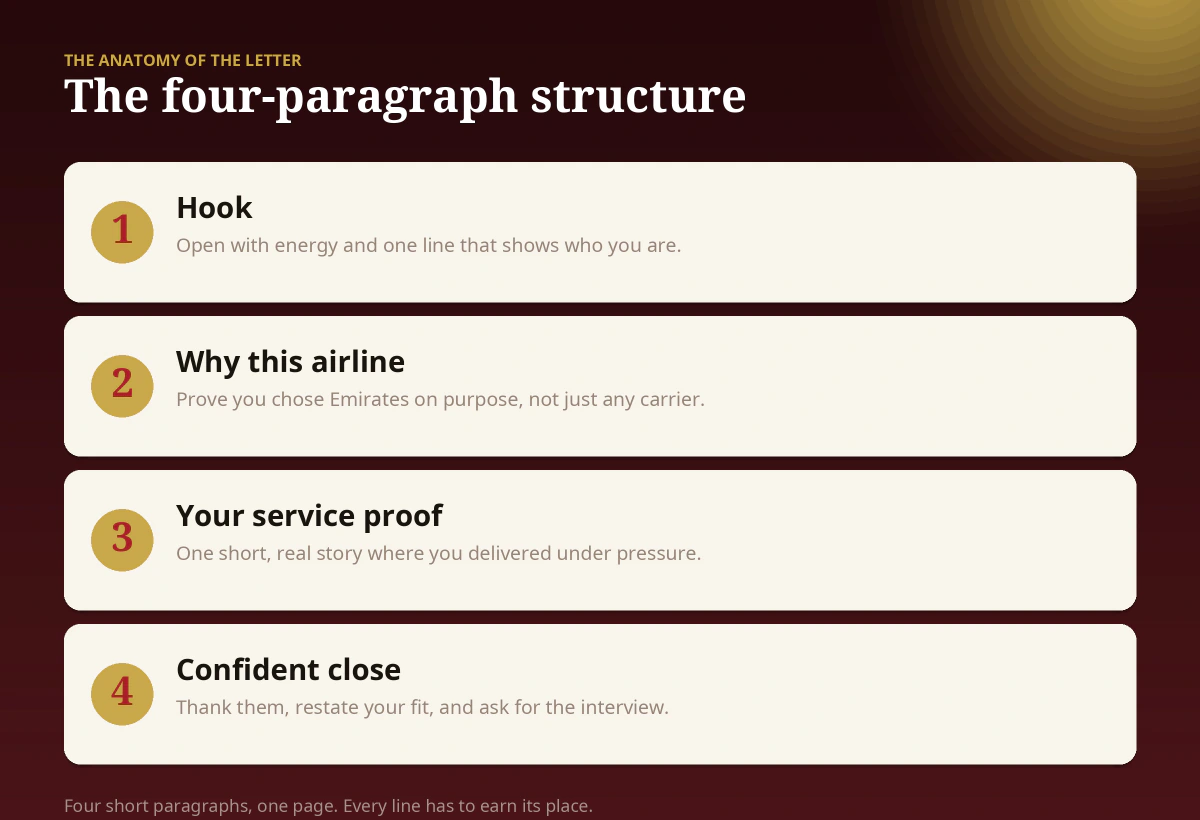
Here is what each paragraph is trying to achieve, and a quick example line for each so you can see the difference between a generic and a specific version.
| Paragraph | Its one job | A stronger example line |
|---|---|---|
| 1. Hook | Show who you are in one human line | "Turning tense boarding gates into calm ones is the part of my job I love most." |
| 2. Why this airline | Prove you chose them on purpose | "Your service across 140+ destinations is the standard I want to hold." |
| 3. Service proof | One real story, not adjectives | "When a family missed a connection, I rebooked them and walked them to the lounge." |
| 4. Confident close | Thank, restate fit, ask to meet | "I would love to bring that care to your cabins — I hope we can talk at assessment day." |
Think of the whole thing as a short conversation. You introduce yourself, you show you know who you are talking to, you give one piece of evidence, and you ask politely for the next step. If you can write those four moves clearly, you have a letter that beats most of the pile.
Writing a hook that earns the next line
The hook is the opening sentence whose only job is to make the recruiter read the second sentence. Most cabin crew cover letters open with the weakest possible line — "I am writing to apply for the position of cabin crew as advertised on your website" — which tells the reader nothing and sounds like everyone else. Cut it. Start instead with a small, true detail about you and the work.
A good hook is specific and human. It can name the moment you knew you wanted this job, a trait that shows up in how you serve people, or a short reason the sky pulls you. "The morning I calmed a frightened first-time flyer, I knew I wanted to do it for a living" works far better than any template opener. You are not being dramatic — you are being real, in one sentence, and then moving on.
If English is your second language, the hook is where you most want your grammar and rhythm to be clean, because it sets the tone for everything after. Reading your opening aloud is the fastest test: if it sounds like a person talking, keep it; if it sounds like a form, rewrite it. Sharpening that spoken-English confidence is exactly what we drill in English for cabin crew.
The "why this airline" paragraph
The "why this airline" paragraph is the sentence or two that proves you are applying to them and not simply to any airline that is hiring. This is the paragraph most candidates skip or fake, and recruiters spot a generic version instantly. If you could swap the airline's name for a competitor and the letter would still make sense, you have not written this paragraph yet.
For an Emirates cover letter, be concrete. Mention the scale of the network, the multicultural crew, the service reputation, the Dubai base, or a real experience you had as a passenger — anything that shows you looked. "I want to work for an airline that treats service as a craft, and Emirates' reputation across its global network is exactly that standard" is specific enough to feel true. You can confirm the current employer messaging and values on the official Emirates Group cabin crew careers page, and read about life and work in the country on the official UAE government portal.
If your "why this airline" paragraph would still be true after you paste in a rival's name, it is not doing its job. Name one thing only that airline offers.
Proving your service with one story
The service proof is the paragraph where you show, with one short story, that you already do the job that cabin crew do on the ground: look after people calmly under pressure. Adjectives are cheap — "passionate", "hardworking", "a great team player" mean nothing on their own. A single concrete moment where you solved a customer's problem is worth more than a paragraph of praise about yourself.
Pick one story and tell it in three beats: the situation, what you did, and the result. It does not have to be dramatic. A delayed guest you rebooked, a difficult customer you defused, a colleague you covered for in a rush — any of these show the instincts an airline wants. Keep it to two or three sentences; the letter is a trailer, not the film. This is the same evidence-first thinking behind the interview technique in our STAR method guide, so a story you use here can double as interview preparation.
One more thing recruiters quietly reward: results and specifics. "I helped a lot of customers" is weak; "I handled a queue of thirty frustrated guests during a system outage and kept every one of them informed" is strong. Numbers, names of feelings, and a clear outcome make a story land. That is one of the few genuinely reliable levers you have in a cover letter.
Closing with confidence
The close is the final paragraph that thanks the reader, restates your fit in one line, and clearly asks for the interview. Weak letters trail off with "I look forward to hearing from you" and nothing else. A strong close is warm and slightly bold: it assumes the next step is worth taking and invites it. You are not begging — you are politely proposing a meeting.
Keep it to two sentences. Thank them for their time, say in a few words what you would bring to their cabin, and end by expressing that you hope to show them more in person or at an assessment day. Confidence here is a signal of the composure they are hiring for; a candidate who closes with a clear, friendly ask reads as someone who will be comfortable in front of passengers.
A cover letter with no experience
A no-experience cabin crew cover letter is one that leans entirely on transferable service skills instead of aviation history — and it can be just as strong as any other. Airlines hire people with no flying background all the time; what they want is proof that you can do the human part of the job. Waiting tables, retail, nursing, teaching, childcare, hospitality, call-centre work — all of it involves calm service, problem-solving and reading people under pressure.
The move is simple: translate. Do not apologise for the absence of a cabin; show the moment from your current life that mirrors it. A barista who handled a morning rush with a smile, a shop assistant who turned an angry return into a loyal customer, a volunteer who reassured a nervous group — each is a cabin-crew story in disguise. Name the skill the airline needs and hand them the evidence for it.
- List your service moments. Write down five times you looked after a customer or calmed a situation, in any job or setting.
- Pick the one that best shows composure and warmth under pressure.
- Match it to the role. Say plainly which cabin-crew quality it proves — calm, care, teamwork, or problem-solving.
- Cut the apology. Never write "although I have no experience" — lead with the strength, not the gap.
Confidence, not experience, is what carries a first-time applicant's letter. If you can show one clear moment of great service and a genuine reason to fly, you are competitive — and the rest is preparation you can control.
Do this, not that
The fastest way to lift a cabin crew cover letter is to remove the habits that sink it. Recruiters skim, so anything that reads as generic, defensive or padded costs you. The list below sums up what wins and what quietly loses you the read.
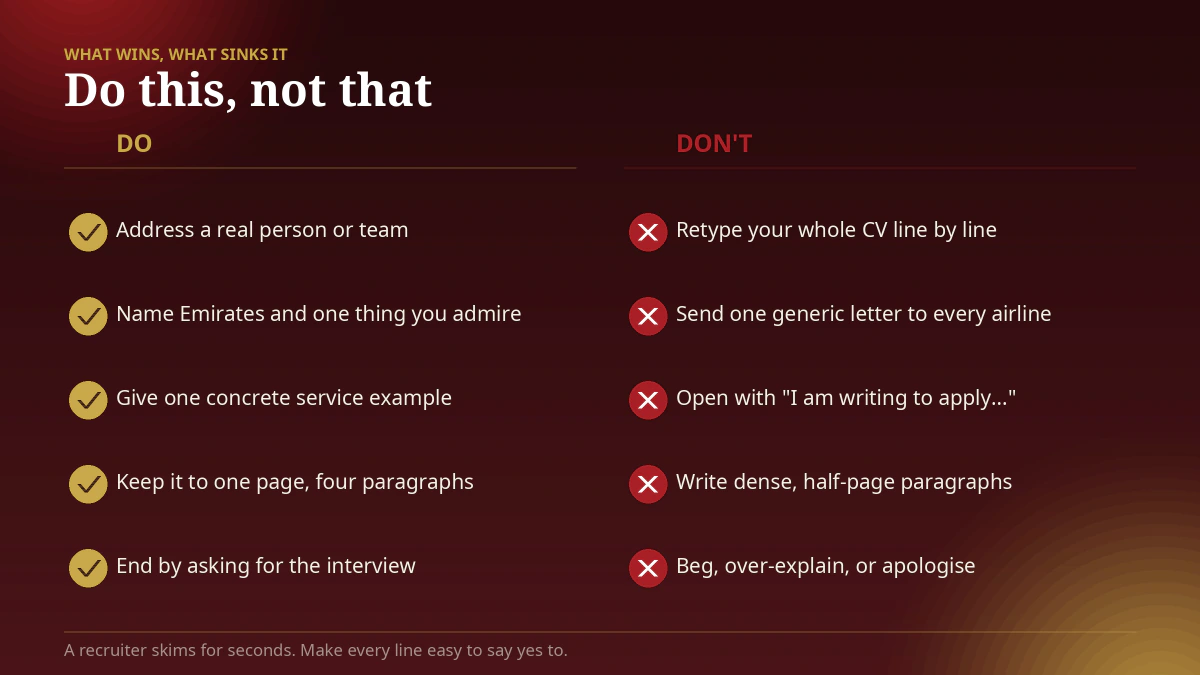
Do address a real person or team where you can, name the airline and one thing you genuinely admire about it, give a single concrete service example, keep the letter to one page, and finish by asking for the interview. Do not retype your CV line by line, send one generic letter to every carrier, open with "I am writing to apply", write dense half-page paragraphs, or beg and over-explain. Each "don't" is a signal that you did not tailor the letter — and tailoring is the whole point.
An annotated template to adapt
An annotated template is a model letter with each paragraph labelled by its job, so you can see the structure and then write your own version. Do not copy it word for word — recruiters have read every template online, and a lightly-changed copy is easy to spot. Use it to understand the shape and the tone, then replace every line with something true about you.
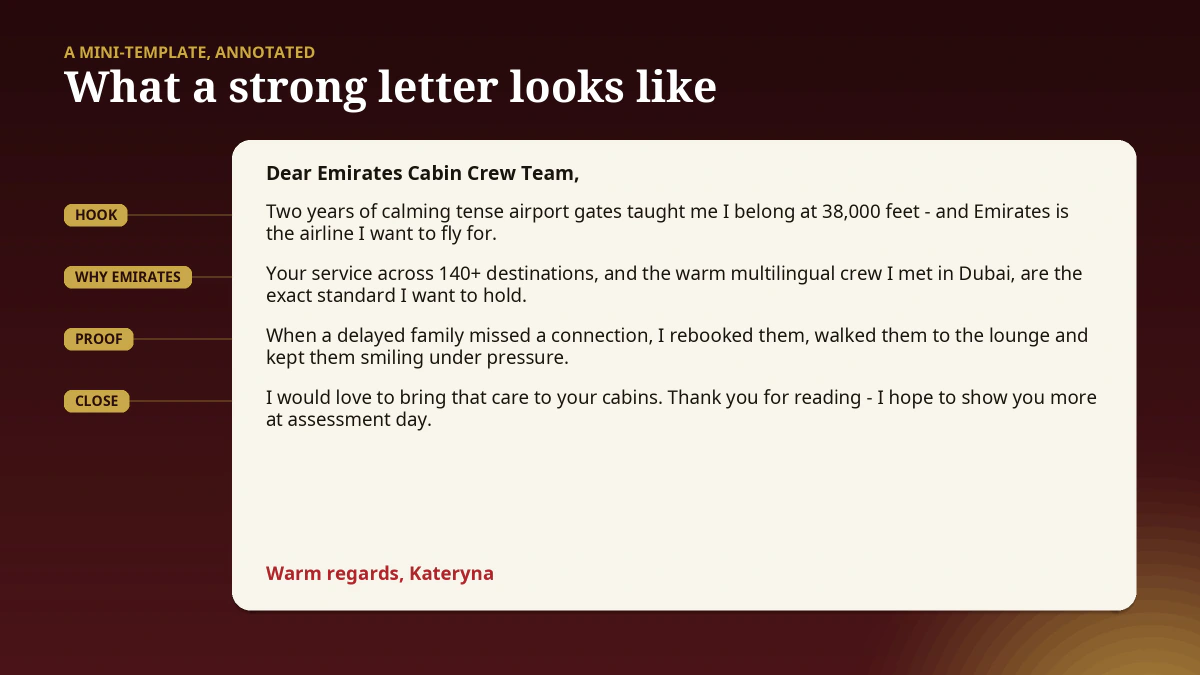
Notice how short each paragraph is, and how the hook opens with a moment rather than a formula. The "why Emirates" line names something specific to the airline. The proof is a single story with a clear action and outcome. The close is warm and asks, gently, for the next step. That is the entire pattern — four moves, one page, no filler. When you draft yours, read it aloud once; if any sentence sounds like a form rather than a person, rewrite it.
Before you send it, pair the letter with a clean, professional application. Your photo and CV do a lot of quiet work on the same recruiter's screen, so make sure they match the standard of your letter — our guide to the Emirates cabin crew CV and photo shows exactly what "professional" looks like for this role.
Common cover letter mistakes
Most cover letter mistakes come from trying to sound impressive instead of sounding real. Three errors show up again and again, and all three are easy to fix once you know to look for them.
- Repeating the CV. The letter is not a second CV. If a sentence just restates a job title and dates, cut it and replace it with why that experience matters for the cabin.
- Being generic. A letter that could go to any airline goes in the "no" pile. One specific, true detail about the airline fixes this instantly.
- Over-apologising. "I know I don't have much experience, but..." undercuts you before you start. Lead with a strength; let the reader decide about the rest.
Two smaller traps are worth naming. First, tone: crew work is warm, so a stiff, corporate letter sends the wrong signal — write the way you would speak to a passenger. Second, errors: a single spelling slip or the wrong airline's name (the classic copy-paste giveaway) can end an application, so proofread slowly and, if you can, have a fluent English speaker check it. You can rehearse the calm, friendly register the whole application needs by drilling real scenarios in the free CrewQuest trainer.
The letter that gets read is not the cleverest one. It is the one that sounds like a warm, competent person who clearly wants to fly for this airline — and proves it in one story.
Length, format and sending it
The right length for a cabin crew cover letter is one page — realistically 180 to 250 words across four short paragraphs. Anything longer and a busy recruiter stops reading; anything shorter and you have not made your case. Use a clean, standard font, keep the layout simple, and address it to a named person or the recruitment team rather than "To whom it may concern" wherever you can find a name.
Match the format to how you are applying. If the airline uses an online form with a text box, paste in your four paragraphs and check the spacing survived. If you are attaching a document, save it as a PDF so the formatting does not shift, and name the file clearly with your own name. Keep your email or message body brief and polite — the letter itself carries the weight. A tidy, well-named application is a small courtesy that recruiters notice, and it signals the same attention to detail they want in the cabin.
One last check before you send: read the whole thing aloud one more time, confirm the airline's name is correct everywhere, and make sure your best story and your clearest ask both survived the edit. If they did, you are ready.
Is it worth it? Next steps
For most candidates the answer is a clear yes: a specific, warm, one-page cover letter is one of the cheapest ways to lift your chances, because so many applicants send a flat, generic one. You do not need perfect experience or perfect English — you need one true reason to fly, one real service story, and the confidence to ask for the interview. That is entirely within your control, and it is the same care that carries through the whole hiring process.
Ready to move from reading to doing? Book a free consultation call with Kateryna — a former Emirates crew member — using the planner just below, and we will map your exact path, your letter and your timeline together. Then work through the funnel: sharpen your spoken English in English for cabin crew, get your CV and photo to standard, prepare your stories with the STAR method guide, and see the full programme on the Emirates cabin crew course page. When you are ready to rehearse, drill real interview scenarios free in the CrewQuest trainer. The letter opens the door — everything after it is preparation you can win.


