 Kateryna Ivanova

The cabin crew final interview is the last stage of the hiring process — usually a one-to-one conversation with a recruiter that lasts around 30 to 40 minutes. It is not a test of trivia. It is a structured chat built around six behavioural competencies, where the recruiter asks you to describe real situations from your past to predict how you would work in a cabin. If you reach it, you are already close: this is where they confirm you are the calm, warm, professional person your application promised.
TL;DR:
- The final interview is a one-to-one (sometimes two-person) competency interview, roughly 30–40 minutes, after the assessment day.
- It probes six competencies: difficult customer, teamwork, working under pressure, initiative, colleague conflict and owning a mistake.
- Questions are behavioural — "tell me about a time…" — so you answer with real stories, structured with the STAR method.
- Prepare a bank of five strong stories; between them they cover all six competencies, so you never improvise.
- Expect a warm-up ("tell me about yourself"), the competency block, a "why Emirates / why us" question, and a chance to ask your own questions.
What the cabin crew final interview is
The cabin crew final interview is a structured competency interview — a focused, one-to-one conversation in which a recruiter asks you to describe real situations from your past to judge how you would behave as crew. It is the last human check before an offer. The recruiter is not looking for perfect answers; they are looking for evidence that you can stay calm, work in a team, look after a passenger and own a mistake. Everything you say is scored against a set of competencies, quietly, on a sheet you never see.
This stage is different from the group assessment and from a written test. It is personal, unhurried and conversational, which fools some candidates into treating it casually. Do not. Behind the friendly tone sits a scoring framework, and the people who prepare specific stories in advance outperform the people who "wing it" every single time. For the official role details and current openings, always cross-check the Emirates Group cabin crew careers page.
The final interview is not where you are discovered. It is where you are confirmed. Your job is to make saying "yes" the easy, obvious choice for the recruiter in front of you.
Where it sits in the hiring process
The final interview is the last stage of the cabin crew selection funnel, and understanding the road to it lowers your nerves. For Emirates the path usually runs: online application and CV screen, an invitation to an assessment day (or open day), group exercises and a reach test, shortlisting, and then the final interview. By the time you are invited to the final, the pool has already shrunk from hundreds to a handful. You have earned your place — now you protect it.
Because so much has already been assessed, the final interview zooms in on the human questions that group exercises cannot fully answer: how you think, how you handle conflict, and whether your motivation is real. If you have not yet reached this stage, work backwards through our assessment day walkthrough and the full how to become Emirates cabin crew guide, so the final interview is the only thing left between you and a golden call.
The one-to-one format, explained
The final interview format is almost always one-to-one — you and a single recruiter — though occasionally a second assessor joins to observe or take notes. It is usually held in a quiet room or by video call, and it feels like a serious but friendly conversation rather than an interrogation. The recruiter will introduce themselves, put you at ease, and then move through their planned questions at a steady pace. Expect eye contact, note-taking and the occasional follow-up when they want a specific detail.
Because it is one-to-one, there is nowhere to hide and no group to carry you — but equally, no one to compete with in the room. The recruiter wants you to do well; a good candidate makes their day easier. Treat them as a partner in the conversation, not a judge to be feared. Warmth, eye contact and genuine listening matter as much here as the content of your answers, because these are the exact qualities you will need with passengers.
How the round is structured
The final interview follows a predictable four-part structure that runs about 30 to 40 minutes. Knowing the map in advance is the single biggest thing you can do to steady your nerves: you always know roughly where you are and what is coming next.
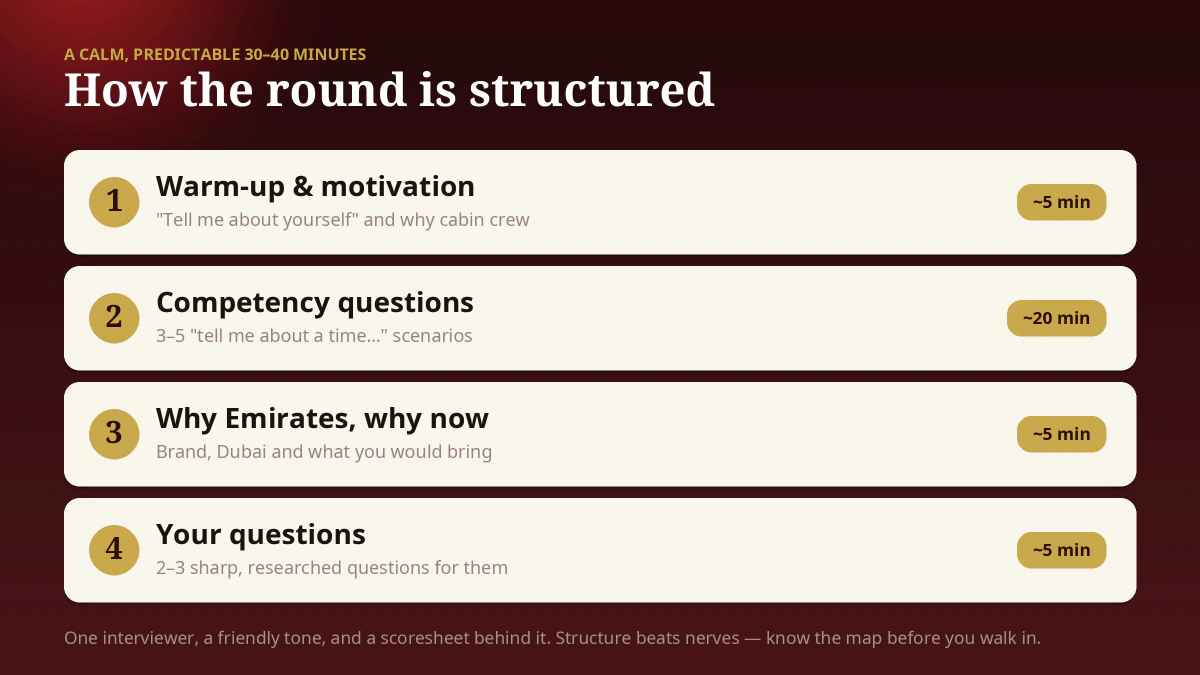
- Warm-up and motivation (~5 min) — introductions, "tell me about yourself", and why you want to be cabin crew.
- Competency questions (~20 min) — three to five "tell me about a time…" scenarios, the heart of the interview.
- Why Emirates, why now (~5 min) — your reasons for this airline, this city and this moment.
- Your questions (~5 min) — a genuine chance to ask two or three researched questions of your own.
The competency block is where the score is won or lost, so most of your preparation should go there. But do not neglect the bookends: a shaky "tell me about yourself" sets a nervous tone, and a flat "why us" answer or an empty "any questions?" can quietly cost you the warmth points. Timings are approximate and vary by recruiter — treat them as a guide, not a stopwatch.
The six competencies they probe
Cabin crew competency questions test six behaviours that predict how you will perform in the cabin. Almost every "tell me about a time…" question maps onto one of these, so once you recognise the six, the interview stops feeling random and starts feeling answerable.
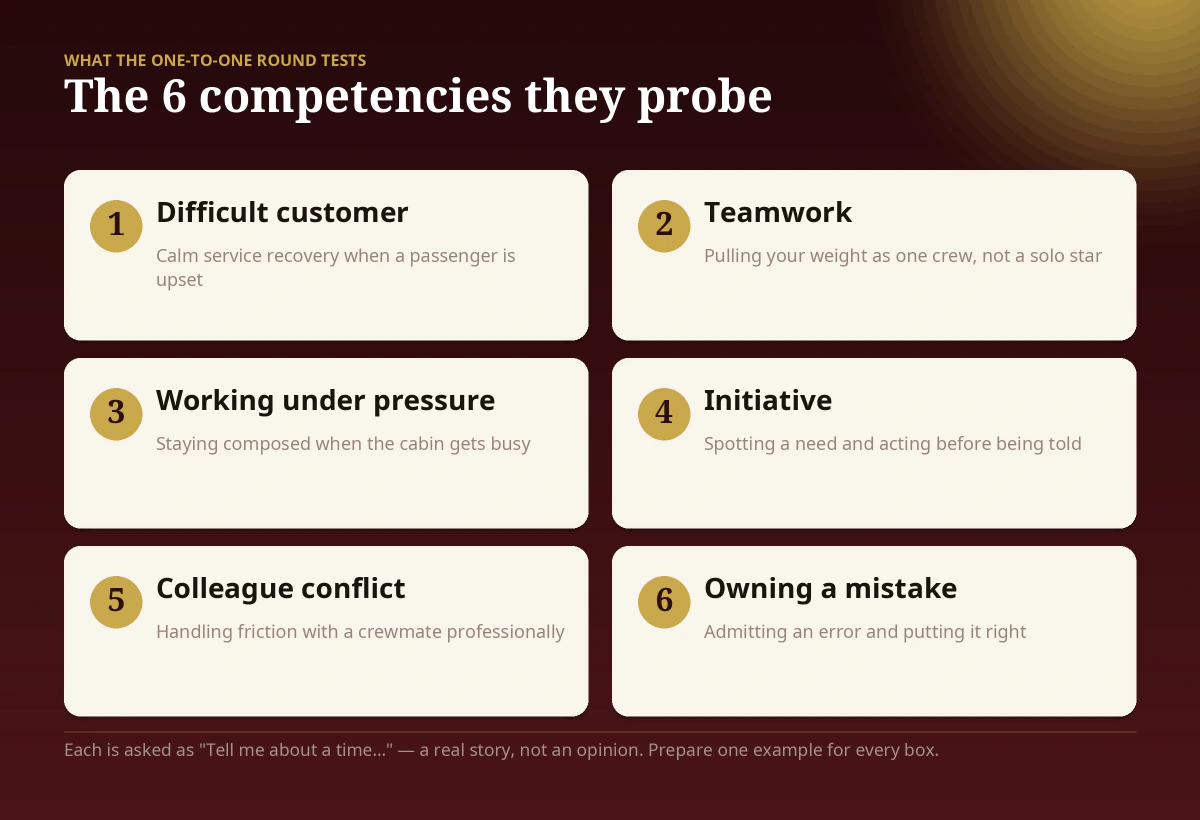
| Competency | What they are really testing |
|---|---|
| Difficult customer | Calm service recovery when a passenger is upset or unreasonable |
| Teamwork | Pulling your weight as one crew, not chasing individual glory |
| Working under pressure | Staying composed and safe when the cabin gets busy or things go wrong |
| Initiative | Spotting a need and acting before you are told to |
| Colleague conflict | Handling friction with a crewmate professionally and without drama |
| Owning a mistake | Admitting an error honestly and putting it right |
Notice the pattern: none of these ask what you think. They ask what you did. The recruiter believes past behaviour predicts future behaviour, so a real, specific example always beats a polished opinion. Read each competency as a question a passenger's safety and comfort depend on, and you will pitch your stories at the right level.
Build five stories that cover everything
The smartest preparation is to build a bank of five strong stories that, between them, cover all six competencies. You are not memorising scripts for twenty possible questions; you are preparing five flexible real events you can angle toward whatever is asked. This is the single technique that separates confident candidates from anxious ones.
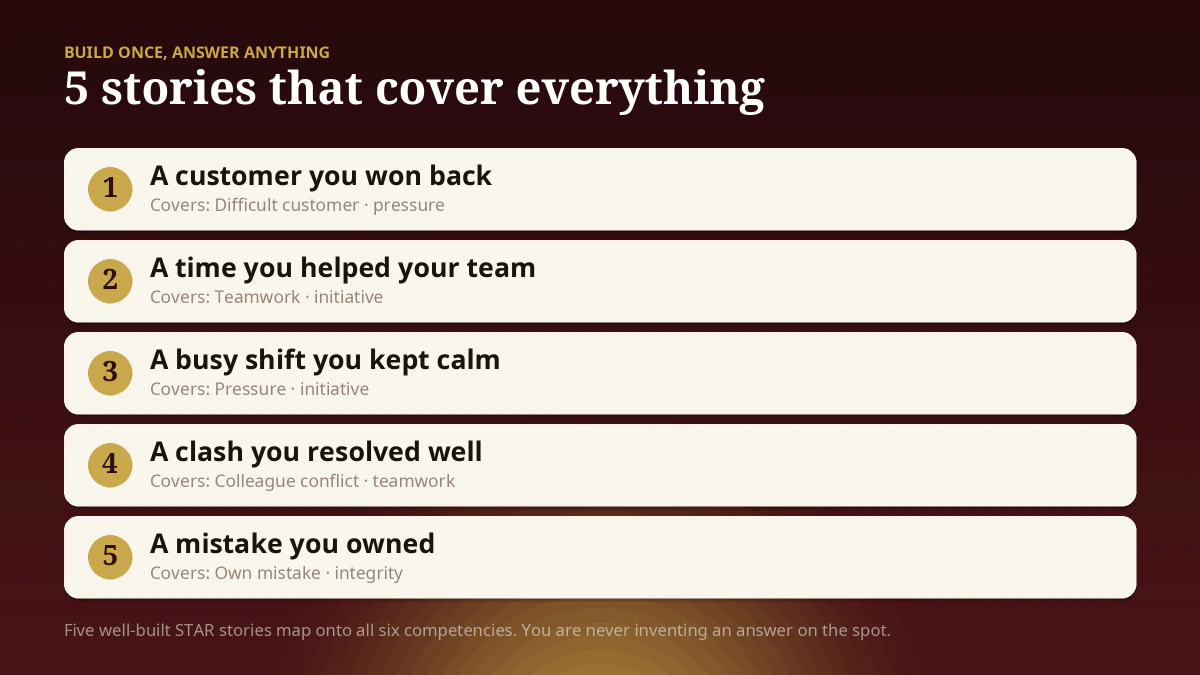
A workable story bank looks like this: a customer you won back (covers difficult customer and pressure), a time you helped your team (teamwork and initiative), a busy shift you kept calm (pressure and initiative), a clash you resolved well (colleague conflict and teamwork), and a mistake you owned (own mistake and integrity). Five events, six boxes ticked. When a question comes, you pick the closest story and shape it to fit.
Each story should be told with the STAR method — Situation, Task, Action, Result — so it stays tight and lands the point. The structure keeps you from rambling and makes your result impossible to miss. If STAR is new to you, spend an evening with our full STAR method for cabin crew interviews guide before you build your bank; it is the exact framework recruiters are trained to reward.
Prepare five stories, not fifty answers. Recruiters can tell a memorised script from a real memory in seconds — and they always trust the memory more.
The warm-up and "tell me about yourself"
The interview opens with a warm-up, and "tell me about yourself" is the question that sets the tone. A strong answer is 60 to 90 seconds, structured as present, past and future: what you do now, the experience that led here, and why cabin crew is your deliberate next step. Keep it professional and relevant — this is not your life story, it is a trailer for why you belong in a cabin.
Avoid the two common traps: the one-line answer that gives the recruiter nothing to work with, and the five-minute monologue that buries your best points. Practise your version out loud until it flows without sounding recited. A calm, warm, well-paced opening buys you goodwill for the harder questions that follow, and it shows the recruiter the exact energy a passenger would feel meeting you at the aircraft door.
The "why Emirates, why now" question
Every final interview includes a version of "why this airline?" — and a generic answer is a wasted opportunity. The recruiter wants to hear reasons specific to Emirates and to Dubai: the global network, the service reputation, the multicultural crew community, the chance to build a career from a world hub. Tie those reasons to something true about you, so it sounds like a fit rather than flattery.
Do a little homework the week before. Know roughly how many destinations the airline serves, what its service brand stands for, and why Dubai suits your plans. It also helps to understand the package honestly — our breakdown of the Emirates cabin crew salary shows why the tax-free, housing-included offer draws candidates from across Europe. Motivation grounded in facts reads as maturity; motivation built on clichés reads as a candidate who applied everywhere and means none of it.
The questions you should ask them
When the recruiter asks "do you have any questions for me?", the wrong answer is "no". This is a competency moment in disguise: two or three thoughtful questions show genuine interest and end the interview on a warm, engaged note. Prepare them in advance so you are never caught blank.
- Ask about the crew community or life in Dubai — it signals you are planning to stay and belong.
- Ask about training or early progression — it signals ambition and a long-term view.
- Ask what makes someone thrive as Emirates crew — it invites the recruiter to picture you succeeding.
Avoid asking only about salary, days off or "how did I do?" — those land as self-interested or needy. Good questions are about the role, the people and the future, not the perks. One well-judged question is worth more than three that you clearly read off a list, so pick the ones you genuinely care about.
English and delivery in a one-to-one
In a one-to-one, how you speak matters as much as what you say. Emirates works in English, and the final interview doubles as a live language check: clear pronunciation, natural pace and the confidence to hold a conversation. You do not need flawless, accent-free English — you need warm, understandable, professional English that a nervous passenger from anywhere in the world could follow.
The most common self-inflicted problem is speed. Nerves make candidates rush, swallow word endings and lose clarity. Slow down by a notch, breathe at your full stops, and let your answers land. If English is your second or third language, structured practice in the months before pays off more than any last-minute cramming — our English for cabin crew guide gives a 90-day plan built for exactly this moment. You can also rehearse spoken answers against real scenarios in the free CrewQuest trainer until they feel automatic.
Common final-interview mistakes
Most final-interview rejections come from a short list of avoidable errors. Knowing them is half the fix:
- Vague, opinion-based answers. "I'm a team player" proves nothing. A specific story where you helped your team proves everything. Always answer with a real event.
- No result. Candidates describe a situation and forget to say how it ended. The result is the point — spell out what changed because of you.
- Bad-mouthing a past employer or colleague. Even a fair complaint reads as a warning sign. Stay professional about everyone, especially in the conflict questions.
- Treating it casually. The friendly tone is real, but the scoring is too. Prepare as seriously as you would for any exam.
- A weak "why us" and no questions. These bookend answers set your warmth score; a flat opening or a blank ending undoes strong middle answers.
Notice that none of these are about talent. They are about preparation and mindset, which means every one of them is inside your control. For a deeper drill on phrasing full answers, work through a set of realistic cabin crew interview questions before the day.
On the day and straight after
On the day, the fundamentals carry more weight than any clever line. Arrive early, dress to the airline's grooming standard, and treat everyone you meet — from reception to the recruiter — with the same warmth you would show a passenger. Bring a printed copy of your CV and any documents requested. When you sit down, smile, make eye contact and let a slow breath settle you before the first question. A calm body language reads as a calm future crew member.
If your mind goes blank during a competency question, it is completely acceptable to say "may I take a moment to think of a good example?" Recruiters respect a considered answer over a rushed one. After the interview, a short, polite thank-you — if you have a point of contact — is a nice touch, but the decision rests on the conversation itself. Then let it go: you have done the work, and second-guessing every answer only feeds anxiety.
You cannot control the recruiter's mood or the exact questions. You can control your stories, your calm and your warmth — so pour your energy there and leave the rest.
How close are you? Next steps
If you have reached the final interview, you are genuinely close — this is the last door, and it opens for candidates who prepare specific stories and stay warm under a friendly spotlight. Build your five-story bank, rehearse your "tell me about yourself" and your "why Emirates", prepare your own questions, and slow your English down a notch. Do that, and you have done everything within your power.
Want a second pair of eyes on your stories before the day? Book a free consultation call with Kateryna — a former Emirates crew member — using the planner just below, and we will pressure-test your answers and map your timeline. Then tighten the rest of the funnel: sharpen your CV and photo, lock in the STAR method, rehearse the assessment day stages, lift your English, and see the full course on the Emirates cabin crew course page. Drill real scenarios any time in the free CrewQuest trainer — the more automatic your stories feel, the calmer you will be when it counts.


