 Kateryna Ivanova

Your family has moved — to the UK, Germany, the Netherlands, the UAE, Canada — and your Ukrainian child is about to walk into a nursery or school where nobody speaks her language. Every parent in this situation asks the same three questions: How long until she understands? Should we switch to English at home to help her? And is it normal that she has said nothing at nursery for a month? As a teacher who works with Ukrainian families across the world, I answer these questions every week. This guide collects everything I tell them: the honest timelines, the silent period that frightens parents but is completely normal, the survival phrases to teach first, and the one mistake that hurts most — dropping Ukrainian to "make room" for English.
The silent period: why your child says nothing at nursery
The scene that panics parents most: three, four, six weeks at the new nursery — and the child hasn't said a single English word. She plays alone or watches the others. The teacher smiles reassuringly, but you lie awake wondering if something is wrong.
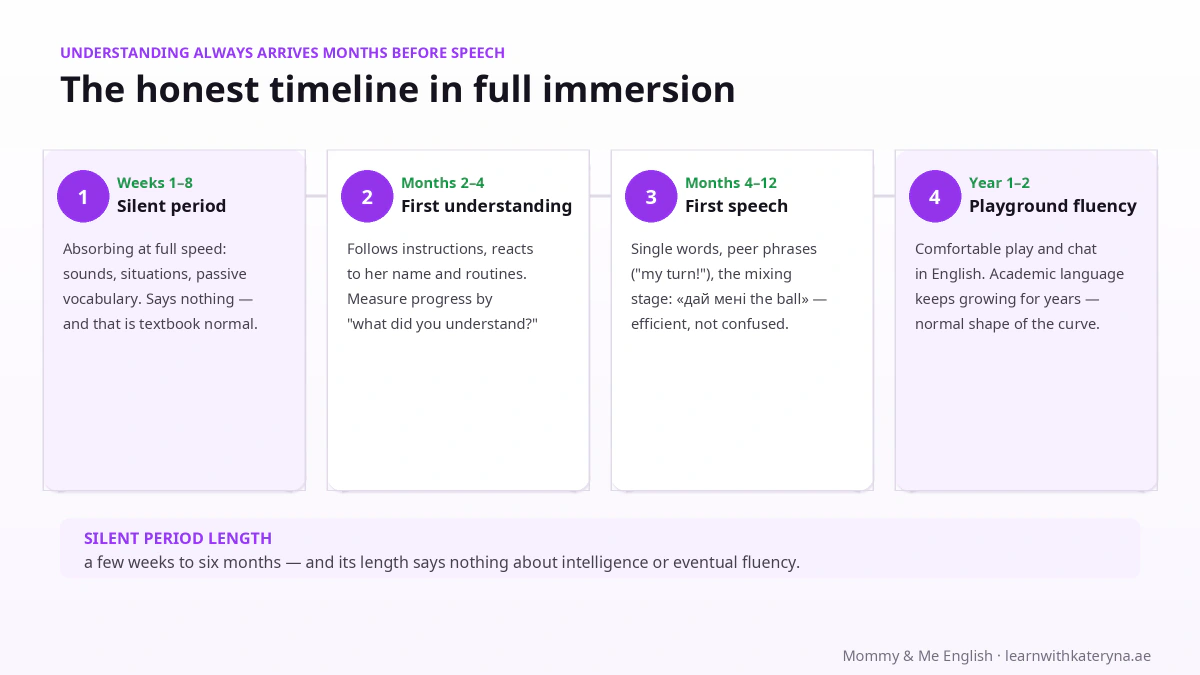
Nothing is wrong. This is the silent period — a well-documented, universal stage of second-language acquisition in children. During it, the child is not "failing to learn": she is absorbing at full speed — sorting sounds, mapping phrases to situations, building a passive vocabulary — while producing nothing. For children aged 2–6 the silent period typically lasts from a few weeks to six months, and its length says nothing about intelligence or eventual fluency. Quieter, more observant children often have longer silent periods and then "come online" with surprisingly complete phrases.
What helps: pressure-free exposure (playdates where nobody demands speech), your calm confidence, and English at home as play, not therapy. What harms: "Say it in English for the teacher!", visible parental anxiety, and treating silence as an emergency. The single best question to check progress during the silent period is not "What did you say today?" but "What did you understand today?" — understanding always arrives months before speech.
Honest timelines: what to expect month by month
Researchers distinguish two very different kinds of language proficiency, and knowing the difference will save you months of worry:
Playground English (conversational fluency). Understanding instructions, playing with peers, chatting about toys and snacks. For a young child in full immersion this arrives fast: first understanding within 2–4 months, comfortable everyday speech within 6 months to 2 years. This is the English you can see and hear — and it is genuinely quick.
School English (academic language). Following a story read aloud, retelling, later reading and writing at grade level. This runs on a slower clock — several years even for children who chat fluently on the playground. It matters mostly for school-age kids: a seven-year-old who "speaks great English" after a year may still legitimately need support with academic tasks. That is not a red flag; that is the normal shape of the curve.
Practical translation for parents of toddlers: expect first understood phrases in weeks, first spoken words in months, comfortable play in English within the first year or two. And expect the mixing stage in the middle — «дай мені the ball» — which is not confusion but a bilingual brain efficiently using everything it has. It passes by itself.
Survival phrases: the first ten things to teach
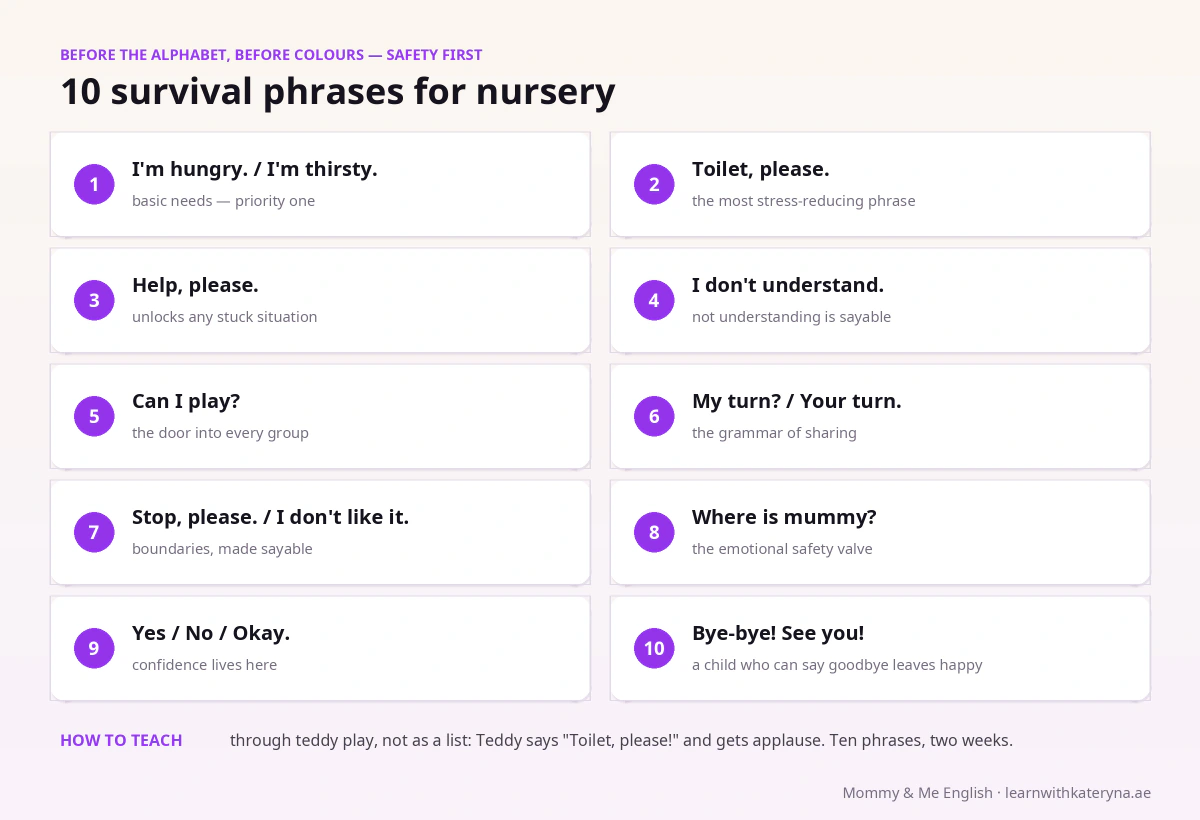
Before the alphabet, before colours, before any curriculum — teach the phrases that make your child feel safe in an English-speaking room:
- I'm hungry. / I'm thirsty. — the basic needs, priority number one
- Toilet, please. — the single most stress-reducing phrase in nursery life
- Help, please. — universal key that unlocks any stuck situation
- I don't understand. — teaches that not understanding is sayable, not shameful
- Can I play? — the door into every playground group
- My turn? / Your turn. — the grammar of sharing, needed daily
- Stop, please. / I don't like it. — boundaries; every child needs them sayable
- Where is mummy? — the emotional safety valve
- Yes / No / Okay. — trivial, but confidence lives here
- Bye-bye! See you! — endings matter: a child who can say goodbye leaves happy
Teach them the same way as any everyday phrases — inside real situations at home, not as a list: play "nursery" with teddies where Teddy says "Toilet, please!" and gets applause. Ten phrases, two weeks of play — and your child walks into the classroom with tools instead of just courage.
The biggest mistake: dropping Ukrainian at home
It feels logical: the child needs English fast, so let's speak English at home too — even our imperfect English. Every language expert will tell you the same thing: don't. Here is why, in three facts:
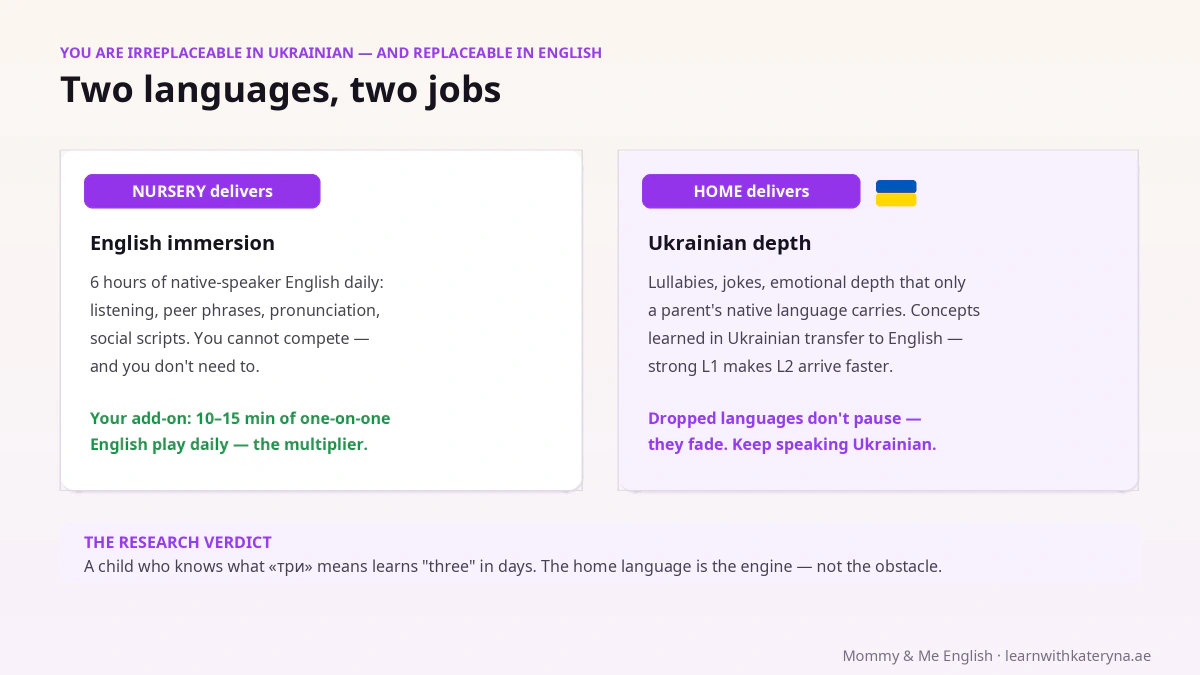
Fact one: the first language is the engine, not the obstacle. Decades of bilingualism research agree — concepts learned in the home language transfer to the second language. A child who knows what «три» means learns "three" in days; a child with a rich Ukrainian vocabulary attaches English labels to ready concepts. Strong Ukrainian makes English arrive faster, not slower.
Fact two: you are irreplaceable in Ukrainian and replaceable in English. The nursery gives your child six hours of native-speaker English daily — you cannot compete with that, and you don't need to. But nobody else on the planet will give her mother-tongue Ukrainian: the lullabies, the jokes, the emotional depth that only a parent's native language carries. Speak to her in the language where you are the best version of yourself.
Fact three: dropped languages don't pause — they fade. Children lose an unused home language with frightening speed. And with it goes something you cannot rebuild later: conversations with grandma, Ukrainian books, the identity thread. The bilingual child who keeps both languages is not doing "twice the work" — she is receiving the one genuine cognitive gift of the whole displacement experience. More myths debunked in my article on bilingualism and speech.
What changes by age: 2–3 vs 4–6
Age 2–3: the invisible advantage. A two-year-old entering immersion barely notices the "language problem" — her Ukrainian is itself just forming, and English simply joins the stream. Expect near-native pronunciation eventually, a longer mixing stage in the middle, and — important — slower visible progress than older kids at first: she is building two systems at once. Your job at home is mostly Ukrainian richness plus playful English rituals — the same 10-minute format I teach in the English-from-age-1 method.
Age 4–6: the fast and fragile window. A five-year-old learns playground English visibly fast — weeks to first phrases — because she has a full first language to lean on. But she also feels the social pain that a two-year-old doesn't: she knows exactly what it means to stand in a circle of kids and not understand the joke. This age needs the survival phrases most, plus emotional naming at home in Ukrainian: «Було важко сьогодні? Ти не зрозуміла гру?» A child whose frustration has words at home carries much less of it into the classroom.
What nursery immersion does — and what it doesn't
Full immersion is the most powerful language engine that exists for children — but it has a specific shape, and knowing it prevents both panic and complacency. What immersion does brilliantly: listening comprehension, peer phrases ("stop it", "my turn", "look at this!"), pronunciation, social scripts. What it does surprisingly poorly: vocabulary breadth beyond classroom routine, answering in full sentences (group settings rarely require them), and — obviously — literacy in either language.
That leaves parents a clear, small, high-leverage role: 10–15 minutes of one-on-one English play daily (books, songs, the games from my guides on verbs and numbers) to widen vocabulary beyond nursery routine — plus unlimited Ukrainian for everything that matters. You don't need to teach English grammar; immersion handles it. You need to keep the input rich on both sides.
Building an English routine at home? The free Mommy & Me English starter guide lays out the daily rituals step by step.
Talking to the teacher: five things to ask
A five-minute conversation with the nursery teacher sets up the whole year. Ask these:
1. "She's in her silent period — please don't push her to speak." Most early-years teachers know the concept; naming it makes you allies.
2. "How does she cope emotionally?" — more informative than any language question in the first months.
3. "Can you give me this week's songs and topics?" — pre-teaching the week's song at home in a relaxed setting turns nursery from decoding into recognising. This one habit doubles early progress.
4. "She speaks Ukrainian at home — we're keeping it." Good teachers will actively support this; if you hear "speak only English at home," smile politely and ignore it — that advice is decades out of date.
5. "What does she do at free play?" Parallel play near other kids is a healthy silent-period sign; full isolation for many months is worth a closer look.
Keeping Ukrainian alive: the heritage-language toolkit
English will take care of itself — the environment guarantees it. Ukrainian is now the language that needs deliberate protection, and the toolkit is pleasantly concrete: daily Ukrainian reading aloud (the single highest-impact habit); scheduled video calls with grandma — a real conversation partner who only speaks Ukrainian is worth more than any app; Ukrainian audio in the car and kitchen; the culture thread — borshch stays borshch, святий Миколай comes in December, vyshyvanka on holidays. And when the child answers you in English (this will happen around year two abroad): don't scold, don't dramatize — just keep answering in Ukrainian. Comprehension stays alive as long as you keep speaking, and active speech follows the need.
The first nursery day: a preparation checklist
Two weeks before the start, run this checklist — each item is small, and together they turn the first day from a plunge into a step:
1. The teddy nursery. Play "nursery" at home daily: teddies sit in a circle, sing a song, eat a snack, say "Toilet, please!" and "Bye-bye!". The child rehearses the whole script in a world she controls.
2. The survival ten. The phrases from the section above — through play, two weeks is exactly enough.
3. One nursery song, pre-learned. Ask which songs the group sings (most English-speaking nurseries live on the same ten — Wheels on the Bus, Head Shoulders, Baa Baa Black Sheep) and play one at home until it is familiar. Walking in and hearing a song she KNOWS is the single strongest "I belong here" signal a child can receive.
4. The goodbye ritual. Agree on a short, always-identical parting: hug — high five — "Bye-bye, see you later!" — and leave without lingering. Long goodbyes feed anxiety; identical ones dissolve it. Rehearse it with the teddies too.
5. The comfort anchor. A small familiar thing in the pocket (a tiny toy, mum's hair tie). Check the nursery allows it — most do for the settling period.
6. The photo card. A little card with family photos in the backpack. If tears come, the teacher has an instant tool — and the child has her people with her. It doubles as a conversation starter: "Who is this? Mummy!" — the first English exchange with the teacher, built on the warmest possible material.
Country notes: UK, Germany, UAE
United Kingdom. Nurseries and Reception classes are built around EAL children (English as an Additional Language) — teachers have seen dozens of silent periods and usually handle them beautifully. Expect strong phonics from age 4–5: if you want to prepare, my guide to phonics covers exactly the system UK schools use. Useful to know: "nursery" (age 3–4) and "Reception" (4–5) are play-based — your child will not be "behind" academically by arriving mid-year.
Germany. The twist: nursery German, not English, becomes the immersion language — and English waits until school. My advice for Ukrainian families in Germany: don't try to run three languages at full intensity. Priority one is Ukrainian at home, priority two is German (the environment handles it), and English stays as light play — songs and 10-minute rituals — until the German foundation settles. Three languages is a marathon, and pacing wins it.
UAE. English is the lingua franca of nurseries and daily life, but your child will hear a dozen accents around her — Indian, Filipino, British, Arabic. That is an advantage, not a problem: children raised on accent variety understand everyone effortlessly later. Native-speaker audio at home (songs, cartoons from my cartoon guide) provides the stable pronunciation reference point, and the multicultural playground provides the flexibility.
When to seek professional advice — and when not to
Almost everything that worries parents in the first year abroad is normal: silence at nursery, language mixing, a temporary dip in Ukrainian, answering in the "wrong" language. None of these need a specialist — they need time and the routines described above.
What genuinely deserves a professional look (a speech-language therapist who works with bilinguals): if the child's Ukrainian — the stronger language — shows real regression that lasts (losing words and structures she had securely, not just preferring English ones); complete social withdrawal at nursery beyond six months with zero parallel play; or if the silent period passes but speech in BOTH languages stays far behind age norms. The key principle professionals use: assess the bilingual child across both languages together — a child who knows 30 words in Ukrainian and 30 in English has a 60-word vocabulary, which is exactly on track.
And one protective note: if any professional tells you to drop Ukrainian "to reduce the load" — seek a second opinion. Current clinical guidance for bilingual children says the opposite, and a therapist working with bilinguals should know it.
5 mistakes displaced families make
1. Switching to English at home. Covered above — the engine runs backwards. Your language is your child's foundation, not her obstacle.
2. Panicking during the silent period. Weeks or months of silence at nursery is the textbook path, not a warning sign. Measure understanding, not speech.
3. Comparing with other children. "Their daughter arrived at the same time and already chats!" Every silent period, every mixing stage, every curve is individual — and the quiet observers routinely overtake the fast starters by year two.
4. Outsourcing everything to school. Immersion builds playground English brilliantly and vocabulary breadth poorly. Ten minutes of one-on-one play daily is the multiplier.
5. Treating Ukrainian as yesterday's language. The family that keeps Ukrainian gets a bilingual child; the family that drops it gets a monolingual English speaker who can't talk to her grandmother. The choice happens in your kitchen, one dinner at a time.
Next steps
This week: teach "Toilet, please" and "Help, please" through teddy play, ask the teacher for the current week's songs, and put one Ukrainian book into the bedtime slot — permanently. That is the whole system in miniature: survival English through play, pre-taught nursery content, protected home language. For the structured version — the daily 10-minute rituals, games and phrases that widen English beyond nursery routine — start with the daily rituals guide and the parent phrasebook.
And if you want the complete method in one place — video lessons, audio, checklists, a plan for every day, built by a Ukrainian teacher for Ukrainian families abroad — take a look at the Mommy & Me English starter guide. From Kyiv to Dubai to London: 10 minutes a day, mum in the leading role, both languages alive.


