 Kateryna Ivanova

Emirates, Qatar Airways and Etihad all pay their cabin crew a tax-free package of roughly AED/QAR 9,000–11,000 a month with free shared housing, transport and medical cover — so the money is close. The real difference is lifestyle: Emirates gives you the biggest network from Dubai, Qatar the most awarded service from Doha, and Etihad a smaller, close-knit base in Abu Dhabi. Choose on the city and community, not the salary.
TL;DR:
- Pay is nearly the same across all three: a tax-free ~9–11K monthly package plus free housing, transport, medical cover and flight benefits. Do not choose on salary alone.
- Emirates (Dubai) wins on network size and community — the largest fleet and the most destinations, so the widest travel and the biggest crew base.
- Qatar Airways (Doha) wins on service prestige — a multi-award, five-star product and a polished, service-first cabin culture.
- Etihad (Abu Dhabi) wins on a calmer, close-knit lifestyle — a smaller airline with a tighter community and a quieter home city.
- Requirements are almost identical: minimum age 21, ~212 cm arm reach, ~160 cm height, fluent English and a high-school education — prepare once and you qualify for all three.
The three Gulf carriers at a glance
The Gulf "big three" are Emirates, Qatar Airways and Etihad — three long-haul airlines based in the United Arab Emirates and Qatar that hire cabin crew from all over the world. They compete for the same passengers, fly similar aircraft and offer similar crew packages, which is exactly why candidates find them so hard to tell apart. The honest answer is that on money and benefits they are close cousins; where they separate is in the city you live in, the size of the operation and the feel of the job day to day.
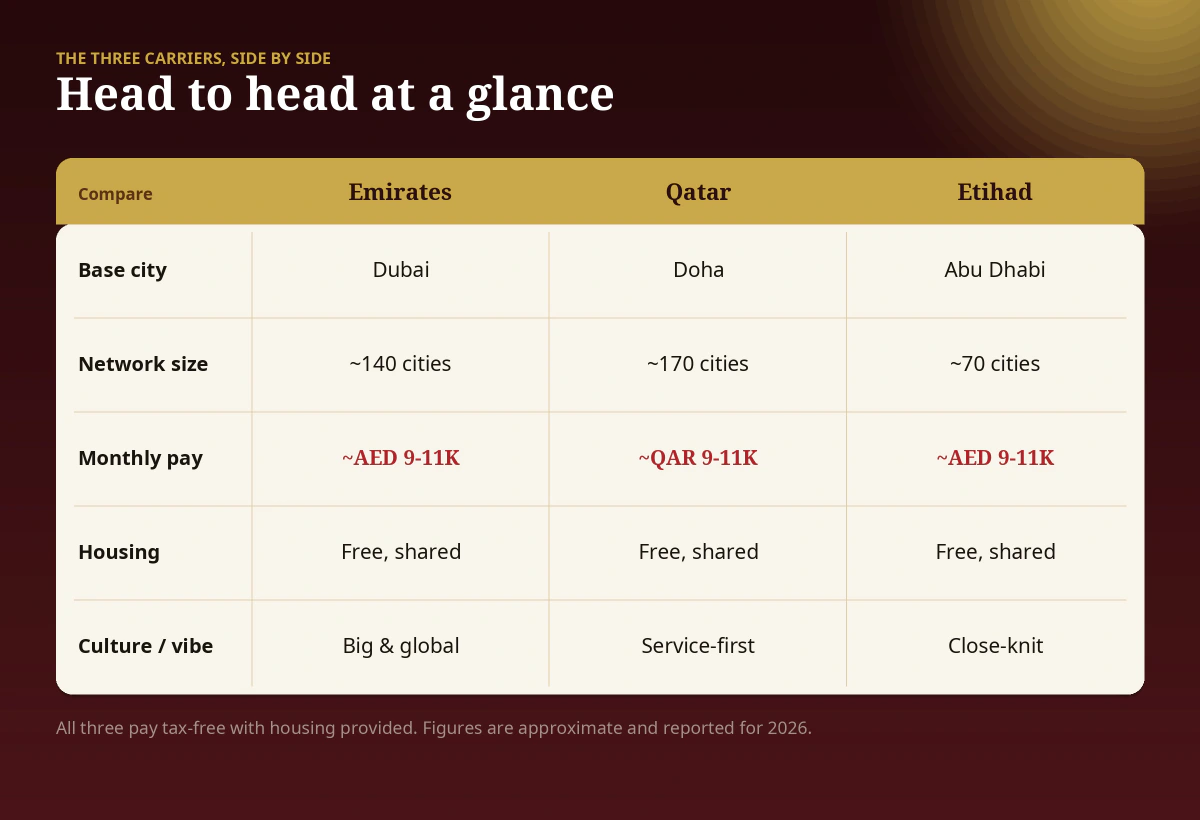
| Factor | Emirates | Qatar Airways | Etihad |
|---|---|---|---|
| Base city | Dubai | Doha | Abu Dhabi |
| Network size | ~140 destinations | ~170 destinations | ~70 destinations |
| Monthly pay (tax-free) | ~AED 9–11K | ~QAR 9–11K | ~AED 9–11K |
| Housing | Free, shared | Free, shared | Free, shared |
| Best known for | Largest network | Award-winning service | Close-knit community |
Read that table and one thing stands out: four of the five rows are almost the same. The pay bands overlap, all three provide free accommodation, and all three are tax-free. The rows that actually decide it are the base city and what each airline is known for — and those are lifestyle choices, not spreadsheet choices.
Pay compared: is any airline higher?
Cabin crew pay at Emirates, Qatar and Etihad sits in the same tax-free band — none is dramatically higher than the others for a new joiner. Each package is built the same way: a fixed basic salary, hourly flying pay that rewards the hours you are in the air, and an allowance for time spent away from base. Because part of the pay is hourly, your monthly total moves with your roster at every one of the three, so two crew at the same airline can earn different amounts in the same month.
New economy-class crew at all three report a total in the region of 9,000–11,000 a month (Emirates and Etihad in dirhams, Qatar in riyals, which are close in value), and none of it is taxed. For the full anatomy of how those parts add up — basic, flying pay and allowances — see our detailed Emirates cabin crew salary breakdown, which applies almost line-for-line to Qatar and Etihad too.
Chasing a few hundred dirhams between these airlines is the wrong game. The pay is close enough that the deciding factors are the city, the network and the culture — not the number on the offer letter.
One nuance worth knowing: because part of pay is hourly, an airline with more long-haul flying can put more hours on your roster. Emirates and Qatar both run huge long-haul networks, so a heavy month can pay a little more than at smaller Etihad — but this evens out over a year and should not drive your decision on its own.
Housing and benefits compared
The benefits packages at Emirates, Qatar and Etihad are near-mirror images of each other. All three provide free furnished shared accommodation, transport to and from flights, medical and dental cover, concessional flight tickets on their networks, an annual ticket home and around 30 days of paid leave. These are not occasional perks; they replace the biggest monthly costs you would otherwise carry, which is why the effective value of any of the three packages is well above the salary line.
- Accommodation — free, furnished and shared at all three, with bills covered; you can usually opt for a housing allowance later.
- Transport — company buses to and from every flight, so you never pay to commute to work.
- Medical cover — full medical and dental from your first day at each carrier.
- Flight benefits — concessional (discounted) tickets plus a yearly ticket to your home country.
- Leave — roughly 30 days of paid annual leave across all three.
Because these are so similar, benefits rarely break the tie. Where small differences appear they tend to be in the details of housing location and building quality, which vary by city and change over time — not in whether the benefit exists at all.
Network and bases: Dubai vs Doha vs Abu Dhabi
Network is the clearest hard difference between the three, and it follows the size of each airline. Emirates flies to around 140 destinations from Dubai on the world's largest fleet of wide-body jets; Qatar Airways serves roughly 170 destinations from Doha; Etihad is the smallest of the three, with about 70 destinations from Abu Dhabi. For a crew member, a bigger network means more places you actually fly to and more variety in your roster.
Your base city also shapes daily life. Dubai is a large, fast, international city with a huge expat population and endless things to do — it is the busiest of the three and the most "always on". Doha is smaller and more compact, quieter than Dubai but growing fast, with a strong food and culture scene. Abu Dhabi, the UAE capital, is the calmest of the three: more relaxed, more residential and often a favourite for crew who want a quieter home base with the beach close by. None is objectively "best" — they suit different personalities.
Pick the city first. You will spend far more of your life in your home base than in any single destination, so the question "would I be happy living in Dubai, Doha or Abu Dhabi?" matters more than the route map.
Culture and lifestyle at each base
Culture is the soft factor that crew talk about most once they are hired, because it is what makes a base feel like home or not. Emirates is the largest employer of the three and has a genuinely global crew community — you will work alongside colleagues from over a hundred nationalities, and Dubai's size means there is always a social scene. That scale is a strength if you love variety and a big community, and it can feel less personal if you prefer somewhere smaller.
Qatar Airways is known for a polished, service-first culture: the product is famously five-star, standards are exacting, and crew often describe the operation as disciplined and premium. Etihad, being smaller, tends to feel more close-knit; crew frequently say they recognise more colleagues and that Abu Dhabi's calmer pace suits a steadier lifestyle. There is no wrong answer here — it is genuinely about which environment fits how you like to live and work.
Which airline suits you?
The best airline for you is the one whose base city and culture match how you want to live — because the pay and benefits will be similar wherever you go. A simple way to decide is to name the one thing you most want from the move and let it point you to a carrier.
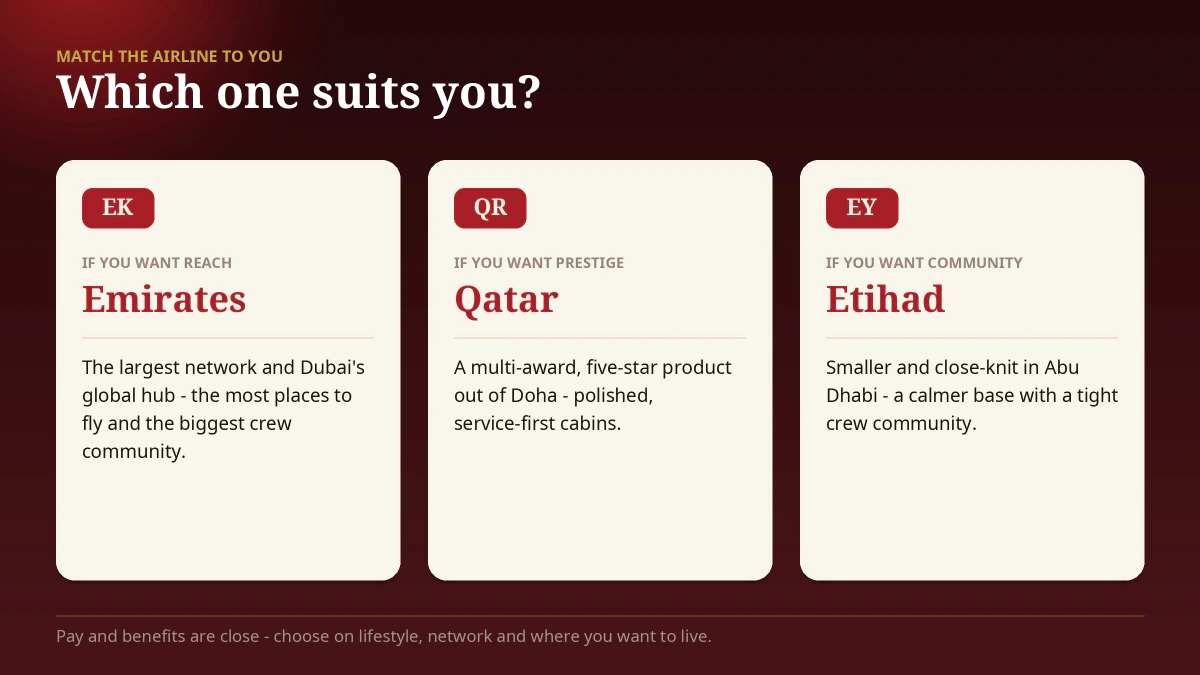
- Want the biggest network and community? Aim for Emirates. Dubai's hub gives you the most destinations and the largest crew base.
- Want the most prestigious service? Aim for Qatar Airways. Its multi-award, five-star product is the benchmark in the industry.
- Want a calmer, close-knit base? Aim for Etihad. Abu Dhabi is quieter and the smaller operation feels more personal.
Many candidates apply to all three and take the first solid offer, which is a perfectly sensible strategy — the packages are close enough that being hired matters more than which of the three it is. If you have a clear preference, lead with that airline but keep the others as strong backups.
Requirements compared
The joining requirements for Emirates, Qatar and Etihad cabin crew are almost identical, which is great news: preparing for one prepares you for all three. Each airline asks for a minimum age of 21, an arm reach of around 212 cm on tiptoes (this is the safety standard for reaching overhead equipment), a minimum height of roughly 160 cm, fluent spoken English and at least a high-school education. All three also expect a professional appearance, no visible tattoos in uniform, and the right to relocate.
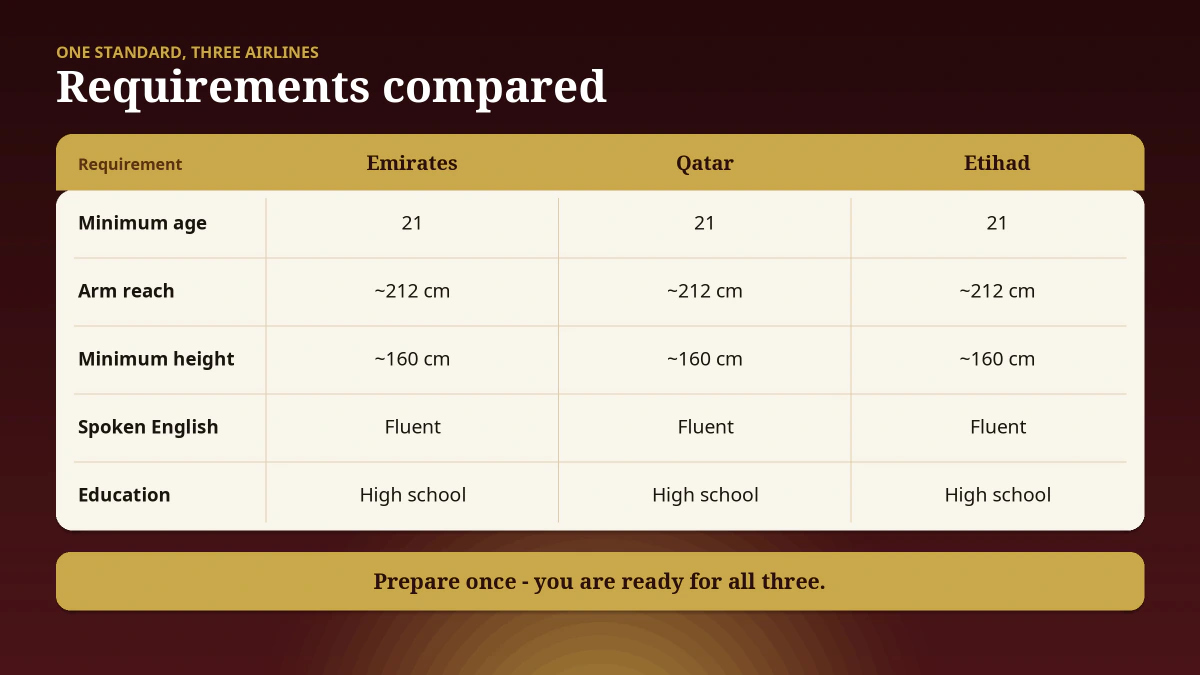
Because the bar is the same, your preparation is portable. The two things that matter most across all three are your English and your arm reach, and both can be worked on. If English is your gap, our guide on English for cabin crew covers the exact level and vocabulary interviewers listen for. Meeting the physical standard is usually simpler than candidates fear — the arm reach is measured on tiptoes, so most people who worry about height still qualify.
The practical upshot is a single, efficient prep plan. Get your English to a confident conversational level, confirm you meet the reach and appearance standards, and prepare one strong set of examples about your service experience. That work carries you into any of the three assessment days without needing to start over.
Interviews and assessment compared
The hiring process is broadly the same shape at all three airlines: an application with a professional photo, an assessment day with group exercises and a reach check, and a final one-to-one interview. Emirates and Etihad run open days and online assessments; Qatar runs similar assessment events. In each case they are testing the same qualities — clear English, calm teamwork, a warm service manner and the resilience to relocate and fly irregular hours.
- Apply with a CV and a professional photo that meets each airline's grooming standard.
- Attend the assessment day — group tasks, a reach test and short exercises that reveal how you work with others.
- Pass the final interview — a competency conversation about real situations from your past.
Because the format overlaps so much, you can prepare once and reuse it. Work through our cabin crew assessment day guide for the group-stage detail, then drill the airline-specific questions free in CrewQuest: the Emirates interview trainer, the Qatar Airways interview trainer and the Etihad interview trainer. Practising all three side by side is the fastest way to see how little they really differ.
Emirates vs Qatar cabin crew
Emirates vs Qatar is the closest of the three match-ups, because both are giant, premium, long-haul airlines with huge networks and near-identical packages. The deciding line is city and style. Emirates gives you Dubai — bigger, busier, more international, with the largest crew community and a slightly larger fleet of destinations for personal travel. Qatar gives you Doha — smaller and calmer than Dubai but rapidly modernising, paired with a service product widely rated the best in the world.
If you thrive on scale, non-stop energy and the widest possible community, Emirates edges it. If you want to work for the most awarded service brand in aviation and prefer a more compact home city, Qatar edges it. Financially there is little to separate them, so this one really does come down to which city you would rather call home for the next few years. Both reward the same preparation, and many candidates hold offers from both and simply choose the city.
Emirates vs Etihad cabin crew
Emirates vs Etihad is a contest of scale against intimacy, both inside the UAE. Emirates is far larger, with roughly double the destinations and a much bigger crew base in Dubai; Etihad is the boutique option in Abu Dhabi, with a smaller network and a more close-knit feel. Living costs, tax status and benefits are essentially the same across the two Emirati carriers, so the choice is about the size of the operation and the character of the city.
Choose Emirates if you want maximum network, maximum variety and the buzz of Dubai. Choose Etihad if you prefer a quieter capital, a smaller team where you recognise your colleagues, and a steadier rhythm. A useful tie-breaker: Abu Dhabi and Dubai are only about 90 minutes apart, so whichever you pick, the other city stays within easy reach on days off — you are not cut off from either lifestyle.
Qatar vs Etihad cabin crew
Qatar vs Etihad pits the larger, more decorated Doha operation against the smaller, community-focused Abu Dhabi one. Qatar Airways has the bigger network and the stronger service reputation, so it tends to attract candidates who want prestige and plenty of long-haul flying. Etihad appeals to those who want a calmer base and a more personal working environment, and who like the idea of building a career at a smaller, more agile airline.
Both are excellent first jobs in the Gulf, both are tax-free, and both provide the full housing-and-benefits package. If service prestige and a wide route map top your list, lean Qatar; if lifestyle and a tight community matter more, lean Etihad. As with every pairing here, the requirements and the interview skills are the same, so you lose nothing by applying to both.
Myths about picking a Gulf airline
A few myths push candidates toward the wrong decision:
- "One airline pays much more." No — the three sit in the same tax-free band. Small monthly differences come from roster hours, not from one airline being generous and another stingy.
- "The biggest airline is automatically best." Not for everyone. Emirates' scale is a plus if you want variety and a huge community, but some crew are happier at smaller Etihad.
- "I have to pick one and only apply there." No — the requirements overlap so heavily that applying to all three is the smart move. Take the strongest offer.
- "Requirements are stricter at the fancier airline." No — age, reach, height and English standards are essentially the same everywhere.
How to choose and apply: next steps
Choosing between Emirates, Qatar and Etihad comes down to one question — which city and culture do you want — because everything financial is close to equal. Decide on your preferred base, then prepare a single strong application you can adapt to all three, and give yourself the best chance by applying widely rather than betting on one.
Ready to turn this into a plan? Book a free consultation call with Kateryna — a former Emirates crew member — using the planner just below, and we will match you to the right airline and map your exact timeline. Then work the funnel: read the full how to become Emirates cabin crew pillar, get your English to level, prepare with the assessment day guide, and drill real questions for each carrier in the CrewQuest trainer. When you are ready to go deeper on the Dubai route, see the full Emirates cabin crew course. And always confirm the current requirements on the official career pages — Emirates, Qatar Airways and Etihad — before you apply.


