 Kateryna Ivanova
Quick answer
easyJet does not publish a cabin crew salary — not on its cabin crew careers page and not on its rewards page. Checked at source on 19 November 2026, what it does publish is exact: you must be 18 or older, between 157.5 cm (5’2”) and 190 cm (6’3”) without shoes, able to swim 25 metres unaided, free of visible tattoos on the head, face or neck, and hold a passport that allows unrestricted travel across the UK, the EEA and easyJet’s network — visa sponsorship is not available. You need no flying experience, the course is four weeks, and if an application is turned down you can reapply after six months. The only pay information from the airline’s side is that crew share in on-board sales commission. The only numbers anyone has put on record come from the crew union, not from easyJet.
TL;DR:
- No salary figure on easyJet’s own pages. The careers page talks about commission and travel perks; the rewards page talks about an annual bonus of up to 10% (up to 20% for exceeding goals) that sits on a company-wide rewards page, not a crew-specific one.
- The requirements are precise and short: 18+, 157.5–190 cm, a 25-metre swim, fluent English plus the language of your base, no head/face/neck tattoos, a CAA or EASA cabin crew medical, and the right to travel freely in the UK and EEA.
- Experience is not required. The page says “no” to previous flying experience. It also says you will be a great fit with at least six months in a customer-facing role — a hint about what recruiters read, not a rule.
- There is no upper age limit on the page. easyJet reported on 25 August 2026 that 12% of its crew are over 50, up 127% since 2022.
- The window is closed right now. On 19 November 2026 the page says registrations of interest are closed and earlier applicants are being reviewed in phases for Summer 2027; new vacancies will be posted on the same page.
- Where the money numbers come from: a 2024 union announcement (a 20% rise in basic pay from 1 May 2024) and unverifiable user-submitted figures that disagree by a factor of two.
What easyJet publishes, and where
Everything below was read on 19 November 2026 in three places: the cabin crew page of easyJet’s careers site (including the FAQ answers hidden behind its drop-downs, which carry edit dates in April 2026), the rewards-and-benefits page on the same site, and a press release dated 25 August 2026 about older crew. The vacancy search that the page points to returned an error on the day, so no individual job advert could be read.
| Topic | What easyJet’s own pages say |
|---|---|
| Experience | “No” previous flying experience needed; you are “a great fit” with at least six months in a customer-facing or people-focused role |
| Salary | No figure on the cabin crew page or the rewards page |
| Pay elements named | A share of the commission from in-flight retail sales; free crew food and drink |
| Training | Four weeks, with a swimming assessment; hotel provided if your base is not the training site |
| Contracts | “Fixed-term, seasonal and permanent contracts across our bases”; details in each vacancy |
| Promotion | Apply to become a Cabin Manager after 12 months as crew |
| Bases | France, Germany, Italy, Morocco, Netherlands, Portugal, Spain, Switzerland, United Kingdom |
Two things to keep in mind when you compare this with other guides. First, easyJet describes how you are paid (commission, bonus, travel perks) but never how much. Second, the page is edited without notice: the FAQ entries carry April 2026 edit dates, and easyJet changed its recruitment status between the August press release and today.
The requirements, line by line
The FAQ answer to “What are easyJet’s requirements to become cabin crew?” splits into two parts: what recruiters like to see, and what is required “to meet regulatory and operational requirements”. Here is the second part as written, with what each line means in practice.
| Requirement (as published) | In practice |
|---|---|
| Be 18 years or older | The only age rule on the page. There is no upper limit. |
| Be between 5’2” (157.5 cm) and 6’3” (190 cm) without shoes | Both ends are firm: a minimum and a maximum. |
| Be fluent in written and spoken English as well as the language native to your base | A Spanish base means Spanish and English; a Portuguese base means Portuguese and English. |
| Hold a valid passport with unrestricted travel across the UK, EEA and the easyJet network | “Skilled Worker visa sponsorship is not available.” If you need a visa to work at your base, this route is closed. |
| Live within 90 minutes of your chosen base, or be willing to relocate | The relocation and the rent are yours; the page mentions no housing. |
| No visible tattoos on the head, face or neck; all tattoos must be inoffensive | Tattoos elsewhere are allowed if they are not offensive. For how other airlines handle this, see the guide to what disqualifies cabin crew. |
| Be comfortable selling items from the CAFE.SHOP range, including alcohol | This is a job requirement, not a perk: selling feeds the commission. |
| Swim 25 metres unaided, tread water, inflate a life jacket and climb in and out of a life raft | The same four tasks appear again in the training swim assessment. |
| Pass a UK CAA or EASA cabin crew medical and fit securely into a jump seat | The medical is a pass/fail gate, not a form you fill in; airline-by-airline requirements are compared in the requirements-by-airline guide. |
The “great fit” list is softer: at least six months in a customer-facing or people-focused role, clear and kind communication, calm under pressure, teamwork and ownership. None of it is a pass mark. But it tells you what the online test and the interview later measure.
Salary: the number easyJet does not publish
There is no salary on the cabin crew page, none on the rewards page, and the vacancy search was down on the day, so there was no advert to read either. That is the same pattern as with most European low-cost carriers: the airline says “competitive” or says nothing, and the figures you see come from somewhere else. For the sources that do exist, here is what each says and what it can and cannot prove.
| Source | What it says | What it can prove |
|---|---|---|
| easyJet careers pages | No figure; crew share in in-flight sales commission | That commission is part of pay. Not how much. |
| easyJet rewards page | Annual bonus of up to 10%, up to 20% for going beyond goals; UK share schemes | Company-wide page, not crew-specific. |
| Unite the Union, 10 April 2024 | A 20% increase in basic pay from 1 May 2024, 3% more on variable pay, an 18-month deal; £15 when a service is disrupted by more than an hour | A percentage of a basic figure that is not published. It describes UK crew, a year and a half before the page you are reading. |
| An anonymous forum comment (about a year old) | “Base salary is £22,000” plus sector pay and on-board commission, about £1,500 a month | Nothing. It cannot be traced to a document. |
| A salary-review site’s average (715 entries when checked) | About £44,649 a year, up to roughly £59,068 | Only what its contributors typed in. The spread between this and the forum figure is a factor of two. |
The union announcement is the most solid item on the list, and it was read here through the union’s own news page as shown in search results and two trade-press reports of the same deal; the full article sits behind a bot check that this guide does not try to bypass. Even so, it is a percentage. A 20% rise on a number nobody publishes does not give you a monthly figure you can plan rent around.
So how should you budget? Do not use the forum figure or the review-site average as a base. Ask the recruiter, in writing, for the components of pay at your base — basic, per-sector or hourly flying pay, commission — and a typical first-year month. For how this compares with Gulf carriers that do publish numbers, the salary-by-airline guide sets them side by side.
Commission, the on-board shop and perks
The cabin crew page says crew get “a share of the commission from in-flight retail sales, plus free crew food and drink”. The requirement list adds the other half: you must be comfortable selling from the CAFE.SHOP range, including alcohol, because “this contributes to commission earnings”. In other words, part of your pay depends on how much customers buy, and selling is part of the job from the first day.
The perks that easyJet names are travel-based: discounted flights, hotels, car hire and holidays; staff travel that friends and family can also use; and easyJet Plus. The rewards page adds an annual bonus, UK share schemes and life assurance, with the note that benefits vary “depending on where you’re based”. None of these is a salary, and none of them is a number.
The application process, step by step
easyJet publishes the process in order, and it is short.
- Online application. You submit your details, a copy of your valid passport and an up-to-date CV, once you meet the minimum requirements. You can apply for one base at a time, so choose your first.
- Online assessment. A link to an ability test covering verbal reasoning, situational judgement and workplace behaviour. Results arrive by email as soon as you submit it.
- Application review. easyJet checks the test results, your CV and passport upload, and that every question is answered. Updates can take a few weeks.
- Interview. Most interviews are virtual (on Microsoft Teams); occasionally you may be invited to an in-person assessment day.
- Offer and training. A successful interview leads to the four-week course.
If you are turned down at any stage, the answer is to “wait six months from your original application” and apply again. If you cannot find the base you want among the open vacancies, easyJet says that means it is not recruiting there right now and recommends registering your interest.
The online test and the interview

The test. easyJet names the three areas — verbal reasoning, situational judgement and workplace behaviour — and says to “find a quiet place” and check that your laptop or computer meets the technical requirements. It does not publish a pass mark or the number of questions, so nothing here can tell you what score you need.
The interview. There are two formats, both with a group exercise and a competency-based interview. In the virtual version you join from home, using Microsoft Teams on a laptop or computer; full preparation details are sent before the day. In the in-person version you attend a presentation about a day in the life of cabin crew, then a group exercise and a competency-based interview. “Competency-based” means questions that ask for a real example of how you behaved, and the way to prepare is to have six or seven such stories ready and structured.
easyJet publishes no scoring scheme for the group exercise, so treat it as a test of how you work with others rather than of whether you “win”.
The four-week course
Training lasts four weeks. Before it starts you complete pre-course work, and the course itself covers safety equipment and procedures for the Airbus A319, A320 and A321, first aid, aviation security and dangerous goods, customer service, and cabin service and uniform standards. You practise in simulators at the training centres and take a swimming assessment in the pool.
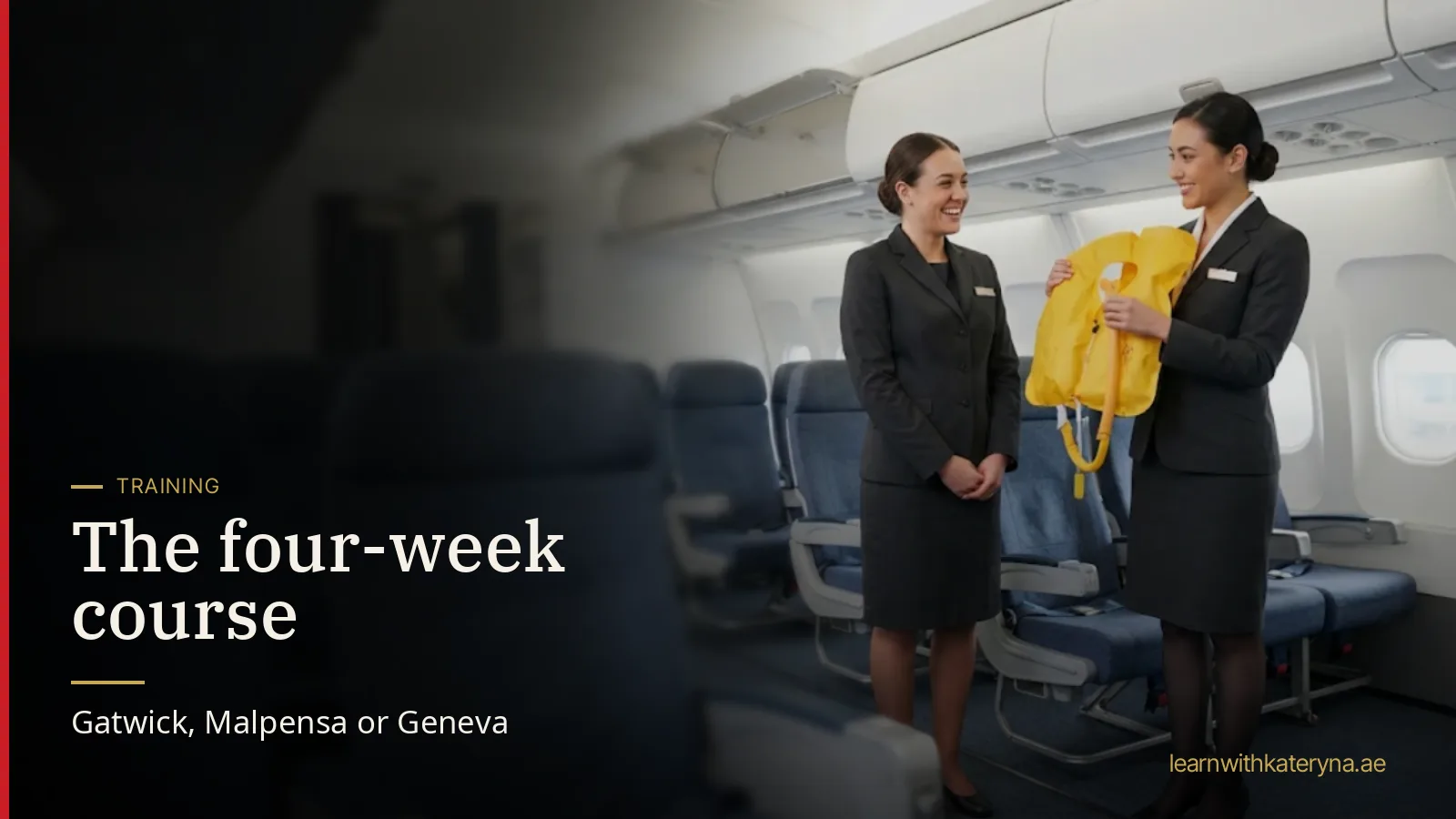
The initial course takes place at London Gatwick or Milan Malpensa; candidates joining a Swiss base train in Geneva. If your home base is not the training site, easyJet provides hotel accommodation for the duration. When you pass all your exams and have shown your trainers that you have learnt what you need, you receive your wings and become a full member of the crew. Compare that with the six weeks at Ryanair or the 7.5 weeks at Emirates in the table further down.
The page does not say whether you are paid during training or whether any part of the course is deducted from pay later. That is one of the checks at the end of this guide.
Bases, contracts and the 90-minute rule
The cabin crew page lists nine countries where easyJet has crew bases: France, Germany, Italy, Morocco, the Netherlands, Portugal, Spain, Switzerland and the United Kingdom. You can apply to one base at a time, and each base recruits on its own schedule. The language requirement follows the base: English plus the local language.
Contracts are “fixed-term, seasonal and permanent”, and the page sends you to each vacancy for the details. Two consequences follow. First, whether your first job is seasonal or permanent depends on the base and the intake, not on you. Second, the rule to “live within 90 minutes of your chosen base or be willing to relocate” applies from day one: easyJet names no housing, so rent and moving costs are yours. Combine that with the passport rule — no Skilled Worker visa sponsorship — and you can see who this route is for: people who already have the right to live and work in the UK or the EEA.
Age: 18 minimum, no maximum on the page
The only age rule easyJet states is 18 or older. There is no upper limit anywhere on the cabin crew page, and the company has gone out of its way to say so. In a press release dated 25 August 2026 it reported that around one in ten (12%) of its crew are over 50, that the number of over-50s has risen 127% since 2022, and that the number of over-60s has almost quadrupled. It also described its 2024 “Returnships” taster sessions for career changers over 50.
That does not mean age is irrelevant. The physical requirements (the swim, the medical, the jump seat) apply at every age. But if you have been told you are “too old” for cabin crew, easyJet’s own page and its own statistics say otherwise.
When you can apply: what the page says today
The same press release said applications would open in September 2026 for hundreds of crew roles for 2027 across the UK. On 19 November 2026 the cabin crew page says something different: the recruitment update states that people who registered their interest and have not heard back are being reviewed “through a phased approach, aligned to our recruitment requirements for Summer 2027”, and that registrations of interest are now closed. Future cabin crew vacancies will be posted on the page as they become available.
What that means for you in practice:
- If you registered earlier, wait for contact; easyJet says it will be in touch “if and when” opportunities arise.
- If you did not register, there is no sign-up to complete today; check the page regularly for new vacancies.
- The page is the only place easyJet says vacancies will appear. For questions, it gives CabinCrewrecruitment@easyJet.com for UK and EU bases and SwissCrewrecruitment@easyJet.com for Swiss bases.
From crew to Cabin Manager
The page puts the first promotion at 12 months: you may apply to become a Cabin Manager after a year as crew. The Cabin Manager is “in charge of the cabin”, leads the crew, and is the link between everyone on board and the teams on the ground. To apply you need at least 12 months of flying experience in the last five years, plus a shared passion for customer service and safety. On-the-job training, shadowing, workshops and e-learning are named as the ways to step up or move around.
easyJet, Ryanair or Emirates: what each one publishes
The comparison does not say one employer is better. It shows what is published, because that decides how much you can plan before you apply. The Ryanair column comes from our Ryanair cabin crew guide (read 7 November 2026); Emirates lines come from its careers page.
| easyJet (19 Nov 2026) | Ryanair (7 Nov 2026) | Emirates | |
|---|---|---|---|
| Minimum age | 18 | Not stated; 18 by law | 21 |
| Height | 157.5–190 cm, no shoes | 157–188 cm | 160 cm minimum |
| Experience | No flying; 6 months customer-facing is “a great fit” | None required | At least one year in hospitality or customer service |
| Training | 4 weeks | 6 weeks | 7.5 weeks |
| Pay published | No | No | Yes |
| Housing | Not mentioned; live within 90 minutes of base | Not mentioned | Provided |
The shortest reading: easyJet is the easiest to enter and the hardest to price. Emirates asks for more (age, experience) and tells you the pay. Whichever you consider, read the source behind each line instead of the summary.
Seven checks before you apply
The gaps above are all questions. Ask them in writing, before you invest in a flight, a notice period or a new flat:
- Which base, and is the first contract fixed-term, seasonal or permanent?
- What are the components of pay — basic, flying pay, commission — and what does a typical first-year month look like at that base?
- Are you paid during the four-week course, and is any part of the cost deducted later?
- Who pays for the hotel if you train away from your base?
- How is the commission calculated, and is it shared across the crew on a flight?
- Do you have the right to work in your base’s country, since no visa sponsorship is offered?
- Are you applying through the real site? Use the “Apply” button on a vacancy on the careers site, and contact only the recruitment addresses the page itself lists. The process described has no payment step.
If an answer will not be given in writing, that is itself an answer. And if you want your tests and interview answers rehearsed with someone who has been through airline recruitment, the consultation below is the place. Kateryna flew for Emirates, not easyJet, so the work there is on what is the same at every airline: the group exercise, the competency questions and the judgement-style test.