 Kateryna Ivanova

A day in the life of Emirates cabin crew is built around one flight, not one office schedule. On a long-haul rotation you are collected from home by company transport, brief with your team, board and welcome passengers, run the in-flight service, take a rotated rest, then land into a layover city where the rest of the day is yours. Hours are irregular, but so are the rewards.
TL;DR:
- A working day follows the flight, not the clock: pickup, briefing, boarding, in-flight service, crew rest, landing and a layover hotel — then a real rest day in a new city.
- Crew fly roughly 85–100 hours a month across short-haul and long-haul, so no two weeks look the same.
- The honest trade-offs are jet lag, night flights and nights away from home; the pay-off is generous days off, paid travel and a free flight home each year.
- Between trips you live in Dubai in a furnished, shared crew flat with bills and transport covered, in a tax-free city with a huge crew community.
- The job runs on calm, clear English and steady service under pressure — the exact skills that also get you hired.
What a day in the life really looks like
A day in the life of Emirates cabin crew is one working "duty" that centres on a single flight or rotation, wrapped in rest before and after. There is no nine-to-five. Instead your day is shaped by report time, sectors flown and the city you land in. One week you might operate a night flight to London and sleep the next morning; the following week you could wake up in Tokyo, Sydney or São Paulo with a full day off before the flight home.
That is the first thing to understand about the lifestyle: it is a series of days that each look different, tied together by a monthly roster. Some duties are short and sharp — a quick turnaround to the Gulf and back in a shift. Others are long-haul rotations that keep you away for two to four days. The common thread is that when you are on duty you work hard and to a high standard, and when you are off you are genuinely off, often in a place most people save all year to visit.
The job is not a routine you repeat. It is a rhythm — intense hours in the air, then real rest in a new city — and learning to ride that rhythm is what separates crew who thrive from crew who burn out.
A long-haul day, hour by hour
A long-haul day for Emirates cabin crew runs from an early pickup at home to a late check-in at a hotel on the other side of the world. The exact clock times shift with the route and time zones, but the shape of the day is remarkably consistent. Here is how a typical long-haul duty unfolds, hour by hour.
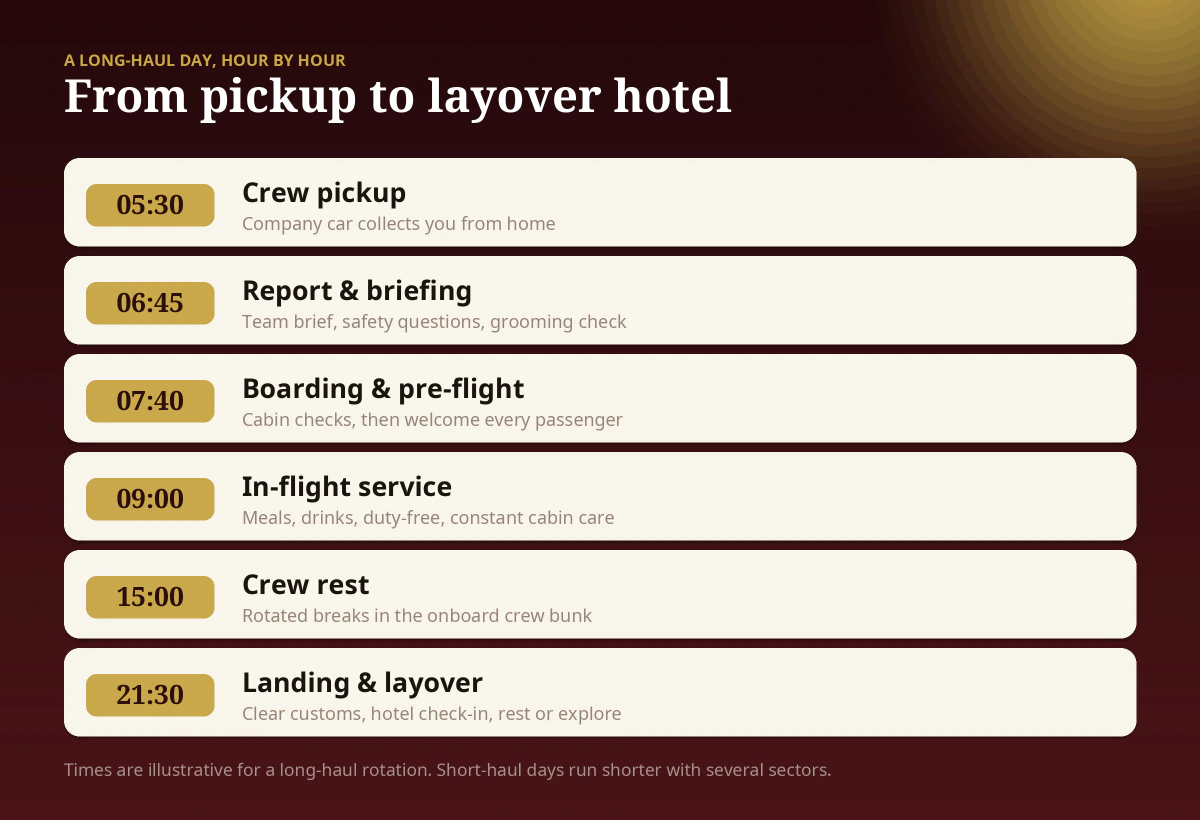
- Crew pickup (approx. 05:30): a company car or crew bus collects you from home and takes you to the airport, so your commute is never your problem.
- Report and briefing (approx. 06:45): the whole crew meets, the Purser leads a briefing, and you may be asked safety and service questions before you are cleared to fly.
- Boarding and pre-flight (approx. 07:40): you complete cabin safety checks, set up the galleys, then welcome every passenger aboard with a smile that has to look effortless even at dawn.
- In-flight service (from approx. 09:00): meals, drinks, duty-free and constant cabin care fill the busiest hours of the flight.
- Crew rest (approx. 15:00): on long sectors the crew rotate through breaks in a dedicated onboard rest area so everyone stays sharp.
- Landing and layover (approx. 21:30 local): you clear customs as a crew, ride to the hotel, and the rest of the day is yours to sleep or explore.
That single duty can span 14 to 16 hours of work once you count report time, the flight and post-flight duties. It is a long day — but it ends in a hotel in a new country, and the next day is usually a rest day.
Wake-up, grooming and pickup
The day in the life starts well before report time, with grooming and preparation at home. For an early long-haul departure that can mean waking at 04:00. Emirates has a recognised grooming standard — hair, make-up, uniform and accessories all have to be correct before you leave the house, because the first "check" of the day is visual. Crew build a fast, reliable morning routine so this becomes muscle memory rather than a scramble.
The commute itself is one of the quiet perks. You do not drive, park or fight traffic: company transport collects you and drops you at the crew report area. After a night flight the same transport brings you home. It sounds small, but never having to think about getting to work removes a real daily stress — and it is one of the reasons the lifestyle feels different from a normal shift job. If you are still weighing up the move, our guide on how to become Emirates cabin crew covers the full relocation picture.
Report and pre-flight briefing
The pre-flight briefing is where a group of individuals becomes one crew. You report at a set time before departure, sign in, and gather with the team you will fly with — often people you have never met, from a dozen different countries. The Purser (the cabin manager) runs the briefing: safety procedures, the day's service flow, any special passengers or medical considerations, and questions to confirm everyone knows their positions and drills.
This is also a professional filter. If your uniform or documents are not right, or you cannot answer a safety question, you may not operate. It sounds strict, but there is comfort in it: everyone around you has passed the same bar. The briefing sets the tone for the whole duty — calm, prepared and united — and it is one of the first things you rehearse in training and in the assessment day that gets you the job in the first place.
Boarding and pre-flight checks
Boarding is the phase where safety checks and first impressions happen at the same time. Before a single passenger steps aboard, crew complete a full security and safety sweep of their zone — checking emergency equipment, doors, galleys and the cabin itself. Only once the aircraft is confirmed safe does boarding begin.
Then the door opens and the human part of the job starts. You greet hundreds of passengers, help with bags, guide people to seats, and manage the small dramas of boarding — a missed connection here, an anxious first-time flyer there — all while keeping the cabin moving. Doing this warmly at 6am, or at midnight, is a skill. It is not about a fixed smile; it is about genuine, steady hospitality that holds up whether you feel fresh or tired.
Passengers remember how you made them feel, not how many hours you had slept. Learning to give the same calm welcome on hour one and hour twelve is the real craft of the job.
In-flight service: the busy hours
The in-flight service is the most physically demanding part of a day in the life. Once the aircraft is at cruise, the galleys come alive: meals are prepared and served, drinks poured, special meals tracked, duty-free sold, and the cabin kept clean and calm for hours. On a full long-haul flight you are on your feet for long stretches, walking the aisles, lifting trays and carts, and reading the cabin constantly for anyone who needs help.
Underneath the hospitality sits the real job: safety. Crew are trained for medical events, turbulence, technical issues and, in the rare worst case, an evacuation. Most flights are smooth, but you are always the person passengers turn to when something goes wrong. That dual role — host and safety professional in the same shift — is what makes the work meaningful and, honestly, tiring. It is also why strong, clear communication matters so much; we build exactly that in English for cabin crew.
Crew rest on a long-haul flight
Crew rest is a scheduled, rotated break that keeps long-haul crew safe and alert. On ultra-long sectors — think Dubai to Los Angeles, Auckland or Buenos Aires — the flight is long enough that regulators require crew to rest in shifts. Wide-body aircraft have a dedicated crew rest compartment, often a set of bunks tucked away from the cabin, where you can genuinely lie down and sleep.
You take your rest in a rotation with your colleagues, so the cabin is always fully staffed. It is not a luxury; it is a safety measure, governed by flight-time and duty rules from authorities such as the UAE General Civil Aviation Authority. For a new joiner, learning to fall asleep quickly on a moving aircraft is a genuine skill — one experienced crew master because it is the difference between landing wrecked and landing ready to enjoy a layover.
The layover: what crew actually do
A layover is the rest period between the flight out and the flight home, spent in a hotel in the destination city. This is the part of the lifestyle that fills people's Instagram feeds — and, handled well, it is as good as it looks. Emirates puts crew up in comfortable hotels, and depending on the route you might have anywhere from a short overnight to two or three full days before you fly back.
What crew actually do varies by person and by trip. After a hard night flight, a long layover often starts with sleep and a slow reset. But a well-planned layover is a chance to see the world for free: breakfast by a harbour in Sydney, a museum morning in Boston, a walk through old-town Prague, or simply a quiet café and a book. Some crew train, some sightsee, some just recover. The point is that your "commute home" can include a day in a city you would otherwise pay thousands to visit.
A layover is not a holiday — you are still on duty and flying home soon — but few jobs pay you to wake up in a different country most weeks and hand you the daylight hours to enjoy it.
The roster reality (the honest bit)
The roster reality is the honest core of the lifestyle: irregular hours, jet lag and time away from home, balanced by generous days off. Your monthly roster is published in advance and mixes short-haul and long-haul duties, standby days and rest days. It is not a fixed pattern, and that is both the appeal and the challenge — you rarely work a boring week, but you also cannot assume every weekend is free.
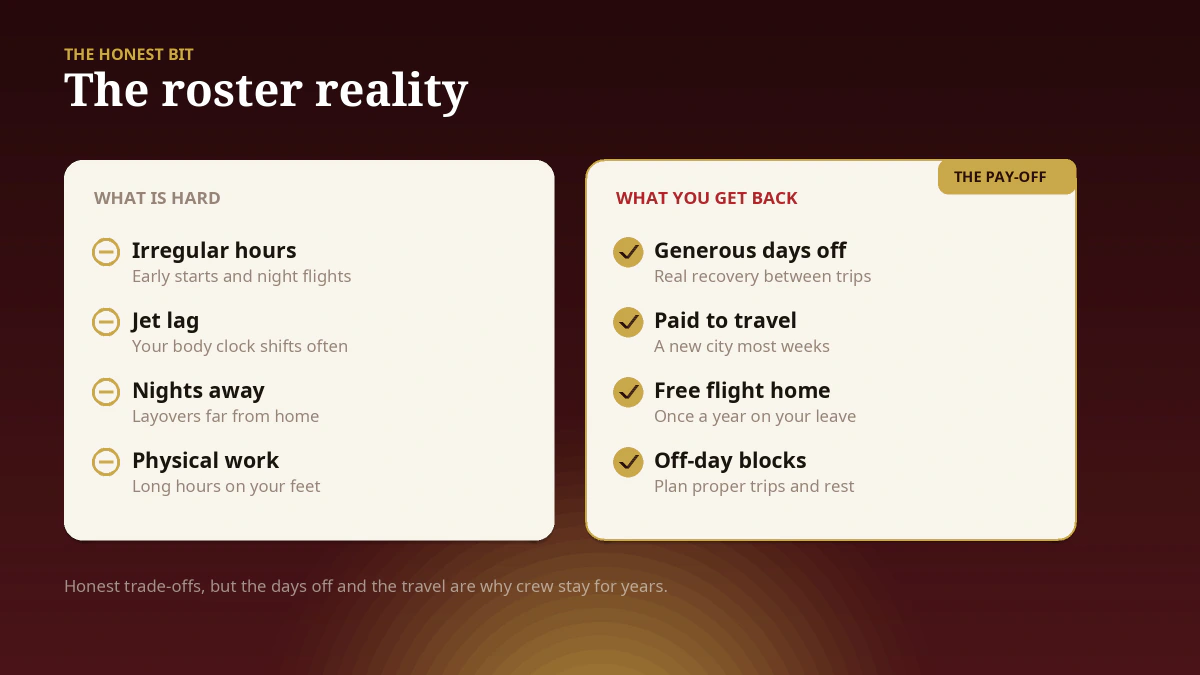
Let us be clear about the trade-offs, because pretending they do not exist helps no one. Night flights and time-zone hopping mean real jet lag; you will miss some birthdays and events at home; and the work is physical. In return, you get proper blocks of days off to recover and travel, a new city on many trips, and a free flight to your home country once a year on your leave. Crew who plan around the roster — protecting sleep, batching social plans on off-days, and using layovers to rest — find the balance works. Those who fight it tend to struggle. As you gain seniority you also earn more influence over your roster through a monthly bidding system, which lets experienced crew shape their lifestyle as well as their income.
Life in Dubai between flights
Life in Dubai between flights is the "home base" half of the lifestyle, and it is a big part of why crew choose Emirates. When you are not flying, you live in the city as a resident, not a tourist. New crew are placed in a furnished, shared flat with bills covered and transport to flights provided, usually in a serviced building with a pool and a gym. The hardest part of moving abroad — finding and paying for a home — is handled for you.
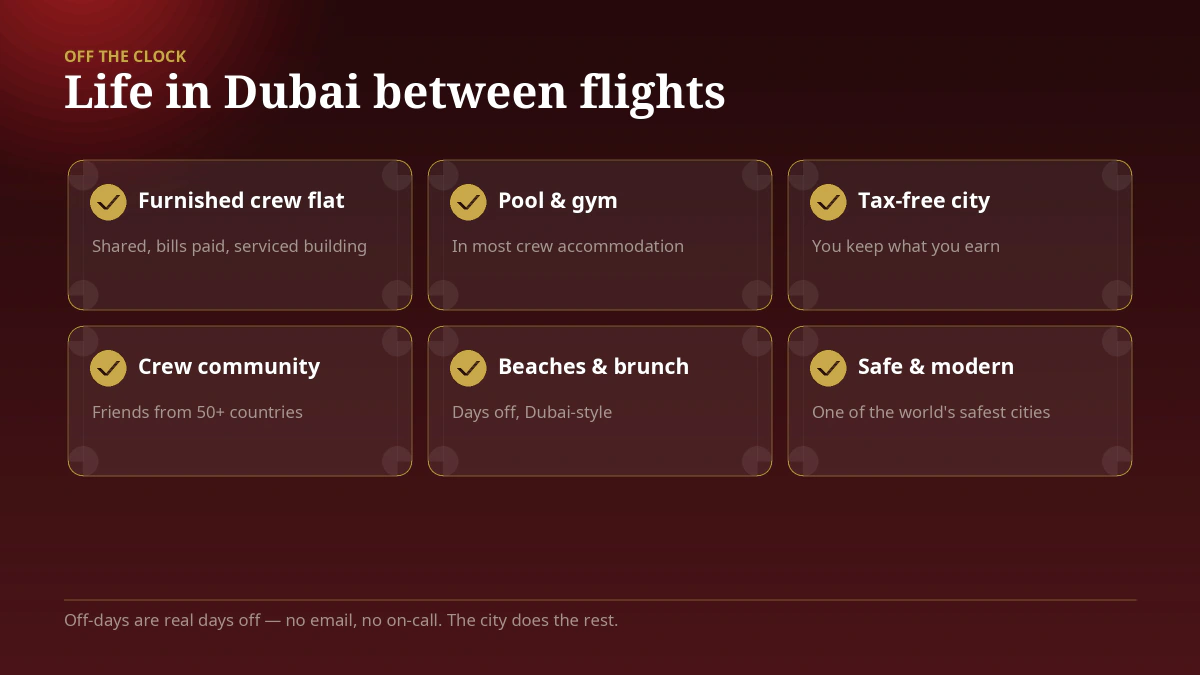
Dubai itself suits the lifestyle. It is tax-free, so you keep what you earn; it is modern and consistently ranked among the safest big cities in the world; and it is packed with beaches, restaurants and things to do on a day off. Above all, there is the community. Emirates crew come from more than 50 nationalities, and you live and fly alongside them, so friendships form fast. Many crew describe their base as a second family — the people who understand the odd hours because they live them too. For a candidate relocating from Ukraine or the EU, that built-in community makes a huge move far less lonely than it sounds.
Short-haul days vs long-haul days
Short-haul and long-haul days are two very different versions of the job, and most crew fly a mix of both. A short-haul day is a there-and-back or a couple of quick sectors within the region; a long-haul day is a single long flight into a layover. Understanding the difference helps you picture the real week.
| Feature | Short-haul day | Long-haul day |
|---|---|---|
| Shape | One duty, back to Dubai the same day | One long flight into a layover city |
| Sectors | Often two or more | Usually one |
| Sleep | Home in your own bed | Hotel in a new country |
| Crew rest | None needed | Rotated bunk rest on ultra-long routes |
| Feel | Fast, busy, familiar | Marathon shift, then real time off |
Neither is "better" — they suit different personalities and life stages. Some crew love the variety of long-haul and the free travel; others prefer short-haul so they sleep in their own bed most nights. A good month blends the two, and as you get senior you get more say over the balance.
What the lifestyle pays — and costs
The lifestyle pays a tax-free package with your biggest living costs covered, which is why it stretches so far. Pay is built from a basic salary plus hourly flying pay and layover allowances, and because the UAE has no personal income tax, the gross figure is your take-home. Rent, transport to flights, healthcare and your uniform are provided, so more of what you earn is genuinely yours to save or spend. We break the numbers down in full in our guide to the Emirates cabin crew salary.
The costs are not only financial. You pay in tiredness, in missed events at home, and in a body clock that never quite settles into one rhythm. Being honest about that is important — the highlight reel online rarely shows the 3am wake-ups or the jet lag. But for many crew the maths clearly works: they see the world, save at a rate that is hard to match on a taxed salary in Europe, and use the first few years as a launchpad for whatever comes next. For the official role details and current requirements, always cross-check the Emirates Group cabin crew careers page.
The English you actually use on board
The English you use in a day in the life is practical, calm and clear — not perfect or fancy. From the briefing to the last passenger, English is the working language: you brief with a multinational crew, make announcements, take orders, explain safety, reassure nervous flyers and handle complaints, all in a second (or third) language for most crew. It rarely needs to be advanced; it needs to be confident and easy to understand under pressure.
This is exactly why strong spoken English is such a lever for getting hired and for thriving once you are in. The good news is that the English of the job is learnable and repeatable — a set of scenarios you can rehearse until they feel automatic. You can practise real onboard and interview scenarios free in the CrewQuest trainer, and build the underlying fluency with English for cabin crew. Sound natural in these moments and the whole day — briefing, service, layover chats with your crew — becomes easier and more enjoyable.
A typical day off in Dubai
A day off in Dubai is a genuine rest day with no on-call and no email — the job does not follow you home. Because your essentials are handled, an off-day is discretionary time, not chores. Crew use it in every possible way: a slow brunch, a beach afternoon, the gym, a long sleep to clear jet lag, a coffee with flatmates who are also off, or a quick trip to another emirate.
What surprises new crew is how restorative these days become once you protect them. The trick most experienced crew learn is simple: guard your sleep first, then plan the fun. Off-days often come in blocks, which means you can travel properly on your own concessional tickets, visit family, or simply switch off. Combined with the free annual flight home, it is a lifestyle that gives back the time it takes — as long as you use the rest days as rest days.
Is this life for you? Next steps
A day in the life of Emirates cabin crew is demanding and glamorous in equal measure, and it suits people who love variety, hospitality and travel more than a fixed routine. If early starts, night flights and time away from home feel like a fair price for paid travel, a tax-free base in Dubai, a community from 50-plus countries and real days off in new cities, then this life is very likely for you. The hard part is not living it — it is getting hired.
Ready to move from reading to doing? Book a free consultation call with Kateryna — a former Emirates crew member — using the planner just below, and we will map your exact path and timeline. Then work through the funnel: get your English to level, prepare with the assessment day guide, understand the full picture in how to become Emirates cabin crew, and see the full course on the Emirates cabin crew course page. You can also drill real interview and onboard scenarios free in the CrewQuest trainer.