 Kateryna Ivanova

You leave before eight. You get home after six. By the time the bath is done and the last story is read, you have had maybe an hour and a half of actual awake time with your child — and you are supposed to be building a second language inside it. Most advice about teaching English at home is written as though you have the whole day. You do not. So this guide starts from the opposite end: not "here are twenty lovely activities", but here is exactly how many minutes you actually have, which of them are worth using, and what to deliberately abandon. Twelve minutes a day, placed correctly, genuinely works. Three hours at the weekend does not. Here is why, and here is the plan.
Quick answer
A working mother realistically has 90–120 minutes of awake contact time with a toddler on a workday — not twelve hours. You do not need most of it. You need roughly 12 focused minutes, split across three anchors that survive a job: the morning dressing routine, bath time, and bedtime. These three happen every single day regardless of your schedule, which is exactly what makes them work. What does not work is saving it all for the weekend: language is built by daily distributed repetition, and a three-hour Saturday block cannot replace six short weekday contacts. Research on early language also suggests that back-and-forth conversational turns matter more than sheer volume of words — which means your short, attentive, genuinely interactive minutes count for more than a distracted afternoon.
The honest math: how much time you actually have
Before planning anything, count. Most working mothers dramatically overestimate how much contact time they have, then feel like failures for not filling it. Here is a realistic weekday with a toddler and a full-time job.
| When | What happens | Real contact time | Usable for English? |
|---|---|---|---|
| 06:45–07:30 | Waking, dressing, breakfast | ~25 min | Yes — highly repetitive, same sequence daily |
| 07:30–08:00 | Nursery drop-off, commute | ~10 min | Partly — rushed, but the car or buggy works |
| 08:00–18:00 | Work | 0 min | No. Stop trying. |
| 18:00–18:30 | Pickup, coming home | ~20 min | Yes — emotionally the richest window |
| 18:30–19:15 | Dinner | ~25 min | Partly — often the most chaotic slot |
| 19:15–19:45 | Bath | ~20 min | Yes — calm, hands-on, unhurried |
| 19:45–20:15 | Story and bed | ~20 min | Yes — the single most protected slot |
Add it up and a typical working weekday gives you somewhere around 90 to 120 minutes of genuine awake contact. That is the real budget. Every plan that assumes more than this will fail in week two.
Now the good news, and it is genuinely good: you need about 12 of those minutes. Roughly 10–12% of your contact time, placed in the three slots that never disappear. That is a target you can actually hit on a bad Tuesday. If you want the per-age version of this budget — what 18 months needs versus what four years needs — it is set out in the age-by-age roadmap.
Why your 12 minutes beat someone else's three hours
This is the part that should change how you feel about the whole thing.
For years the received wisdom in early language was essentially a volume argument: more words heard, better outcomes. More recent work has refined that considerably. Research from MIT led by Rachel Romeo and colleagues found that what predicted children's language scores — and even measurable differences in brain activity in language regions — was not the raw number of words a child heard but the number of conversational turns: the back-and-forth exchanges between adult and child. Turn-taking mattered more than volume, and the effect held across family backgrounds.
The practical implication for you is direct. A parent who is physically present all day but talking past their child is producing a lot of words and few turns. A working mother who gets twelve minutes and spends them in genuine back-and-forth — she says something, the child responds with a word, a sound, a look, a gesture, and she responds back — is producing exactly the thing that counts.
This is not a consolation prize. It is the actual mechanism. Serve-and-return interaction, as the Harvard Center on the Developing Child describes it, is what builds the language system, and it is measured in exchanges, not hours.
So the target is not "more time". It is fewer, better minutes, every single day.
Why you cannot save it all for the weekend
Almost every working mother tries this, and it is the single most common reason home English quietly dies. The logic feels sound — I have no time Monday to Friday, so I will do a proper session on Saturday — but it runs against how language is stored.
Learning research going back to Ebbinghaus consistently finds that distributed practice beats massed practice: the same total amount of exposure produces far more durable retention when it is spread across many short sessions than when it is concentrated into a few long ones. Vocabulary in particular responds to spacing. Six two-minute contacts across a week will outperform one twelve-minute Saturday block, even though the total is identical.
There is a second problem specific to toddlers. A three-year-old's tolerance for a "session" is short — often five to ten minutes before attention collapses. So the Saturday block does not actually deliver its promised time; it delivers ten good minutes and thirty minutes of a tired child and a frustrated adult, which then attaches a negative feeling to English.
The rule: weekdays carry the language; weekends add pleasure, not catch-up. Use Saturday for the long story, the park in English, the messy game — the things you genuinely cannot do on a Tuesday. Do not use it to compensate.
The three anchors that survive a job
Choose rituals by one criterion only: does this happen every single day whether or not I am organised? Anything that depends on you having energy or spare time will not survive month one.
| Anchor | Why it survives | Fixed phrases | Minutes |
|---|---|---|---|
| Morning dressing | Non-negotiable, identical sequence every day, hands already busy | "Good morning." "Arms up." "Let's put on your socks." "Are you ready?" | 4 |
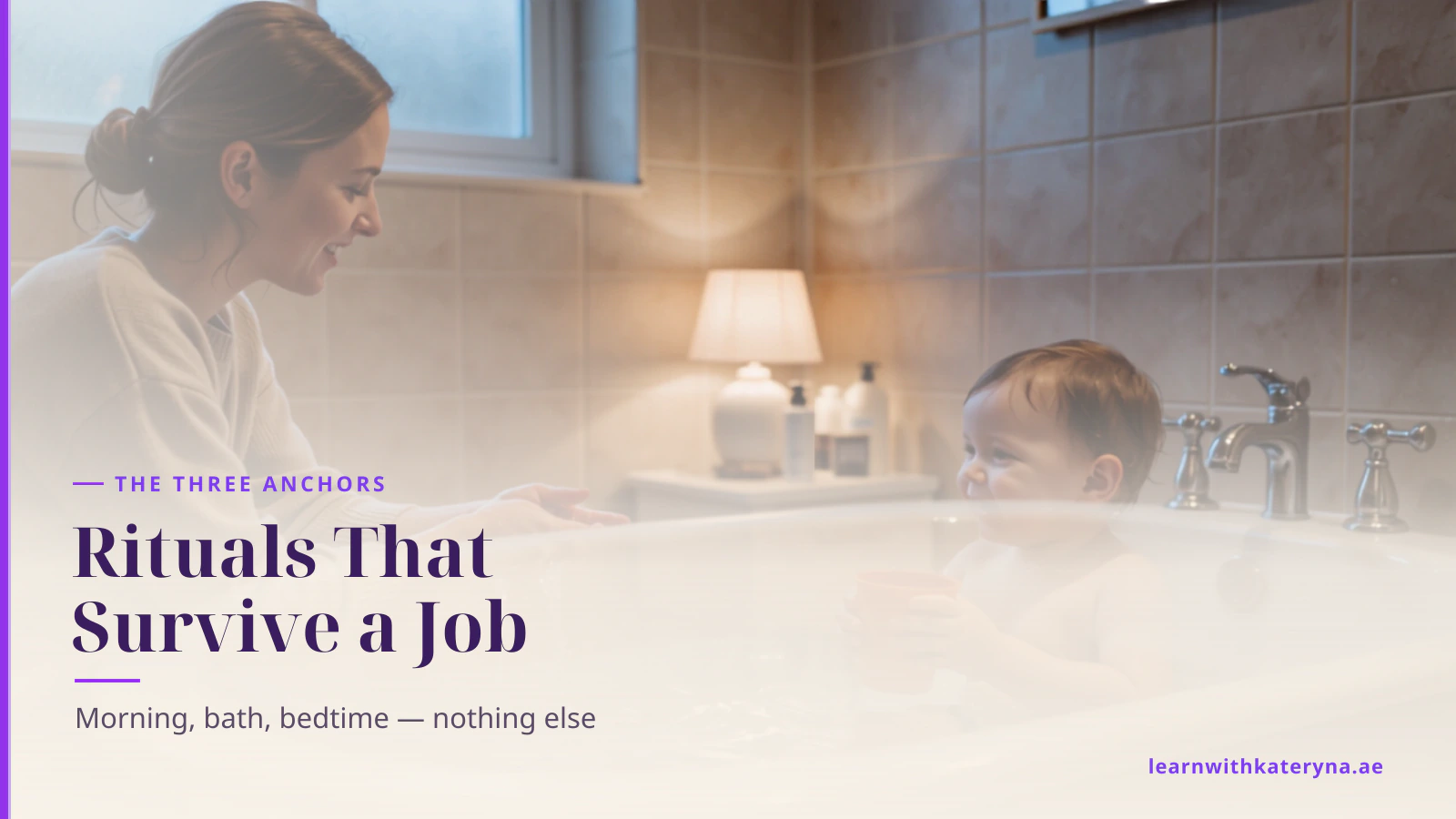
| Bath | Happens regardless of your day; calm, close, no rush | "Water's warm." "Wash your tummy." "Splash!" "All finished." | 4 |
| Bedtime story | Already protected in almost every household | The same book, the same repeated lines, pausing before the last word | 4 |
Notice what is not on the list: dinner, playtime, the drive to nursery. Not because those are bad, but because they are unreliable — dinner is chaotic, playtime gets cancelled, the drive depends on who does drop-off that week. Build on the three that never move, then add unreliable slots later as a bonus rather than as a foundation. The full mechanics of ritual design are in daily English rituals at home.
One more constraint that matters for working parents: use the same phrases for weeks. Do not introduce new language each day. Repetition is doing the work, and it is also the only way this stays possible when you are tired — you should not have to think.
The 12-minute working day, minute by minute
Here is the whole plan. Print it, or do not — after ten days you will not need it.
- Minutes 1–4 — Morning, while dressing. Five fixed sentences, the same ones, in the same order. "Good morning. Time to wake up. Arms up. Let's put on your socks. Are you ready? Let's go." That is it. No questions, no testing, no "how do we say that?"
- Minutes 5–8 — Bath. Narrate what your hands are doing. "Water's warm. Wash your tummy. Wash your feet. Splash! All finished." Add one action song if it fits — this is the best slot for a song because nobody is going anywhere.
- Minutes 9–12 — Bedtime. One picture book, the same one, for at least two weeks. Point and name rather than reading the text. From week two, pause before the last word of a repeated line and let your child fill it in — that pause is where production starts.
Plus one thing that costs zero minutes: put three English songs on during breakfast or in the car. Not as a lesson — as background. You are not required to do anything with them. Passive audio will not teach your child English on its own, but it keeps the sound system familiar between your twelve minutes, and it costs you nothing at all. The songs that work best are worth choosing deliberately once, then leaving alone.
Total daily cost: twelve minutes of attention, zero minutes of preparation, zero extra time in your calendar. Every one of those minutes was already happening.
The most valuable four minutes of your day
If you only do one thing from this article, do this one.
The four minutes immediately after you walk through the door are the emotionally densest of your entire day. Your child has been waiting for you. Attention, motivation and memory are all bound up with relationship, and at that moment your child wants you more than at any other point in the twenty-four hours.
Most of us spend those four minutes putting down bags, checking a phone, asking the nanny how the day went, and starting dinner. Try instead: drop everything, get on the floor, and give four undivided minutes before anything else happens. Do it in English, with a tiny fixed script — "Hello! I'm home. I missed you. What have you got there? Show me."
Two things happen. The language lands unusually well because attention is at its peak. And, less measurably but just as importantly, the guilt eases — because you have given the day's best four minutes to your child rather than its leftovers.
A caution worth stating: do not turn the reunion into an interrogation. "What did you do today? Did you speak English? Who did you play with?" A tired three-year-old has neither the words nor the energy. Offer presence, not questions.

Turning your nanny, nursery or grandparent into a real English source
You are not the only adult in your child's life, and for a working mother that is an advantage rather than a compromise. The people who have your child during the day can carry far more English hours than you can — if you set it up deliberately instead of hoping.
If you have a nanny or helper:
- Ask for one specific, repeated ritual in English rather than "please speak English sometimes" — vague requests fade within a fortnight. Snack time is usually the easiest to hand over.
- Write the exact phrases down. Five sentences on a card on the fridge. Do not rely on improvisation from someone who may also be a non-native speaker.
- If your nanny speaks a third language and is comfortable in it, that is a genuine asset, not a problem — but agree who owns which language, so your child gets consistency rather than a blur.
If your child is at nursery: that is likely already your largest single source of English, which changes your job. You are no longer the main input; you are the person who keeps English alive at home so it does not become a place-specific school language. Ask the key worker which songs they sing and use those exact ones at bath time — the overlap is powerful, because your child arrives already knowing them.
If grandparents do childcare: do not ask them to speak English. Ask them to own the home language deliberately and richly — the stories, the songs, the family words. The strong first language is what English gets built on, so this is a real contribution rather than a consolation. It also tends to convert scepticism into pride.
What to drop — an explicit permission list
Working mothers usually fail at home English not by doing too little but by attempting a stay-at-home-parent plan and collapsing under it. Here is what you may abandon, with no cost to your child:
- Flashcards. They are the least efficient minute you can spend at this age. Drop entirely.
- Craft activities and printables. Preparation time you do not have, for a language benefit you can get from a bath.
- Speaking English all day. Not realistic, not necessary, and attempting it produces the anxious inconsistency that kills the habit.
- Vocabulary breadth. Colours, shapes, animals, numbers — all of it can wait. Fifteen phrases used daily beat two hundred words met once.
- Tracking and progress charts. One note on your phone every fortnight is enough.
- Weekend catch-up sessions. Covered above — they do not work, and they make you feel worse.
- Apps that require your supervision. If it needs you sitting there, it is competing with your twelve minutes, not adding to them.
What you may not drop: the three anchors, and the daily-ness. That is the whole method. And if your child starts actively pushing back against English rather than simply ignoring it, that is a different problem with a different fix — see what to do when your child refuses to speak English with you.
Shift work, travel, and two parents working late
If you work shifts and your evenings are unpredictable, anchor to your child's routine rather than to a clock time — whoever does bath does bath in English, and you take it when you are there. Consistency of sequence matters more than consistency of hour. Agree a fixed short script with the other adult so the words stay identical whoever is holding the towel.
If you travel for work, do not try to replicate the ritual over video. Instead, record yourself reading the bedtime book once — audio or video — and let that play in your absence. The familiar voice, the familiar text and the familiar sequence carry the continuity; a live call at a bad hour usually does not.
If both parents work late and someone else does the evening, move your anchor to the morning and make it slightly longer. The morning is the most under-used slot for dual-income families and the most reliable, because nobody's meeting overruns before 07:00.
If you have more than one child, run one ritual for both rather than two separate ones. The younger absorbs; the older performs and consolidates by leading. Do not split your twelve minutes into six and six.
The five-minute version, for the worst weeks
Some weeks twelve minutes is not available. A deadline, a sick child, a family crisis, a week where you are simply empty. This is the point at which most home-English habits die — not because the mother decided to stop, but because she missed four days, felt she had broken it, and never restarted.
So decide now what the minimum version looks like, before you need it. Mine is this:
- Keep one anchor only — bedtime. Not the best one pedagogically, but the one most likely to still happen when everything else has collapsed.
- Drop to three sentences. "One more story. Good night. Sleep tight." Nothing else. No book if there is no book in you.
- Keep the songs running. They cost nothing and they hold the sound of English in the house while you are not managing anything.
- Do not apologise or explain. Your child does not know the plan shrank. Only you do.
Five minutes, or less. The point is not the language content of those five minutes — at that level there barely is any. The point is that the thread does not break, so there is nothing to restart when the week ends. A habit that survives a bad fortnight at ten per cent strength is worth far more than a perfect routine abandoned twice a year.
And if you do break it entirely: start again the next ordinary evening, at normal size, with no compensation and no mention of the gap. Children do not audit consistency. They just notice what happens tonight.
About the guilt
I want to address this plainly, because it is usually the real reason a mother reads an article like this at eleven at night.
The guilt is not evidence that you are doing badly. Almost every working mother I have taught arrives convinced she is short-changing her child linguistically, and almost none of them are. What the evidence points to — conversational turns rather than word counts, distributed daily contact rather than long blocks — happens to describe the working mother's situation quite well, provided the contact is genuinely interactive.
It is also worth being honest about the alternative you may be comparing yourself to. A parent at home all day is not automatically producing more turns; presence and interaction are different things. Your twelve deliberate minutes are not a lesser version of someone else's day. They are a different, and perfectly viable, delivery method.
And on the days you miss entirely — because the flight was delayed, because someone was sick, because you had nothing left — nothing breaks. Language is built over months. The habit tolerates gaps far better than it tolerates guilt-driven over-correction the next day.

Where Mommy & Me English fits
Everything above is designed to be run without buying anything, and plenty of mothers do exactly that. The part that is genuinely hard when you work is not understanding the method — it is the decision load. Which phrases this week. What to do when she refuses. Whether what you are seeing is normal. Those decisions are cheap when you are rested and expensive at 21:40 on a Wednesday.
That is what the Mommy & Me English course removes. It is built for mothers of children aged 1–5 and it hands you the sequence already made: the ritual scripts in order, the songs and games matched to your child's stage, and the answers for the weeks when it stalls. No textbooks, no preparation, nothing that needs a free afternoon — because you do not have one.
If you are in Dubai and the evenings genuinely will not stretch, I also run in-home English sessions for children aged 2–5 across Dubai — Kateryna travels to you, which for a working family removes the commute that usually makes a class impossible.
I'm Kateryna — Trinity College London CertTESOL, NILE Young Learners trained, with a background in speech therapy and primary education and over nine years teaching young children. There is more about my approach here, and the starter guide is free if you want tomorrow morning's five sentences today.
One last thing. The mothers whose children end up genuinely comfortable in English are almost never the ones who had the most time. They are the ones who found something small enough to survive a bad week and then did not stop. Twelve minutes, three anchors, every day. That is a plan you can keep — and keeping it is the entire skill.


