 Kateryna Ivanova

The cabin crew interview role-play is a 60–90-second live scene where the recruiter plays a difficult passenger and you show, in real time, how you would handle it on board. It is the shortest block of Assessment Day and the one that cuts the most candidates. The reason is simple: STAR stories can be rehearsed, role-plays cannot — so this is where your real temperature under pressure shows. Below are the 12 scenarios Emirates, Qatar and Etihad regularly run in 2026, with a breakdown of weak vs Emirates-approved answers.
TL;DR:
- The role-play is a 60–90-second scene at Assessment Day where the recruiter plays the passenger and you play crew. They score your behaviour, not your script.
- The A-S-R framework works on almost any scenario: Acknowledge (name the feeling) → Solve (offer one concrete action) → Reassure (close with confidence).
- Recruiters quietly score you on four scales: empathy, safety, Emirates brand, teamwork. One answer must land on all four.
- Non-native English speakers most often fail on over-apologising, freezing mid-scene, and skipping the empathy statement.
- Don't rehearse scripts — rehearse a bank of 10–12 scenarios that cover the categories: service complaint, safety, conflict, medical, cultural, teamwork.
What the cabin crew role-play actually is
A cabin crew interview role-play is a short live scene in which the recruiter describes a situation on board, switches into the passenger's role and tests how you respond in real time. The format is standard across Emirates, Qatar Airways, Etihad and low-cost carriers: one scene runs about 60–90 seconds, sometimes extended into a three-minute back-and-forth. It is not a memory test — it is a test of presence, tone and your ability to stay calm when the person opposite raises their voice.
The prompt usually starts with «Imagine you are on a night flight to London and…». Then the recruiter drops the assessor role and picks up the passenger role — an angry business traveller, a frightened child, a guest with a food allergy. Your job in 90 seconds is to show a real slice of service as if you were already in uniform.
Where role-play sits in the selection process
The role-play is the second or third block of Assessment Day, after the group task and before the final one-to-one interview. At Emirates in 2026 it usually falls between the English test and the final round, when the room is down to 6–10 candidates from the original 30. We covered the full Assessment Day agenda in our Assessment Day guide; this piece is about the role-play block specifically.
There are two formats. In the first, the recruiter plays the passenger and you answer. In the second, you are paired with another candidate: one plays passenger, the other crew, then after 90 seconds you swap. The second is harder because your "passenger" improvises without a script, and you have to respond to a live line, not the one you rehearsed for.
The A-S-R framework: three moves that always work
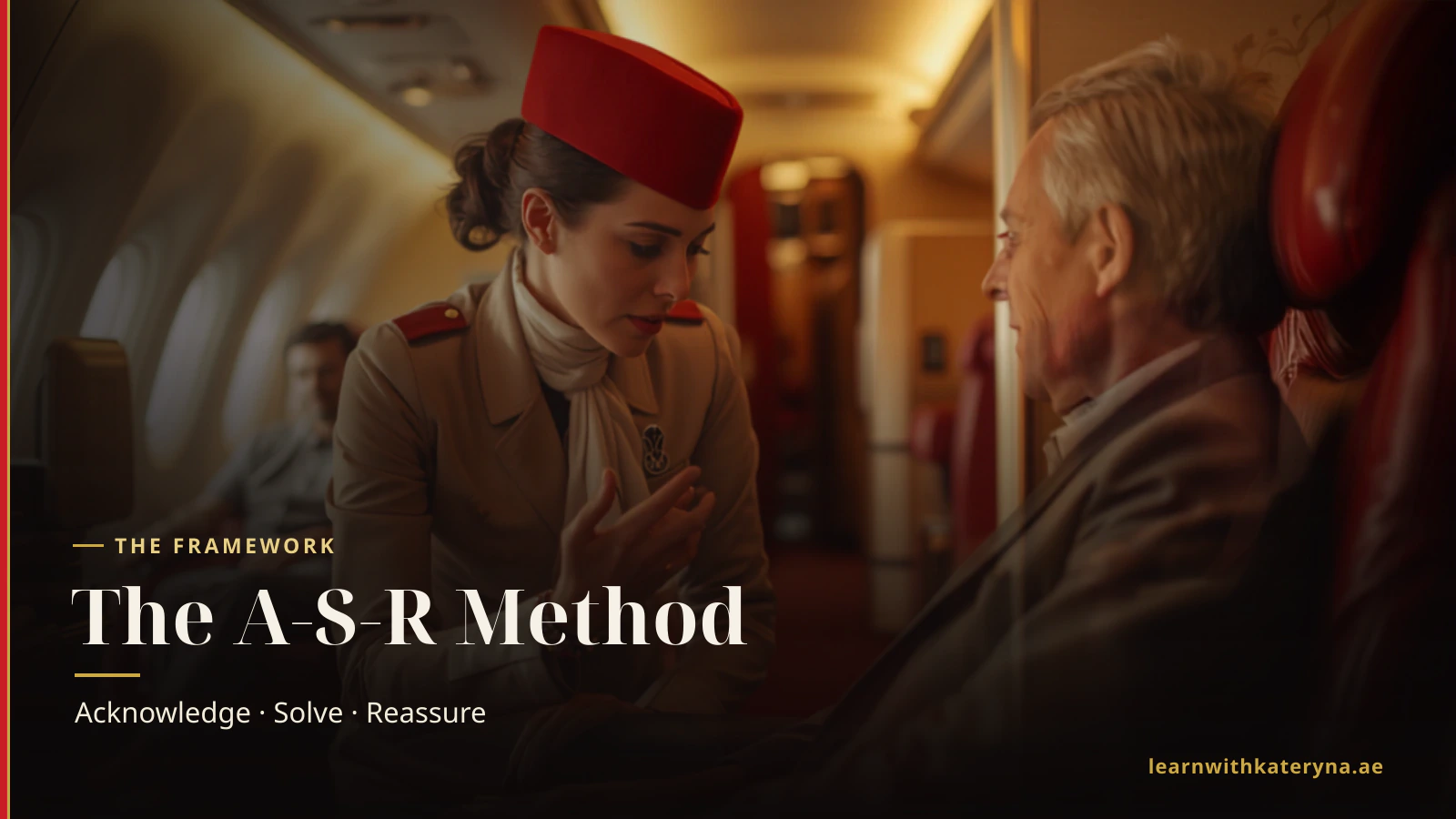
The A-S-R framework is three sequential moves that close almost any role-play scene: Acknowledge (name what the passenger is feeling), Solve (offer one concrete action), Reassure (close with confidence). It is not my invention — it is how Emirates ab initio training teaches it, just without the acronym. I packaged the three steps into a name so they stay in your head under stress.
«Nine out of ten candidates forget the first step. They jump straight to solving. The passenger feels unheard, and the scene falls apart.» — Kateryna Ivanova, ex-Emirates cabin crew
Step 1 — Acknowledge (5–7 seconds). You name what you see: «I can see this hasn't been the start you hoped for, sir.» No «I'm sorry». You are not to blame for the delay or the hot soup — you are simply acknowledging his state. That takes about 60 % of the tension out of the passenger before you have offered anything at all.
Step 2 — Solve (20–30 seconds). One concrete solution, not a menu. Emirates coaches «offer one, mention second» — lead with the primary option and add a fallback in half a sentence. «Let me move you to seat 24A right after take-off — window, empty row. Or, if you prefer, I can bring you a cold towel and check if 32B opens up in cruise.» That shows initiative without chaos.
Step 3 — Reassure (5–10 seconds). You close the loop: «I'll come back to you in ten minutes to make sure you're comfortable, Mr Smith.» The name at the end is a small but powerful signal: you remembered, you'll return, he is safe in your hands. Many candidates stop at step 2 and leave the passenger hanging.
Weak vs Emirates-approved: the anatomy of the gap
The fastest way to see what recruiters want is to put two answers to the same scene side by side. Scenario: business passenger in 3A unhappy with his seat, says loudly «This is unacceptable», neighbours start looking over. You have 90 seconds.
| What the candidate does | Weak answer | Emirates-approved |
|---|---|---|
| First 5 seconds | «I'm so sorry, sir.» | Kneels to eye level, drops tone, «I hear you, sir — this really isn't the start we wanted.» |
| What she says about the problem | «That's the rule, seats are assigned.» | «Give me two minutes to check the cabin — let me see what we can do before doors close.» |
| Action | Calls the senior crew from the aisle. | Quietly checks the manifest on iPad, returns with one specific option. |
| Close | «Okay, thank you.» — walks away. | «I'll come check on you again after the seatbelt sign is off, Mr Almeida.» |
| What the recruiter sees | Panic, deflection, guest left dangling. | Calm, ownership, guest will hold on to her for the rest of the flight. |
The difference is not in the English. The difference is in the sequence of moves. The weak answer jumps straight to apology and the rulebook, skipping acknowledge. The strong one runs all three A-S-R steps and lands the name at the end. Both can be delivered at the same level of English — B2 is enough, if you know what to say.
12 scenarios recruiters actually run in 2026
Below are the twelve scenarios that have been run at Emirates Assessment Days in Dubai, London, Manila and Warsaw during 2024–2026. They cover six common categories, so drilling this dozen covers roughly 85 % of the prompts you might face. Each ends with a short Emirates-approved A-S-R answer.
1. Passenger demanding a Business upgrade
«Sir, I completely understand — this connection has been long. Upgrades on this flight are managed pre-boarding, so I can't move you today, but let me bring you our best economy cocktail and confirm your Skywards miles for the disruption. I'll also flag your frustration to our purser.»
2. Passenger loudly complaining about being seated next to a child
«I can see this isn't the flight you had in mind. Let me check for a quieter row in cruise — if not, I'll bring you our noise-cancelling headphones from the comfort kit. I'll be back in fifteen minutes.»
3. Toddler crying and refusing the seatbelt
You speak to the parent, not the child: «Mummy, we're about to take off — would you help her hold this little bear while I click her belt? It's the safest way for her right now.» Bringing the parent in shows teamwork and respect.
4. Passenger with a food allergy whose vegan meal is missing
«That's on us, sir. I'll bring you our fruit platter and a warm bread selection right now, and I'll speak to the galley to see what we can prepare fresh. I'll follow up in twenty minutes.» Key move — do not blame catering.
5. Guest feels unwell during service
«Madam, stay seated — I'm here. Take a slow breath with me. I'm bringing water and calling my colleague, who is our first-aid lead. You are safe.» Voice drops, pace drops, passenger picks up your rhythm.
6. Passenger panicking during turbulence
«This is a normal patch, sir — the pilots have this. Would you like to hold my wrist while we ride it out? I've flown through worse and I'm still here to tell you.» Humour plus a physical anchor — this is a technique from Emirates training.
7. A colleague speaks over you in front of passengers
«Let's talk about this in the galley in a moment.» You never resolve conflict in front of guests. Then in galley: «I felt talked over just now — can we align before the next service?»
8. Passenger who missed his connection because of your flight
«I'm bringing you a Skywards agent's number, printed with your PNR. We'll have someone meet you at gate B22 — your bag will follow the same routing. Would you like me to hold a hot meal for you before landing?»
9. Wheelchair passenger asks for help getting to the lavatory
You bring in a second crew member — you never take the passenger alone. «Madam, I'll get my colleague Elena to help — two of us is safer for you and it's our standard on wide-body flights.»
10. Intoxicated passenger keeps ordering more alcohol
«Sir, I really enjoyed serving you this evening — let me bring you a coffee and a bottle of water to enjoy over the movie. We'll pause the wine list here so you land in top form.» Emirates word: «pause», never «refuse».
11. Passenger requests a halal meal that was not pre-ordered
«Absolutely, sir — let me check the galley for a spare halal option. If not, I'll build you a plate from our vegetarian and fish selection so nothing crosses your dietary rules. Two minutes.»
12. Passenger tells you a close relative has died and she is flying to Dubai for the funeral
«I'm so sorry, madam. Let me sit with you for a moment — is there anything I can bring, tea, water, a warm blanket? I'll also let the flight deck know so we can help with priority disembarkation.» Here Solve is presence, not a task.
The scoring rubric: how the recruiter quietly grades you
The Emirates recruiter is holding a four-column rubric and ticking each box during your 90-second scene. You will never see the sheet, but knowing the columns is useful — they show you where to point your own answer.
| Scale | What it means | What the high-scoring candidate does |
|---|---|---|
| Empathy | You saw a person, not a task | Kneels to eye level, names the state («I hear you»), soft tone |
| Safety | Did not break a safety protocol for the sake of service | Did not reseat during take-off, did not leave the guest unattended |
| Brand | Delivered the Emirates luxury standard | Used the words «our», «for you», brought one premium touch (cold towel, chocolate) |
| Team | Pulled in colleagues where appropriate | Named a colleague («Elena»), called the purser correctly, did not fly solo |
Body language and tone: what they score without words
Words carry 30 % of the score. Body and tone carry 70 %. At Assessment Day the recruiter holds the clipboard and watches five signals candidates often miss.
- Kneel to eye level. When the passenger is seated, you drop to the armrest. That removes the power asymmetry and shows respect. Candidates who stay standing automatically lose a point on Empathy.
- Open palms. Hands in front of the body, palms toward the passenger. Crossed on the chest or behind you is a protective signal that the recruiter reads as fear.
- Speech tempo. Early in the scene you speak slower than the passenger. If he is at 140 words per minute, you are at 110. That physiologically slows him down.
- Volume. Half a tone quieter than him. He will lean in — and instinctively drop his own volume.
- Name at the end. «Mr Almeida», «Madam», «Fatima». A small signal: I am here with you, you are not a seat number.
Traps for non-native English speakers
I have coached more than a hundred non-native candidates through Emirates prep and I see three mistakes that even the strong ones repeat. They are not about grammar — they are about cultural habits that a Dubai recruiter reads differently than you might expect.
Trap 1: over-apologising. «I'm sorry, sorry, so sorry» at the start of every sentence. In Dubai this reads as guilt or lack of confidence, not politeness. Swap for «I hear you» or «Let me help».
Trap 2: freezing in English under stress. You know the phrases, but when the recruiter raises his voice, the speaker in your head cuts out and you grope for words. Fix: B2 English with an aviation phrasebank and ten live drill sessions before Assessment Day.
Trap 3: skipping the empathy statement. Many of us were raised to «solve quickly» — so we jump straight to Solve. This is the same mistake as skipping step 1 of A-S-R, but for non-native speakers it is almost guaranteed. Drill a conscious five-second pause before the first sentence.
A 14-day drill plan
Role-play is muscle memory, not text. Over 14 days it becomes automatic if you train 20 minutes a day.
- Days 1–3. Learn the 12 scenarios below. Say each answer out loud three times, standing in front of a mirror. Don't read — deliver.
- Days 4–7. Find a partner (friend, partner, teenage child). She pulls a random scenario, you have 90 seconds. Record on your phone, then review — check whether you knelt, whether the name landed at the end.
- Days 8–10. Escalate: your partner adds one reaction after your answer («And now what?»). You have to keep going for another 30 seconds without losing the A-S-R structure.
- Days 11–13. Three scenarios back-to-back with no pause. That simulates Assessment Day fatigue, where the role-play block lands after five hours in the room.
- Day 14. One full mock session with a coach or a free consultation with an ex-Emirates crew member. That is the person who spots the traps a partner won't see.
Mistakes that cost you marks
The most common failures in 2026 repeat the same patterns. Avoid them and you already leapfrog half the room.
- A memorised script instead of a reaction. Recruiters can smell rote answers in three seconds. Drill the framework, not the text.
- Handing the passenger to the senior straight away. «Let me call my senior» in the first line = you are not ready to take a decision. You bring the purser in at step 3, not step 1.
- Breaking safety for the sake of service. Reseating during take-off, unbuckling a child's belt «so mum is comfortable» — instant fail, even if the rest of the answer is perfect.
- No follow-up. A scene without «I'll come back» reads as unfinished work. The passenger must know when you'll return.
- An extended list of reasons why you cannot. The passenger doesn't need to hear your constraints — he needs to hear one solution. Emirates line: «Let me see what we can do», never «That's not possible because…».
For the full list of reasons candidates get cut across all five stages, see Why Cabin Crew Candidates Get Rejected — strongly recommended reading before Assessment Day.
Next steps and support
If you are reading this 4–6 weeks before an open day — you have a window to turn the role-play from your scariest block into your strongest one. Half the strong candidates get filtered here, so it is disproportionately worth your time.
Three concrete moves for this week:
- Read the STAR method guide — you will use it on the one-to-one round right after the role-play.
- Read the final interview post to picture the full chain: role-play → final → golden call.
- Book a free 20-minute consultation — I'll review your CV, run two test scenarios and tell you exactly what to fix before Assessment Day. WhatsApp +971 58 642 9245.
For candidates who want a systematic prep — the Emirates Cabin Crew Prep course follows the same 14-day drill structure, mock sessions and rubric review described above. It is the coaching I wish I had had when I passed Assessment Day on my first try and realised I had got lucky with English — not because I knew the framework.
Updated: 30 July 2026 · Author: Kateryna Ivanova, ex-Emirates cabin crew, Trinity CertTESOL, NILE UK.


