
 Kateryna Ivanova
Quick answer
Most two- and three-year-olds in Dubai do not need a tutor — they need more English in the day they already have. A tutor becomes genuinely useful at a narrow set of moments: a nursery place starting in weeks, a child who understands English but will not speak it, or a parent who cannot model the language themselves. The Dubai market is built around school-age children, so the first thing to check is whether a provider actually works with ages 2–5 at all. Expect roughly 80 AED an hour at the budget end of the market, and considerably more for early-years specialists who come to your home.
TL;DR:
- "Tutor" is the wrong word for a toddler. Tutoring means catching up on taught material. A two-year-old has no curriculum to catch up on — they acquire language through play and repetition.
- Most Dubai providers start at 4+. Marketplaces and centres are organised around Year 1–6 and KG support. Always ask the minimum age before anything else.
- The market's entry price is around 80 AED/hour, rising sharply for qualified early-years teachers. Cheap hourly rates usually mean a tutor trained for school subjects, not toddlers.
- Four situations where it genuinely pays off — nursery starting soon, a stalled silent period, a parent who cannot model English, or a household where English has no natural slot.
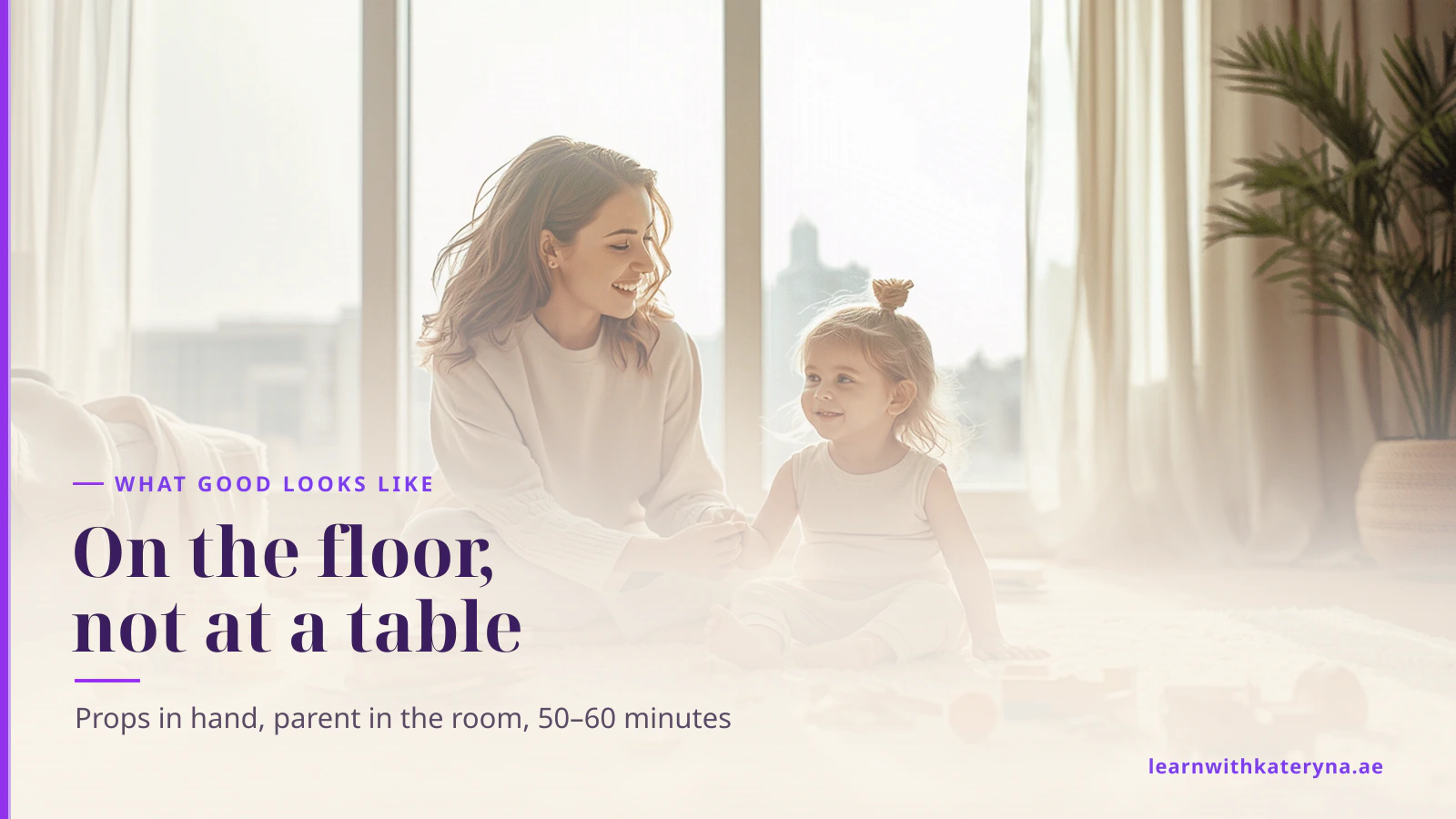
- What good looks like at this age: on the floor, props in hand, no worksheets, no screens, the parent in the room, and 50–60 minutes maximum.
- Ask seven questions before you pay. Minimum age, qualification, session format, parent involvement, what happens between sessions, group size, and what the trial costs.
What "tutor" actually means for a toddler
Tutoring is a school concept. It means a child has been taught something, has not fully absorbed it, and someone goes back over it. That is a sensible service for a seven-year-old struggling with reading. Applied to a two-year-old it describes nothing real: there is no syllabus behind them, no gap to close, and no test ahead.
What a two- to five-year-old does is acquire language — absorbing it from repeated, meaningful situations where the words are attached to something happening in front of them. That process does not respond to explanation. It responds to repetition, routine and play, which is why early-years teaching looks almost nothing like tutoring.
This matters commercially, not just pedagogically. When you search for a tutor in Dubai, you enter a market built for the school-age version of the job. The listings, the hourly rates and the teacher profiles are mostly organised around subjects and year groups. Ask for help with a three-year-old and many providers will say yes without changing anything about how they work — and you will pay for a scaled-down school lesson that a toddler cannot use.
The honest reframe: at this age you are not buying instruction. You are buying either input (more hours of good English in your child's week) or coaching for yourself (someone showing you how to turn your existing day into English). Both are legitimate. Neither is tutoring, and knowing the difference changes what you should ask for.
What the Dubai market offers — and for which ages
Dubai has an unusually dense tutoring market, and almost all of it is aimed at older children. Search for a home tutor and you will meet four distinct types of provider. They are not interchangeable.
| Type of provider | Typically serves | Good for a 2–5-year-old? |
|---|---|---|
| Tutor marketplaces (profiles, ratings, you contact directly) | Year 1 to Year 12, all subjects | Sometimes — but you must filter hard and verify early-years experience yourself |
| Tutoring centres (a venue you travel to) | School support, exam prep; many state ages 4+ | Usually not — the format and the minimum age both work against you |
| Agencies placing home tutors | Primary and secondary, often several subjects per tutor | Rarely — a tutor who covers maths, English and science is not an early-years specialist |
| Early-years specialists (small, often one teacher) | Ages 2–5, language through play | Yes — this is the category you are actually looking for |
The pattern to notice: the bigger and more convenient the platform, the less likely it is to be built for your child's age. Marketplace profiles advertising "English, Maths and Science, ages 3–11" are describing a primary-school tutor who is willing to take younger children, not someone trained in early language acquisition.
There is also a practical Dubai detail worth planning around. Because most provision is school-shaped, availability clusters in the late afternoon — after school hours. For a toddler that is the worst slot of the day, when they are tired and least able to absorb anything. A provider who only offers 4pm or 5pm is a provider built around older children.
What it costs in Dubai
The entry price in the Dubai market sits at roughly 80 AED an hour, and that figure is misleading in both directions. At the bottom end it buys a university student or a generalist tutor working through school material. For early-years work with a qualified teacher who travels to your home, expect to pay substantially more — and to get a different service.
| What you are buying | Typical Dubai price | What it usually means |
|---|---|---|
| Marketplace tutor, hourly | from ~80 AED/hour | Generalist, school-trained, you verify early-years experience yourself |
| Tutoring centre, per session | Mid-range, you travel | Classroom format; many set a minimum age of 4 |
| Early-years specialist, in-home | Higher per session | Play-based, age-specific, travel and planning included |
| Trial session | Free to ~100 AED | A free trial is a sales step; a paid trial is usually a real session |
Three things change the real cost, and none of them appear in an hourly rate:
- Travel. A teacher coming to Marina or Business Bay is absorbing Dubai traffic into their day. In-home sessions cost more than you going to a centre, for an obvious reason.
- Group size. One child and two children are different products. A sibling pair or a friend joining usually costs less per child than two separate bookings.
- Whether anything happens between sessions. One hour a week is about 0.6% of your child's waking time. If a provider gives you nothing to carry into the rest of the week, you are buying a very small amount of English at a very high price per word.
For transparency about our own numbers, since we are describing a market we work in: our in-home sessions in Dubai are 100 AED for a trial, then 350 AED per session for one child or 500 AED for two, running 50–60 minutes as an eight-session programme for ages 2–5. We publish those figures on the Dubai sessions page rather than quoting on request, because a parent comparing options deserves to compare numbers.
When a tutor is not the answer
There are four common situations where paying someone will not fix what is actually happening. Recognising yourself here saves money and gets you a better result.
- Your child is two and simply has not started talking much yet. This is usually a timing question, not a teaching one. Adding a weekly lesson does not accelerate a stage that has not arrived.
- You want English to "start" but nothing in the day has changed. One hour a week against a home that runs entirely in another language will not tip the balance. The day has to change first — our guide to speaking English with your child every day is the cheaper intervention, and it works.
- Your child already attends an English-medium nursery. They are getting substantial daily input. The gap is usually at home, in the hours around nursery, not in needing more formal teaching.
- You are worried because a relative commented. Family comparisons are the single most common reason parents book early. Check the real milestones before you spend — our piece on a toddler who understands but will not speak covers what is normal and what is not.
If you speak limited English yourself and that is your reason for considering a tutor, read teaching your child English when you are not fluent first. It is a solvable problem, and solving it yourself gives your child far more exposure than any weekly session.
Four times when it genuinely helps
There is a real case for professional help, and it is more specific than "my child should learn English".
- A nursery place starts in six to twelve weeks. This is the strongest case. A child walking into an English-medium room with zero English has a harder first month than one who recognises the routine words — sit, snack, tidy up, line up, toilet. Targeted preparation genuinely shortens that adjustment. Our guide to choosing a nursery in Dubai covers what that first term involves.
- Understanding is there, speech has stalled. A child who follows English instructions but answers in another language often needs a low-pressure adult who is not their parent, in a setting where English is the only option on the table.
- No adult in the home can model the language naturally. If both parents speak limited English, a few hours of native-quality input a week is doing something you genuinely cannot replicate — provided you are also given material to use between sessions.
- Dubai's language load has pushed English out. In trilingual households the home language and Arabic at nursery can crowd English into nothing. We wrote about that balance in raising a trilingual child in Dubai.
What a good session looks like at 2–5
You can judge quality from the first ten minutes, without knowing anything about pedagogy. At this age, a good session has a recognisable shape.
Green flags
The teacher is on the floor at your child's eye level · there are physical props, not paper · the same opening and closing ritual every time · your child is moving, not sitting still · instructions are acted out rather than translated · the session runs 50–60 minutes and stops before the meltdown · you are welcomed in the room · you are told what to repeat during the week.
Red flags
Worksheets or alphabet drills for a three-year-old · a tablet used as the main activity · translating every word into your home language · sitting at a table for the full hour · promising reading or a fixed number of words by a date · asking you to leave the room "so the child concentrates" · a 90-minute session · no idea what happens between visits.
The translation point is the one parents most often get wrong. It feels helpful when a teacher explains each English word in the child's home language, but it teaches the child to wait for the translation instead of reading the situation. Meaning should come from the object, the gesture and the repetition — this is the same principle behind the method in teaching English from age one without a tutor.
Seven questions to ask before you pay
- "What is your minimum age, and how many children under four are you teaching right now?" The second half is the real question. Anyone can say yes to the first.
- "What is your qualification in early years specifically?" A general TEFL or a degree in English is not early-years training. Ask what the certificate covers for ages 2–5.
- "Describe a typical session minute by minute." If the answer involves a table, a book and a worksheet, the format is school-shaped.
- "Am I in the room?" At this age the answer should be yes, at least at first — and you should be given something to continue.
- "What do we do between sessions?" The single most predictive question. A provider with no answer is selling you one hour, not progress.
- "Can my second child or a friend join, and what does that cost?" Toddlers often engage better in a pair, and the per-child cost usually drops.
- "What does a trial cost, and what happens if my child cries through it?" A specialist will have a calm, specific answer. It happens often and it is not a failure.
At home or at a centre?
For under-fives, home usually wins — for reasons that have nothing to do with convenience. A toddler's language is tied to context. Words learned beside their own bath, their own fridge, their own toy box attach to objects they meet again fifty times that week. The same words learned in a neutral room have to transfer home before they become useful, and often they do not.
Home also removes the two things that most often ruin a session at this age: the car journey before it and the unfamiliar room during it. A child who has just spent twenty-five minutes in Dubai traffic has already used up the attention you are paying for.
A centre makes sense when your child is four or five and genuinely benefits from a group, when you want them used to a classroom before school, or when no in-home option covers your area. Below that age, the balance tips the other way.
Mistakes parents make choosing
- Comparing hourly rates across different products. 80 AED for a generalist tutor and a specialist early-years session are not the same purchase. Compare what happens in the hour, and what you get for the rest of the week.
- Booking in the late afternoon because that is what is offered. Morning is when a toddler can actually absorb language. If a provider has no morning slot, that tells you who they are built for.
- Expecting speech on a schedule. Comprehension always arrives before production, sometimes months before. A provider who promises a word count by a date is selling you something they cannot control.
- Stopping everything at home once a tutor starts. The weekly session is the smallest part of the week. It supplements your routine; it cannot replace it.
- Not checking who is actually in your home. For in-home sessions, ask who they are, what their qualification is, and whether they work with you directly or through an intermediary.
- Quitting after two sessions because the child cried. Two-year-olds frequently refuse a new adult for the first two or three visits. Judge at session four, not session one.
Your next steps
Start with the free change, not the paid one. For one week, pick two fixed moments that already happen every day — breakfast and bath are the usual winners — and run only those in English. Most families discover that this alone moves things, and that tells you whether what was missing was teaching or simply opportunity. If you are restarting after a gap, picking English back up after a break walks through it.
If you have tried that and one of the four situations above describes you, then professional help is a reasonable next step — and now you know what to ask for. Kateryna is a Trinity-certified teacher (Young Learners) with nine years of experience who comes to families across Dubai: Marina, Jumeirah, Business Bay and Sobha Hartland. Sessions run fully in English, 50–60 minutes, one or two children, using Total Physical Response and story rituals rather than worksheets. A trial is 100 AED.
Whoever you choose, judge them on the format, the age specialism and what they hand you for the rest of the week — not on the hourly rate.


